



Experimentation buys you knowledge. Engineering buys you a system that still works next quarter, when the data shifts and the volume triples.
Confusing the two is the costliest mistake in enterprise AI right now, and it is easy to make. A convincing demo creates confidence that the underlying system has not yet earned.
You have probably felt the gap. The pilot impressed the board. Six months on, it still has no owner, no cost per transaction, and no way to prove it was right last Tuesday.
You will leave with a seven-point self-diagnostic, a five-level maturity model, and nine questions that separate a build budget from a research budget.
In short:
- Experimentation reduces uncertainty. Engineering reduces variance. Different work, different budgets, different exit criteria.
- Independent research blames cost, unclear business value, and weak risk controls for stalled pilots, ahead of model quality.
- Seven observable signals tell you whether you are still experimenting, whatever the roadmap says.
- Six foundations carry a system into production, in this order: evaluation, observability, data contracts, guardrails, deployment pipelines, and inference economics.
- Nine questions decide whether your next AI request deserves funding.
What Is the Difference Between AI Experimentation and AI Engineering
Experimentation is time-boxed work that answers whether a use case is viable, where throwaway output is fine. Engineering makes that use case reliable, observable, affordable, and owned, where output has consequences.
The split shows up in every dimension of delivery.
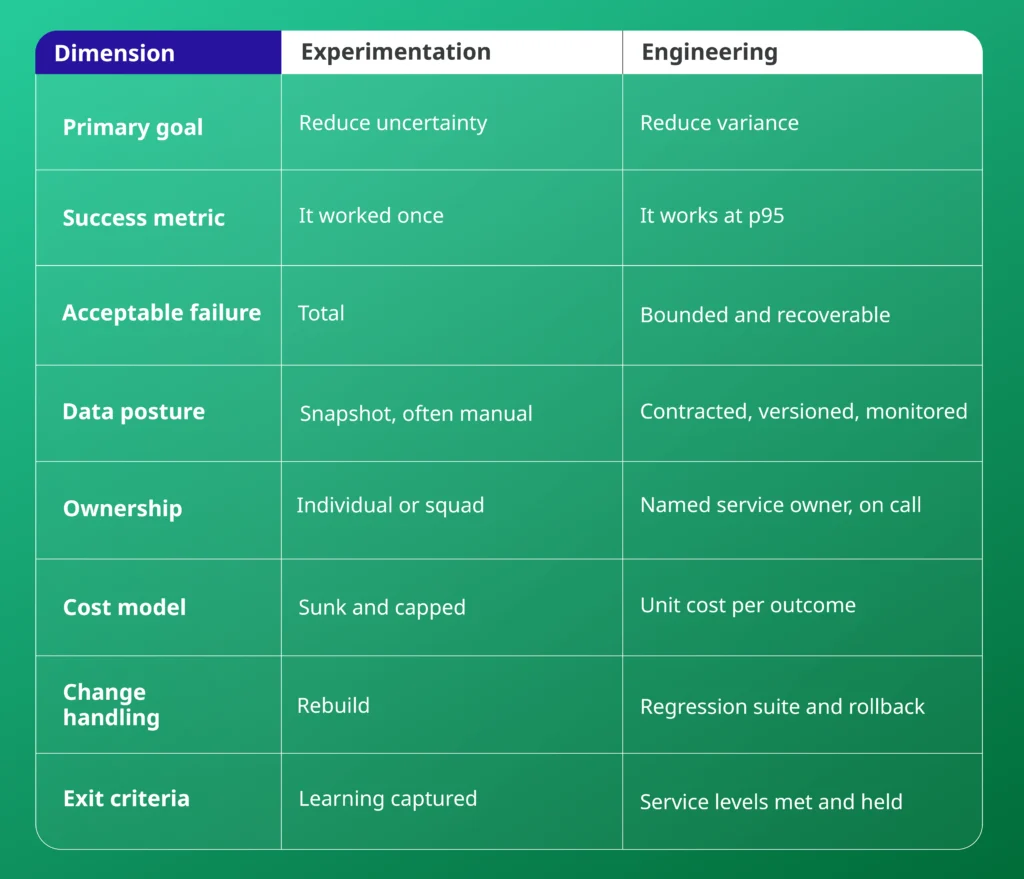
Read the right-hand column as a shopping list. Every row you cannot tick is a reason your pilot will stall.
Why Most AI Pilots Stall: What the Research Shows
Pilots die at the funding gate when somebody finally asks three questions.
- What does a successful outcome cost?
- Who owns this next quarter?
- How would you prove any given output was correct?
Few pilots are built to answer any of them. Almost none get cancelled for a technical reason.
The failure rate is rising. S&P Global Market Intelligence surveyed more than 1,000 IT and business leaders across North America and Europe for its 2025 Voice of the Enterprise research.
The share of companies abandoning most of their AI initiatives before production climbed from 17% to 42%, and the average organisation scrapped 46% of its proof-of-concept projects. Read the direction of travel instead of just the headline. Model capability improved sharply across that period, while abandonment more than doubled.
Gartner lands on the same diagnosis from a different angle. Its June 2025 forecast put more than 40% of agentic AI projects on course for cancellation by the end of 2027, blaming escalating costs, unclear business value and inadequate risk controls. Look at that list again. Every item is a delivery failure. Each one is decided before anybody picks a model.
Seven Signs You Are Still Experimenting, Whatever the Roadmap Says
Two minutes, seven questions. Ask the team that built the system rather than reading the answers off the steering deck. Any gap between the two versions is itself a finding.
- Your evidence of quality is a screenshot. A demo proves the system worked once for someone who knew what to type.
- Prompt changes ship without a regression run. Every release becomes an uncontrolled experiment on live users.
- Nobody can state the cost per successful outcome. Success then arrives as a budget surprise.
- An upstream schema change breaks the pipeline. No data contract exists, so another team can take you down by accident.
- No rollback is defined for a bad model release. Your only recovery is switching the feature off in front of customers.
- No on-call owner sits outside the build team. Ownership rests with whoever still remembers how it works.
- Success is described in adjectives. “Much better” cannot be audited, defended in a board paper, or compared with last quarter.
How to score it. The seven do not carry equal weight. Items 3, 5, and 6 should each block a production launch on their own. Unknown unit economics, no rollback, and no named owner all turn a routine bad day into an incident with nobody to run it. Four or more across the full list puts you in experimentation, and the next funding request should buy foundations rather than features.
Six Foundations of AI Production Readiness
Six capabilities separate a system you can defend from one you can only demonstrate. Build them in this order, because every later decision depends on being able to tell good output from bad. Together, they form the backbone of any serious AI engineering project.
- Evaluation harnesses and regression suites. Golden datasets, offline evaluations, and model-assisted scoring calibrated against human judgement, with a pass threshold that blocks releases. Skip it, and quality turns anecdotal within a fortnight.
- Observability, tracing, and cost telemetry. Trace every request, tie token spend to outcomes, and alert on quality regression as well as uptime. An uninstrumented system stays fully available and quietly wrong.
- Data contracts and retrieval quality. Agree on schemas and freshness commitments with upstream owners, and measure retrieval precision separately from end-to-end accuracy. Retrieval degrades in silence, so diagnosis costs weeks.
- Guardrails, override, and rollback. Filter inputs and outputs, escalate low-confidence cases, and name whoever holds the override switch. Rehearse the rollback until it takes minutes.
- Deployment pipelines for prompts, models, and agents. Version-control prompts and model configuration, then promote through environments. Canary releases and shadow traffic tell you which change caused the regression.
- Inference economics. Track unit cost per outcome, tier models by task difficulty, and cache what repeats. Give budget alerts to engineering rather than finance.
Two clocks, easily confused. Release controls fire when something changes. Request controls fire on every call. Build only the first, and the system passes its gate, then degrades quietly in production.
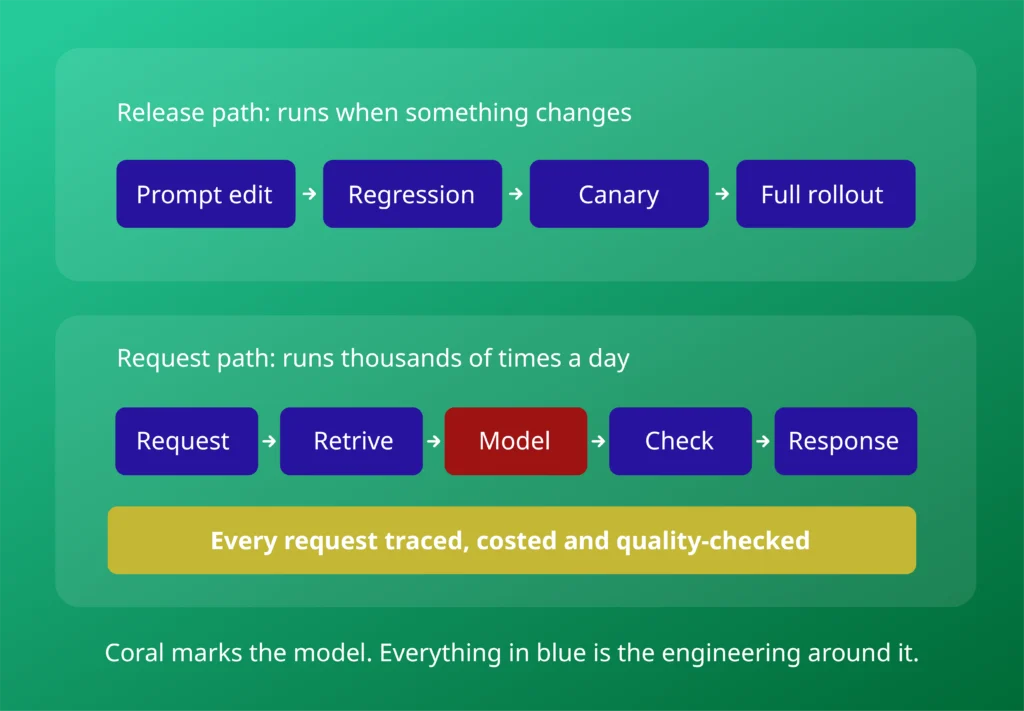
DORA’s research, published by Google Cloud and worth reading with that in mind, lands in the same place. AI amplifies whatever system surrounds it, and the largest returns come from platform quality, workflow clarity, and team alignment rather than from the tools.
AI Maturity Model: Find Your Level Before You Fund the Build
Locate yourself on this ladder. The next sensible action follows from where you are, and skipping rungs is what produces the cancellations.
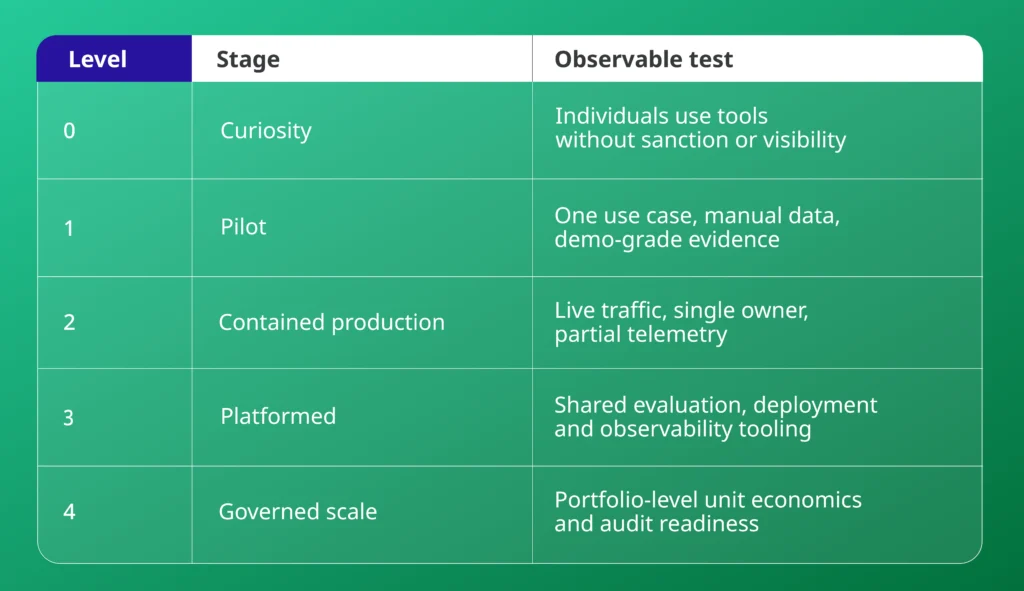
Two traps catch capable businesses. Adding more Level 1 pilots feels like progress towards Level 3, though the two move on separate axes. And unsanctioned tool use drags you sideways from Level 0, creating exposure without creating capability.
Levels 0 and 1 are experimentation, whatever the budget line calls them. Everything from Level 2 upwards is engineering, and the gap between the two is a funding decision.
Nine Questions to Ask Before You Sign Off the Build
Put these in any AI proposal asking for delivery money. The vague answers are the finding: anything met with “we will work that out in delivery” is a gap the budget is about to absorb.
- What baseline does this replace, measured before any build starts?
- What is the target, and what variance is acceptable?
- What does one successful outcome cost at ten times today’s volume?
- Who runs the service in production, by name and by team?
- Who answers for it when the output is wrong in front of a customer?
- How is correctness measured without a human reading every output?
- What happens when the provider changes or retires the endpoint?
- What is the rollback, and who has executed it in a rehearsal?
- What evidence would your regulator or auditor accept?
Ask for the answers in writing, 48 hours before the approval meeting. A proposal that answers on paper is ready to build. A proposal that needs the meeting to work it out is still research, and funding research as delivery is how cancellation statistics are made.
One decision outranks all nine. Choosing a measurable workflow over a demonstrable one determines whether any of these questions can be answered at all. Back-office processes with countable baselines look dull in a board pack, and dullness is exactly what makes them provable.
Who Owns AI Systems in Production?
Ownership decides whether a system survives its first bad week. Three structures work, and the right one follows from how many AI systems you are running rather than from how large the organisation is.
One or two live use cases: embed the engineers. AI engineers sit inside the product team that owns the business outcome. Fastest route to production, and the approach stops working the moment a third team wants the same evaluation tooling and builds its own.
Five or more: build the paved path. A central platform team owns evaluation, deployment, and observability tooling, and product teams consume it. Slower to stand up, and the only structure that stops per-team reinvention once volume arrives.
Somewhere between: run the hybrid. A small platform group sets the evaluation standard, product teams build against it, and keep the pager. Most organisations pass through this stage, and few plan for it.
One anti-pattern recurs across all three. An innovation function builds, a platform function inherits, and no shared evaluation standard exists between them. Handover becomes a negotiation about whether the thing works at all, conducted after the budget has gone.
The test that matters is simpler than the org chart. Whoever carries the pager should also be able to change the prompt, roll back the model, and see the cost per request. Split those three across teams, and you have created an escalation path rather than an owner.
Four Mistakes That Send AI Projects Back to the Lab
Each one has a tell. Listen for it in the room.
Upgrading the model to fix a delivery problem. A newer model rarely repairs bad retrieval, missing baselines or an absent owner, and the upgrade buys a quarter of hope before the same wall arrives.
The tell: “Let’s try it on the new model and see.”
Treating evaluation as a testing task. Evaluation is a system with its own datasets, owner and release cadence. Parked in QA, it decays the moment the use case shifts.
The tell: “QA will pick that up before release.”
Buying an agent platform before defining a single agent’s job. Gartner has warned about agent washing, where assistants, chatbots and robotic process automation are rebranded as agentic without substantial agentic capability. Ask what decision the agent takes alone, and what it may do with no human present.
The tell: “Once we have the platform, the use cases will follow.”
Reporting adoption instead of outcome. Seat counts and query volumes rise happily while the number the business actually cares about sits flat.
The tell: “Usage is up 40% month-on-month.”
How to Move From AI Experimentation to AI Engineering
Three moves, in order.
- Score your maturity level honestly.
- Pick one workflow with a countable baseline, choosing dull over demonstrable.
- Instrument it before you build anything, then put the proposal through the nine questions.
Deployflow builds the foundations that carry AI systems into governed production. Three examples from the work:
National-scale energy AI: experimental to industrial-grade
- 1PB+ of subsurface data processed in real time across H100 GPU clusters
- 100% air-locked subscriptions, reachable only from the customer network
- Zero manual steps, with every environment inheriting security and governance policies
- New AI workloads land without re-engineering the core platform
UAE public sector: proof of concept to national deployment
- One data layer replacing surveys, spreadsheets, and disconnected regional systems
- AI pipelines replacing manual classification
- 24/7 real-time ingestion in place of manual reporting
- 6-12 month phased route to full national rollout
Strike: instability to release confidence, after losing their internal DevOps team
- 70% improvement in cloud environment stability
- 60% reduction in downtime, with nearly all outages eliminated
- 55% improvement in release reliability
- 25% reduction in costs
“One of the most impressive aspects of Deployflow is their commitment to delivering customised solutions. They took the time to understand our specific requirements and crafted a strategy that perfectly aligned with our goals.”
Dan Rafferty, CTO at Strike
Get an Independent Read on Your AI Systems
Get an outside read on where you actually are. Deployflow’s independent technical audit covers architecture, codebase quality, infrastructure, DevOps maturity, AI systems, and security posture. Read-only access throughout, no disruption to your engineers, and findings prioritised by risk and cost.
You receive six deliverables: a tech debt register, a risk matrix formatted for a board, an architecture review against your growth plan, a phased remediation roadmap, a two-page executive summary, and a 60-minute findings walkthrough. The Foundation audit completes in 10 business days.
Independence is the point. Your team built the system, which makes an honest self-assessment close to impossible. If nothing critical turns up, the report says so.
See the report before you commit. Get the 12+ page sample report with your work email, and £3,000 comes off the audit automatically.
Still working out which use case to back? Start with AI consulting services instead.
Frequently Asked Questions on AI Experimentation vs AI Engineering
How long does it take to move an AI pilot into production?
Plan in months rather than weeks, with the exact figure driven by data readiness rather than model choice. A pilot with clean, contracted data and a clear baseline can reach contained production in a single quarter. One that needs upstream data work, a security review, and a new evaluation approach takes longer. Sequencing matters more than speed. Instrument and baseline first, then harden with evaluation gates and rollback, then operate with agreed service levels. Our breakdown of six-sprint delivery timelines sets out how the phases fit together in practice.
What should you budget for AI engineering beyond the model costs?
Model spend is usually the smallest line. Budget for four other things: data work to make sources reliable, evaluation infrastructure including human review time, platform and observability tooling, and ongoing operations once the system is live. Running costs deserve particular attention. Inference charges scale with usage, so a system that succeeds becomes more expensive, which surprises finance teams the first time. Split the budget into build and run from the outset, and protect the run line for at least a year past launch. Programmes funded only for the build tend to lose their evaluation and observability work first, which is precisely the work that keeps the system trustworthy.
Should you build an in-house AI team or bring in a partner?
Build in-house when AI is core to your product, and you can hire and retain the skills. Bring in a partner when you need the foundations laid quickly and want your own engineers trained on the way through. Many organisations run both. A partner sets up evaluation, pipelines, and observability, then hands over to an internal team that owns the roadmap. Judge any partner on whether they transfer capability or create dependency. Our comparison of AI consulting firms worldwide covers what to look for.
Do UK AI rules apply to internal AI tools?
Yes, though through existing law rather than one statute. The UK has no equivalent of the EU AI Act at the time of writing. Oversight sits with sector regulators applying current rules, including the ICO on personal data, the FCA in financial services, and Ofcom on online services. Internal tools that process employee or customer data fall squarely inside data protection obligations. If you serve EU customers, the EU AI Act may also reach you. Start with an AI register listing every AI system in active use, including features embedded in SaaS products you already buy. Teams routinely underestimate that list.
How do you measure ROI on an AI system?
Measure against a baseline captured before deployment, using the workflow’s own metric. Cycle time, error rate, cost per case, and handling volume all work. Estimated hours saved rarely survive scrutiny because they rely on self-reported guesses. Set the baseline first, then compare like for like once the system is live. Divide the total running cost, including inference, review time, and maintenance, by the number of successful outcomes. Falling cost per outcome alongside a stable or improving quality score is the clearest evidence you have that engineering investment is paying back.
Explore our BLOG
Recent articles
ISO 42001 Explained: Requirements, Certification and What Your Engineering Team Must Build
ISO 42001 is the international standard that demonstrates your organisation governs AI properly, and enterprise...
read full article

Is Claude Down? Anthropic Outage: Protect Your Cloud Infrastructure
Claude went down across every surface on 29 September 2026. From 14:00 to 14:59 UTC,...
read full article

Top 10 Healthtech Companies in 2026: What Their Growth Means for AI and DevOps
Every software change that reaches a hospital has to clear regulatory, legacy system, and clinical...
read full article