



Every software change that reaches a hospital has to clear regulatory, legacy system, and clinical risk hurdles. The top global healthtech companies of 2026 are outstripping their peers in all three.
One is turning a surgical robot into a software platform. Another is giving hospitals the tools to build their own AI agents inside the patient record.
This ranking shows what each of the ten did, what it means for AI and DevOps teams, and the three engineering bets that will decide who leads next.
The Top 10 Healthtech Companies Worldwide in 2026
The ten companies below cover surgical robotics, imaging, medical devices, patient records, life sciences software, precision medicine and clinical AI. Each profile shows one growth signal, one AI move and the engineering pressure it creates for the teams behind it.
1. Medtronic: The Hidden Engineering Cost of a Live Separation
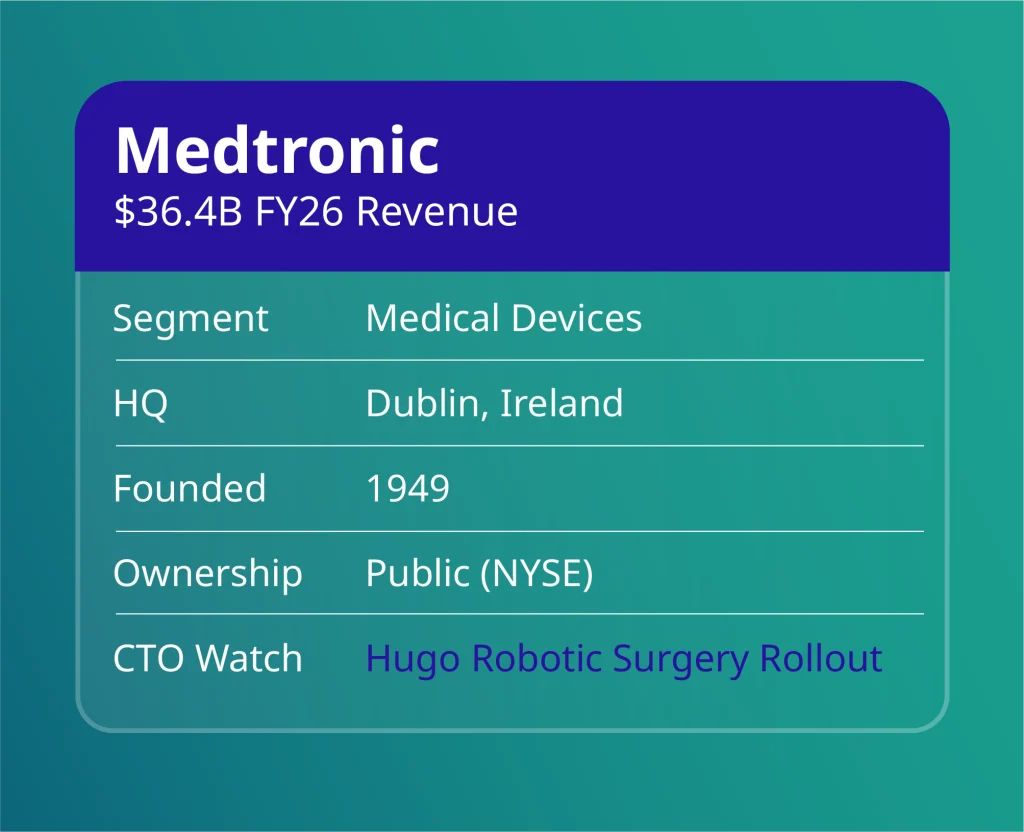
A separation that happens while products stay live puts identity and logging ahead of any product roadmap. Medtronic is in that position with its diabetes business.
MiniMed completed its IPO on 9 March 2026, with Medtronic keeping about 90% of the shares ahead of an exchange offer to complete the split. Nine days later, the FDA cleared the MiniMed Flex, a smartphone-controlled insulin pump.
The rest of the group is buying as well as splitting. Medtronic closed the CathWorks acquisition in April 2026 and completed the roughly $550 million acquisition of Scientia Vascular. On an organic basis, international sales grew 6.2% against 5.4% in the US.
- Growth Signal: Fiscal 2026 revenue up 8.4% as reported and 5.8% organically, the strongest growth in a decade, with cardiac ablation revenue up 78% in the fourth quarter.
- AI Move: Connected diabetes apps such as MiniMed Go, which combines smart insulin pens and glucose sensors to give patients real-time, personalised guidance.
- DevOps Implication: A listed subsidiary that still shares parent systems needs arm’s-length access controls and audit trails. Both have to exist before the split, not after it.
2. Veeva Systems: What AI Agents Do to Validated Software
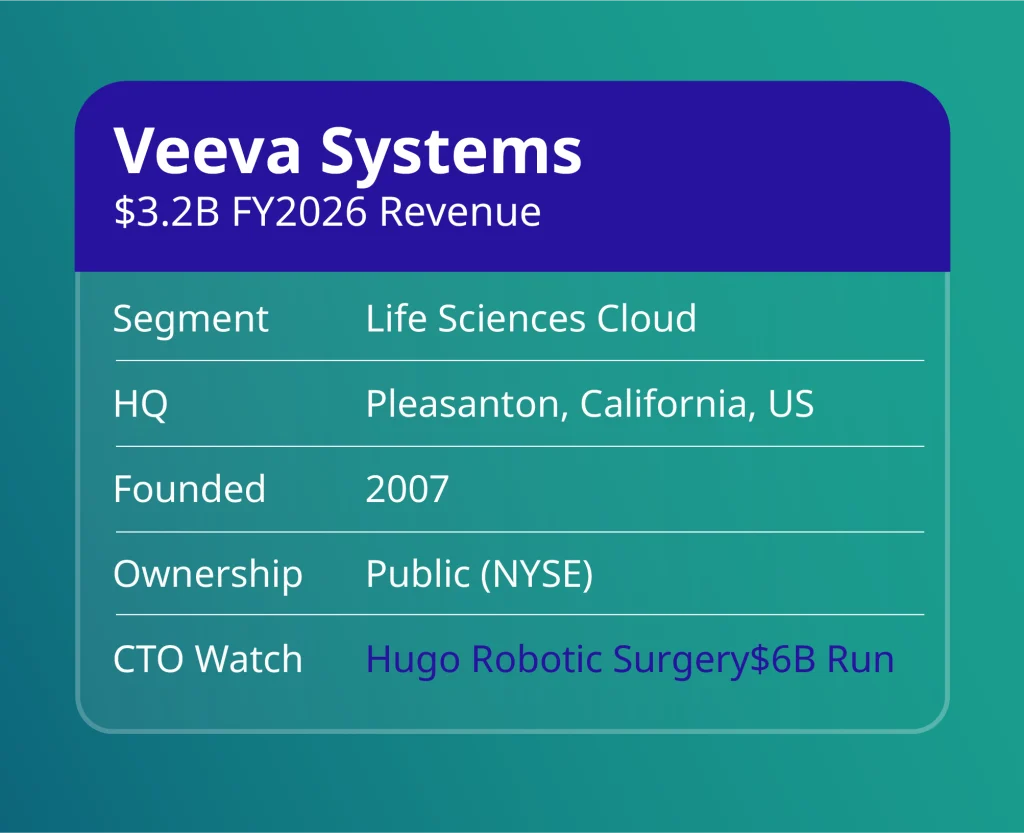
AI agents break the fixed release cadence that validated software depends on, and Veeva is the first large test of how to manage that. Its customers are pharma and biotech teams working in GxP-regulated processes, where every system change is validated before use.
CEO Peter Gassner says “the agentic transformation underway represents a substantial opportunity for Veeva and life sciences”. The agents arrive during a large migration, as customers move onto Vault CRM. Veeva funds both from strength. Non-GAAP operating income rose 24% in fiscal 2026, and momentum held into fiscal 2027, with first-quarter revenue up 16%.
- Growth Signal: Fiscal 2026 revenue up 16%, with subscription revenue up 17%.
- AI Move: The first Veeva AI Agents, for CRM and commercial content, launched in December 2025 with several customers already live. More agents are due across its other applications during 2026.
- DevOps Implication: Agents can change behaviour between releases, so prompts, models and agent configurations need the same version control as code. Teams planning that capability can start with specialist agentic AI development support.
3. Epic Systems: What Happens When AI Agents Live Inside the EHR
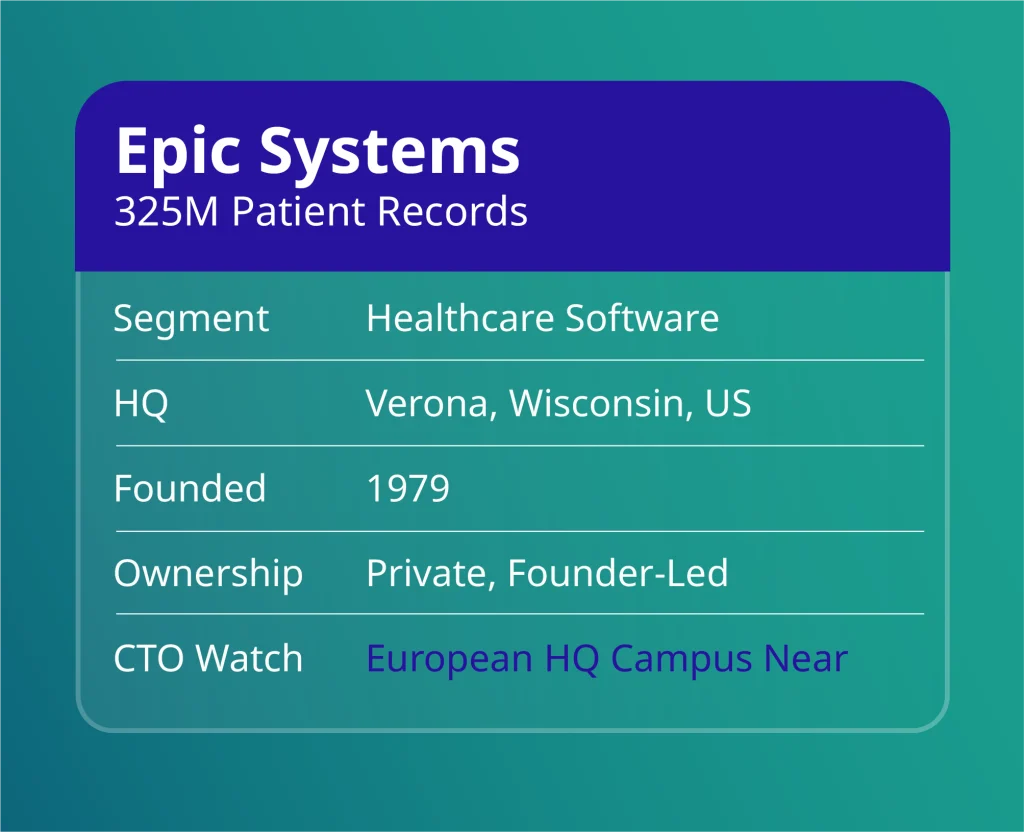
When AI agents run within the electronic health record, each agent becomes a production system that someone must own. Epic is making that the norm. More than 85% of its customers already use AI in some form.
Ambient notes and predictive models, however, are a long way from agentic workflows, and few health systems have the teams to close that gap. For a view of the firms building those workflows, see this comparison of agentic AI development companies.
The upside is already visible: at the heaviest users of Penny, Epic’s revenue cycle assistant, coding-related claim denials fell by more than 20%.
- Growth Signal: Revenue of $6.7 billion in 2025, more than double the figure five years earlier, and 77 US acute care hospitals added in the year for a 43.7% market share.
- AI Move: Agent Factory, previewed at HIMSS 2026, lets health systems build their own agents inside Epic. Training for the first early-adopter group starts in October 2026, with wider availability planned for 2027. At Summit Health, Penny cut medication prior authorisation submission time by 42%, with 92% of responses accepted unedited.
- DevOps Implication: Each agent needs a named owner after go-live. Acceptance rates, error patterns and drift have to be monitored in production, not only tested before launch.
4. Siemens Healthineers: How to Ship AI to Scanners That Stay for a Decade
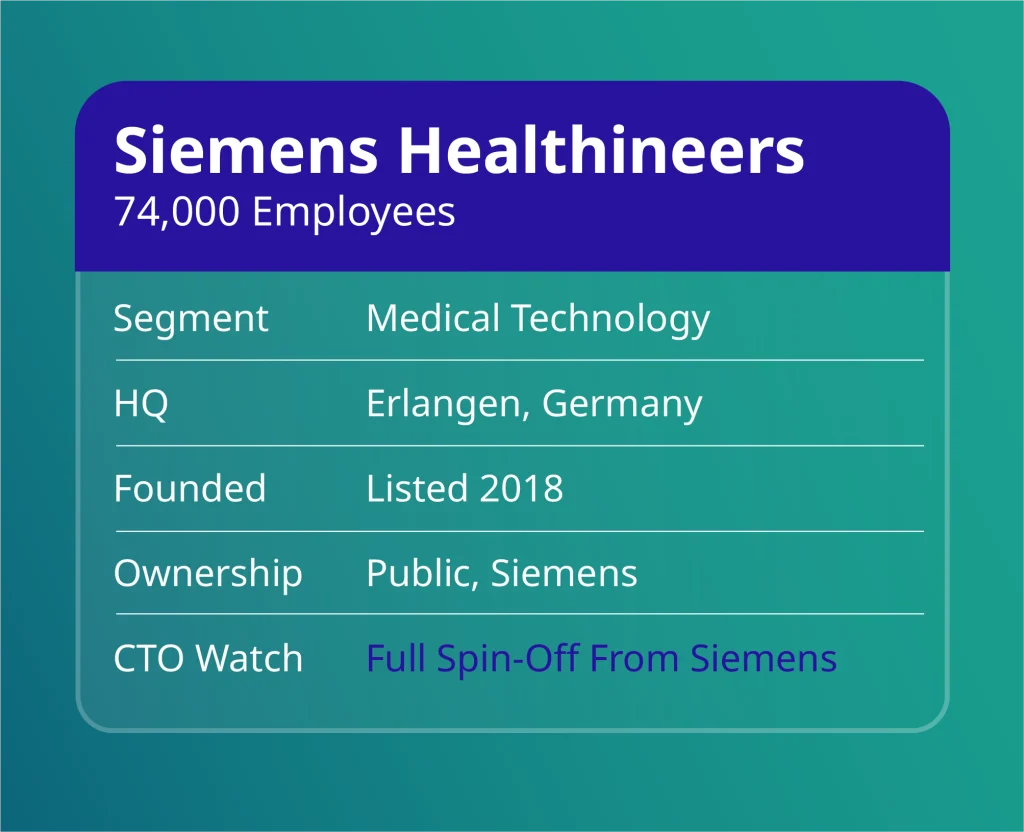
Shipping AI to scanners that stay in hospitals for ten years depends as much on fleet management as on model quality. Siemens Healthineers grows on the strength of that installed base. Imaging did the heavy lifting in fiscal 2025, with comparable revenue growth of 8.5%, to €13.2 billion. Varian added 6.9% comparable growth in radiotherapy. Diagnostics stayed flat but improved its margin through cost cuts.
Regionally, most growth came from the Americas, while China declined slightly. The adjusted EBIT margin still rose to 16.5% despite higher tariffs, which shows the business can absorb trade shocks and keep funding R&D.
- Growth Signal: Revenue of around €23.4 billion in fiscal 2025, comparable growth of 5.9%, with fiscal 2026 guidance cut in July 2026 to 3.5% to 4% on weak Diagnostics sales.
- AI Move: AI embedded across imaging, diagnostics and Varian radiotherapy planning, shipped into a base that keeps expanding. Equipment book-to-bill reached 1.27 in the third quarter of fiscal 2026.
- DevOps Implication: AI features land on hardware of many ages and configurations. Delivery speed depends on staged fleet updates, fast security patching and compatibility with older systems.
5. GE HealthCare: Why AI Is Now Sold Inside the Device
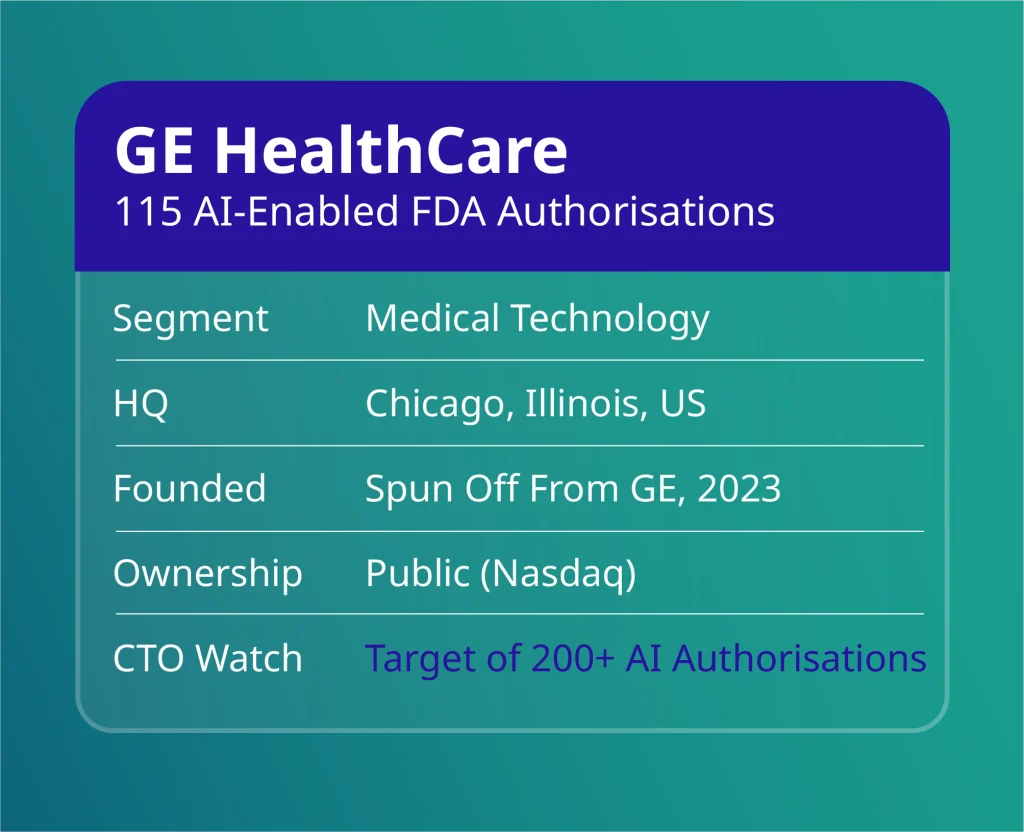
GE HealthCare sells AI as part of the scanner. That turns every algorithm into a regulated product with its own documentation and monitoring duties. The company describes its direction as a move from equipment maker to healthcare solutions provider.
Long-term health system deals support that shift, including a strategic collaboration with Ascension on technology and efficiency. Nuclear medicine is its quieter growth engine. Demand for its radiopharmaceuticals rose, and it secured its largest-ever US order of Omni Legend PET systems.
Buying the remaining 50% stake in Nihon Medi-Physics, completed in March 2025, deepened that position in Japan.
- Growth Signal: $20.6 billion in revenue in 2025, under a strategy linking smart devices and drugs across disease states.
- AI Move: SIGNA One, a new ecosystem of AI-enabled MR workflow tools, alongside digital, AI and cloud services across the portfolio.
- DevOps Implication: Each authorised algorithm needs post-market performance monitoring. That requires secure telemetry from devices in the field, linked to the exact software version each one runs.
6. Intuitive Surgical: When a Surgical Robot Becomes a Software Platform
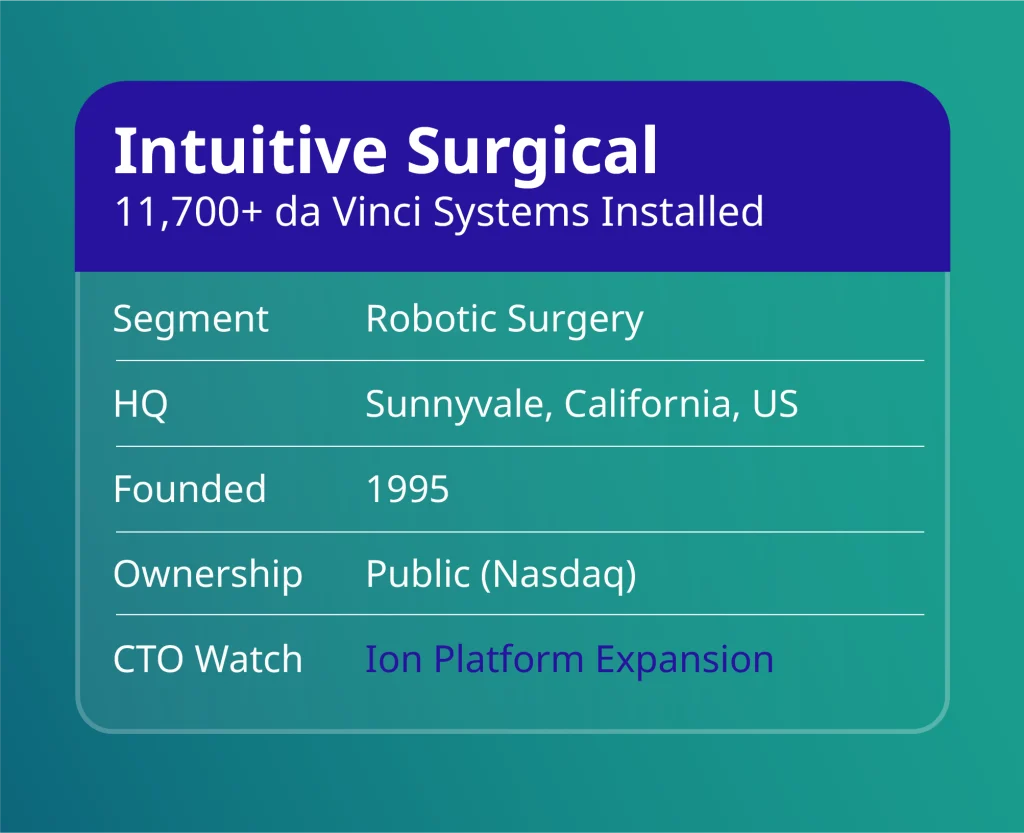
Intuitive shows what happens when a medical device starts behaving like a software platform. Its newest robot, da Vinci 5, was built with 10,000 times the computing power of its predecessor, so new capabilities can be added without new hardware.
In June 2026, Intuitive began a phased US rollout of more than 100 software, instrument and user experience updates to the system. The release added multifactor login at the surgeon console and stronger instrument encryption.
Telepresence now lets an expert guide a live procedure from another site. Every one of those changes ships into an operating theatre, not a browser.
- Growth Signal: 2025 revenue of about $10.1 billion, up 21%, with da Vinci procedures up about 18% and 870 da Vinci 5 systems placed in the year.
- AI Move: Case Insights combines system data, video and movement data, using machine-learning phase segmentation to give surgeons objective performance metrics after each procedure. The underlying computing platform was built with NVIDIA.
- DevOps Implication: A robot that receives regular updates in live operating theatres needs staged rollouts, version tracking for every system and tested rollback. Surgical video and movement data also need consent and retention rules before they feed any model.
7. Philips: Why Release Governance Now Wins Deals
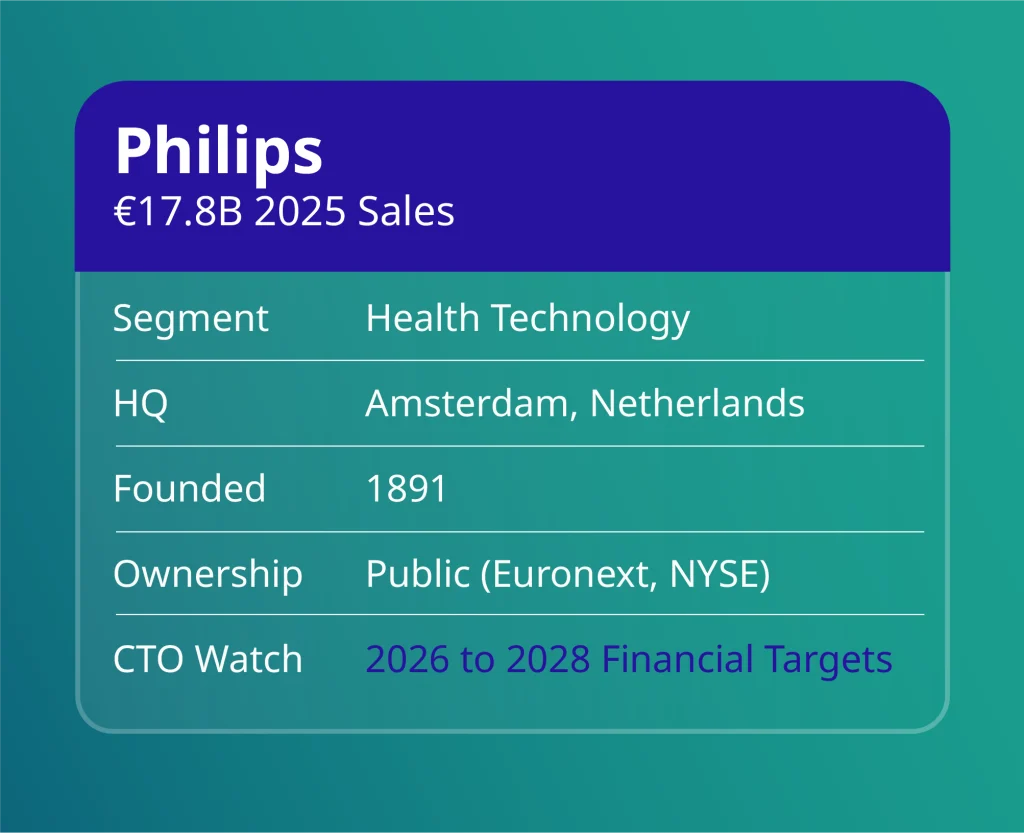
For Philips, provable control over software change has become a sales argument. Since its sleep and respiratory device recall, every quality process faces extra scrutiny.
The recovery is uneven across the portfolio. In 2025, Personal Health grew 8% on a comparable basis, Connected Care 3%, and Diagnosis and Treatment stayed flat. Comparable order intake rose 7% in the fourth quarter, providing visibility into the year ahead. Innovation has not slowed.
Philips filed 700 new patents in 2025 and unveiled BlueSeal Horizon, which Philips describes as the industry’s first helium-free 3.0T MRI platform, at RSNA 2025.
- Growth Signal: Comparable sales growth of 2% in 2025, accelerating to 7% in the fourth quarter, with full-year comparable order intake up 6%.
- AI Move: FDA clearance for SmartSpeed Precise, dual AI software for faster and sharper MR imaging.
- DevOps Implication: Buyers and regulators want to see controlled change. The delivery pipeline is where that evidence is produced and stored. Compliance does not have to slow releases when evidence is automated in the pipeline, as two-hour healthtech deployments show.
8. Tempus AI: Why Its Data Pipeline Matters More Than Its Tests
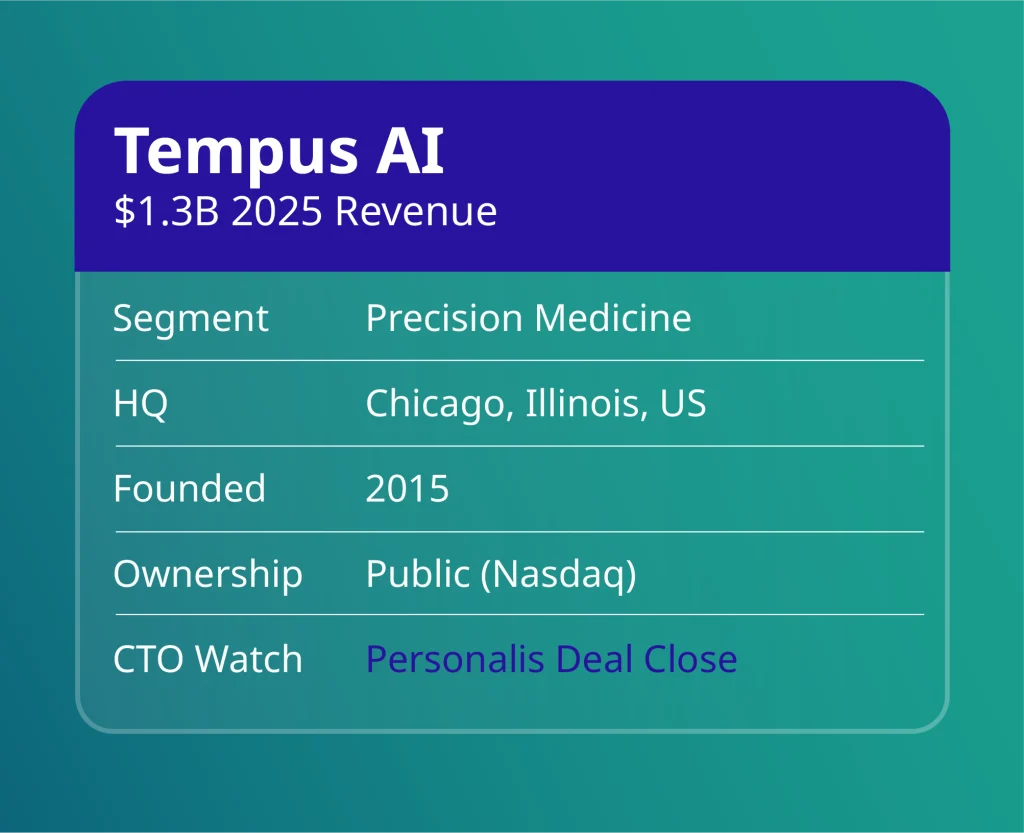
Tempus’s valuation rests on licensable data, which makes its pipelines the real product. The company grew largely through acquisition. Ambry Genetics, Paige AI and OneOme’s pharmacogenomics assets are already part of the group. Each deal added new tests or AI capability and, more importantly, another dataset to bring into a common model.
Diagnostics still carries most of the revenue, reaching $955.4 million in 2025 as oncology test volumes rose 26%. Profitability is the next milestone. After a small adjusted EBITDA loss in 2025, Tempus expects adjusted EBITDA of about $65 million in 2026.
- Growth Signal: Revenue up 83.4% in 2025, with 2026 guidance raised to between $1.595 billion and $1.605 billion, about 25% growth.
- AI Move: A multimodal data library licensed to pharma, which helped Data and Applications revenue reach $316.4 million, with 126% net revenue retention in Insights, its data licensing business.
- DevOps Implication: Each acquisition adds another data estate. Lineage, consent tracking, and de-identification built into the data and AI pipelines decide how quickly new data can be licensed.
9. Doctolib: What It Really Takes to Sell Software to the NHS
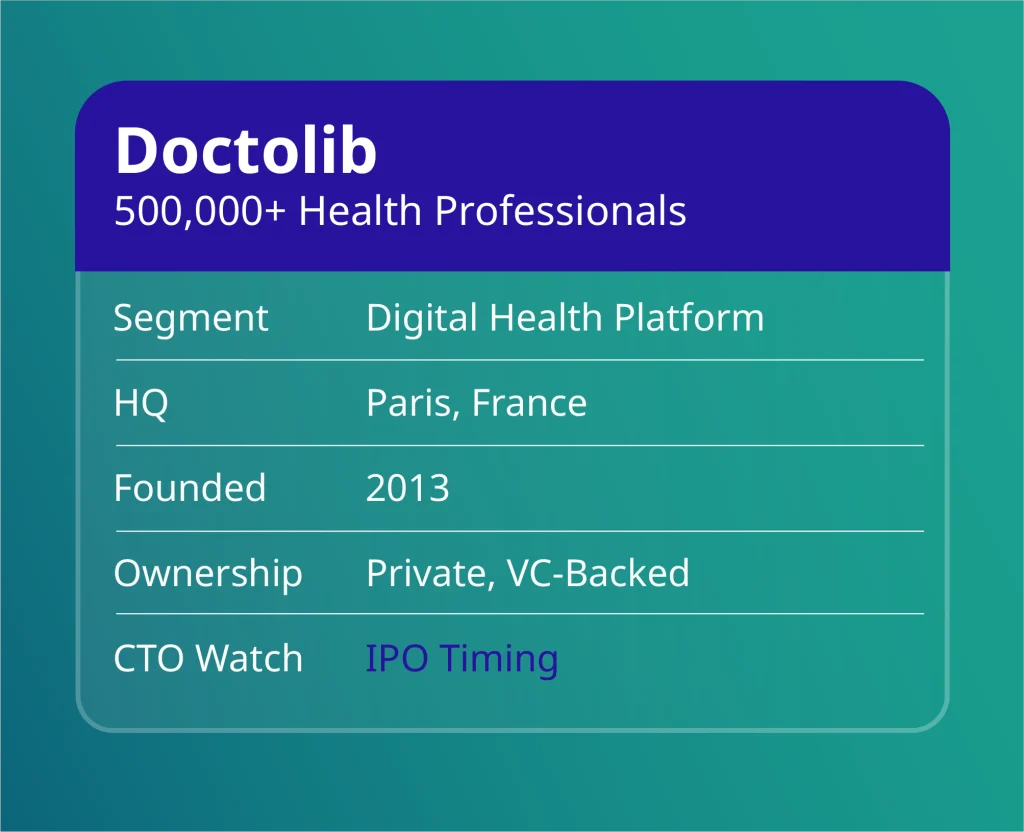
Selling to NHS general practice takes local integration and assurance work that European scale cannot replace. EMIS (now part of Optum) and TPP have controlled GP software in England for more than 20 years. Doctolib’s route was Medicus, the first new clinical system in 25 years to gain NHS England validation, bought in May 2026.
Medicus founder Emile Axelrad stays on to lead the UK business. Doctolib has used acquisitions before to add AI capability. It bought Aaron.ai, an AI phone assistant already used by thousands of German providers, and Typeless, a speech recognition spin-off from Switzerland’s Idiap Research Institute. The UK is now its fifth market, after France, Germany, Italy and the Netherlands.
- Growth Signal: Annual recurring revenue of €348 million in 2024, up 22.5%, and a UK commitment of over £100 million with 150 new hires over four years.
- AI Move: €115 million in R&D in 2024, about a third of revenue, behind an AI consultation assistant already used in more than 2 million consultations. A planned London R&D centre will extend that work to UK primary care.
- DevOps Implication: GP adoption will depend on integration with hospital, pharmacy and community systems, not on the AI assistant. The engineering budget follows the interfaces.
10. Abridge: Why Ambient AI Is Becoming a Margin Problem
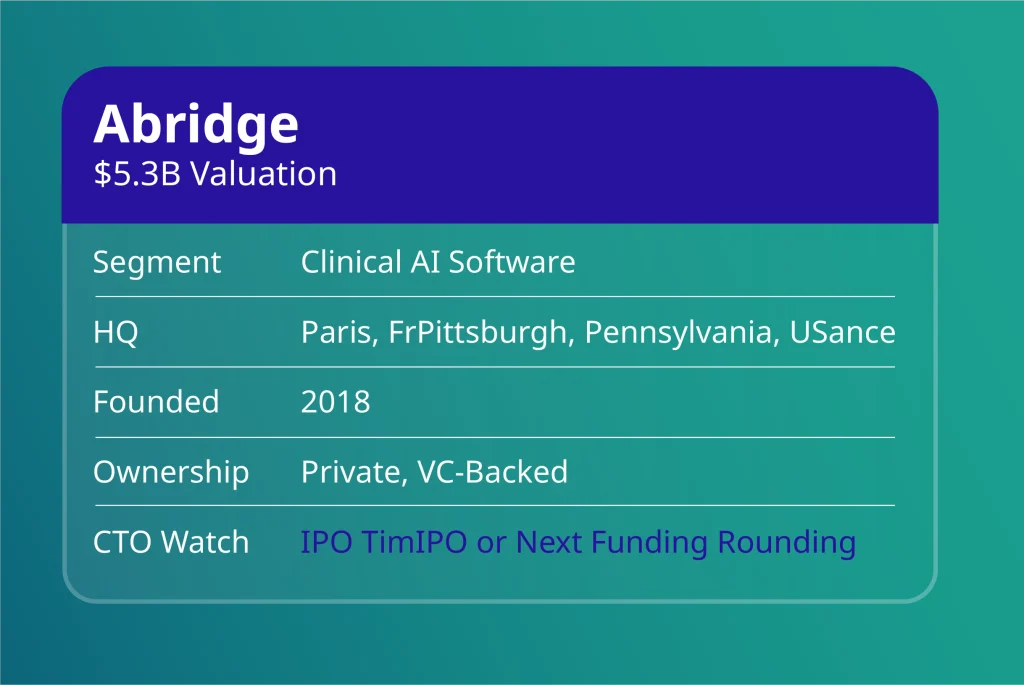
Ambient AI at clinical scale turns inference cost into a margin question. Abridge has already proved demand. It now works with more than 300 health systems, up from about 150 in mid-2025. KLAS named it Best in KLAS for Ambient AI in Revenue Cycle for the second year running. By mid-2025, it already supported 55 specialties and 28 languages.
Customers are also extending use beyond doctors, with Abridge now covering nursing workflows alongside outpatient, emergency and inpatient care. Competition is heavy, with Microsoft’s Nuance, Ambience, Suki and Nabla all chasing the same workflow.
- Growth Signal: A $300 million Series E in June 2025 at a $5.3 billion valuation, followed by a reported $316 million extension in April 2026.
- AI Move: Expansion from clinical notes into billing, drug trials and real-time insurance claims.
- DevOps Implication: Every encounter carries a latency budget, a speciality-specific evaluation suite and a cost to track. Model operations now shape gross margin.
Engineering Pressures Across the Top 10
| Company | Carve-Out or M&A | Connected Devices | Regulated Releases | AI Agents | Data Platform |
| Medtronic | ✓ | ✓ | ✓ | ||
| Veeva Systems | ✓ | ✓ | ✓ | ||
| Epic Systems | ✓ | ✓ | |||
| Siemens Healthineers | ✓ | ✓ | |||
| GE HealthCare | ✓ | ✓ | ✓ | ||
| Intuitive Surgical | ✓ | ✓ | ✓ | ||
| Philips | ✓ | ✓ | |||
| Tempus AI | ✓ | ✓ | ✓ | ||
| Doctolib | ✓ | ✓ | ✓ | ||
| Abridge | ✓ | ✓ |
The Verdict: Three Engineering Bets That Decide Healthtech Winners
The lesson from all ten companies is that AI creates value in healthcare only when the underlying engineering can ship it safely and frequently. Three decisions make the difference.
1. Get the Platform Right Before Adding AI
Acquisitions and separations, like Tempus buying Paige AI or Medtronic splitting off MiniMed, leave companies with mixed systems, data and access rights. AI built on that mess is slow and risky. Rebuild infrastructure as code with clear ownership, and every later AI project moves faster. The same applies to any regulated cloud migration.
2. Treat Device Data as a Clinical Service
Insulin pumps, surgical robots and scanners now send data all day and night. If that data stops, patients can be affected. Set clear reliability targets, alert care teams automatically and test failover before launching new features.
3. Make Every AI Update Auditable
The FDA now accepts pre-approved plans for AI updates, and the MHRA backs the same principles, but only with evidence for each change. A CI/CD pipeline that automatically records evidence lets teams release AI improvements monthly instead of once a year.
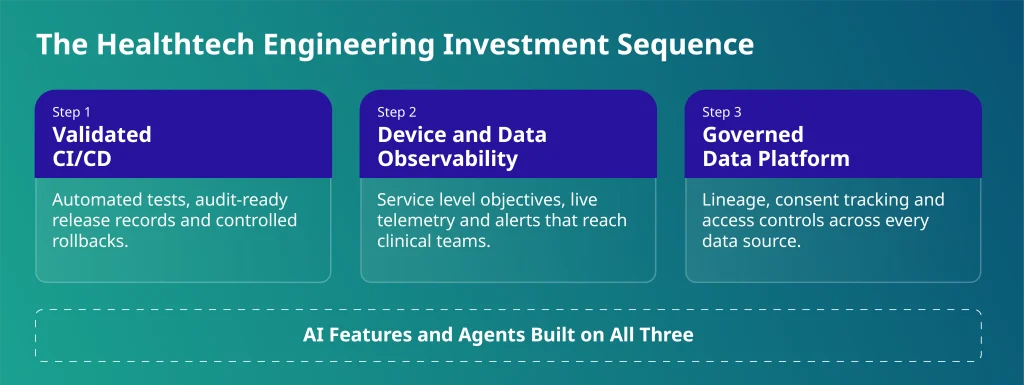
If you’re leading technology at a healthcare company, or working with one, the order of investment matters. Each step depends on the one before it. A specialist healthcare DevOps partner knows the sequence and gets you through it faster, without cutting corners that regulators will find later. The companies that get the order right are the ones shipping AI quickly and still passing the audit.
How This List Was Ranked
Each company was assessed on three criteria.
- The first is a verifiable growth signal, such as results, investments or deals announced in 2025 or 2026, taken from company filings, press releases or funding rounds confirmed by the company or reported by reputable trade press.
- The second is AI or connected software shipping inside a live product, not announced as a pilot.
- The third is how directly the company’s growth changes the work of engineering teams.
Information comes from company results releases and regulatory filings, executive interviews, and coverage in healthcare trade publications such as Becker’s Hospital Review, Fierce Healthcare and Digital Health, with all figures checked against the original source where one exists.
Size was not a criterion on its own. Medtronic ranks first because it meets all three criteria while managing a change many CTOs will eventually face themselves: separating a live business without stopping it.
Top Global Healthtech Companies: Frequently Asked Questions
What Is Healthtech?
Healthtech is technology used to prevent, diagnose, treat or manage health conditions, and to run the organisations that deliver care.
Examples include electronic health records, remote patient monitoring, clinical decision support and online booking tools. The term overlaps with digital health, which usually refers only to software and data.
Healthtech buyers include hospitals, GP practices, insurers, pharma companies and patients. What sets the sector apart is regulation. Products that influence clinical decisions can face medical device rules, and anything handling patient data must meet strict privacy laws. That shapes how healthtech products are designed, tested and released.
What Is the Difference Between Healthtech and Medtech?
Medtech is a subset of healthtech that focuses on physical medical devices, such as scanners, pumps, implants and surgical tools.
Healthtech is the wider category. It also includes software, data platforms and services that never touch a patient directly, such as scheduling systems or analytics tools.
The line is blurring fast. Many medical devices now depend on software, cloud connectivity and AI to work. For technology leaders, the practical question is not the label. It is whether a product is regulated, because that decides the level of testing, documentation and change control required.
What Does DevOps Mean in Healthcare?
DevOps in healthcare is the practice of building, testing and releasing software quickly and safely in a regulated clinical environment.
It uses the same core methods as other sectors: version control, automated testing, continuous integration and infrastructure as code. The difference is in the evidence. Every change must be traceable, and releases that affect clinical systems need documented risk assessment and approval.
Downtime also carries higher stakes, because clinicians depend on these systems during patient care. Well-run healthcare DevOps therefore automates compliance evidence inside the pipeline. That lets teams release more often while giving auditors and clinical safety officers a clear record of what changed and why.
Can Patient Data Be Stored in the Public Cloud?
Yes. NHS organisations can store patient data, including confidential records, in the public cloud, provided the right security controls are in place. Major platforms such as AWS, Microsoft Azure and Google Cloud offer UK data centre regions, which help with data residency.
Responsibility, however, stays with the organisation holding the data. It must assess the risks, comply with UK GDPR and meet the Data Security and Protection Toolkit.
For larger NHS bodies, the toolkit has been aligned with the NCSC Cyber Assessment Framework since 2024. Many cloud incidents stem from customer misconfiguration, so cloud security should be planned before any patient data moves.
What Is Healthcare Interoperability, and Why Does FHIR Matter?
Healthcare interoperability is the ability of different systems to exchange patient data and use it correctly. It lets a hospital record, a GP system and a monitoring device share information without manual re-entry.
FHIR (Fast Healthcare Interoperability Resources) is the main modern standard for this exchange. Developed by HL7, it uses web APIs and common data formats, which makes integration faster than older messaging standards. US rules require FHIR for certain patient access APIs, and it underpins many NHS national services.
For AI, interoperability is a precondition. Models and agents are only as useful as the data they can reach, and poor integration often stalls healthcare AI projects.
Explore our BLOG
Recent articles
Top 10 Healthtech Companies in 2026: What Their Growth Means for AI and DevOps
Every software change that reaches a hospital has to clear regulatory, legacy system, and clinical...
read full article

Is Claude Down? Anthropic Outage: Protect Your Cloud Infrastructure
Claude went down across every surface on 29 September 2026. From 14:00 to 14:59 UTC,...
read full article

How to Build an AI Engineering Capability Without Hiring 20 People
You don’t need 20 hires to run AI in production. Three to five people can...
read full article