



Your managed cloud services fee buys six things: engineering time, tooling, round-the-clock cover, cross-client expertise, risk transfer and cost governance. Everything else is packaging.
Few providers itemise any of it, and the five pricing models on the market each reward a different behaviour. Choose the wrong one, and you fund your provider’s growth instead of your own savings.
Cloud spend is already the pressure point: 85% of organisations name managing it as their top challenge, for the third year running (Flexera, 2026 State of the Cloud).
Ten minutes here arms you for the next procurement or renewal conversation: what a credible contract includes, layer by layer, the incentive built into each pricing model, and seven questions that expose a weak provider before anything is signed.
Executive Summary
- Managed cloud services span six layers, from monitoring to architecture guidance. Budget contracts deliver one.
- In-house 24/7 cover starts at four to five engineers, at a mean advertised UK salary of £77,936 each (Learning People, 2026).
- Percentage-of-spend dominates the pricing market and carries the weakest incentive to shrink your bill.
- Wasted cloud spend climbed to 29% in 2026, the first rise in five years (Flexera). Strong cost governance claws back part of the fee.
- Pressure-test the three highest-risk clauses: SLA response times, exit terms and the savings methodology.
What Are Managed Cloud Services? A Plain-English Definition
Managed cloud services are the ongoing operation, optimisation and security of your cloud infrastructure by a specialist third party, delivered against defined service levels for a recurring fee.
The version that matters at the board level: it is the only sourcing model where a live production incident is contractually someone else’s problem.
Apply that test to every option on your shortlist. A failure finds you at 3am. Whose phone rings?
- Cloud hosting: yours. The provider sold you infrastructure and wished you luck.
- Consultancy: yours again. They ran the migration, invoiced and left in Q2, often with the cloud bill climbing after they’d gone.
- Staff augmentation: technically their engineer, practically your problem. Renting hands never transferred the accountability.
- Managed cloud service provider: theirs. The phone, the fix and the post-incident report all sit with someone under SLA.
73% of organisations now run hybrid estates (Flexera, 2026 State of the Cloud). Two operating models, one headcount.
Demand followed the complexity.
Worldwide IT Spending by Category, 2026
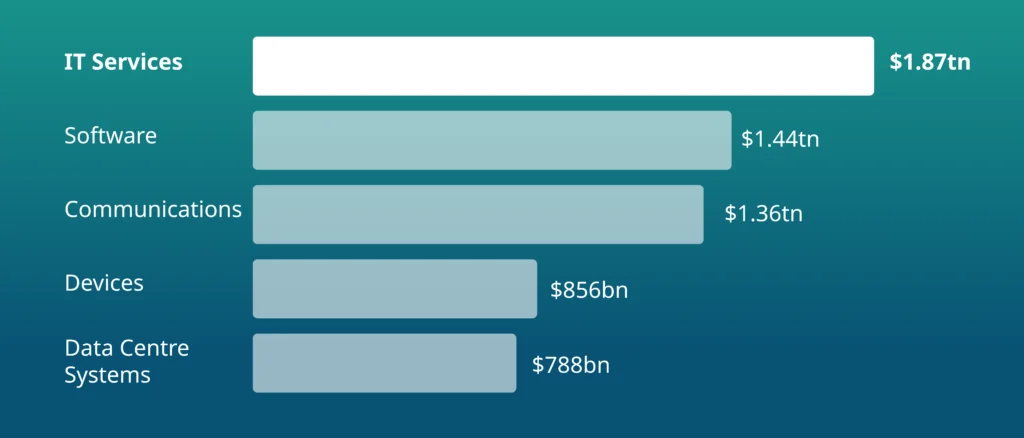
Total worldwide IT spending, 2026: $6.31 trillion (+13.5% year over year)
IT services (the segment that includes application and infrastructure implementation, managed services and IaaS) will exceed $1.87 trillion in worldwide spending in 2026. (Gartner, April 2026)
A market that size runs on standardised baseline tiers. Monitoring dashboards come with every quote. Providers and prices diverge in the layers above. The next section maps all six.
What Do Managed Cloud Services Include? Six Layers, Explained
Every provider will show you a version of this list. Very few will price it layer by layer, and that gap is exactly where the money from the previous section went. Six layers separate a credible contract from a glorified monitoring subscription, and only some of them are standard issue:
- Monitoring and incident response (table stakes). Round-the-clock observation of infrastructure and applications, alerting, triage and a named escalation path for the moment something breaks. Every quote includes it. No quote should charge a premium for it.
- Security and compliance management (standard). Patch discipline, vulnerability scanning, identity hygiene and evidence your auditors will accept without a fight. IDC forecasts worldwide security spending at $308 billion in 2026, growing 11.8% year over year and heading for $430 billion by 2029, which tells you where buyers see the sharpest risk. It is substantial enough that many firms scope it as a dedicated cloud security service rather than folding it into a general contract.
- Cost optimisation and FinOps (differentiator). Rightsizing, commitment and discount management, anomaly detection and reporting that your finance director can actually read. The layer budget contracts most often quietly omit.
- Backup, disaster recovery and resilience (standard). Tested recovery with defined RTO and RPO targets, plus failover exercises rather than a backup job nobody has restored from.
- Lifecycle management (standard). Upgrades, deprecations and version currency handled before they become emergencies.
- Architecture guidance (differentiator). Quarterly reviews that improve the estate instead of merely preserving it. Absent from cheap contracts, decisive in good ones.
Quotes converge on the standard layers and diverge on the two differentiators. Compare accordingly: put all six down the left-hand side of your evaluation sheet and make every provider price against them. Anyone who will only quote a bundle is showing you where the packaging is.
Whether you buy those layers or build them is the next question. The numbers follow.
Cloud Managed Services vs In-House Teams: Run the Numbers First
Building the six layers yourself is a headcount decision before it is anything else, so start where the money starts:
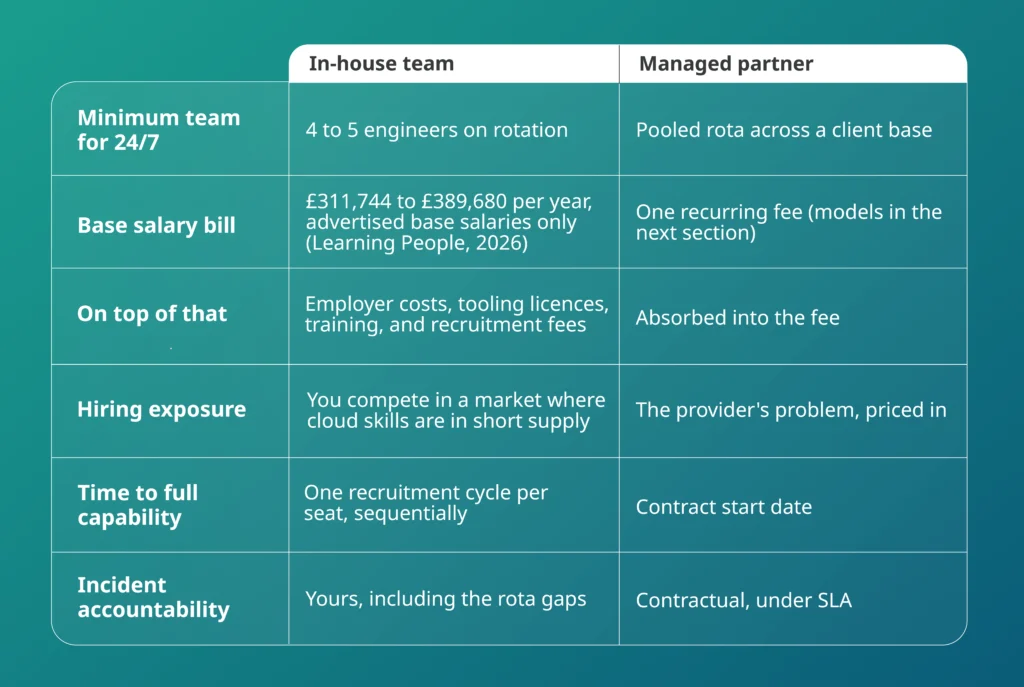
The hiring row deserves a second look, because it gets worse from here. IDC put the IT skills shortage at more than 90% of organisations for 2026, at an estimated global cost of $5.5 trillion (Business Wire). Cloud and security roles sit squarely inside that gap, so every seat in your rota is contested by every other employer in the country.
Two genuine exceptions exist, and they are covered further down. For everyone else, the decision is financial: which model delivers the six layers at a defensible cost per unit of reliability? That depends almost entirely on how the fee is structured, which is where providers differ most.
How Managed Cloud Services Pricing Works: Five Models, Five Incentives
Every fee eventually resolves into one of five structures, and each pays your provider to behave differently. Read them as incentive schemes first and price lists second:
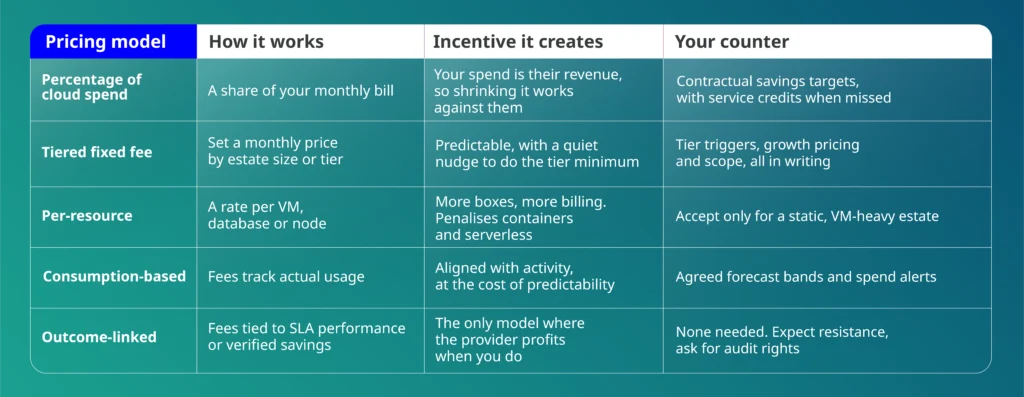
Spend is growing fast, so never accept pure percentage-of-spend without savings obligations attached.
Name the incentive, then write the contract to correct it. No model is wrong by default. Risk lives in the mismatches: percentage-of-spend with no savings clause, or a fixed fee wrapped around a vague scope.
Whatever structure you land on, the fee breaks down into the same six components. The next section itemises each one.
What You’re Actually Paying For, Line by Line
Strip the invoice down, and six cost components sit underneath it. Five are costs you would carry anyway, in-house or out. One should pay you back. For each, there is a tell that shows whether you are getting it or just funding it:
- Engineering time. Reactive incident work plus the proactive hours that prevent the next incident. The tell: your monthly report splits the two. All-reactive means you are paying for firefighting alone, with no time bought for prevention.
- Tooling you no longer buy. Monitoring platforms, security scanners and FinOps software absorbed into the provider’s stack, licences included. The tell: ask for the tooling list and what each replaces on your own licence bill.
- The rota premium. Availability itself. Staffing 24/7 across a client base costs the provider far less per client than your solo rota from the comparison table above. The tell: named engineers and response times per severity, in the contract and not the brochure.
- Pattern recognition. A partner sees failure modes across dozens of estates, so you inherit the fix for every incident they have already resolved elsewhere. The tell: post-incident reports that reference root causes, without you asking.
- Risk transfer. Contractual SLAs move accountability for uptime and response onto someone else’s balance sheet. The tell: remedies with teeth. Service credits nobody would miss are decoration.
- Cost governance. The one line that funds the others. The tell: a savings figure, a baseline and a methodology you could hand to an auditor. The guide to optimising cloud costs with FinOps shows what that methodology looks like in practice.
The 29% waste figure has a cause: surging AI workloads and unfamiliar platform pricing (Flexera, 2026 State of the Cloud).
The sixth line is where that number becomes your leverage. The same report puts generative AI at 58% adoption, now the third most used public cloud service, with fewer than half of organisations using even one commitment discount per cloud provider. Recoverable money sits in every one of those gaps. A provider without a verified savings methodology is asking you to fund five line items and forfeit the sixth.
The six tells above compress into seven questions you can put to any shortlisted provider in a single meeting. They come next.
Seven Questions to Ask Before You Sign a Managed Cloud Contract
Contracts fail on details nobody tested during negotiation. Put these seven to every shortlisted provider, in one meeting, in this order:
- Which pricing model applies, and what happens to your fee if my cloud spend falls?
- What does the SLA specify beyond uptime: response and resolution times by severity, with service credits attached?
- Who owns the tooling, runbooks and documentation if we exit?
- How are cost savings measured, baselined and verified, and by whom?
- What sits explicitly out of scope, and what does it cost when I need it?
- What are the notice period, exit terms and handover process for credentials and access?
- Who is my named escalation contact, and when did they last run an incident like mine?
The answers matter individually. The pattern across them matters more. A provider who hedges on the pricing question will hedge again when savings need verifying, a pause before answering who owns the runbooks is a price you will pay at exit, and “our team” in place of a name tells you the senior engineers are reserved for sales calls. Strong providers give you those answers straight from their standard contract, no scrambling.
Three answers should end the conversation on the spot: an auto-renewing multi-year term, a savings claim without a baseline methodology and unlimited support with undefined response times. Each shifts risk back to you while the fee stays the same.
Clear all seven, and a provider has earned the shortlist. One question remains, and it belongs to you rather than them: whether the managed model fits your organisation at all. Some firms genuinely should keep this work in-house. The next section draws that line.
When Managed Cloud Services Make Sense (and When In-House Wins)
Run a quick audit of your last quarter.
- Did infrastructure work crowd out product work on your engineering board?
- Did an auditor or client ask for operational evidence your team had to assemble by hand?
- Did an AI workload land on the cloud bill faster than anyone adjusted the cost controls?
- Did a cloud or security vacancy sit open past ninety days?
The benefits of managed cloud services compound with each yes, and two or more is usually the threshold where the fee stops being a cost debate and starts being a capacity one.
Regulated firms have an extra reason that rarely appears on the provider’s slide deck. FCA and PRA operational resilience rules expect UK firms to keep important business services running through disruption, and to prove it.
Proof is the expensive part. A provider’s tested incident records, failover exercises and SLA history are exactly the evidence trail those rules demand, already assembled, already timestamped. Firms serving EU markets carry parallel obligations under DORA, with the same logic applying twice.
The Two Exceptions Where In-House Wins
Both were promised back in the numbers section, and both are genuine.
First, when your platform is your product, operational excellence is the moat, and moats are a strange thing to rent. A company whose customers buy uptime should own the discipline that produces it.
Second, where data sovereignty rules constrain third-party access, the shortlist of viable partners can shrink to zero, and no pricing model fixes an empty shortlist. If either describes you, build in-house with confidence and skip the sales calls.
Everyone else should let the arithmetic decide. Honesty about the fit costs less than a mis-scoped contract, and a provider worth hiring will tell you the same in the first meeting.
Find Out What Your Cloud Estate Really Costs to Run
A contract you cannot decompose is a contract you cannot negotiate. Deployflow’s cloud management delivers the six layers this article has mapped, from the 3 am phone call to a savings methodology your auditor would accept, and the starting point is free: a consultation that reviews your cloud spend, in-house operating costs and waste against those layers, so you can see exactly what any provider should deliver for the fee.
Book your free consultation, bring your last three cloud invoices, and feel free to put the seven questions from this article to Deployflow in that meeting. A provider worth hiring answers all seven without looking anything up.
Frequently Asked Questions About Managed Cloud Services
What is the difference between managed cloud services and cloud managed services?
Nothing. The two are the same thing with the words reordered, and providers use them interchangeably across their sites, proposals and directory listings. Search engines treat them as near-identical queries, which is why you will see both phrasings return the same companies.
The reordering carries no technical meaning, so it tells you nothing about scope, quality or price. When you compare providers, ignore the label entirely and read what the contract actually delivers: which service layers are included, which are charged as extras, and where accountability lies. Two providers using identical wording can offer wildly different depth beneath it.
Can you switch managed cloud service providers, and how hard is it?
Yes, though the difficulty depends almost entirely on what your current contract says about leaving. A clean switch turns on three handovers: your tooling and runbooks, complete and current documentation, and full credential and access control.
Providers who onboarded you in days sometimes make offboarding deliberately slow and vague, and that friction is the lock-in revealing itself. The time to protect against it is before you sign the first contract, not when you are already trying to leave. Check the notice period, the transition assistance the provider commits to, who owns the documentation at exit, and whether any tooling is proprietary and therefore leaves with them. A provider confident in their service will make leaving easy, because they rarely have to watch anyone do it.
Do managed cloud services work with multi-cloud and hybrid setups?
Yes, and a hybrid or multi-cloud estate is frequently the reason firms bring in a partner rather than a complication that rules one out. Running AWS, Azure and on-premises infrastructure at once means three operating models, three billing structures and three security surfaces for a single internal team to master, which is where most in-house capacity quietly breaks down.
A capable provider handles all of them under one contract. The real value is consolidation. One reconciled view of cost, usage and security posture replaces three separate dashboards nobody has time to cross-check. Before signing, confirm the provider has genuine, certified competence in each platform you run, since depth in AWS does not guarantee depth in Azure, and a partner strong in one and weak in another can leave your biggest estate underserved.
Are managed cloud services secure, and who is responsible if there is a breach?
Yes, security usually improves under a competent provider, but responsibility is shared and never fully transfers. The split has to be written into the contract.
Under the cloud shared responsibility model, the platform provider secures the underlying infrastructure while you, or the partner acting for you, secure the workloads, data, identities and configurations running on top of it. A managed contract should state precisely which of those duties transfer to the provider, what their monitoring and incident response commitments are, how fast they will act by severity, and where financial liability lands when something goes wrong.
Never assume a breach is automatically the provider’s problem, because a vaguely worded contract can leave the most damaging failures sitting with you. The stronger providers welcome this conversation and show you their security certifications, such as ISO 27001, without being pressed. Where security needs its own depth, it is often scoped as a dedicated cloud security service.
Explore our BLOG
Recent articles

How can a DevOps team leverage the power of AI?
Your CI/CD pipeline is automated, but it still can’t see trouble coming. Alerts land after...
read full article

Why Regulated Industries in the UK Are Getting AI Wrong
Your pilot works. It has worked for months. It still cannot go live, and every...
read full article

What Is AI Foundry, and Why Should CTOs Care?
Somewhere in your Azure tenant, an AI workload is running that nobody formally approved. It...
read full article