



Getting an AI agent from prototype to production is a solved problem. The solution is treating it as a software delivery challenge instead of an AI research project.
What CTOs Need to Know Before Deploying AI Agents
- Production failures are infrastructure problems. Swapping models does not fix them.
- Memory design, tool scoping, and orchestration set the ceiling for how far your agent scales.
- Legacy integration is always the longest item on the delivery timeline. Scope it first.
- Four deployment stages exist. Skipping them creates incidents.
According to McKinsey’s 2025 State of AI report, 62% of organisations are now at least experimenting with AI agents, yet only 23% are actively scaling one.
The organisations shipping stable, scalable agent systems share a specific set of decisions: how they design memory architecture, how they scope tool interfaces, how they integrate with legacy infrastructure, and how they instrument systems that do not behave like conventional software. This article covers each one directly.
Three Reasons Enterprise AI Agent Projects Stall at Prototype (and the Architecture Fixes That Work)
According to Gartner, over 40% of agentic AI projects will be cancelled by the end of 2027, due to escalating costs, unclear business value, or inadequate risk controls. The infrastructure surrounding the model (not the model itself) is where these projects break down.
Three failure modes consistently account for this, and each has a direct architectural fix.
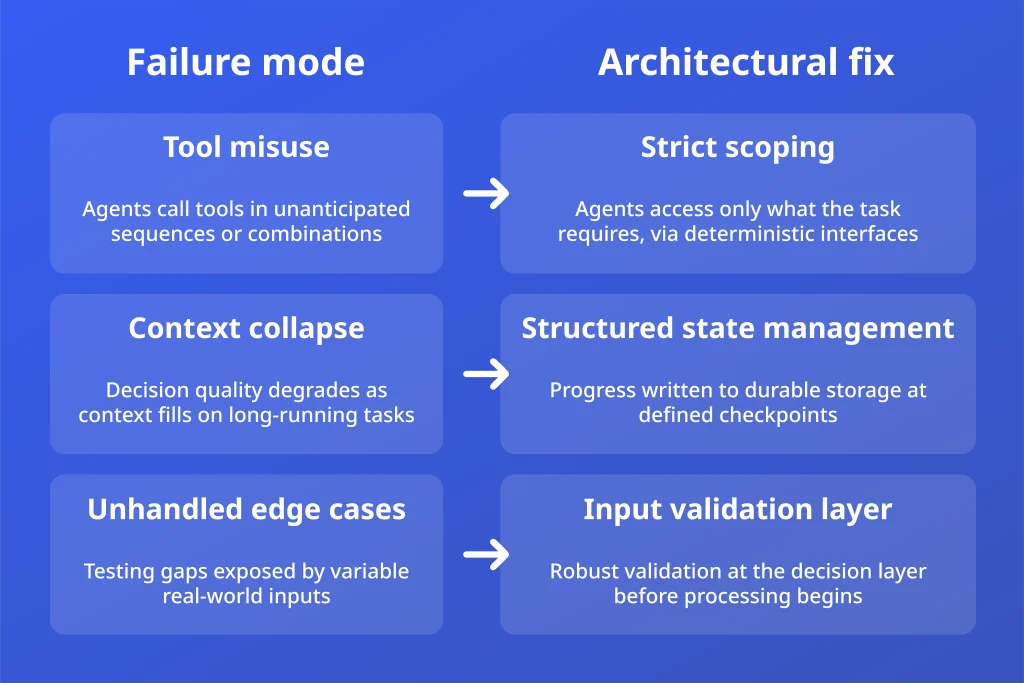
The architecture is where attention is due. Addressing these three failure modes at the infrastructure layer is what separates agent programmes that reach production from those that remain permanently at prototype.
Customer service deployments illustrate this clearly: the input variability, escalation logic, and compliance requirements that agents encounter in live environments bear little resemblance to what development conditions produce. If that is the deployment context you are working towards, what production-grade customer service agents require is worth reading before the build starts.
Enterprise AI Agent Infrastructure: What Separates Stable Deployments from Expensive Mistakes
Production readiness is a specific set of capabilities. For enterprise deployments, five requirements define it.
- Reliability under variable input quality. Robust input validation and fallback logic handle malformed, incomplete, or ambiguous inputs before they reach the agent’s decision layer.
- Graceful degradation. Failure should be informative and routed, not silent. The system logs what failed, at what stage, and escalates appropriately.
- Full auditability. Every decision, every tool call, and every output should be reconstructable after the fact. Without this, incident response is guesswork and compliance is theoretical.
- Latency and cost predictability. Agent systems that perform well at low volume frequently become financially unviable at scale. Token consumption, execution time, and cost per run require instrumentation from the first sprint.
- Human-in-the-loop as permanent architecture. Approval gates at defined decision points are not a temporary measure for immature systems. For high-stakes tasks, they stay.
What this looks like in practice: A financial services firm deploying an AI agent to process supplier invoices designs input validation that catches missing fields and currency mismatches before the agent acts. When the agent cannot reconcile a line item, it logs the failure state, routes the invoice to a human reviewer, and halts. Every action is timestamped and auditable for compliance. Cost per invoice run is tracked from day one. Approval gates remain in place for any transaction above a defined threshold permanently. That is not a prototype with guardrails, but a production system.
Scaling AI Agents in Production: The Architecture Decisions That Set Your Ceiling
Three decisions made early in the build determine how far an agent system can scale without significant rework. Get them right once rather than re-architect under pressure.
Single-agent vs multi-agent orchestration is a question of task structure. Single-agent systems are simpler to instrument, debug, and maintain, and they suit bounded, well-defined tasks with limited tool surface area. Multi-agent architectures unlock specialisation and parallelism at the cost of coordination complexity, inter-agent communication failures, and attribution challenges when something goes wrong. Let the task dictate the choice.
Memory architecture is where production failures most commonly originate. In-context memory is fast but limited. External vector stores extend recall but introduce latency and retrieval failure risk. Structured state management, writing agent progress to durable storage at defined checkpoints, is the most operationally sound approach for any long-running workload. Memory decisions made at prototype and carried unchanged into production are a reliable source of context collapse at scale.
Tool design is an engineering discipline. Tools provided to agents should be scoped narrowly, return deterministic outputs, and be independently testable in isolation. Tool interfaces deserve the same rigour applied to internal APIs. Without that standard, agent behaviour becomes difficult to reproduce and harder to fix. Agent architecture sits squarely in DevOps territory, and the disciplines that produce stable, observable microservices apply directly here.
Before your team commits to an architecture, these questions need answers:
- Can you attribute a failure to a specific tool call, memory state, or orchestration decision within five minutes of an incident?
- If the agent fails mid-task, does it restart from the last checkpoint or from zero?
- Has each tool been tested in isolation under conditions that reflect real production inputs?
- Is the orchestration model driven by task structure, or by what the framework made easiest to build?
A no on any of these is an architecture risk, not a testing gap.
Connecting AI Agents to Legacy Enterprise Systems: What to Resolve Before the Build Starts
Four integration decisions determine whether an enterprise agent deployment runs on schedule or spends six months in remediation.
Authentication for Non-Human Actors
Service accounts running AI agents need three things that most initial scoping documents skip:
- principle-of-least-privilege access scoped to the exact systems the agent touches
- automated credential rotation on a defined cycle
- a full audit trail of every action taken under that account
Set this up before the agent touches a single production system. Retrofitting it after go-live is significantly more expensive than building it in.
The Legacy Translation Layer
Modern agent frameworks communicate in JSON over REST or GraphQL. ERP platforms, mainframe outputs, and proprietary middleware accumulated over a decade do not. The work of translating between these worlds, building the adapter layer that sits between LLM-native tooling and legacy data formats, is consistently the longest item on the delivery timeline and the one most frequently underestimated in initial scoping.
Audit your integration surface before committing to a timeline. Every undocumented API endpoint, every flat-file data export, every SOAP service still running in production adds weeks.
Event-Driven vs Polling: Pick Deliberately
Event-driven agent triggers respond to real-time signals with lower latency and no wasted compute cycles between events. Polling is faster to build but introduces lag and creates unnecessary load on downstream systems at every interval.
The decision should follow two questions: what latency does the task actually require, and can the integrated system reliably emit events? If both answers support event-driven, build it that way from the start. Changing architecture mid-delivery is expensive.
Data Access as a Security Design Exercise
Define read scope and write permissions before writing integration code. Agents with narrow write access scoped to specific data objects and defined read permissions are auditable, easier to debug, and far safer to operate than agents granted broad access for convenience.
A useful working rule: if an agent does not need to write to a system to complete its task, it should have no write access to that system at all.
The integration layer is where agent programmes either earn confidence or lose it. Build it with the same rigour applied to any production API, and scope it honestly before the delivery timeline is set.
AI Agent Observability: Four Instrumentation Layers Your Monitoring Stack Is Probably Missing
Standard application monitoring tracks errors, latency, and uptime. Autonomous agents produce a fourth failure type that none of those catch: correct execution of the wrong decision. Catching it requires instrumentation built specifically for non-deterministic systems.
Four layers are required, and most initial deployments are missing at least two.
4 Instrumentation Layers for Agent Observability
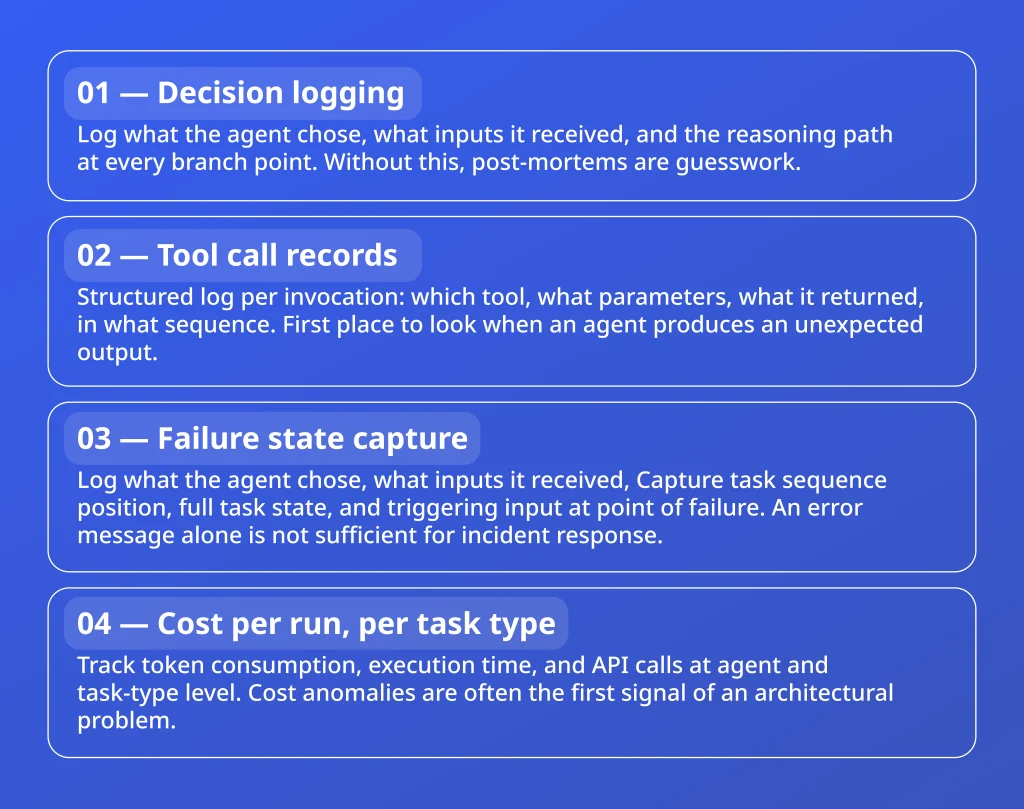
One organisational decision underpins all four: assign explicit ownership of agent observability before deployment. When it sits unclaimed between engineering and data science, instrumentation gaps accumulate. Defining accountability once, before go-live, is cheaper than the alternative.
The AI Agent Maturity Model: A Four-Stage Deployment Roadmap for CTOs
Reliable AI agent programmes move through four operational stages, each with its own infrastructure requirements. The cost of skipping stages shows up as incidents, rework cycles, and delivery timelines that stretch well past the original commitment.
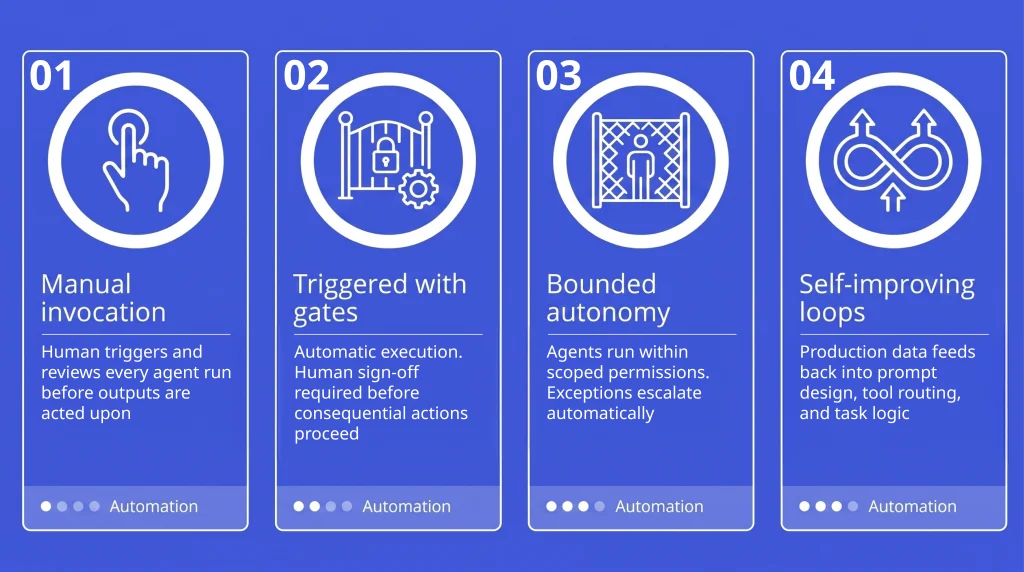
Stage 01 exists to build confidence in system behaviour. Instrumentation built at this stage, decision logs, tool call records, and cost tracking become the foundation on which every subsequent stage runs. Teams that skip it and deploy directly to scheduled runs consistently find themselves retrofitting observability after their first production incident.
Stage 02 is where the organisation stress-tests its trust in the system under real conditions, with a safety net still in place. Permission scoping and escalation routing are built in stage one, and get validated here under volume.
Stage 03 is where integration quality becomes visible. Agents running autonomously against legacy systems surface every translation layer gap and permission misconfiguration that earlier stages did not catch under controlled conditions.
Stage 04 requires that the previous three stages produce clean, structured data. Decision logs need sufficient resolution to identify where behaviour can be improved. Cost-per-run data needs to be granular enough to identify inefficiency by task type. Failure state records need enough detail to drive prompt and tool iteration.
A 2025 Gartner survey found that 45% of leaders in high-AI-maturity organisations keep AI initiatives in production for 3 years or more, compared with only 20% in low-maturity organisations.
Each stage is a checkpoint. If the instrumentation, integration quality, and permission architecture from the previous stage are not in place, the next stage will produce incidents rather than results.
Build, Buy, or Partner: How to Structure Your Enterprise AI Agent Programme
The component boundaries for this decision map clearly against where proprietary value actually sits.
Build in-house: agent logic specific to your domain, tools that interact with proprietary internal systems, evaluation harnesses, and the feedback mechanisms that drive performance improvement over time. These are the components where internal knowledge creates a durable competitive advantage.
Buy: model providers, vector database infrastructure, observability tooling, and orchestration frameworks with established community support. Building these from scratch is rarely a justified use of engineering resources.
The buy decision also carries a strategic dimension that goes beyond vendor selection. AI agents are beginning to bypass the workflow layers that SaaS platforms spent a decade building around. For CTOs weighing how that shift affects their current stack, the case for rethinking your SaaS dependencies is worth considering alongside the tooling decision.
Partner on: architecture design, enterprise infrastructure integration, legacy modernisation, and the operational scaffolding that moves a system from prototype to stable production.
The partner decision is the point at which most AI agent programmes either accelerate or stall. Evaluating delivery partners requires specific questions. A partner that cannot articulate a clear position on infrastructure readiness, permission scoping for non-human actors, or legacy integration complexity is selling the prototype experience, not the production outcome. Ask for specifics on observability approach, integration methodology, and how they define production readiness before signing anything.
Deployflow: End-to-End AI Agent Delivery for Scaling Engineering Teams
Deployflow’s AI agent development service is built specifically for the partnership layer. Working with engineering teams at scaling companies, Deployflow replaces manual DevOps workflows with AI agents that plan and execute across pipelines and infrastructure in real time, covering the full lifecycle from discovery to production execution, with no handoffs among strategy, build, and operations.
The outcomes clients see are up to 70% less manual operational effort through agent-driven automation, incident response in minutes rather than hours, and delivery scale without proportional headcount growth.
The service covers the components that a partnership should own: workflow discovery and mapping, agentic AI system design and engineering, DevOps integration and execution, AI-powered pipeline automation, infrastructure execution, and multi-agent orchestration across complex environments.
Deployflow holds UK Cyber Essentials and ISO 27001 certifications, partners with AWS, Microsoft Azure, and Google Cloud, and is rated five stars by clients across fintech, healthtech, edtech, real estate, and farming.
“Working with Deployflow has been a game-changer for our organisation. From the outset, their team demonstrated a deep understanding of our needs and challenges. Their expertise in streamlining our development and operations processes has significantly improved our efficiency and productivity.”
Dan Rafferty, CTO at Strike (now Purplebricks)
Engineering leaders who are serious about moving AI agent programmes from prototype to production face one consistent constraint: the infrastructure and integration work required is substantial, and internal teams are rarely built to absorb it. Start with a free consultation to identify your delivery gaps and what it takes to close them.
Frequently Asked Questions about AI Agent Deployment
How long does it take to deploy an autonomous AI agent in a production environment?
It depends on the maturity stage you are targeting.
A Stage 1 deployment, manual invocation with human review, can be operational within four to eight weeks for a well-scoped use case. Reaching Stage 3 autonomous execution typically takes six to twelve months when enterprise integration, observability infrastructure, and security architecture are built properly. Organisations that try to compress this timeline consistently encounter the same result: incidents that cost more to remediate than the time saved.
What is the difference between an AI assistant and an autonomous AI agent?
An AI assistant responds to prompts. An autonomous agent plans and executes multi-step workflows without per-step human input.
The distinction matters for infrastructure: assistants sit on top of existing systems, while agents act within them, calling tools, reading and writing data, and making sequential decisions. The security, observability, and integration requirements are categorically different.
What skills and roles does an enterprise AI agent programme need?
A production AI agent programme needs four distinct capability areas: ML or LLM engineering to design and prompt the agent logic; DevOps or platform engineering to build the infrastructure and integration layer; security architecture to handle credential management, permission scoping, and audit requirements; and observability engineering to instrument non-deterministic systems properly. In practice, organisations that try to run this through a single “AI team” without these specialisations spend the first six months discovering the gaps.
Which industries are seeing the strongest ROI from AI agent deployment?
Fintech, healthtech, and logistics are seeing the clearest returns, primarily in operations where high-volume, rule-bound workflows can be handed to agents without significant compliance risk.
DevOps and platform engineering teams are also among the earliest to see measurable impact: incident response automation, pipeline execution, and infrastructure provisioning are well-suited to agents because the inputs are structured and the success criteria are unambiguous.
What security risks do autonomous AI agents introduce, and how are they managed?
The primary risks are permission creep, credential exposure, and unintended data access.
Agents operating with service account credentials can accumulate access that was never explicitly granted if permission scoping is not maintained. The mitigation is architectural: principle-of-least-privilege scoping from day one, automated credential rotation, full audit trails on every action taken by a non-human actor, and narrow write access defined before any integration work begins.
Explore our BLOG
Recent articles

Why Your Company Needs an AI Innovation Service, Not Just an AI Vendor
An AI vendor sells you one working system. An AI innovation service sells you the...
read full article

Top 10 Agentic AI Development Companies in 2026
Every firm here will build you an agent. Gartner estimated in 2025 that only around...
read full article

How can a DevOps team leverage the power of AI?
Your CI/CD pipeline is automated, but it still can’t see trouble coming. Alerts land after...
read full article