



An AI vendor sells you one working system. An AI innovation service sells you the ability to build the next five.
Your first AI project looks the same under either model. Your second does not. With a vendor, it costs the same as the first one, because nothing carries over.
This piece covers what changes at use case two, the five costs missing from every vendor quote, and who answers to the regulator.
What Your AI Business Case Is Missing
- A vendor sells a product. A service sells capability you keep.
- Vendor costs stay flat. Every use case starts from zero.
- Platform costs fall. Use case two reuses use case one.
- Five costs sit outside the quote: data, deprecation, integration, evaluation, exit.
- A licence does not transfer accountability. The auditor comes to you.
- Rent commodity AI. Own what touches your margin.
AI Innovation Services vs AI Vendors: The Real Difference
Both models are sold on price. Judge them on what stays inside your organisation after the contract ends.
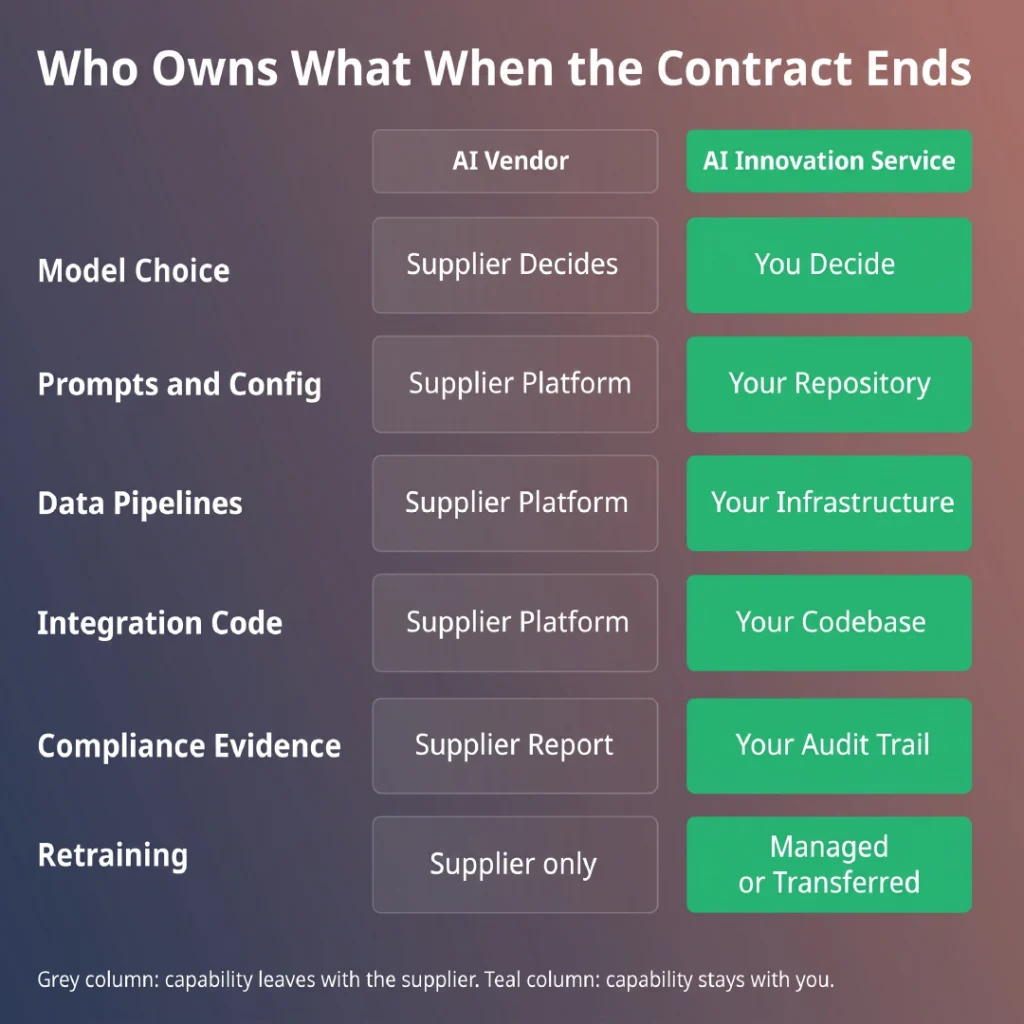
What an AI Vendor Gives You
A licence to a bounded capability. The roadmap is theirs. So is the model choice. Support covers uptime on their platform and not accuracy on your data. Inside the product boundary, this works well. Outside it, your only move is a feature request.
What an AI Innovation Service Gives You
Engineering capacity and a system your team can extend. That means opportunity mapping across your workflows, a prototype validated on your data, deployment into your existing infrastructure, and model maintenance afterwards. Knowledge transfer is part of the deal, so the capability stays with you.
Why AI Consulting Alone Never Reaches Production
Most consultancies hand over a strategy document or a prototype, and neither one runs in production. That gap is measurable. S&P Global found that companies abandoning most AI initiatives before production rose from 17% to 42% in a year. The data pipelines, infrastructure and compliance controls were never scoped at the start. If you are weighing up a partner or consultant, this is the distinction that decides it.
The Hidden Cost of AI Vendors Shows Up at Use Case Number Two
Price your first AI project and the two models look comparable. Price your fifth and the gap is obvious.
With a vendor, every use case restarts the cycle:
- New procurement round
- New security review
- New data protection impact assessment
- New integration into systems never designed to talk to each other
Use case six costs roughly what use case one cost. Nothing from the first build carries over.
With an engineering-led model, the first project funds a platform layer. Identity, access control, data pipelines, observability, evaluation harnesses and governance controls are built once. Use case two connects to what already exists.
Deployflow calls this one platform where new AI use cases land without re-engineering the core. That is the whole commercial argument in a line.
AI Total Cost of Ownership: Five Costs Vendors Leave Out
The quoted figure is almost never the total cost of ownership. Five items sit outside it.
- Data Readiness. Vendor demos run on clean, representative data. Yours is scattered across systems, spreadsheets and platforms that do not talk to each other. Someone has to unify it, and that work lands with you whether the contract mentions it or not. Gartner expects 60% of AI projects without AI-ready data to be abandoned through 2026.
- Model Deprecation. Foundation models are retired on the supplier’s schedule, not yours. Each retirement forces prompt revision, retesting and sometimes redesign. Deployflow covered the operational fallout when switching foundation models became a live issue for UK engineering teams.
- Legacy Integration. AI creates value when it reaches the systems that run the business. Those systems usually predate the AI product by a decade. Connecting them is engineering work, not configuration.
- Evaluation. Someone has to prove the system still performs after launch. Without an evaluation set built from your own data, you have no evidence for the board or the auditor.
- Exit. Ask what happens at contract end. If the prompts, pipelines and institutional knowledge leave with the supplier, you pay a second time to rebuild the same capability.
AI Compliance in the UK: Why Accountability Stays With You
Accountability does not transfer with a licence. If an automated decision harms a customer, the questions arrive at your door.
Three rules that stay with you:
- FCA outsourcing. UK financial services firms remain responsible for outsourced functions. A supplier’s assurances are evidence, not a defence.
- GDPR. Individuals have rights over decisions made solely by automated means. Answering those requests needs explainability you can produce on demand.
- EU AI Act. Obligations fall on the organisation deploying a system and not only on the company that built it.
So, you need audit trails you control, model explainability you can evidence, and data residency you can prove.
Deployflow builds audit trails, explainability and data residency into the architecture. Delivery runs under ISO 27001 certification, with UK Cyber Essentials in place, across AWS, Microsoft Azure and Google Cloud. Compliance designed in at the start costs a fraction of compliance retrofitted under audit pressure, which is why AI consulting starts with compliance scoping.
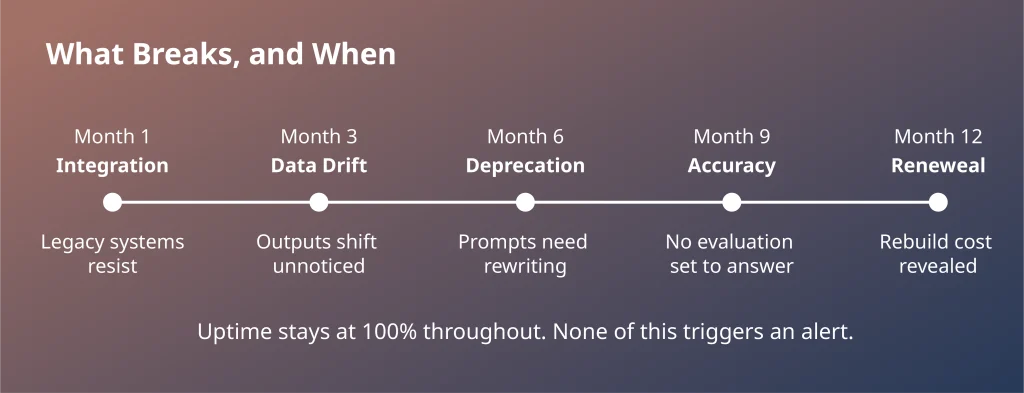
Why AI Accuracy Falls While Uptime Stays at 100%
AI systems degrade. Input data shifts. Customer behaviour changes. Model accuracy falls without a single alert firing.
An uptime SLA doesn’t capture this because the service was available throughout.
What you actually need:
- Continuous monitoring
- Drift detection
- Scheduled retraining
- Performance tuning
Someone has to own that work in month nine instead of just week one.
The honest arrangement gives you a choice. Keep it as a managed service, or bring it in-house once your team is ready. A partner willing to hand over the keys is telling you the value sits in the engineering. Deployflow’s AI engineering work is built to transfer, so your team can run and extend the system without them.
When Buying an AI Vendor Is the Smarter Decision
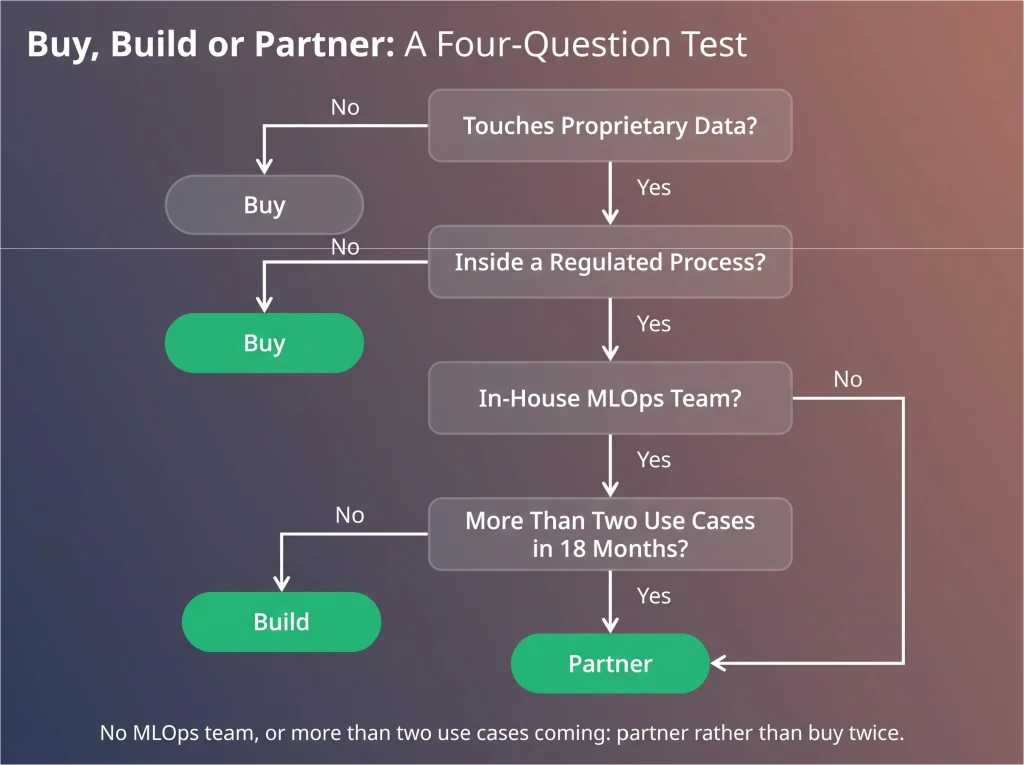
Buying is often correct. Any partner who denies that is selling something.
Buy when the capability is commodity, the workflow does not differentiate you, and no proprietary data advantage is at stake. Transcription, meeting summaries, standard document processing and off-the-shelf service tooling are cheaper and faster to buy. Payback is quick and switching costs are low.
Build when AI touches your product, your margin or your regulated processes. Anything depending on your own data, your own rules or your own customer relationships is a poor fit for a generic product. Your advantage is the part a vendor cannot ship.
The useful question is not build versus buy. It is which capabilities you can afford to rent.
The fair objection to the platform argument is that it front-loads cost. Use case one carries the identity, pipeline and governance work that use cases two through six will use for free. If you are genuinely only ever building one thing, a vendor wins on payback. The platform case hinges on whether you believe your AI roadmap ends with one.
The AI Delivery Timeline You Can Put in Front of Your Board
Board approval depends on dates, not methodology diagrams. A credible delivery model commits to a sequence you can state publicly.
Weeks 1 to 3: Discovery. Opportunity mapping across your workflows, producing prioritised use cases and a delivery plan.
Weeks 4 to 9: Prototype. Feasibility validated on your data, in your environment, before you commit to scale.
Weeks 10 to 21: Production. Models, integrations and infrastructure go live while existing systems keep running.
Ongoing: MLOps. Monitoring, retraining and drift detection, with knowledge transfer so your team can extend the system alone.
Each phase has its own commercial gate. You can stop after discovery, take the prioritised list to your board, and decide later whether to build. No phase commits you to the next one.
Case Study: Energy AI at National Scale
Deployflow’s work on a national-scale energy AI platform shows what the ongoing phase produces:
- 1 platform. New AI workloads land without re-engineering the core infrastructure.
- 0 manual steps. Every environment auto-inherits security, networking and governance policies.
- 1PB+ processed in real time across H100 GPU clusters, with every change tracked through GitOps for regulatory evidence.
Deployflow built a capability the client’s own teams operate, not a product they rent.
Your Next Step: AI Discovery in Three Weeks
If you have already run an AI pilot that never reached production, the problem was almost certainly structural rather than technical. The prototype worked. The path from prototype to a governed live system was never built.
Two to three weeks of honest discovery will tell you which of your AI use cases are worth building, which you should simply buy, and what the second one will cost once the first is live. That is a decision you can take to a board.
Book a free consultation with Deployflow’s AI team and bring your two most expensive manual processes to the first call. You will leave with a prioritised list and a delivery plan, whether or not you go any further.
AI Innovation Services: Frequently Asked Questions
How much do AI consulting services cost in the UK?
Most UK engagements are priced in three parts rather than as a single figure. Discovery is normally a fixed-scope piece of work lasting two to three weeks. Build phases are quoted either as a fixed price against an agreed scope or on a time and materials basis. Ongoing MLOps is usually a monthly retainer.
Ask for the discovery cost separately, because it should give you a prioritised use case list and a delivery plan whether or not you proceed. That structure also lets you stop after discovery without writing off a large commitment.
What is the difference between MLOps and DevOps?
DevOps manages code. MLOps manages code, data and model behaviour together.
A DevOps pipeline assumes that the same input produces the same output every time. Machine learning breaks that assumption, because model performance depends on data that keeps changing. MLOps therefore adds model versioning, data lineage, drift detection, retraining triggers and performance monitoring on top of standard CI/CD. Most organisations already have the DevOps half. The gap is usually the monitoring and retraining layer, which is what causes accuracy to decay unnoticed after launch.
Will our data be used to train someone else’s model?
Not if your contract and architecture prevent it, but you must check and not assume.
Enterprise agreements with major providers normally exclude customer data from training by default, while consumer and free tiers often do not. The risk sits in the detail: retention periods, human review processes, subprocessor lists and logging. Ask for the data processing agreement, confirm the retention window, and check whether prompts are stored for abuse monitoring. If your data is sensitive, deploy through a private endpoint in your own cloud tenancy so the data never leaves your boundary.
Can AI run in a private cloud or on-premises?
Yes. Open-weight models can run entirely inside your own infrastructure, and major cloud providers offer private endpoints that keep traffic within your tenancy.
The trade-off is cost and capability. Self-hosting gives you full data control and predictable spend, but requires GPU capacity and engineering effort. Managed private endpoints give you frontier model quality with strong isolation, at a higher per-token cost. For most regulated UK organisations, a private endpoint inside AWS, Azure or Google Cloud meets data residency requirements without the overhead of running your own inference infrastructure.
How do we measure ROI from an AI project?
Measure against a baseline you capture before the build starts. The most defensible metrics are hours removed from a named process, error rates before and after, and cycle time on a specific workflow.
Avoid blended productivity claims, because boards discount them. Capture the baseline during discovery, when you are already mapping the process. Then agree the target with the business owner rather than the technology team. Include the cost of monitoring and retraining in the calculation, since an AI system that is not maintained will lose its measured gain within a year.
Explore our BLOG
Recent articles
ISO 42001 Explained: Requirements, Certification and What Your Engineering Team Must Build
ISO 42001 is the international standard that demonstrates your organisation governs AI properly, and enterprise...
read full article

Is Claude Down? Anthropic Outage: Protect Your Cloud Infrastructure
Claude went down across every surface on 29 September 2026. From 14:00 to 14:59 UTC,...
read full article

Top 10 Healthtech Companies in 2026: What Their Growth Means for AI and DevOps
Every software change that reaches a hospital has to clear regulatory, legacy system, and clinical...
read full article