



Every firm here will build you an agent. Gartner estimated in 2025 that only around 130 of the thousands of vendors claiming agentic capability are real.
The ten agentic AI companies below are profiled on where the agent executes, who owns it six months later, and where each firm’s work stops.
| Company | Best for | Worth Knowing |
| Deployflow | Agents in pipelines and infrastructure | Not a global integrator |
| Neurons Lab | Regulated financial services | You own the infrastructure |
| LeewayHertz | An agent platform in your own estate | Enterprise pricing |
| Quantiphi | Google Cloud-native programmes | Hyperscaler concentration |
| Thoughtworks | Modernising legacy systems | Platform launched in 2026 |
| EPAM | Open-source orchestration | Scale gravity |
| Accenture | Multi-country rollouts | Premium, procurement-heavy |
| Markovate | A fast pilot in one vertical | No infrastructure run |
| Sierra | Customer-facing chat and voice | No published pricing |
| Beam AI | Back-office agents, no engineers | You inherit the platform |
The Best Agentic AI Development Companies in 2026, Reviewed
1. Deployflow: Best Agentic AI Company for DevOps and Infrastructure
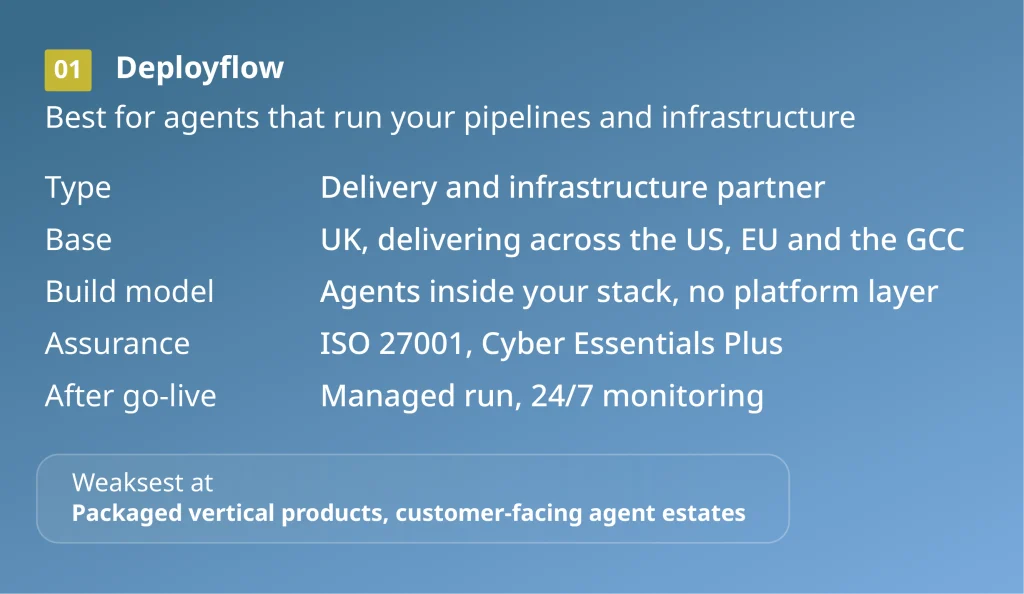
Pick Deployflow when the blocker is execution.
- Proof: an AI platform inside a national energy programme’s air-locked network, and a decision-intelligence platform for a UAE public body
- Timeline: discovery in 2 to 3 weeks, production in 6 to 12
- Before you sign: confirm squad capacity if your rollout spans many countries at once
Deployflow builds the agent and runs the infrastructure underneath it, so there is no second vendor to coordinate with. The agents stay in your cloud accounts, on your pipelines, with no platform layer between you and the system. After launch, Deployflow keeps it running under a managed contract, with your engineers trained to take it over whenever you want them to.
An air-locked national energy network is the hardest place an agent can run. Nothing reaches the internet, every permission is granted by hand, and sign-off comes from people who answer to a regulator. Deployflow shipped there.
2. Neurons Lab: Best for Agents That Pass an Audit
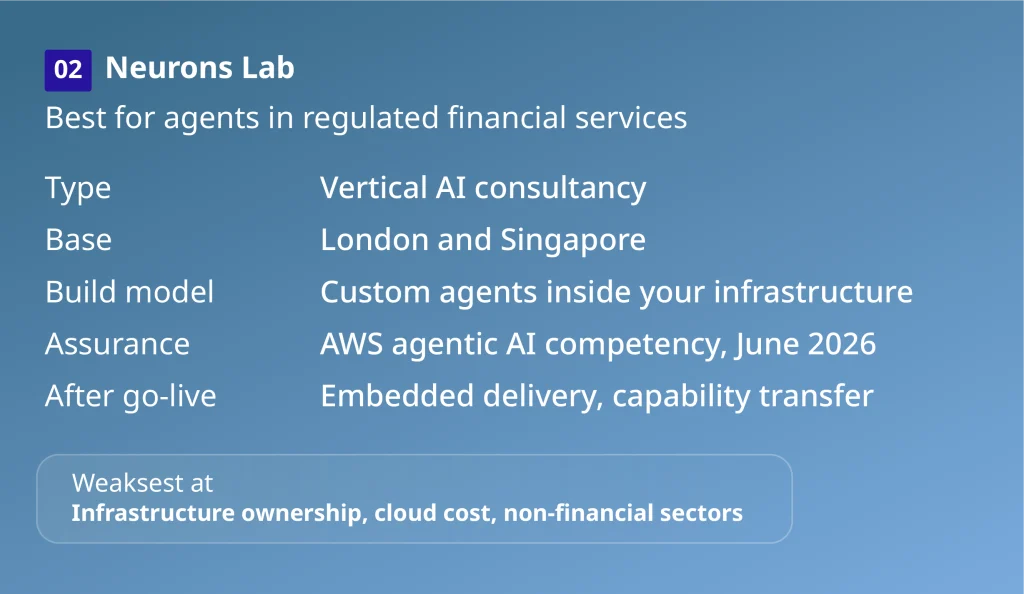
Banking fluency removes the translation layer that stalls regulated builds.
- Proof: 100-plus clients, including HSBC, Visa and AXA
- Typical work: KYC checks, fraud detection, compliance automation
- Before you sign: no published pricing, so budget a scoping call first
Regulated agent work carries an evidence burden that generalist firms tend to discover late. Every decision an agent makes in a KYC or fraud workflow needs a trace an auditor can follow months afterwards.
Building the audit trail from the first sprint costs a fraction of retrofitting it under examination. Neurons Lab starts there, which is what a decade of financial services work teaches you to do.
3. LeewayHertz: Best Enterprise AI Agent Platform for Private Deployment
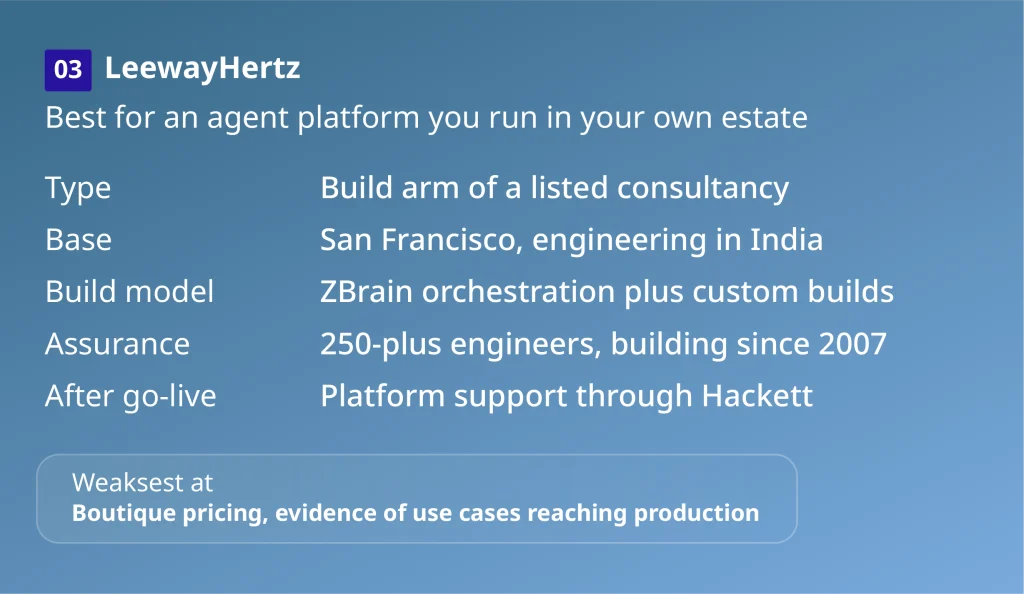
ZBrain keeps agents inside your own infrastructure, which matters when data cannot reach third-party models.
- Ownership: acquired by The Hackett Group in September 2024, ZBrain is now a joint venture under CEO Akash Takyar
- Proof: enterprise clients including Coca-Cola and Siemens
- Before you sign: the use-case library is very wide, so ask which ones have reached production
An acquisition changes the shape of an engagement more than most buyers expect. Account structure, minimum deal size and escalation paths all move toward the parent company’s model within a year or two. The engineering capability is unchanged. The commercial experience is not.
Request references from work delivered after September 2024, not the pre-acquisition case studies that are still on the site.
4. Quantiphi: Best for Agents Built on Vertex AI
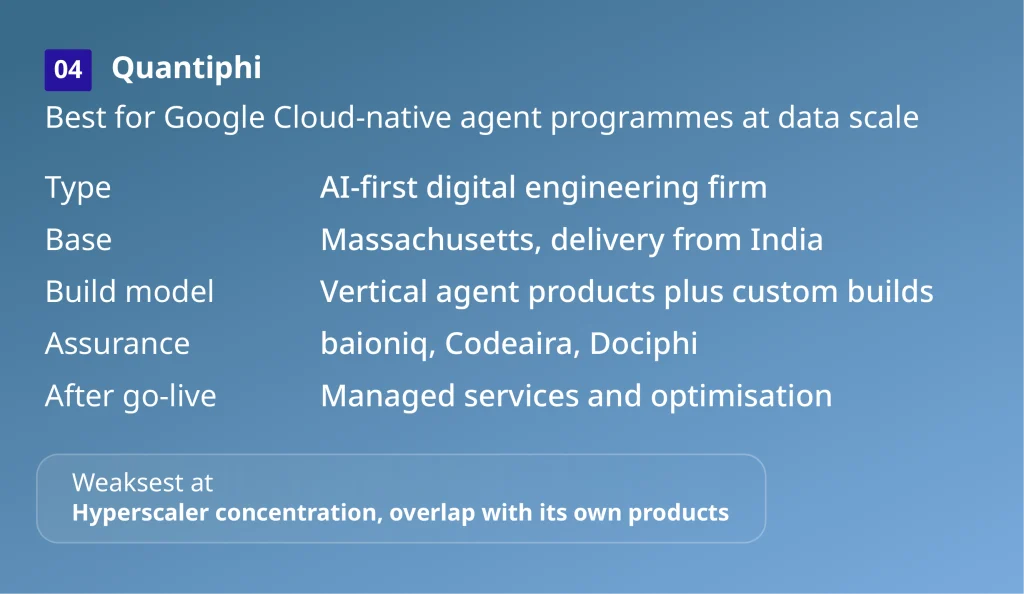
Deeper hyperscaler backing than the firm’s size suggests.
- Proof: 2026 Google Cloud Partner of the Year in four categories, awarded for agentic AI work
- Tooling: Codeaira reported speeding up enterprise database migration by 50 to 85%
- Before you sign: a new chief executive took over in 2026, so check continuity on your account
Partner awards measure the strength of a relationship with the cloud provider. They say nothing about what your agent will cost to run. Quantiphi’s depth on Google Cloud is genuine, and it pulls your architecture toward Vertex AI and Gemini.
Model what a migration to another provider would cost in two years before the architecture is locked. If that number is uncomfortable, a vendor-agnostic partner suits you better.
5. Thoughtworks: Best for Agents That Modernise Legacy Systems
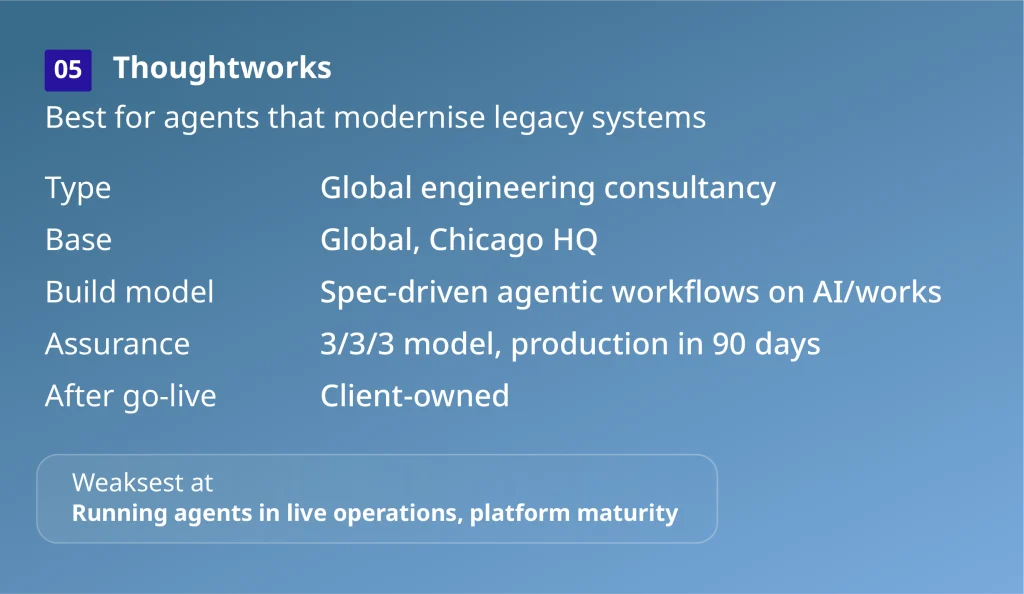
Built for estates where the legacy system is the constraint.
- How it works: AI/works reverse-engineers legacy apps into specs, then generates code, tests and pipelines
- Reach: mainframes covered through the Mechanical Orchard collaboration
- Before you sign: launched January 2026, initial clients unnamed, so request a reference in your sector
Reverse-engineering a legacy application into a specification is only useful if the specification is right. A system that has drifted for fifteen years contains behaviour nobody documented and a few bugs the business now depends on.
Budget real time for your own engineers to review generated specs against what the system actually does. Teams that skip that step end up faithfully modernising their bugs.
6. EPAM: Best for Open-Source Orchestration and Avoiding Lock-In
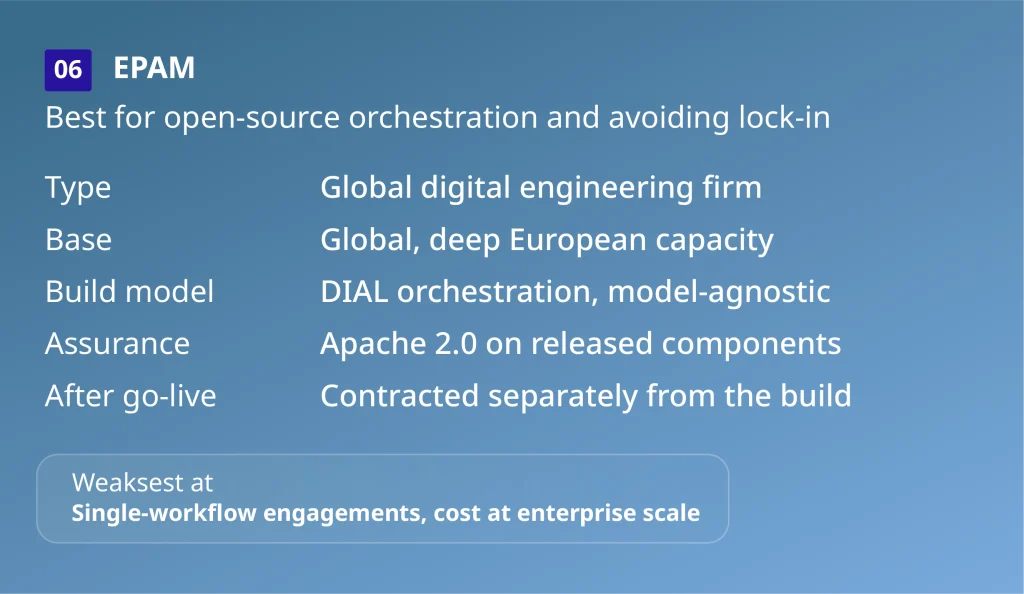
Open source settles the question of who owns the platform in three years.
- Maturity: DIAL 3.0 adds agentic workflows, listed on AWS Marketplace
- Extras: DMTools ships 320-plus tools for Jira, Azure DevOps and GitHub, run under your own credentials
- Before you sign: DIAL is open source under Apache 2.0, so the cost sits in the engineering day rate
Open source removes licence lock-in and leaves knowledge lock-in in place. A DIAL deployment built entirely by an external team is still a system your engineers cannot operate.
Write named internal engineers into the delivery squad from week one, with handover milestones attached to payment. That single clause is worth more than any exit provision in the contract.
7. Accenture: Best for Multi-Country, Multi-Function Rollouts
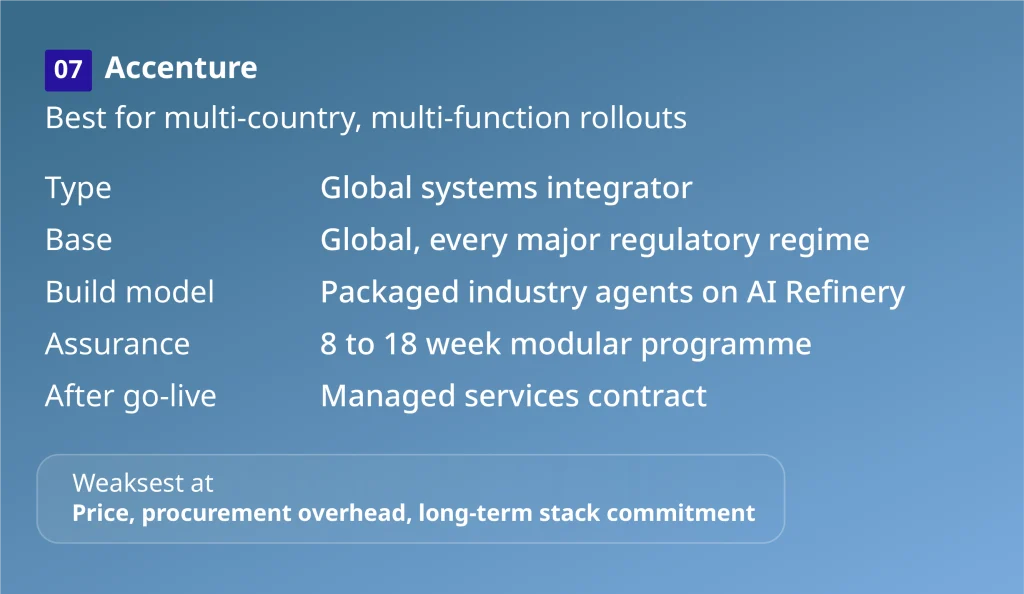
Built for rollouts that cross dozens of jurisdictions at once.
- Catalogue: AI Refinery for Industry launched in 2025 with 12 packaged agents, and has since expanded across industries
- Stack: built on NVIDIA AI Enterprise, with governance frameworks inside the programme
- Before you sign: the pitch team rarely builds, so name the delivery leads in the contract
Packaged industry agents shorten the build and lengthen the customisation. The agent arrives with a workflow encoded by someone who has never seen your process, and closing that gap is where the programme budget goes.
Ask to see the packaged agent running against a client’s real data before scoping. A demo environment will always look ready.
8. Markovate: Best for a Fast Pilot in One Vertical
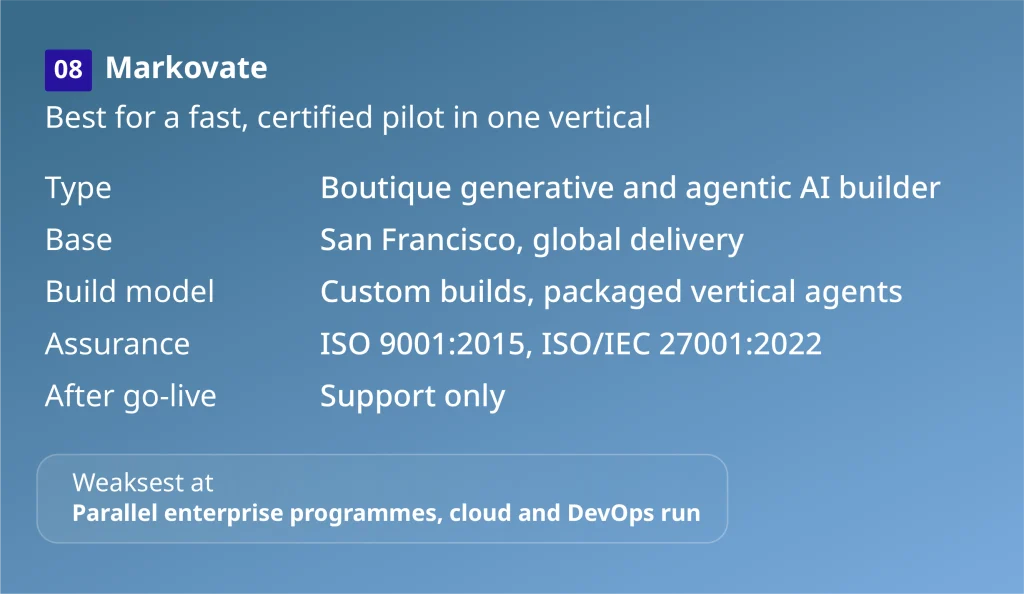
Validation arrives before the budget commitment does.
- Pilot: runs on your real data against your own baseline, results in roughly two weeks
- Depth: 50-plus certified engineers, 300-plus solutions, led by ex-AT&T and IBM AI leader Rajeev Sharma
- Before you sign: check whether your use case maps to an existing vertical agent such as CADIAM
A two-week pilot proves the agent can do the task. It does not prove the task is worth automating.
Decide the success metric and the baseline number before the pilot starts, because a result measured after the fact will always find something to celebrate. Small firms move fast on this. Hold them to the metric anyway.
9. Sierra: Best for Customer-Facing Agents You Buy Rather Than Build
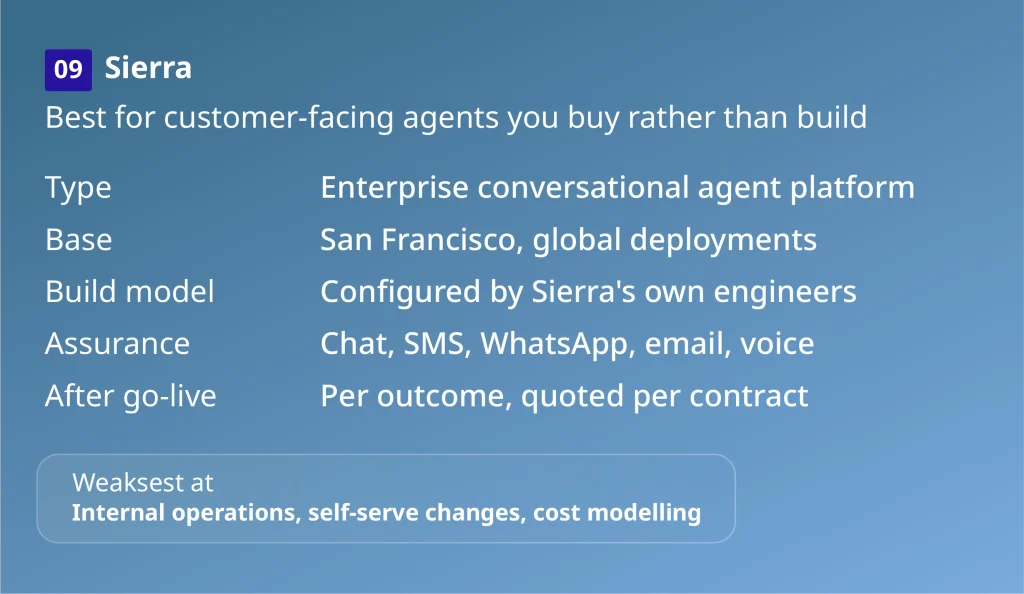
Outcome pricing moves the risk of a weak agent onto the vendor.
- Scale: reported $950m Series E in May 2026, with Cigna, Nordstrom and Nubank as clients
- Range: Horizon agents, launched in July 2026, pursue one outcome across weeks
- Before you sign: no public rate card, so model cost against your current cost per contact
Outcome pricing rewards close reading of the contract. What counts as a resolution, what happens on escalation to a human and which low-value interactions fall outside the outcome model are all negotiated per deal.
Get the resolution definitions in writing before volume forecasts enter the conversation. A resolution rate that looks strong on a quarterly report can still cost more per contact than the team it replaced.
10. Beam AI: Best for Back-Office Process Agents Without an Engineering Team
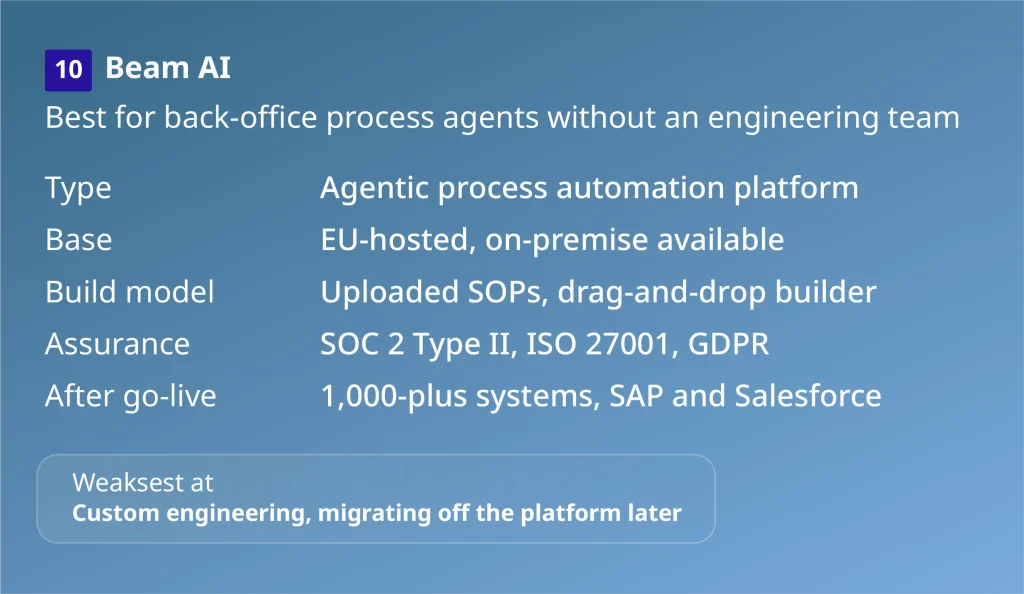
Built for teams with process knowledge and no spare engineers.
- How it works: an uploaded standard operating procedure becomes a running agent, with no code underneath
- Typical work: order processing, billing, claims, with DATEV alongside standard connectors
- Before you sign: published accuracy figures come from the vendor, so ask for a trial on your messiest process
Uploading a procedure document exposes how good the document is. Most standard operating procedures describe the happy path and leave the exceptions to whoever has been doing the job for nine years. Those exceptions are the work.
Run the trial on a process with genuine edge cases and not the clean one, since the clean one was never the bottleneck.
What Agentic AI Development Companies Do
An agent differs from a chatbot in one respect that matters commercially: it takes actions in your systems. That turns the work into an integration and governance problem rather than a model problem.
Four layers make up almost every serious engagement.
- Workflow discovery. Finding the execution-heavy work worth automating, across pipelines, infrastructure and operations
- Agent design and validation. Building agents that plan and execute across APIs, tools and environments, then testing them against real workflows
- The execution layer. Wiring agents into CI/CD, monitoring and infrastructure so actions happen inside your environment
- Run and observability. Guardrails, fallback logic, scoped permissions and monitoring, expanded gradually from low-risk workflows
A firm that only covers the first two layers is selling you a prototype. Gartner’s agent washing warning applies here, since assistants, chatbots and RPA are routinely rebranded without substantial agentic capability.
How to Choose an AI Agent Development Company
Capability stopped being the differentiator. Stanford HAI’s 2026 AI Index found agent deployment still in single digits across nearly all business functions. Three questions decide whether yours ships.
Where does the agent execute? Customer conversations, back-office processes, infrastructure and the software development lifecycle are four separate markets. Sierra and Deployflow would both build you an agent, and not the same one.
Who owns the run? An agent acting on production needs a name attached to it at 3am. Handover at go-live means that the name is one of yours.
Who owns the infrastructure underneath? Agents stall on permissions and integration, not reasoning. A partner already running your cloud and CI/CD layer removes the handover point that absorbs the delay.
Then work the shortlist. Each question has a tell.
| Ask | What a real answer contains |
| What does the agent do when it cannot finish a task? | A named escalation path, not “it retries” |
| Which permissions does it hold in production? | A scope, and who approves changes to it |
| What triggers a rollback? | A threshold someone monitors |
| Who runs this in six months? | A contract, not an intention |
| Show one agent in production, with the result | A number and a client who will take the call |
Firms that have shipped answer these in specifics. Firms that have piloted answer them in principle.
Build vs Buy AI Agents: Which Model Fits
One test settles most cases. Would a competitor’s version of this agent work unchanged in your business? If yes, buy. If not, build.
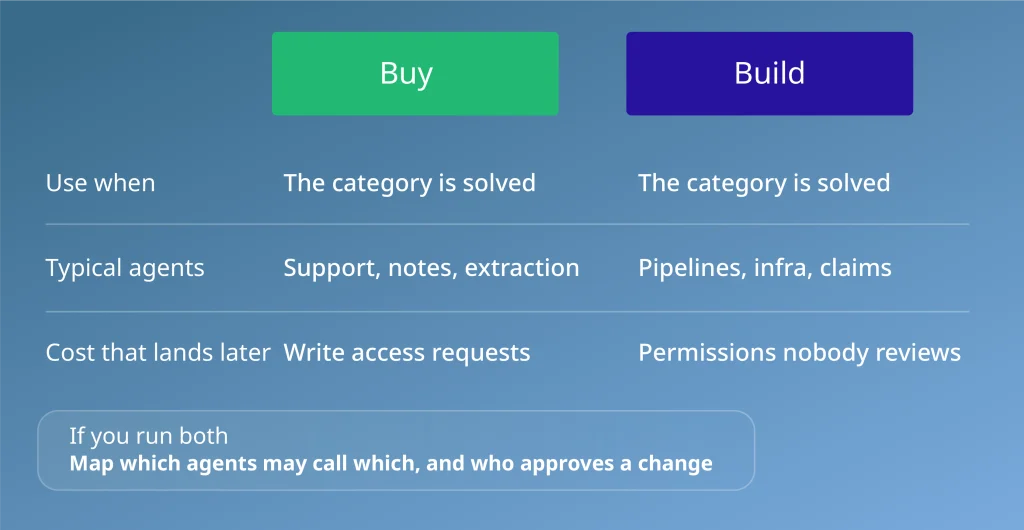
Buying moves fast until the vendor needs write access to the systems its agent acts on. That request turns a subscription into an integration project, and it usually arrives after the contract is signed. Building has no such moment, because the access is granted on day one and then rarely looked at again.
Most organisations end up with both. The expense nobody forecasts sits in the gap between them, where a bought agent triggers a built one and no single person owns the permission chain that connects the two.
How Much Does Agentic AI Development Cost in 2026
The pricing model matters more than the headline number because each one grows in a different direction.
| Model | Who uses it | What makes it grow |
| Fixed-scope package | Delivery partners | Nothing; the quote is the price |
| Per outcome | Customer-facing vendors | Volume, so a good quarter costs more |
| Per seat or tier | No-code platforms | The step between tiers |
| Time and materials | Large integrators | People on the account |
Scoped pilots typically range from £20K to £50K. Enterprise programmes reach six or seven figures.
Build fees end. Inference, cloud and monitoring do not, and they climb with every workflow the agent absorbs. The FinOps Foundation’s State of FinOps 2026 found 98% of organisations now manage AI spend, up from 31% two years ago. Ask each firm to quote the run cost at ten times the pilot volume. A quote that covers only the build means the run was never modelled.
Why Most AI Agent Projects Fail to Reach Production
The pilot clears its demo, then meets integration, permissions and accountability. Momentum drains there.
The same Gartner forecast expects over 40% of agentic AI projects to be cancelled by the end of 2027, naming escalating costs, unclear business value and inadequate risk controls. None of those is a model problem. Multi-step systems raise the stakes further, since one unmonitored action cascades before a human sees it. Staged rollout and scoped permissions belong in the build, not in the incident review.
The compliance clock also moved in July 2026, when Regulation (EU) 2026/1744 deferred the EU AI Act’s main high-risk deadlines.
- 2 Aug 2026: transparency obligations live
- 2 Dec 2026: grace period ends for marking AI-generated content
- 2 Dec 2027: high-risk obligations under Annex III
- 2 Aug 2028: high-risk AI inside regulated products
Nothing was softened, only moved. Conformity assessment, documentation and human oversight still apply to any firm whose AI output reaches the EU.
Get Your AI Agents Into Production
Your pipelines, permissions and infrastructure decide whether an agent ships. A Deployflow audit reviews all three and returns a prioritised, costed set of actions, including where cloud spend becomes recoverable as agents scale. You keep the findings either way.
Book an agentic AI assessment if you have a pilot waiting to reach production. Start with a cloud cost review if the run cost is what worries you.
Frequently Asked Questions About Agentic AI Development Companies
What is an agentic AI development company?
A firm that builds AI systems which plan and take actions across your tools, APIs and infrastructure, rather than systems that only answer questions.
The distinction is execution. A chatbot returns text and escalates anything complex. An agent pursues a goal, pulls data from several systems, takes multi-step actions and adapts when conditions change. That means the build work is mostly integration, permissions and guardrails, which is why firms with infrastructure depth tend to reach production more often than firms with model depth alone.
How long does it take to build an AI agent?
A single scoped workflow typically reaches production in 12 to 20 weeks end-to-end, while multi-agent systems spanning several enterprise platforms take six months or more.
Deployflow’s sequence runs discovery in 2 to 3 weeks, agent design and validation in 4 to 6, then production deployment in 6 to 12. The build is rarely the bottleneck. Access reviews, security sign-off and deciding who approves an agent’s permissions are what stretch timelines, and regulated settings add documentation and oversight on top.
Should we use an agent platform or build custom agents?
Use a platform where the workflow is generic and the data can leave your estate. Build custom where the agent needs access to your infrastructure or where the workflow is a competitive advantage.
Platforms give you speed and a template library at the cost of working inside someone else’s model of what an agent is. Custom builds give you agents that run in your own environment on your own permissions, which is the only viable option where data residency, air-gapped networks or regulated approval chains apply. Most teams run both and underestimate what it costs to make them interoperate.
Who owns the code and IP when you hire an AI agent development company?
In a well-structured engagement, you own the code, the configuration and the architecture, though this is set by contract and varies by firm, so confirm it in writing.
Watch for agents built on a closed platform that only the vendor can maintain, since that converts a build into a subscription. The cleanest arrangements leave the agents running on your cloud accounts, using your tools and pipelines, with documentation good enough for your engineers to extend them without the original vendor.
How do you stop an AI agent from making mistakes in production?
Through scoped permissions, approval thresholds, fallback logic and monitoring, introduced on low-risk workflows first.
A well-built agent escalates instead of acting when it cannot complete a task with confidence. Execution scope, permissions and decision boundaries are defined before deployment and adjusted as trust builds. Deployflow’s guide to agentic AI governance covers how those thresholds get set. The design question to ask any vendor is what happens on failure, since the answer reveals whether the system was built for production or for a demo.
Explore our BLOG
Recent articles
ISO 42001 Explained: Requirements, Certification and What Your Engineering Team Must Build
ISO 42001 is the international standard that demonstrates your organisation governs AI properly, and enterprise...
read full article

Is Claude Down? Anthropic Outage: Protect Your Cloud Infrastructure
Claude went down across every surface on 29 September 2026. From 14:00 to 14:59 UTC,...
read full article

Top 10 Healthtech Companies in 2026: What Their Growth Means for AI and DevOps
Every software change that reaches a hospital has to clear regulatory, legacy system, and clinical...
read full article