



Reduce operational overhead and fix your MTTR before the next board report. If you are managing 200+ hosts across a fragmented UK estate, this is your roadmap to turning legacy firefighting into a predictable, high-performance asset.
Data Centre Managed Services impose structure on hybrid complexity: continuous monitoring across all layers, automation of high-risk manual tasks, 24×7 stack-aligned support, and a controlled hardware refresh pipeline.
TL;DR
- Deploy unified monitoring across Windows, Linux, and virtualisation layers to detect performance degradation before it becomes an outage.
- Automate repetitive operational tasks (log rotation, retention enforcement, secure transfers) to eliminate human error and reclaim engineering hours.
- Introduce 24×7 hybrid-stack-aligned support with defined escalation paths to reduce MTTR and remove dependency risk.
- Implement structured hardware lifecycle planning to prevent end-of-life failures and stabilise budget forecasting.
If you’re a CTO, founder, or Head of IT, this piece shows how to stabilise hybrid infrastructure, reduce operational risk, and turn your data centre into a strategic asset.
The Hidden Cost of Reactive Hybrid Infrastructure Management
Hybrid infrastructure is not unstable by default, but when it’s managed reactively, instability becomes systemic.
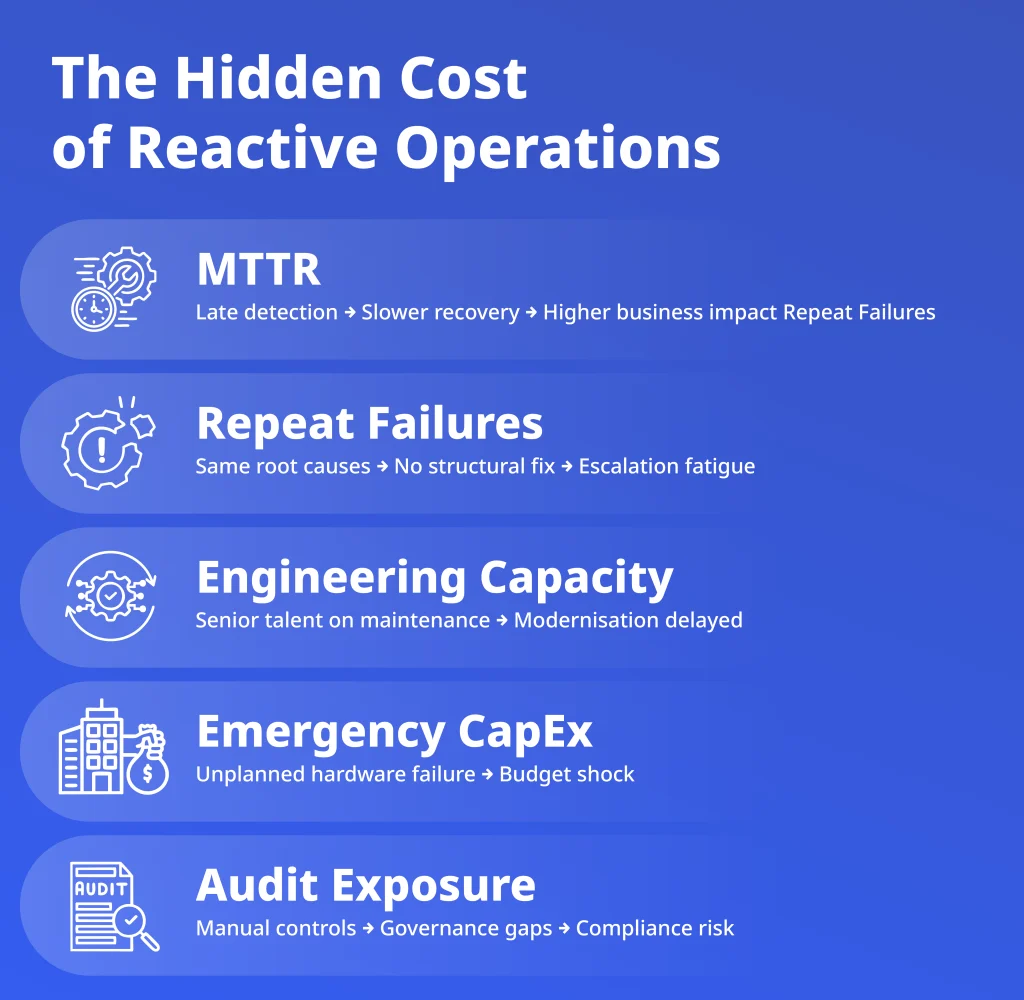
Hybrid infrastructure is usually a conscious architectural decision. If it feels unstable, the issue is how it’s being operated.
Stop Blind-Spot Troubleshooting: Unifying the Hybrid Stack
Hybrid Infrastructure Management starts to weaken when visibility is split across teams and tools. Windows is monitored one way, Linux another, and virtualisation often sits in its own layer entirely.
When alerts, logs, and performance data aren’t unified, incidents are rarely caught early. Degradation builds slowly until users report it. Root-cause analysis becomes slower because engineers must piece together signals from multiple systems.
The consequences aren’t dramatic at first; they’re just longer resolution times, creeping SLA pressure, and gradual erosion of uptime across critical workloads.
According to the 2024 Accelerate State of DevOps Report by DORA, only about 19% of teams qualify as elite performers, defined by on-demand deployments, lead times under 1 day, change failure rates near 5%, and recovery from incidents in under 1 hour.
The gap between average and elite performance is operational discipline.
De-Risking Your Estate: Automation Over Human Error
In many hybrid estates, routine operational tasks still rely on manual effort. Log rotation is scheduled, but not always verified. Retention policies are applied but not consistently audited. Data transfers depend on someone executing the right process at the right time.
At a small scale, this works. At 200+ hosts, it introduces variability. Human intervention becomes the weak link in otherwise stable systems.
Industry research shows engineering teams spend roughly 30–33% of their time responding to incidents and operational disruptions instead of driving innovation. (source: New Relic)
Proactive IT Operations replace repetition with engineered workflows, ensuring governance and consistency without depending on individual vigilance.
24×7 Skill Gaps in Hybrid Infrastructure
Hybrid environments demand specific expertise across operating systems, virtualisation, and infrastructure layers. Generic support models rarely provide that depth.
When escalation paths are unclear or when knowledge isn’t formalised in runbooks, incident response slows. Troubleshooting becomes reactive and personality-driven rather than structured and predictable.
Over time, this creates dependency on key individuals, increases burnout risk, and extends recovery times during high-pressure incidents.
The Technical Debt Clock and Ageing Hardware
Hardware rarely fails without warning, but without structured lifecycle planning, those warnings are ignored. End-of-life systems continue to support production workloads because replacement feels disruptive or expensive.
Eventually, failure forces action. Procurement becomes urgent. Budgets are stretched unexpectedly.
Infrastructure Modernisation should not be driven by breakdown. In a mature operating model, hardware refresh follows a defined roadmap, aligned with performance needs and financial planning.
The Financial Impact of Reactive Operations
If 30% of engineering capacity is consumed by incident response, the cost compounds quickly.
Example:
- 6 senior engineers
- Average fully-loaded cost: £100,000 each
- 30% firefighting allocation
That equals £180,000 per year spent on reactive maintenance instead of modernisation.
And that excludes:
- Revenue impact of downtime
- Delayed product releases
- Emergency hardware procurement
- Audit remediation effort
Reactive infrastructure is not just operational drag, but silent capital erosion.
What Are Data Centre Managed Services in a Hybrid Environment?
In a hybrid estate, Data Centre Managed Services means structured operational ownership, and not ticket-based support.
From the operating system layer upward, the focus shifts to unified monitoring across Windows, Linux, and virtualisation, automated maintenance, defined incident response, and planned hardware lifecycle control. The infrastructure itself may not change. The discipline around it does.
The difference becomes clear when you compare the models:
Reactive Support vs Strategic Managed Services
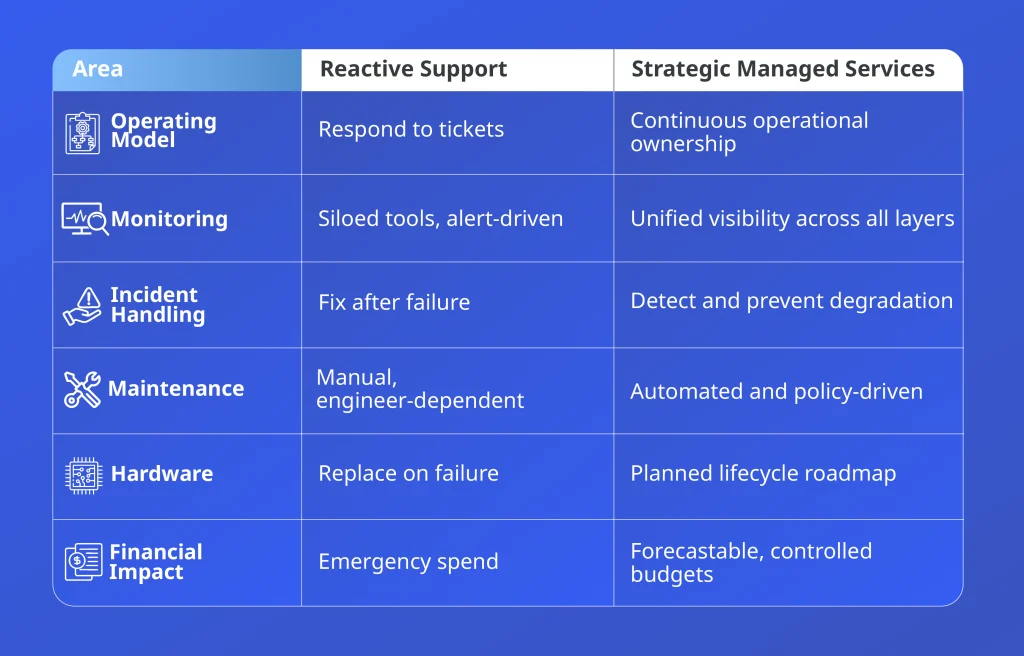
Reactive support restores service, and managed services reduce the likelihood and impact of failure in the first place.
Choosing the right partner determines whether that shift actually delivers value, which is why Deployflow outlined the essential criteria for selecting a managed IT support services provider that meets operational, governance, and performance expectations.
For companies pursuing infrastructure modernisation, this distinction is important. Modernisation is about making hybrid infrastructure predictable, governed, and performance-driven.
The Four Pillars of Proactive IT Operations
Hybrid Infrastructure Management becomes stable when operations are structured around four clear control points: visibility, automation, ownership, and lifecycle discipline.
- 360-Degree Unified Monitoring: The End of Blind-Spot Troubleshooting
Stop toggling between Windows, Linux, and hypervisor dashboards. Visibility silos are the primary cause of extended MTTR in the UK mid-market.
Single-Pane Visibility: Centralise OS and hypervisor telemetry to eliminate tool sprawl.
Predictive Alerting: Identify performance drift and saturation levels before they trigger a P1 incident.
Automated Correlation: Reduce Mean Time to Detect (MTTD) by linking signals across the entire hybrid stack.
You stop reacting to user complaints and start resolving issues before the business feels them.
- Intelligent Automation: Reclaiming High-Value Engineering Hours
Manual processes are the silent tax on your innovation budget. At 200+ hosts, human intervention is a liability.
Policy-Driven Governance: Automate log rotation, retention enforcement, and secure data transfers to ensure 100% compliance.
Standardised Provisioning: Eliminate configuration drift across mixed environments through scripted workflows.
Resource Redistribution: Shift your senior engineers from keeping the lights on to high-impact modernisation projects.
Consistency is engineered, not requested, reducing operational expenditure and human error.
- 24×7 Specialist Hybrid Support: Resilient Expertise on Tap
Generic helpdesks fail when hybrid stacks get complex. You need depth across Windows and Linux layers, backed by formalised runbooks.
Stack-Aligned Engineering: Instant access to specialists who understand the interplay between virtual layers and OS.
Formalised Runbooks: Transition from hero-based troubleshooting to documented, repeatable incident response.
Defined Escalation: Guaranteed response targets that align with your business SLAs, not just best-effort tickets.
You eliminate dependency risk and prevent internal burnout by providing a professional safety net for your core team.
- Strategic Lifecycle Management: Ending the CapEx Shock
Infrastructure doesn’t collapse overnight; it ages in the dark. Strategic discipline turns hardware replacement from an emergency into a scheduled financial event.
Obsolescence Roadmapping: Visualise end-of-life exposure months in advance to secure procurement at better rates.
Budget Forecasting: Align hardware refresh cycles with your fiscal year to prevent unplanned capital spikes.
Performance Protection: Proactively migrate workloads off ageing hardware before failure rates climb.
You move from Emergency Procurement to Predictable Capital Planning, keeping the board happy and the estate stable.
In practice, when these four pillars operate together, Proactive IT Operations replace instability with measurable control. Hybrid environments stop reacting to problems and start operating with foresight.
What Changes Within 90 Days?
When operational structure replaces reactive maintenance, patterns shift quickly:
- Incident recurrence drops as root causes are structurally addressed
- MTTR compresses due to unified telemetry and defined escalation
- Engineering hours are reallocated from maintenance to modernisation
- Hardware risk exposure becomes visible months in advance
From Complexity to Predictability: Measurable Outcomes
Proactive IT Operations are not theoretical improvements. They show up in budgets, uptime reports, and audit results.
✔️ Zero-Surprise Infrastructure: When hardware refresh follows a defined lifecycle roadmap, emergency replacements disappear.
End-of-life systems are identified months in advance. Capacity planning is aligned with performance data. Procurement is scheduled instead of triggered by failure.
The result is predictable capital expenditure and fewer production disruptions caused by ageing infrastructure.
✔️ Compliance by Design: Retention policies enforced through automation remove inconsistency.
Logs are rotated and archived according to policy. Data retention windows are applied systematically across hosts. Audit trails are generated automatically.
Compliance stops being a quarterly scramble and becomes an embedded operational control.
✔️ Reduced Downtime and Increased Stability: Unified monitoring detects degradation early.
Instead of reacting to full outages, teams intervene during performance drift. Alerts are correlated across layers, reducing noise and accelerating diagnosis.
Mean Time to Detect drops. Mean Time to Repair shortens. Repeat incidents decline.
Predictability is the real outcome. When detection is early, maintenance is automated, and lifecycle planning is structured, the data centre supports business continuity rather than threatening it. Stability improves because operations are disciplined.
Why Hybrid Data Centres Still Make Strategic Sense
Cloud-first does not mean cloud-only. Hybrid remains a deliberate choice when control, performance, and cost discipline matter.
- Regulatory constraints require certain data to remain within defined jurisdictions or controlled environments.
- Data sovereignty demands clear ownership, location transparency, and auditability.
- Performance-sensitive workloads benefit from on-premise proximity and predictable latency.
- Long-term, steady workloads can be more financially efficient outside elastic cloud pricing models.
Hybrid architecture is often an intentional balance between control, compliance, performance, and flexibility.
Infrastructure Modernisation does not require abandoning hybrid. It requires operating it with structure, automation, and measurable performance standards.
When to Consider Data Centre Managed Services
Data Centre Managed Services become necessary when operational strain starts affecting stability, cost control, or compliance posture.
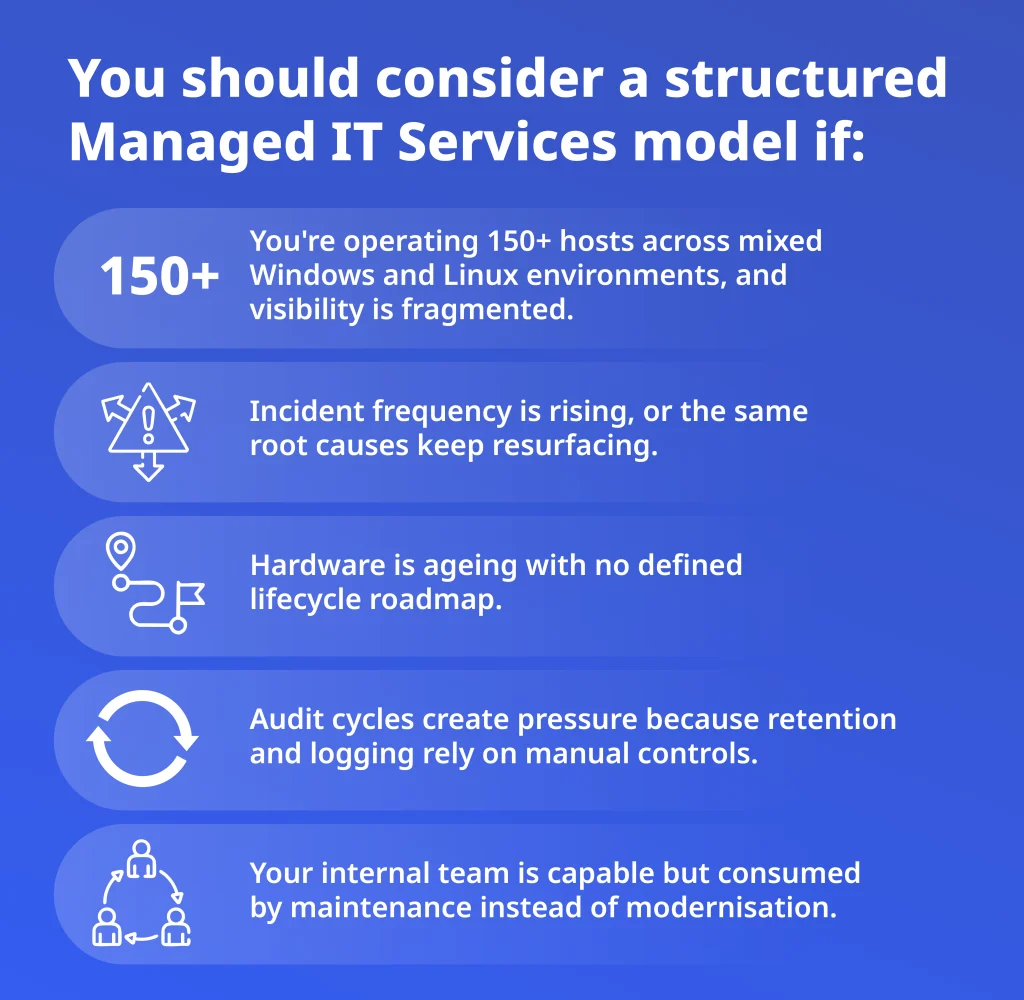
At this point, the issue is operational ownership.
Deployflow’s mature Managed IT Services model introduces unified monitoring, automation, structured 24×7 hybrid support, and hardware lifecycle discipline, stabilising the environment so internal teams can focus on transformation rather than firefighting.
Infrastructure does not need replacing; it just needs to be governed properly.
Deployflow’s Managed IT Services established structured operational control across Hall Hunter’s hybrid estate, replacing fragmented vendor support with unified monitoring, formalised escalation paths, and documented infrastructure governance.
Alongside the migration to Microsoft Dynamics 365 Business Central, the team stabilised core systems, extended hardware lifecycles, and implemented continuous support for 150+ users.
The result was a resilient, well-documented environment with reduced incident volume, improved security posture, and a 30% reduction in overall IT costs.
“Deployflow has truly excelled in providing HHP with Hybrid support. Their team has effectively supported our 150+ staff, addressing daily technical requests promptly and professionally.”
Toni S
Hall Hunter
For some organisations, stabilising the data centre is only the first step. Once infrastructure is predictable, the next constraint often becomes delivery capacity.
Full-stack delivery squads combine infrastructure engineers, platform specialists, and application-level expertise into one accountable unit. Instead of separating operations and delivery, the squad owns stability and forward progress together.
Executive Takeaways for Technology Leaders
- Reactive operations drain strategic capacity. When detection is late and maintenance is manual, engineering time shifts from innovation to containment.
- Operational discipline reduces measurable risk. Unified visibility, automation, and structured ownership compress MTTR and prevent repeat incidents.
- Lifecycle control stabilises financial planning. Hardware refresh becomes forecastable instead of disruptive.
- Predictability is the competitive advantage. Stable infrastructure frees leadership focus for growth, delivery, and strategic execution.
When stability is engineered into the operating model, leadership time returns to growth, product, and competitive advantage, rather than to outage reviews and emergency approvals.
If your hybrid environment is demanding more oversight than it should, a structured review may be the right next step.
A focused discussion with Deployflow can clarify where instability is structural, where risk is accumulating, and what it would take to operate your data centre with measurable control and predictability.
FAQs: Data Centre Managed Services in Hybrid Environments
How much does data centre downtime cost UK enterprises?
Multiple reports show that major outages can cost thousands per minute, depending on the sector and the level of digital dependency.
However, the financial impact rarely stops at immediate revenue loss. Downtime affects customer confidence, SLA penalties, regulatory reporting exposure, and internal productivity. Reducing MTTR is therefore not just an operational objective but a risk and cost control strategy.
Can hybrid infrastructure outperform full cloud in certain scenarios?
Yes, in specific use cases, hybrid can be more efficient and predictable than full cloud.
Latency-sensitive workloads, regulated data environments, and steady long-term compute demand often benefit from on-premise control and predictable performance. In these cases, hybrid is not a compromise but a deliberate architectural choice balancing compliance, performance, and financial stability.
How do Managed Services improve engineering productivity?
Managed Services reduce reactive workload so engineers can focus on strategic initiatives.
When monitoring is unified, automation replaces manual repetition, and escalation paths are structured, incident recurrence declines. That reclaims engineering capacity that would otherwise be consumed by firefighting. Over time, productivity shifts from containment toward optimisation, modernisation, and delivery acceleration.
Does moving to Managed Services mean losing operational control?
No, it formalises control rather than reducing it.
Structured managed models introduce documented processes, visibility standards, and defined ownership boundaries. Leadership retains strategic authority while operational execution becomes predictable and measurable. The goal is not outsourcing responsibility, but engineering discipline at scale.
How long does it take to stabilise a reactive hybrid estate?
Early improvements are often visible within 60 to 90 days.
Visibility gaps can be closed quickly, escalation paths clarified, and automation introduced across high-risk operational tasks. While deeper optimisation compounds over time, measurable reductions in repeat incidents and MTTR can begin within the first quarter of structured intervention.
Explore our BLOG
Recent articles

Is Claude Down? Anthropic Outage: Protect Your Cloud Infrastructure
Claude went down across every surface on 29 September 2026. From 14:00 to 14:59 UTC,...
read full article

The SOC 2 Remediation Roadmap: From Compliance Dashboard to Passed Audit
This SOC 2 remediation roadmap takes you from a red compliance dashboard to a clean...
read full article
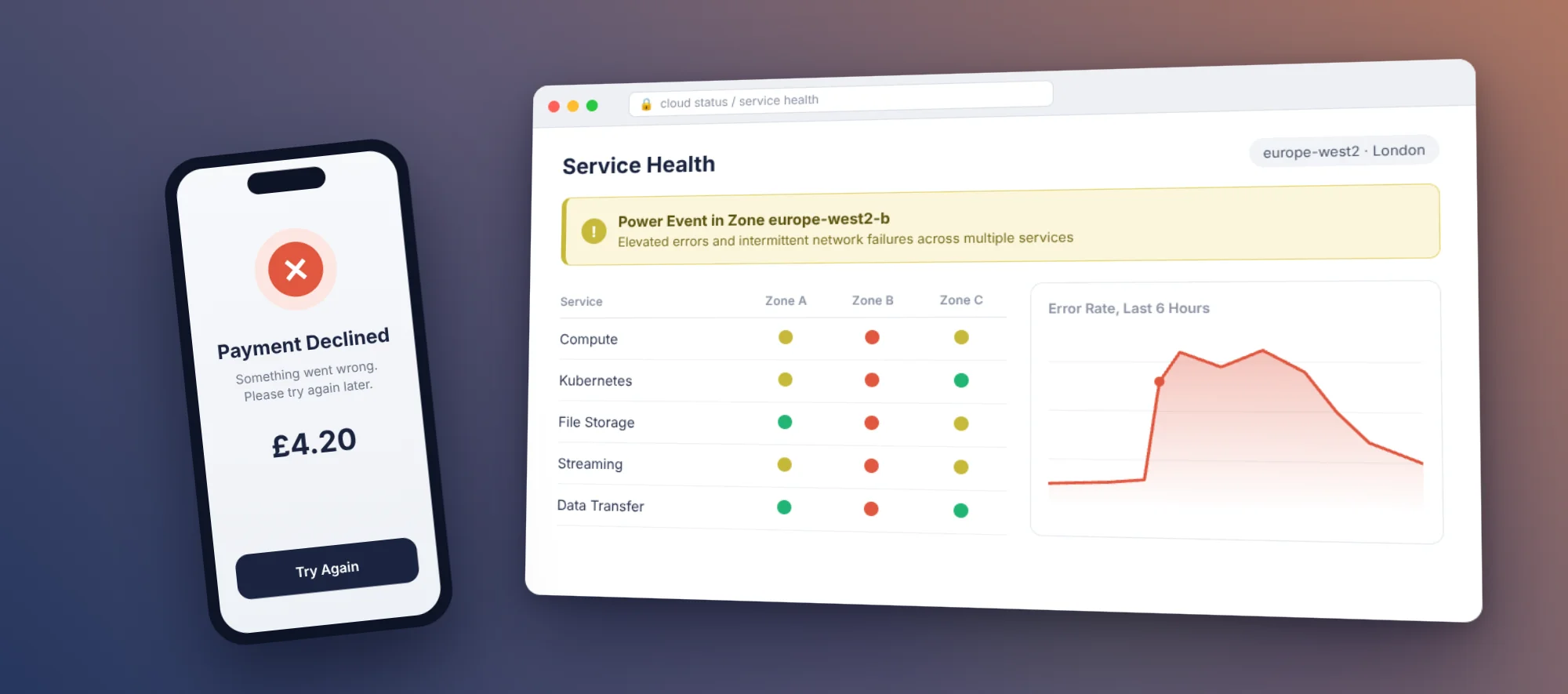
Is Google Cloud Down? The GCP Outage That Froze Revolut Cards and What CTOs Should Fix Now
Yes, Google Cloud went down in London. A major Google Cloud outage hit the europe-west2...
read full article