


Spreadsheets don’t stop breaches; code does.
That’s the simplest way to describe the shift happening inside FinTech compliance. For years, PCI DSS and PSD2 audits have lived in PDFs, shared folders, and endless manual checklists.
Each audit round meant screenshots, exported logs, and a nervous rush to prove controls existed.
But Go changes that dynamic entirely by letting compliance live inside the codebase and not in the paperwork.
Instead of proving compliance after release, Go enforces it while you build.
Strong typing blocks unsafe data handling before compilation, and explicit error checks make every risk visible.
With tools like gosec and staticcheck, compliance scanning runs automatically in CI/CD; fast, consistent, and ready for audit.
This guide shows how to turn regulatory frameworks like PCI DSS and PSD2 into automated workflows using Go’s native strengths and open-source tooling. You’ll learn:
- How Go enforces PCI DSS and PSD2 controls directly through its compiler and type safety.
- How to plug in analysers like gosec and staticcheck for continuous security scanning.
- How to integrate compliance checks into CI/CD to automatically produce auditable, testable evidence.
You’ll see that compliance doesn’t need to be a separate process; it can be a byproduct of how you build and ship code.
Turning PCI DSS and PSD2 Requirements Into Real Go Code
Auditors want paperwork, but developers need proof that code actually plays by the rules.
Under PCI DSS, that means showing card data is encrypted, access is controlled, logs are safe, and vulnerabilities are caught before production.
With PSD2, the focus shifts to keeping APIs secure, verifying users through Strong Customer Authentication (SCA), and making sure every transaction stays intact from end to end.
According to a PCI DSS compliance review by 24By7 Security, only 43% of required controls were in place when breaches occurred, a reminder that partial compliance is often the biggest risk.
In real life, that boils down to a few simple truths:

Go makes these guardrails easier to enforce, not through policies but through design. The language itself handles data, errors, and security in a way that naturally supports compliance.
Go’s Built-In Features That Simplify Financial Compliance
Go is disciplined by design. Every rule that PCI DSS and PSD2 expect from developers can be translated into predictable, verifiable behaviour right inside the language. Instead of chasing compliance at the end of a sprint, you can bake it into every commit.
If you want to see how Go’s architecture outperforms Python and Node.js in financial environments, explore how it powers real-time transactions in modern FinTech systems built for speed, stability, and scale.
Strong Typing That Keeps Financial Data Consistent
In finance, small mistakes create expensive problems. Go’s strict typing helps prevent them long before production.
When you define types clearly, you force data to behave exactly as intended without silent conversions or unexpected leaks.
Example:
Storing encrypted data as a “string” might look harmless, but it risks being logged or serialised accidentally. Using “[]byte” keeps it binary-safe and harder to mishandle, fully aligned with PCI DSS 3.2.1, which prohibits storing unprotected cardholder data.
// Safer data handling
type EncryptedCardData []byte
func StoreSecure(data EncryptedCardData) error {
return saveToVault(data)
}
Strong typing stops non-compliant patterns from compiling in the first place.
Explicit Error Handling That Creates Built-In Audit Trails
Auditors love traceability, and Go practically demands it.
Every if “err != nil” line creates a visible checkpoint that can be tested, logged, or even exported as audit evidence.
Example:
Using “fmt.Errorf” to wrap errors gives you context (what failed, why, and where) all in one chain.
if err := encryptData(card); err != nil {
return fmt.Errorf(“PCI DSS encryption failed: %w”, err)
}
This explicit pattern builds a breadcrumb trail for auditors. Instead of chasing logs, they can trace failures directly through the code, with clear, provable accountability.
Visibility matters. Most organisations take nearly 200 days to detect and over two months to contain a breach, making traceable error handling one of the most effective early-warning systems developers can build (source: Varonis).
Static Analysis Tools That Catch Issues Before Release
Go’s ecosystem doesn’t wait for human reviews to catch security issues. Tools like gosec, staticcheck, and govulncheck scan your code automatically before it ever ships.
They enforce rules that map directly to PCI DSS and PSD2 requirements. For example, banning weak crypto, hardcoded secrets, or unsafe file permissions.
Example:
A simple “gosec” run inside your CI pipeline might flag something like this:
G101: Potential hardcoded credential
> dbPassword := “SuperSecret123!”
One line of output can prevent a major compliance failure.
When integrated into CI/CD, these scans become part of daily development, a silent guardrail that never forgets the rules.
How to Automate PCI DSS and PSD2 Compliance in Go CI/CD Pipelines
Compliance should run every time you push code.
Here’s how to build that safety net directly into your pipeline.
Integrating Gosec and Staticcheck Into Your Pipeline
Add gosec and staticcheck as mandatory stages in your pipeline – whether you’re using GitHub Actions, GitLab CI, or Jenkins. These tools scan every commit and block deployments when risky code appears.
Example (GitHub Actions):
– name: Run gosec security scan
run: |
go install github.com/securego/gosec/v2/cmd/gosec@latest
gosec ./…
A failed scan stops the build automatically, ensuring that unsafe code never reaches production.
Generating Real-Time Audit Reports in CI/CD
Every scan can double as audit evidence.
Both gosec and staticcheck export structured reports in JSON, which you can archive or transform into readable compliance summaries.
gosec -fmt=json -out=reports/gosec.json ./…
From there, a short Go script or pipeline step can create a dashboard or PDF for auditors showing real-time proof that your security controls are active.
Continuous Verification With Go Tests and Compliance Assertions
Extend your test suite to check compliance behaviours.
For example, you can add Go tests that verify log redaction, token expiration, or encryption functions; small automated checks that ensure PCI DSS controls remain in place with every release.
func TestMaskedLogs(t *testing.T) {
log := redact(“4111111111111111”)
if strings.Contains(log, “4111”) {
t.Errorf(“Card data not masked properly”)
}
}
When compliance runs alongside your unit tests, audits become simple: you already have the evidence: tested, timestamped, and automated.
Real-World Example: From Code Commit to PCI DSS Audit Proof
Imagine you’re building a payment API that must remain PCI DSS-compliant from day one.
Here’s how a Go-based CI/CD pipeline turns that requirement into code you can trust and proof auditors can verify.
# .github/workflows/compliance.yml
name: Compliance Pipeline
on: [push, pull_request]
jobs:
compliance-check:
runs-on: ubuntu-latest
steps:
– name: Checkout code
uses: actions/checkout@v4
– name: Set up Go
uses: actions/setup-go@v5
with:
go-version: 1.23
– name: Run Static Analysis
run: |
go install github.com/securego/gosec/v2/cmd/gosec@latest
gosec -fmt=json -out=reports/gosec.json ./…
– name: Run Unit Tests
run: go test ./tests/compliance/… -v -cover
– name: Sign and Archive Reports
run: |
sha256sum reports/gosec.json > reports/gosec.hash
tar -czf compliance_artifacts.tar.gz reports/
env:
GPG_KEY: ${{ secrets.AUDIT_SIGNING_KEY }}
– name: Upload to Artifact Storage
uses: actions/upload-artifact@v4
with:
name: compliance-reports
path: compliance_artifacts.tar.gz
Each step mirrors what auditors need to see:

By the time an audit begins, everything’s already versioned, verifiable, and one command away, not a week of scrambling through spreadsheets.
Best Go Security Tools for PCI DSS and PSD2 Compliance
Go’s security toolchain is a practical way to prove compliance without slowing down development.
Each tool can be mapped directly to PCI DSS and PSD2 requirements, giving developers clear, testable controls inside the build process.
Compliance is only as strong as the cloud it runs on. Deployflow’s cloud security services help teams from regulated industries harden Go-based infrastructure with automated policies, continuous monitoring, and built-in protection for sensitive financial workloads.
Gosec: Detecting Insecure Patterns and Weak Crypto
Detects security risks like weak encryption, hardcoded secrets, unsafe file handling, and SQL injection patterns.
To align it with PCI DSS 3.2 (Protect stored cardholder data), configure rules to block any function that writes unencrypted data or exposes sensitive variables.
Example configuration in CI:
gosec -exclude=G104,G306 -fmt=json -out=reports/gosec.json ./…
You can whitelist rules that match your architecture, but keep critical ones (G101–G103) for payment data safety.
Staticcheck: Enforcing Safe, Idiomatic Go Practices
Goes beyond syntax to enforce safe, maintainable practices. It flags hidden bugs, unchecked errors, or code that violates internal security standards, exactly what PCI DSS 6.5 (Develop secure applications) demands.
Example command:
staticcheck ./…
When paired with a pre-commit hook, it prevents insecure patterns before they reach your repo.
Govulncheck: Finding Vulnerable Dependencies Early
Scans all dependencies for known vulnerabilities (CVEs). A perfect fit for PSD2 API integrity since it ensures that third-party packages used in transaction flows stay patched and trusted.
govulncheck ./…
Integrate it weekly in CI to generate ongoing vulnerability reports.
GolangCI-Lint: Combining Security and Style Rules in One Pass
Aggregates multiple analysers (including gosec and staticcheck) into one consistent report.
You can define a “.golangci.yml” file to set internal security baselines that mirror your compliance framework:
linters:
enable:
– gosec
– staticcheck
run:
timeout: 5m
issues-exit-code: 1
With a single command, your CI pipeline checks all relevant PCI DSS and PSD2 controls automatically, fast enough for daily development, strong enough for audit-proof.
Faster PCI DSS and PSD2 Audits With Go’s Reproducible Builds
When audit season hits, nothing saves more time than having proof ready before anyone asks for it. Go helps make that easy.
And considering that downtime costs financial institutions an average of $152 million every year, the ability to produce instant, audit-ready proof isn’t just a compliance win but a business safeguard (source: Splunk).
Every Go build produces a single, consistent binary; the same code always creates the same output. That predictability makes it simple to show auditors exactly what’s running in production and where it came from.
Example:
In your CI pipeline, you can build and sign binaries automatically.
go build -trimpath -ldflags “-X main.commit=$(git rev-parse HEAD)” -o bin/payment-service
sha256sum bin/payment-service > bin/payment-service.sha256
That hash acts like a digital fingerprint for your app. Combine it with your commit ID, static analysis reports, and test results, and you’ve built a clear trail from source code to deployment.
When the auditor asks, “How do you know this binary is compliant?”, you don’t scramble through folders.
You just point to the CI logs and say, “Here’s the proof.”
Continuous compliance doesn’t stop at code. It thrives on infrastructure built for it. With Deployflow’s DevOps managed services, teams can scale automation, strengthen delivery pipelines, and maintain PCI DSS and PSD2 alignment across every environment.
Common PCI DSS and PSD2 Mistakes in Go, and How to Avoid Them
Even with automation, it’s easy to slip up. Here are a few traps to watch for, and how to dodge them.
- Skipping dependency scans. Running go mod tidy keeps your modules clean, but it doesn’t mean they’re safe. Always run vulnerability scans with govulncheck or a similar tool; most compliance issues hide in third-party code.
- Ignoring false positives. When a scanner flags something harmless, don’t just silence it. Whitelist it properly and document why. Auditors care less about the false alert itself and more about whether you handled it responsibly.
- Over-engineering compliance. Not every rule deserves a microservice. Focus on the controls that actually protect customer data (encryption, access, logging) and automate those first. Good compliance is consistent, not complicated.
Compliance-as-Code in Go: Example Repository for PCI DSS and PSD2 Teams
Turning compliance into code is about structure. A clean repo setup makes continuous verification easy and repeatable.
Example structure:
/cmd → service entry points
/internal → core logic, payment and audit modules
/pkg/security → encryption, token, and validation utilities
/tests/compliance → automated PCI DSS and PSD2 checks
Example Makefile:
security-scan:
gosec ./… && staticcheck ./…
compliance-test:
go test ./tests/compliance/… -v
report:
tar -czf compliance_artifacts.tar.gz reports/
This setup lets developers run “make security-scan” before every push and “make compliance-test” before every release, turning what used to be manual checks into one-line commands.
For deeper dependency governance, integrate Snyk, Sonatype, or Trivy into the same pipeline.
These tools flag outdated or vulnerable packages before they reach production, closing one of the most common compliance gaps.
By the time code ships, it’s already passed the same checks auditors rely on.
Key Takeaways: Building Compliance Into Everyday Go Development
- Go makes PCI DSS and PSD2 compliance practical, built into the code, not added afterwards.
- Strong typing, explicit error handling, and static analysis tools like gosec and staticcheck catch issues early.
- CI/CD pipelines automate scans, tests, and report generation for continuous compliance.
- Build reproducibility and artifact signing to turn audits into quick verification, not week-long stress.
- The real payoff: faster releases, fewer surprises, and code that’s secure by design.
Accelerate PCI DSS and PSD2 Compliance with Sprint-Based Go Delivery Squads
When compliance is coded into every sprint, audits stop being interruptions and start becoming milestones. Sprint-based Go delivery squads make that possible.
They embed directly into your workflow, automate security and testing routines, and ship production-ready code that already meets PCI DSS and PSD2 standards.
This approach isn’t theory; it’s proven.
Zilch, the UK-based Buy Now, Pay Later company, scaled from MVP to a $2B valuation in record time with Deployflow’s sprint-based squads.
In just one month, the dedicated team delivered complex API integrations, automated AWS infrastructure with Terraform, and built a secure, fully compliant environment ready for financial audits, all while doubling their delivery speed.
With the same model, your platform can achieve measurable reliability, predictable releases, and compliance baked into every sprint, without slowing innovation.
Building compliant systems doesn’t always require hiring more developers. Sometimes, it just takes the right team structure. Discover a smarter alternative to traditional Golang hiring, sprint-based squads that embed into your workflow and deliver production-grade Go environments from day one.
Explore how sprint-based Golang squads can modernise your FinTech delivery while keeping every line of code compliant:
Frequently Asked Questions About Go and Financial Compliance
Is Golang good for building PCI DSS-compliant financial applications?
Yes. Go is one of the most reliable languages for PCI DSS compliance because it combines strong typing, native encryption libraries, and predictable builds.
With packages like “crypto/aes”, “crypto/tls”, and “net/http”, Go allows teams to implement secure payment flows, data masking, and TLS 1.3 communication directly in code.
Unlike interpreted languages, Go compiles to a single binary, reducing external dependencies and making audits far simpler; every build is verifiable from source to deployment.
How can I make my Go APIs PSD2-compliant for Open Banking?
To meet PSD2 standards, Go APIs must implement Strong Customer Authentication (SCA), secure communication, and transaction integrity.
You can achieve this using:
- OAuth2 or OpenID Connect via the “golang.org/x/oauth2” library.
- JWT-based token validation for identity and access control.
- Mutual TLS (mTLS) for encrypted client–server authentication.
When integrated into Go frameworks like Gin or Echo, these methods create compliant, secure API layers that pass PSD2 audits and protect user sessions.
How do I automate PCI DSS and PSD2 compliance checks in Go pipelines?
Automation is key to passing audits at scale.
Integrate tools like Gosec, Staticcheck, and Govulncheck into your CI/CD pipeline to scan for weak encryption, insecure functions, or unpatched libraries on every commit.
Pair these with signed build artifacts and JSON-based compliance reports, and your pipeline becomes a live audit trail that proves controls are always active.
This approach aligns directly with PCI DSS 6.5 (secure software development) and PSD2’s ongoing monitoring requirements.
How do Go teams manage vulnerability tracking and dependency updates?
Go’s “go.mod” and “go.sum” files make dependency tracking explicit and verifiable.
Teams typically use Govulncheck or Snyk to identify known CVEs automatically.
For tighter governance, connect these scans to your artifact repository, so every release is linked to a vulnerability report, security checksum, and commit hash.
This creates traceable proof that your dependencies are patched and compliant, a frequent sticking point in PCI DSS audits.
How can sprint-based Go delivery squads speed up compliance and delivery?
Sprint-based squads combine DevSecOps automation with specialised Go engineering.
Instead of building teams manually, Deployflow’s sprint-based model embeds pre-aligned Go developers, DevOps, and QA specialists directly into your workflow.
Each sprint includes built-in security scanning, CI/CD validation, and compliance reporting — so by the time code ships, it’s already PCI DSS and PSD2 audit-ready.
This approach helps FinTech companies move from reactive compliance to continuous delivery, releasing faster, reducing audit prep time, and cutting operational risk.
If you’re exploring how to scale your Go delivery with compliance built in, talk to Deployflow about forming a sprint-based squad tailored to your roadmap.
Explore our BLOG
Recent articles

Is Claude Down? Anthropic Outage: Protect Your Cloud Infrastructure
Claude went down across every surface on 29 September 2026. From 14:00 to 14:59 UTC,...
read full article

The SOC 2 Remediation Roadmap: From Compliance Dashboard to Passed Audit
This SOC 2 remediation roadmap takes you from a red compliance dashboard to a clean...
read full article
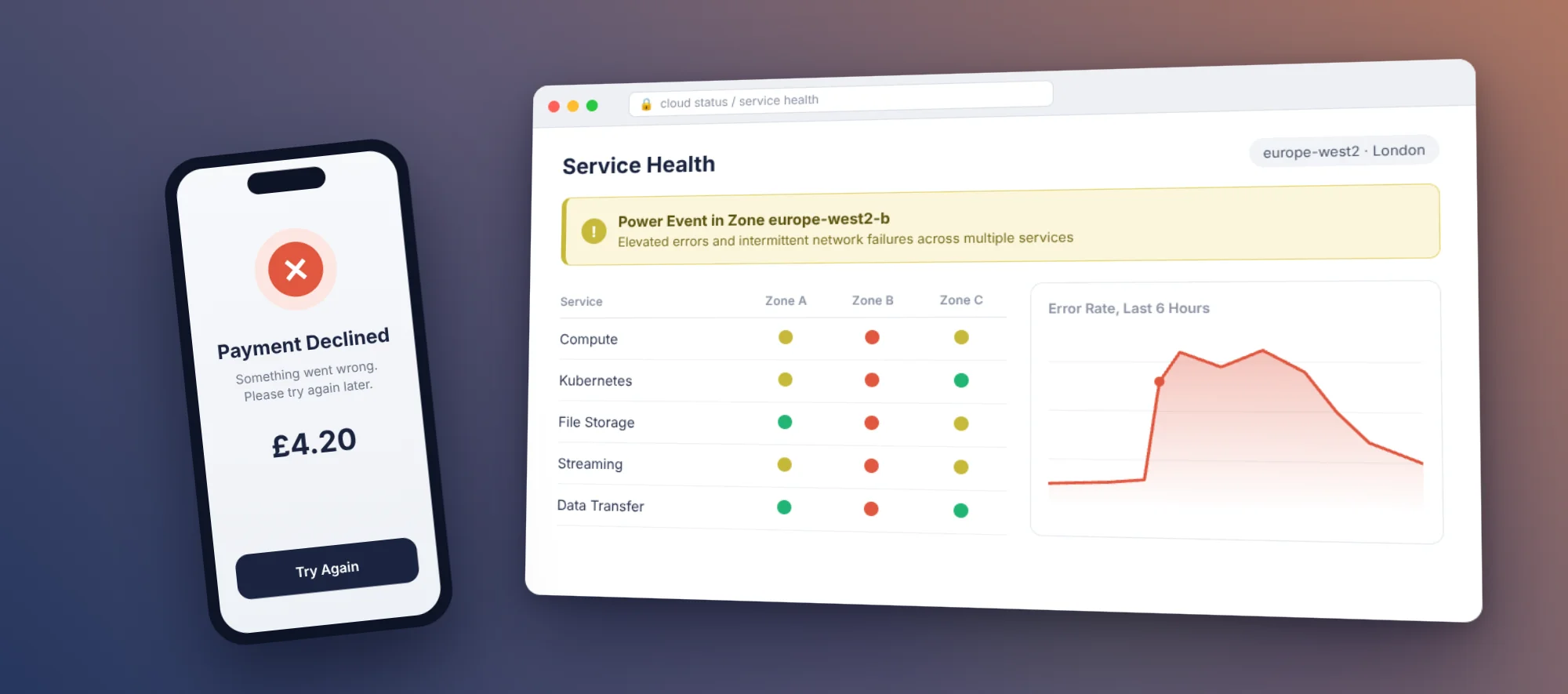
Is Google Cloud Down? The GCP Outage That Froze Revolut Cards and What CTOs Should Fix Now
Yes, Google Cloud went down in London. A major Google Cloud outage hit the europe-west2...
read full article