



Missing deadlines is a bit like ordering fast food and waiting three hours for it to arrive. You did everything right. You placed the order, paid on time, even tipped, but the system behind the counter was broken.
In product delivery, the same thing happens: no matter how hard your team works, the wrong delivery model guarantees cold fries and frustrated stakeholders.
Here’s what you’ll take away from this article:
- Why the wrong product delivery model is the silent culprit behind missed deadlines.
- Real strategies to scale faster without burning out your team or overspending.
- How delivery squads powered by P-Suite turn fragmented efforts into a smooth flow of releases.
If you’re tired of apologising for delays and want to finally hit deadlines with confidence, keep reading. This is where you’ll see how easy it is to change the game.
The Root Cause of Missed Deadlines
It’s easy to blame a late project on lazy developers, unrealistic clients, or “that one missing feature.” But the truth usually hides deeper: deadlines slip because the delivery model itself is broken. When the structure guiding your team is outdated, even the best people can’t deliver on time.
Outdated product delivery models cause recurring issues:
- Waterfall rigidity: On paper, waterfall gives a sense of control because everything is planned upfront. In practice, it collapses when market conditions or customer needs shift mid-project. Teams are forced to rework months of planning, and by the time delivery happens, the solution already feels outdated.
- Siloed teams: When developers, testers, and operations work separately, every handoff slows things down. Misunderstandings creep in, fixes take longer, and deadlines slip. Instead of a steady flow, work moves in bursts that stall at every transition.
- Slow agency handoffs: Agencies often focus on scopes and contracts rather than sprint outcomes. Getting them onboarded takes time, and any change means more back-and-forth. By the time they’re aligned, the project has already lost momentum.
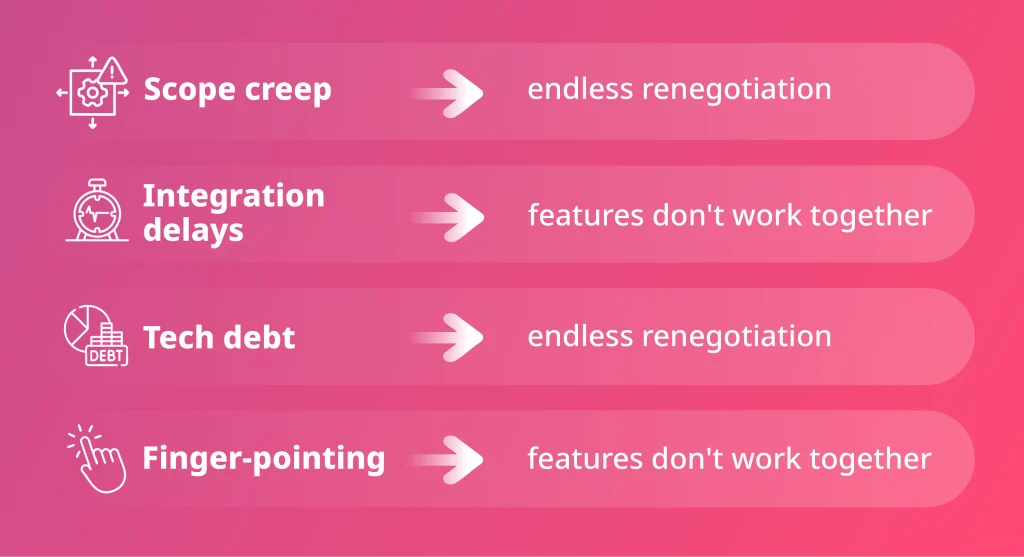
The symptoms are everywhere, and they’re hard to ignore.
Scope creep stretches on endlessly because every new request sparks another round of negotiation.
Features that looked solid in isolation fall apart once stitched together, turning integration into a slow and frustrating process.
Short-term fixes keep piling up, creating a backlog of technical debt that drags down every future release.
In open-source projects, studies show that over 50% of releases pile up technical debt as deadlines get closer. That’s proof that rushing delivery almost always trades short-term speed for long-term problems. (source: Arxiv)
And instead of working as one unit, teams slip into finger-pointing, blaming each other for delays instead of solving the bottleneck that caused them. When these patterns repeat, it’s not a people problem. It’s a product delivery model issue. And unless the model changes, missed deadlines will stay the norm.
In fact, research shows that 64% of software projects still miss deadlines, even in agile environments, proving the problem isn’t about how hard teams work, but whether the delivery model itself is fit for purpose. (source: Yaware)
Symptoms of a Broken Delivery Model
Why Traditional Agencies and Staffing Don’t Work Anymore
When deadlines slip, many companies reach for a quick fix: hire an agency or bring in extra contractors. On the surface, it seems logical because more people should mean more output. But in reality, it often makes things worse.
Agencies take time to get up to speed. Long onboarding cycles eat into project timelines before any real work begins.
Contracts are rigid, built around scopes and deliverables that rarely align with fast-moving sprint goals. And even when the work gets delivered, the focus is usually on outputs (tickets closed, hours billed) rather than outcomes like faster releases, better user experience, or sustainable scaling.
This is where the difference between a traditional IT agency and an engineering squad becomes clear. A DevOps service provider doesn’t just supply talent; it embeds cross-functional squads that operate like part of your team.
Instead of slowing things down with handoffs and paperwork, they accelerate delivery by managing infrastructure, automating pipelines, and keeping deployments reliable. The model shifts from “renting extra hands” to gaining an integrated squad that owns results.
Engineering Squads as a Fix
If outdated delivery models keep teams stuck, engineering squads offer the reset button. Think of them as sprint-driven, cross-functional units that embed directly into your organisation.
Instead of parachuting in contractors or outsourcing projects to agencies, a squad-based delivery model builds a self-contained team with developers, operations, QA, and even security specialists working side by side.
This setup tackles the root causes of missed deadlines head-on. With shared accountability and ownership, no one is “waiting on another department” to move forward.
Collaboration flows seamlessly because the people writing the code, testing it, and deploying it are all in the same room, or at least the same Slack channel. Squads also codify that collaboration in tooling—shared Jira templates for epics, stories, and release checklists keep alignment tight even as requirements shift.
And when requirements shift (as they always do), squads can adapt quickly without weeks of contract renegotiation or bureaucratic back-and-forth.
Deadlines stop being moving targets. Projects gain momentum instead of losing it.
An engineering squad fix isn’t just about plugging holes but about creating a delivery engine built for speed, resilience, and consistency.
With 49% of companies reporting faster time-to-market and 61% seeing higher quality after adopting DevOps, it’s clear that the right practices directly translate into predictable delivery and stronger outcomes. (source: Spacelift)
When teams reach their limits, it helps to learn from others. Our blog on how sprint-based squads fill gaps without disrupting delivery flow explains how organisations keep momentum even when resources are stretched thin.
From Architects to DevOps: How a Complete Squad Powers Delivery
A delivery squad is a full-stack team designed to handle every aspect of a project.
With P-Suite, squads are assembled to cover the entire lifecycle of delivery: front-end and back-end engineers build the product, solution architects ensure it’s designed for scale, project managers keep everything aligned, testers safeguard quality, and DevOps specialists automate and optimise deployment.
Every role that would normally sit in a separate department comes together under one roof.
So what is P-Suite?
P-Suite is the framework behind full-stack delivery squads, cross-functional teams built to deliver outcomes at speed and scale. The tool itself is designed as a rough estimator, giving leaders a quick view of:
- Squad cost (approximate budget required)
- Number of sprints needed for delivery
- Squad size based on project scope
It’s not a detailed proposal, but a starting point to understand what it takes to embed a delivery squad into your business.
Instead of hiring individuals one by one (and hoping they integrate), you complete a short quiz and instantly get a ready-to-go team that plugs directly into your organisation.
Every skill set you need is available from day one, deadlines stop slipping, and projects move forward without the usual interruptions.
The real advantage lies in efficiency. With all the necessary expertise already inside the squad, you avoid the delays of external dependencies and last-minute recruitment. Everyone works in sync, like a high-performing pit crew, each specialist playing a distinct role but all focused on the same finish line: delivering results on time.
Comparing Delivery Models: Squad-Based vs Traditional
Imagine you’re stuck in traffic on the way to an important meeting. You’ve got two options: wait it out in a slow-moving line of cars, or take the open fast lane that gets you there on time.
That’s the difference between a traditional agency model and a squad-based approach. Both will eventually get you to the destination, but only one does it at the pace today’s businesses demand.
- Speed to market is the clearest advantage of squads.
A squad-based delivery model moves faster because every role (from developers and testers to architects and DevOps) is already in the mix. Work flows continuously, without bottlenecks or endless handoffs.
Traditional agencies, on the other hand, burn weeks on onboarding and contracts before the real work even begins. By the time a project is finished, the market has often moved on.
- Cost efficiency also leans heavily in favour of squads.
With integrated teams, there’s less duplication of effort, fewer delays, and far less rework. Costs stay focused on progress, not paperwork.
Traditional agencies may appear cheaper at first glance, but hidden costs quickly add up. Renegotiations, misaligned priorities, and time lost to slow feedback cycles all contribute to higher bills.
- Then comes scalability.
Squads flex with your needs. Adding capacity is as simple as spinning up another team, and scaling down doesn’t trigger endless contract rewrites.
Agencies rarely move with that kind of agility. Their processes are fixed, their staffing is slow, and scaling tends to mean paying more for less flexibility.
When the finish line is hitting deadlines without breaking your budget, the fast lane is obvious. Squad-based delivery keeps momentum high, while traditional agencies leave you stuck behind the wheel, watching competitors speed past.
The shift away from traditional IT projects isn’t just a trend. In the blog What Is Sprint-Based DevOps? And Why CTOs Are Choosing It Over Traditional IT Projects, you’ll see why modern leaders prefer faster, more flexible approaches.
Squad-based vs Traditional

Real-World Results: How Modern Delivery Models Beat Deadlines
Abstract arguments are easy to dismiss, but real-world results prove how much the right delivery model can change outcomes. Here are two examples where switching approaches turned missed deadlines and unstable systems into success stories.
Case 1: Zilch: From Racing the Clock to Scaling Into a Unicorn
When Zilch launched in 2018, the goal was bold: disrupt the “Buy Now, Pay Later” market and win customers fast. The problem was having just one month to deliver complex API integrations. With deadlines slipping, their survival depended on finding a partner who could move as fast as the business required.
Instead of piecing together individual hires, Zilch built a scalable, cross-functional team that worked exclusively on their product.
Using automation with Terraform, Bitbucket pipelines, and Octopus deployment, they created environments twice as fast and achieved integration within weeks instead of months.
The impact was dramatic: faster delivery cycles, stronger adaptability to vendor changes, and 100% compliance with security requirements. Within a few years, Zilch went from MVP to becoming a double unicorn valued at over $2 billion.
Case 2: Strike (Purplebricks): Stability Through DevOps Managed Services
Strike, a fast-growing UK property platform, hit a wall when its internal DevOps team left. Outages became frequent, systems grew unstable, and release reliability collapsed. Traditional fixes (hiring replacements or relying on agencies) would have taken too long. They needed expertise now.
Deployflow’s DevOps managed services gave them exactly that. A squad stepped in, integrated quickly with their development team, and rebuilt stability into the cloud environment.
By combining AWS, Terraform, and proactive monitoring, they eliminated outages, reduced downtime by 60%, and improved release reliability by 55%. Costs dropped by 25%, and Strike gained a platform resilient enough to scale.
Turning Insights into a Scalable Model
Whether it’s a startup under extreme time-to-market pressure or an enterprise struggling with system stability, the lesson is the same: outdated delivery models slow you down, while squad-based teams and managed DevOps services unlock speed, resilience, and growth.
If these stories resonate, you’ll find even more insights in our P-Suite whitepaper. It breaks down how organisations can assemble the right squad in seconds, avoid the pitfalls of outdated delivery models, and keep projects on track without unnecessary delays.
How to Choose the Right Delivery Model for Your Organisation
The best delivery model depends less on ambition and more on how your teams actually work. Start by asking a few tough questions:
- Are your teams working cross-functionally, or are they stuck in silos?
- Do projects stall because you spend more time onboarding contractors than shipping code?
- Is compliance and audit readiness a requirement for your organisation?
- Do you have the ability to scale delivery capacity quickly when demand rises?
- Are deadlines slipping despite having strong individual talent?
If you answered “yes” to most of these, your delivery model is holding you back. It may be time to rethink your approach and explore a squad-based product delivery model or a scalable DevOps strategy.
Deadlines don’t have to be missed, and growth doesn’t have to mean burning out your team. With Deployflow’s teams, you get access to the right people, proven frameworks, and the P-Suite tool that can spin up a custom squad in seconds.
Whether you need sprint delivery speed, stronger compliance, or a way to scale without friction, our team is here to help you build a model that works. Get in touch with our experts to explore how your team can move past missed deadlines and start delivering with confidence.
Frequently Asked Questions About Delivery Models and Deadlines
How do I know if my delivery model is holding my team back?
There are clear warning signs that your delivery model isn’t working.
Projects frequently slip past deadlines despite strong individual performance. New features get delayed at integration because teams work in silos. Scope creep feels endless, and quick fixes keep adding to technical debt.
If onboarding contractors takes more time than actual delivery, or if compliance checks constantly stall releases, your model is the issue. These patterns show it’s time to rethink how work is structured, not how hard your team is working.
The blog Best Delivery Model for FarmTech Growth: Freelancers, Agencies, or Engineering Squads? highlights how these models play out in FarmTech, and the insights apply just as much in fast-moving sectors like fintech, healthtech, or proptech.
What makes squad-based delivery more reliable than traditional agencies?
Reliability comes from integration. In a squad-based model, developers, QA, architects, and DevOps work as a single unit, so nothing falls between the cracks. Problems are solved inside the team, without waiting for outside approvals or handoffs.
Traditional agencies, on the other hand, depend on contracts, scopes, and separate departments. Each adjustment creates delays and uncertainty.
Squads stay aligned with sprint goals, adapt instantly to changes, and keep releases consistent, which makes them a more dependable way to hit deadlines.
How does P-Suite reduce project risk?
Project delays often come from gaps in expertise or misaligned hires. P-Suite removes that risk by instantly matching your project’s needs with the right blend of skills, from engineers and architects to QA and DevOps. Because the team is assembled as a complete unit, you avoid the common pitfalls of mismatched talent, missing roles, or late recruitment. The result is predictable delivery, fewer disruptions, and a smoother path from planning to release.
How do DevOps managed services help SMBs deliver on time?
Small and mid-sized businesses often don’t have the budget or headcount for a full in-house DevOps team. That gap leads to slow deployments, fragile infrastructure, and missed deadlines.
DevOps managed services give SMBs access to specialist expertise on demand, without the cost of building everything internally. Pipelines are automated for faster releases, infrastructure is kept stable and secure, and monitoring catches issues before they become blockers. This means SMBs can deliver features at the pace of larger competitors while keeping costs under control.Speed isn’t always about adding people. The blog How You Can Triple Deployment Speed Without Hiring shows how tightening processes and removing friction can transform delivery times.
Explore our BLOG
Recent articles

How can a DevOps team leverage the power of AI?
Your CI/CD pipeline is automated, but it still can’t see trouble coming. Alerts land after...
read full article

Why Regulated Industries in the UK Are Getting AI Wrong
Your pilot works. It has worked for months. It still cannot go live, and every...
read full article

What Is AI Foundry, and Why Should CTOs Care?
Somewhere in your Azure tenant, an AI workload is running that nobody formally approved. It...
read full article