



Think of FarmTech like building a greenhouse. The seeds and soil might be there, but without the right structure, climate control, and constant adjustments, the plants never reach their full yield.
FarmTech startups face the same challenge. Tight budgets, shifting seasonal demand, and complex technology all demand a framework that not only supports growth but adapts quickly when conditions change.
In this article, you’ll learn:
- When freelancers work well, and when they don’t
- The strengths and trade-offs of agencies
- How full-stack engineering squads accelerate growth
- Which delivery model best fits the FarmTech growth at different stages
This guide will help you identify the delivery model that matches your growth stage and keeps your FarmTech business competitive.
Understanding the FarmTech Delivery Model Landscape
When people talk about a “delivery model” in FarmTech, they’re really asking one question: who’s going to build, improve, and maintain the technology that keeps your business running?
Whether it’s a smart irrigation platform, crop analytics dashboard, or IoT sensors in the field, the delivery model decides how quickly new ideas move from concept to reality.
The UK’s agri-tech sector already turns over around £13.7 billion, with total investment reaching £1.2 billion, including £283 million in Innovate UK grants. (source: DataCity) With this level of backing, the pressure is on startups to choose a delivery model that can keep pace with both funding and innovation.
For FarmTech startups, the stakes are higher than in many other industries.
Delivery speed isn’t just about getting ahead of competitors. It can decide whether your platform is ready in time for planting season or misses the window entirely.
Adaptability matters because weather patterns, regulations, and market needs can shift overnight. And sustainability (not just environmental, but operational) ensures that the people and processes behind the tech can keep going year after year without burning out or breaking down.
Some delivery models are better at handling this pressure than others. Freelancers may give you quick fixes, agencies bring structure, but sprint-based squads are increasingly seen as the model that reduces friction, shortens release cycles, and makes scaling less painful.
Freelancers: Flexible but Fragmented
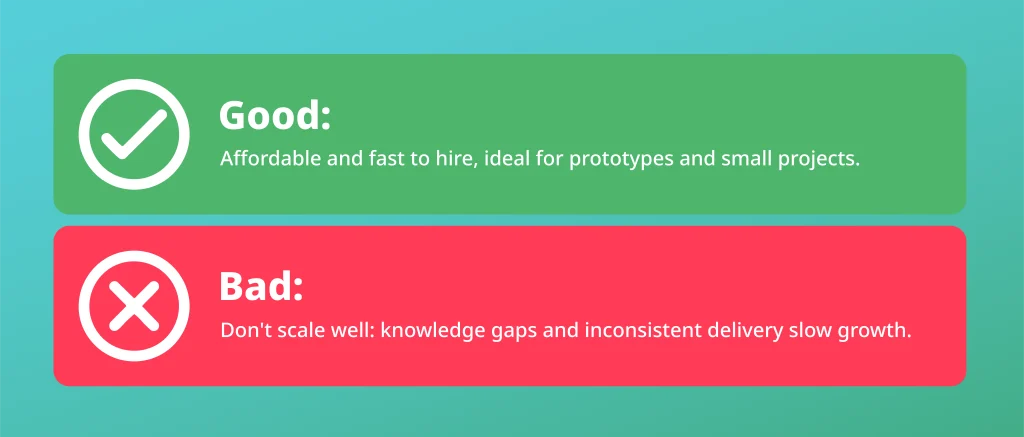
Freelancers are often the first stop for FarmTech startups. They’re affordable, quick to hire, and you can usually find someone with exactly the skill you need, whether it’s a mobile app developer, a data scientist, or a UI designer. When speed is the priority and the budget is lean, bringing in a freelancer can feel like the perfect fix.
But here’s the trade-off: freelancers don’t scale well.
One person might be great at building a feature, but they can’t cover every angle: testing, DevOps, and long-term maintenance.
Delivery can also feel inconsistent, especially if your go-to freelancer is juggling multiple clients. And when they move on, the knowledge they’ve built about your platform often leaves with them.
That’s why freelancers are a solid choice for prototypes or small, one-off projects. But if you’re serious about scaling a FarmTech platform (especially one that needs to handle seasonal spikes and complex integrations), they quickly hit their limits.
Agencies: Structured Expertise with Trade-Offs
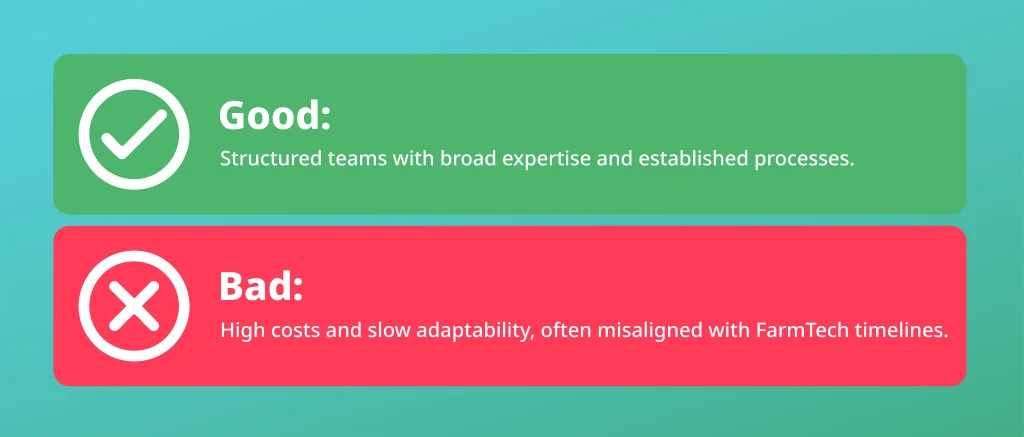
Agencies bring order to the chaos. They come with established processes, project managers, and a ready-made team that can cover everything from design to development to quality assurance.
For a FarmTech startup, that means fewer headaches around hiring and a wider range of skills at your disposal right from the start.
The downside is the cost, and not just in dollars.
Agencies often move slowly due to the layers of communication and approvals.
And while they’re experts in delivery, they may not fully understand the unique rhythms of FarmTech, where missing a seasonal launch window can matter more than hitting a quarterly milestone.
This makes agencies reliable partners for large, structured projects, but when speed and adaptability are critical, they don’t always keep pace with the demands of FarmTech innovation.
Full-Stack Engineering Squads: Sprint-Based Growth for FarmTech
Full-stack engineering squads work like tight-knit teams on a farm: everyone has a role, but they share the same goal: getting the harvest in on time.
Instead of separating design, development, QA, and DevOps into silos, a squad owns the whole process end-to-end. That means fewer handoffs, faster delivery, and less room for things to fall through the cracks.
As explored in this guide on why full-stack delivery squads are the future of product development for tech startups, cross-functional teams consistently outperform siloed structures when speed and adaptability are critical.
The advantages are clear.
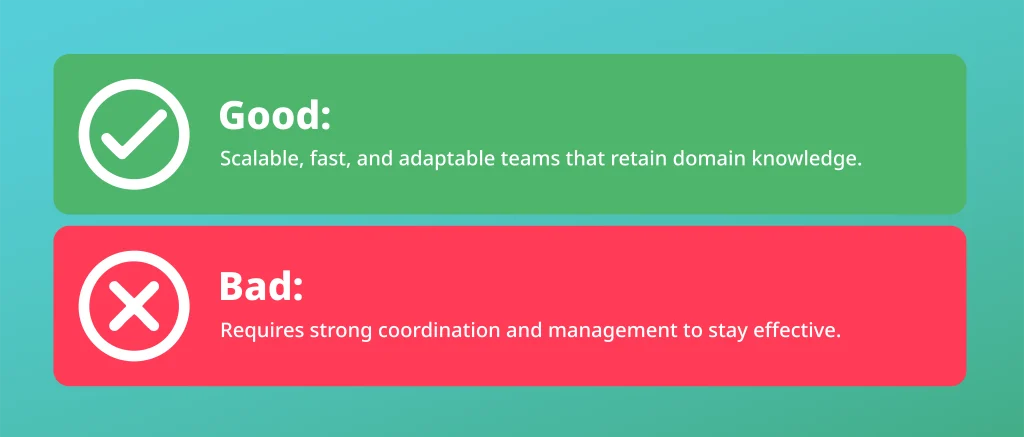
Squads move in short, focused sprints, which lets them ship updates quickly and adapt to feedback without derailing the entire roadmap.
They’re scalable, too. You can add another squad when demand grows instead of trying to stretch a single team thin.
Most importantly, they keep domain knowledge in one place, making sure hard-won expertise isn’t lost between projects.
For FarmTech, this approach is especially powerful. Squads can handle seasonal spikes in demand, integrate IoT and AI tools quickly, and adjust to shifting regulations or market needs without slowing down.
In fact, between 10–15% of UK farms already use IoT technologies like sensors and edge devices, showing just how important it is to have delivery models that can support rapid integration of connected systems. (source: BSI Group)
They bring stability in an industry where timing and adaptability often decide who grows and who falls behind.
Hall Hunter’s Transition to Smarter FarmTech
Hall Hunter, one of the UK’s leading berry growers supplying Tesco, M&S, and Waitrose, faced a familiar FarmTech challenge: outdated systems holding back growth. Despite managing 200 acres, their processes relied on manual counting and forecasting, leading to unreliable data and missed opportunities.
By moving to a secure, cloud-based infrastructure with Deployflow’s support, Hall Hunter transformed how their business operated. AI-driven field counting, soil and temperature controls, and accurate yield predictions replaced spreadsheets and guesswork.
The result was 30% lower IT costs, stronger security, and far more reliable forecasting.
According to Hall Hunter, the biggest difference was stability: their staff of 150+ could rely on responsive support, reduced downtime, and a smoother workflow after the transition.
Hall Hunter’s journey highlights the difference the right delivery model makes: turning complex, error-prone systems into a scalable, future-ready platform.
If your FarmTech company is facing similar challenges, get in touch to see how a tailored full-stack squad could deliver the same results.
Our FarmTech clients typically save 25–38% in IT costs by moving to sprint-based squads versus agency retainers.
Comparing Delivery Models in FarmTech
Freelancer vs Agency vs Squad: Direct Comparison for FarmTech
When you’re picking a delivery model for FarmTech, you’re really choosing the engine that will power your growth.
The wrong one sputters out halfway through the season, while the right one keeps running through tight budgets, shifting regulations, and the crunch of planting or harvest deadlines.
In FarmTech, delivery is about building a system that can survive unpredictable weather, scale when demand spikes, and keep innovating without breaking stride.
Cost and ROI
- Freelancers: Lowest upfront cost. Great if you just need a dashboard built or a quick feature added. But when that freelancer leaves, the knowledge goes with them, and a new hire often has to start over. That hidden churn can eat into ROI fast.
- Agencies: Structured pricing models, usually higher than freelancers. The benefit is predictability; you know what you’ll pay for a set scope. The downside is flexibility; if mid-project, you realise you need an IoT integration or AI-powered forecasting, change requests can inflate costs and delay timelines.
- Squads: At first glance, they sit in the middle to upper range. But the ROI picture changes because squads reduce wasted time and rework. By owning design through DevOps, they deliver faster cycles of usable value. For FarmTech companies, that can mean hitting the planting season window instead of losing an entire cycle.
Delivery Speed vs Adaptability
- Freelancers: Fast for one-off fixes, but struggle with complex projects. If you need quick tweaks, they’re ideal. But the moment multiple freelancers need to coordinate, delivery slows, and adaptability collapses.
- Agencies: Strong at meeting deadlines for well-defined projects, but rigid. In FarmTech, adaptability is everything because weather shifts, new regulations, or sudden demand spikes can’t wait for a lengthy change request process.
- Squads: Designed for adaptability. Sprint-based work means shipping in small, iterative cycles. If crop-monitoring needs to pivot from soil data to drone imagery mid-season, squads can adjust course without resetting the entire project. That kind of agility keeps innovation moving.
Scalability and Knowledge Retention
- Freelancers: Scaling usually means hiring more freelancers, which multiplies management overhead and knowledge silos. Knowledge often leaves with the individual.
- Agencies: Easier to scale in headcount, but not always in domain depth. Agencies often rotate staff across clients, so FarmTech-specific knowledge can get diluted.
- Squads: Built to scale. Need more capacity? Add another squad. Domain knowledge stays within the team, so the more they work on your product, the smarter and faster they get. For FarmTech, where understanding seasonal cycles and agronomic data matters, this retention is a huge advantage.
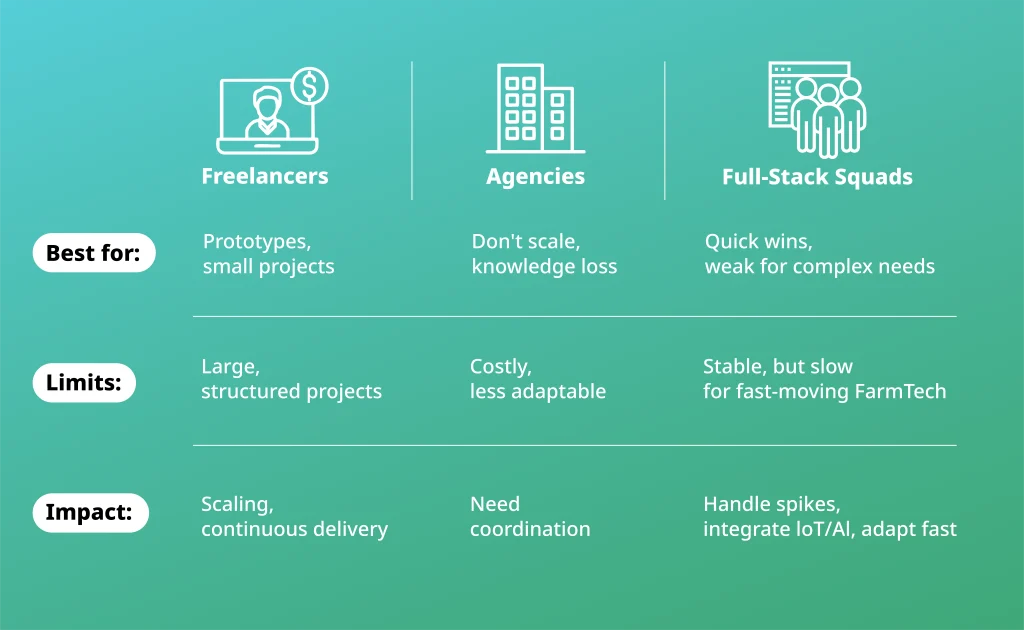
Freelancers keep costs down but struggle with scale. Agencies bring structure but can’t always match the speed and adaptability FarmTech requires. Full-stack squads strike the balance: they deliver quickly, adapt on the fly, and scale without losing domain expertise.
For startups looking beyond MVP, squads are the delivery model built for sustainable growth in FarmTech.
Choosing the Right FarmTech Delivery Model for Growth
There’s no one-size-fits-all answer. The best DevOps delivery model depends on where your company is today and where you’re trying to go.
Before making a decision, it helps to ask a few key questions:
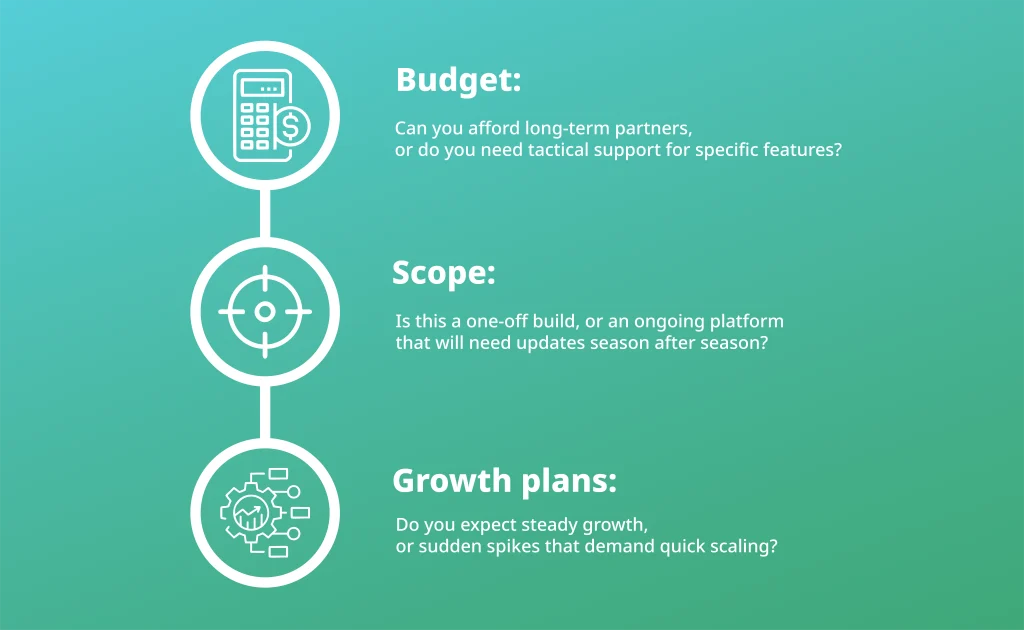
For many FarmTech startups, a hybrid path makes sense. Freelancers are useful for rapid prototypes, agencies can add structure through audits or compliance-heavy projects, and full-stack dev squads are the best option when it’s time to scale fast without losing flexibility.
For companies moving beyond MVP and into real growth mode, sprint-based squads offer a smart way forward: balancing speed, adaptability, and sustainability in one model.
Finding the Growth Engine for FarmTech
Freelancers shine when you need affordable prototypes.
Agencies deliver structure for large, defined projects.
But when it comes to scalable innovation, full-stack squads stand out as the model built for FarmTech realities.
For businesses that want predictable growth and the speed to innovate season after season, P-Suite’s sprint-based squads provide a clear path forward.
P-Suite by Deployflow matches companies with a custom dev squad tailored to their needs, while automating sprint planning, providing real-time visibility, and keeping delivery on track.
Choosing the right model is about building a foundation that can carry you through cycles of growth, change, and innovation in FarmTech.
Dev squads, supported by the right tools, make that foundation far more resilient.
See how it works in practice and download the P-Suite whitepaper for a deeper look at sprint-based delivery and how it supports FarmTech growth.
Frequently Asked Questions About FarmTech Delivery Models
How do full-stack squads work in software development?
Full-stack squads are small, cross-functional teams that own the entire delivery cycle: design, development, testing, and deployment. Instead of passing work between separate departments, the squad works together in short, focused sprints.
This reduces bottlenecks, improves communication, and allows for faster, more reliable releases. In FarmTech, where timing around planting and harvest seasons is critical, squads make it possible to launch updates quickly while keeping domain knowledge within the team.
Why is scalability important in FarmTech technology?
Scalability determines whether a platform can handle growth without breaking down. In FarmTech, this is vital because demand can spike during planting or harvest, data loads increase with IoT adoption, and regulations evolve rapidly. A scalable system ensures consistent performance under pressure, while also reducing the risk of downtime that could disrupt an entire season.
Delivery models that don’t scale well (like relying only on freelancers) can hold companies back just when opportunities to grow are at their peak.
What is sprint-based delivery in software development?
Sprint-based delivery is an agile approach where work is divided into short, repeatable cycles (usually 2–4 weeks). Each sprint delivers a working piece of software that can be tested, used, or adapted based on feedback. This approach makes development more predictable and reduces the risk of large, costly failures.
A similar approach has already proven effective in highly regulated sectors, as shown in this article on sprint-based delivery for FinTech and HealthTech CTOs, where rapid iteration and compliance must go hand in hand.
For FarmTech, sprint-based delivery ensures features are released quickly and can be adapted to real-world conditions, whether that’s a shift in weather data inputs or new compliance rules.
What are the biggest challenges in FarmTech innovation?
FarmTech companies face a unique mix of challenges:
- Seasonal deadlines: Missing a release window can mean waiting another year to test or roll out a product.
- Complex integrations: IoT sensors, AI models, and data platforms must work together seamlessly.
- Adoption barriers: Farmers are cautious about new tech; solutions must prove reliable and deliver clear ROI.
- Regulatory changes: Compliance can shift quickly, requiring fast technical adjustments.
Overcoming these challenges requires delivery models that are both adaptable and sustainable. That’s why squads, with their ability to iterate quickly and retain domain expertise, are becoming a preferred choice for FarmTech growth.
How do I know if my FarmTech company is ready for a full-stack squad?
You’re ready for a full-stack squad when your needs have outgrown quick fixes and one-off projects. Signs include:
- Frequent scaling challenges: seasonal demand spikes or data loads that freelancers or small teams can’t manage.
- Complex integrations: IoT, AI, and data platforms that need to work together reliably.
- Knowledge gaps: losing critical expertise every time a contractor or agency moves on.
- Growth plans: moving beyond MVP and needing predictable, continuous delivery.
If these challenges sound familiar, a full-stack squad can provide the stability, adaptability, and speed to support long-term FarmTech growth.
Explore our BLOG
Recent articles

Is Claude Down? Anthropic Outage: Protect Your Cloud Infrastructure
Claude.ai has spent 2026 fighting its own success. Twenty-one incidents landed between 12 August and...
read full article

AI Experimentation vs AI Engineering: The Difference That Decides Whether Your AI Budget Survives
Experimentation buys you knowledge. Engineering buys you a system that still works next quarter, when...
read full article

Why Most Agentic AI Projects Fail Before They Scale
Has your agent been three months from production for nine months? Agentic projects break at...
read full article