


Your product idea is solid, the demand is clear, but weeks pass, and nothing goes live. Sounds familiar?
In FinTech and HealthTech, where timing can define success, the problem usually isn’t the roadmap but the delivery. You’ve got features to ship, an MVP to launch, or a complex integration to complete. But without the right setup, even simple builds get delayed.
That’s why more teams are moving to sprint-based delivery with full-stack delivery squads, a faster, clearer way to build, test, and launch with minimal friction. These squads bring full-stack capability into short, high-output cycles designed for fast product development, even in regulated environments.
In this post:
- You’ll see why delivery often stalls, even with a clear roadmap
- How MVP development works better with outcome-focused squads
- What steps you can take to move faster without compromising quality or control
If speed matters but nothing’s shipping, it’s time to rethink the way work gets done.
Common Delivery Challenges Slowing Down FinTech and HealthTech Startups
Great ideas aren’t in short supply. Most UK startups and SMBs know what they want to build, and often have a clear picture of the value it brings. The real problem starts when it’s time to deliver.
A staggering 87% of UK IT teams report being understaffed, and 43% (over two‑fifths) say this lack of skills is preventing them from using or maintaining automation tools effectively. (source: CFOtech)
Delivery breaks down not because teams lack vision, but because they fall into traps that drain time, energy, and budget. These are the ones that come up again and again:
Hiring Before Scoping
One of the most expensive mistakes a startup can make is hiring a team before clearly defining the problem. Without a validated scope, engineers often build based on assumptions.
This is the result:
- Sprint goals that shift mid-cycle
- High burn with low output
- Developers spinning on tasks that get reworked later
Startups end up paying for onboarding, planning, and revisions before delivering anything useful. A scoped sprint model ensures you match team size and skillset to actual needs.
Stretching Internal Teams Too Thin
Internal teams already have BAU (business-as-usual) demands—keeping systems running, responding to incidents, handling compliance updates. Expecting them to also ship a new product or integration on top of that spreads them too thin. The outcomes:
- Delays from constant context-switching
- Burnout from juggling priorities
- Technical debt due to rushed, short-term fixes
Sprint-based squads offer external capacity without disrupting internal focus, so your existing team doesn’t stall while trying to build the future.
Overengineering Early Builds
It’s tempting to design V1 like it’s V10; scalable architecture, feature-rich UI, complex integrations. But this mindset often kills speed and eats budgets before users even touch the product.
What happens:
- You delay learning because real feedback comes too late
- Teams invest in infrastructure they may not need yet
- Costs spiral without validation
A smarter approach is to validate first. Build only what’s necessary to test the core hypothesis, then scale with purpose, something sprint-based delivery makes easy to control and iterate.
Chasing AI Without a Delivery Model
AI pilots are everywhere, but working, integrated AI features are rare. Why? Because teams rush into building models without planning for real-world use. That leads to:
- Pilots stuck in sandbox environments
- No pipeline for deployment, testing, or handover
- Compliance and security gaps discovered too late
Sprint-based squads ensure AI work doesn’t stop at prototyping. Models are built with deployment, integration, and compliance in mind, so they move from sandbox to production without friction.
It’s not the idea that fails; it’s the execution that drags. And for smaller teams, these traps hit harder.
In the UK, 84% of health tech companies are small businesses, with 1,819 employing fewer than 50 people. (source: UK Office for Life Sciences) With limited resources and headcount, even a single delay can ripple across multiple priorities.
Without the right structure in place, even strong teams struggle to keep up with delivery demands.
At the core of these issues is a structural problem: misaligned teams and outdated delivery setups.
Traditional approaches, agencies, freelancers, and long hiring cycles weren’t built for the speed or complexity most startups face today. What’s needed isn’t more people but a way to structure delivery around outcomes, not hours.
Sprint-based squads offer something different: execution that’s scoped, focused, and built to deliver, not just work.
Why Freelancers, Agencies, and Hiring Fail When Speed Matters
When it’s time to build, most teams reach for the usual solutions. They hire more people, bring in a freelancer, or call an agency. But these models often introduce more friction than they solve, especially for startups trying to move quickly without overcommitting.
Here’s what typically happens:
- Agencies are built for long retainers, not rapid pivots. They’re slow to adapt and rarely embed directly into your workflow.
- Freelancers may be affordable in the short term, but they’re hard to align, harder to scale, and risky when accountability matters.
- Hiring is a long process. Onboarding a full-time team takes months you may not have, especially if your goal is to ship something this quarter.
Meanwhile, delivery squads are built to do one thing well: ship real outcomes, fast. They drop in ready to work, operate in 2-week sprints, and include all the roles needed to deliver from day one: engineers, QA, DevOps, delivery lead, and more.
Here’s how the models stack up:

If your project can’t wait for a hiring cycle or survive a slow agency process, a delivery squad gives you the speed, structure, and accountability traditional models just can’t offer.
What a Sprint-Based Delivery Squad Actually Looks Like
Imagine this: you’ve got a clear product idea, a tight deadline, and maybe even board pressure to show traction. But your team’s buried in BAU work, your backlog is growing, and you’re still waiting on answers from that agency you briefed three weeks ago.
Now what?
Sprint-based squads focus on the right team and the right outcome from day one.
Each squad is built to run fast and stay lean. You’ll typically see:
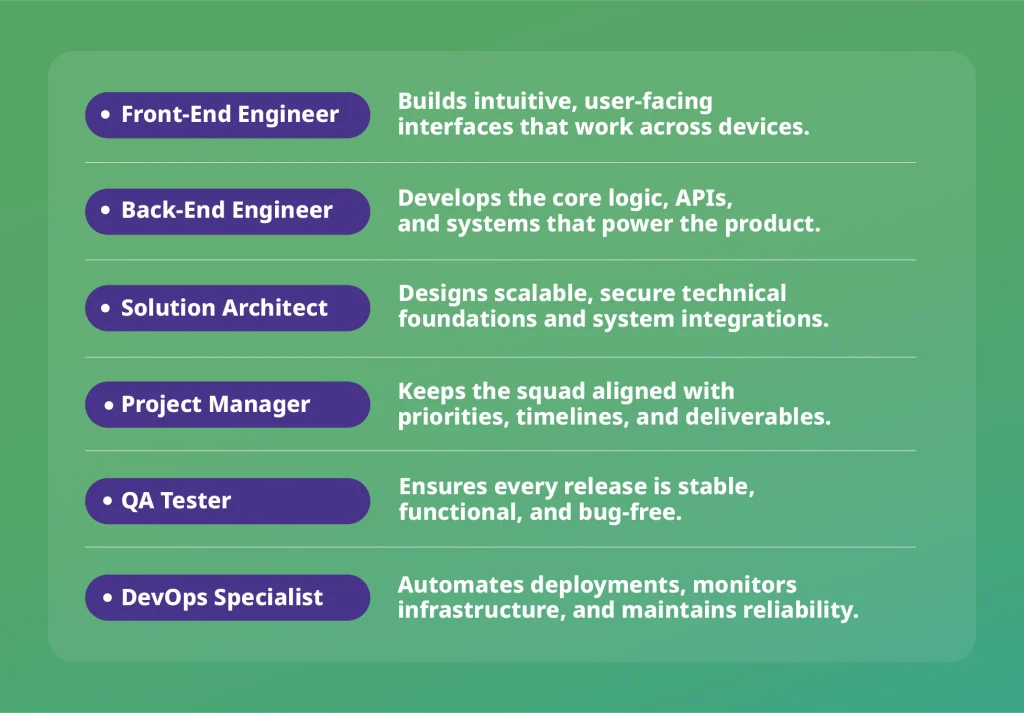
They work in 2-week sprints, with clear deliverables every cycle. No retainers. No filler work. No slow handovers between disconnected freelancers or departments.
These squads are purpose-built for moments when execution matters, whether you’re launching an MVP, integrating with a payments provider, testing an AI pilot, or upgrading legacy cloud infrastructure.
It’s not about moving fast just for the sake of it. It’s about getting the right thing live without getting stuck in the usual build traps.
These squads are backed by DevOps as a Service, which ensures fast, secure, and automated delivery pipelines from day one. With CI/CD, infrastructure as code, and compliance tooling already in place, teams can ship reliably and repeatedly without rebuilding the foundation every sprint.
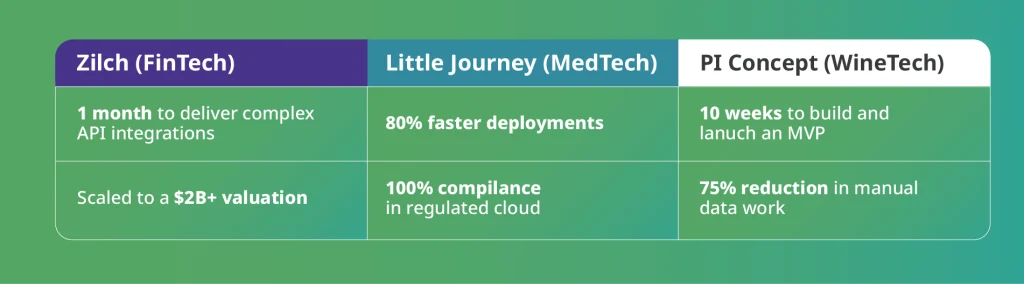
Case Study Snapshots: Real Companies, Real Results
How Sprint-Based Delivery Handles AI, Automation, and Innovation
AI is only valuable when it’s deployed in the real world, and most teams aren’t set up to do that. Building a pilot is easy. Getting it live, compliant, and integrated with the rest of your product? That’s where things fall apart.
Sprint-based engineering squads give AI work the structure it needs to move beyond theory. Instead of isolated experiments, squads build and ship real, working systems on time, with clean handover and documentation.
They use tools like:
- Versal for scoped AI workflows and deployment visibility
- Replate to automate redundant engineering work
- Terraform for repeatable, secure infrastructure setup
Compliance and documentation aren’t added at the end. They’re part of the process from day one. Logs, access controls, and audit trails are all automated as the team works.
The result is that AI pilots don’t stay stuck in slides or sandbox environments. They go live, connect to your systems, and start delivering value fast, without the overhead or risk of duct-taped delivery.
Are You Squad-Ready? Here’s How to Tell
P-Suite is a tool that helps you move fast without losing control. In just 30 seconds, it estimates the right delivery squad for your specific project without templates or guesswork.
It scopes a full-stack team around your actual needs and aligns scope, budget, and delivery from the start.
The result is clear next steps, the right team, and the confidence to build without delays.
You can learn more about P-Suite in our comprehensive whitepaper.
Ask yourself:
- ✅ Do you have a clear goal or outcome in mind?
- ✅ Is your internal team at capacity or unavailable?
- ✅ Is speed more important than hiring right now?
- ✅ Are you open to a sprint-based delivery model?
- ✅ Does a £30K–£100K budget feel appropriate for fast, expert delivery?
If you’re checking off most of these, you can get your squad estimate in 30 seconds.
Frequently Asked Questions: Sprint-Based Delivery for FinTech and HealthTech CTOs
What is a sprint‑based delivery squad?
A sprint‑based delivery squad is a self‑contained, cross‑functional team that delivers projects in short, iterative cycles. Each squad includes all the expertise needed—front‑end and back‑end developers, DevOps engineers, QA, UX/UI, and a delivery lead—so work moves from concept to release without external dependencies.
This model reduces bottlenecks, shortens release cycles, and prevents reliance on any single person.
How does sprint‑based delivery differ from freelancers or agencies?
Freelancers work independently, often requiring heavy coordination and risking delays if someone is unavailable. Agencies typically follow a siloed workflow, passing work through design, development, and QA in sequence, which slows delivery.
Sprint‑based squads solve these problems by:
- Integrating all roles into one cohesive team.
- Delivering in predictable sprints with continuous progress.
- Keeping knowledge in the squad, avoiding single‑point failures.
The result is faster, more reliable output without the handoff friction of traditional setups.
Why is sprint-based delivery a better fit for FinTech and HealthTech startups?
These industries need to move quickly while staying compliant and secure. Sprint‑based squads excel because they:
- Ship features faster through short release cycles.
- Integrate security and compliance checks into every sprint, reducing late‑stage risks.
- Scale smoothly by adding or duplicating squads without reorganising teams.
For startups where delays or compliance failures can be critical, this model balances speed and reliability better than freelancers or siloed teams.
What kinds of projects are best suited for sprint‑based squads?
This model is most effective for complex, evolving projects that benefit from iterative delivery, such as:
- SaaS product or MVP development
- Cloud migrations and DevOps pipeline builds
- API integrations or data orchestration upgrades
- Mobile or web applications with frequent feature releases
One‑off tasks or small, static projects usually don’t require a full squad.
Can sprint‑based squads handle compliance in regulated environments?
Yes. Squads are structured to embed compliance into the workflow, not bolt it on at the end:
- DevOps ensures infrastructure meets cloud security and audit standards.
- QA validates compliance and functionality in each sprint.
- Delivery leads maintain documentation aligned with HIPAA, PCI DSS, or GDPR.
This approach catches potential issues early and keeps projects audit‑ready.
How quickly can a delivery squad start working?
Most squads can begin in 1–2 weeks, following three steps:
- Define priorities, success metrics, and scope.
- Assemble a cross‑functional squad with the required roles.
- Run an initial planning session to kick off the first sprint.
Because squads are pre‑structured for agility, early results are delivered quickly.
What do I need to get started with a sprint‑based delivery model?
To launch effectively, you’ll need:
- Clear project goals and the features or outcomes you want first.
- Access to your systems—source code, cloud accounts, and integrations.
- A dedicated contact to provide feedback and approve sprint deliverables.
With these in place, sprint‑based squads can deliver value from the first sprint.
Explore our BLOG
Recent articles

ISO 42001 Explained: Requirements, Certification and What Your Engineering Team Must Build
ISO 42001 is the international standard that demonstrates your organisation governs AI properly, and enterprise...
read full article

Is Claude Down? Anthropic Outage: Protect Your Cloud Infrastructure
Claude went down across every surface on 29 September 2026. From 14:00 to 14:59 UTC,...
read full article

Top 10 Healthtech Companies in 2026: What Their Growth Means for AI and DevOps
Every software change that reaches a hospital has to clear regulatory, legacy system, and clinical...
read full article