


One engineer runs your entire DevOps setup. What could go wrong?
Plenty. When infrastructure, CI/CD, and incident response all rely on a single DevOps engineer, you’re exposed. A single resignation, sick day, or burnout moment can halt delivery, stall product growth, and spike security risks.
For CTOs and IT leaders at growing companies, this post offers a risk checklist to help assess and fix fragile DevOps setups with DaaS before they break.
You’ll learn:
- How to spot hidden bottlenecks in your DevOps process
- What questions reveal dangerous knowledge silos
- How to reduce dependency without hiring more engineers
- How automation and documentation quickly lower risk
If your DevOps success depends on a single person, now is the time to build something stronger. Read on to find out how to de-risk your team and scale DevOps without starting from scratch.
Replacing Fragile Delivery Models with Scalable DevOps Pods
“The real risk is fragile delivery models that depend on one person holding everything together. At Deployflow, we bring fully managed pods of engineers that embed directly into teams, replacing that fragility with shared systems, automated pipelines, and resilient delivery frameworks that scale as the business grows.”
— Prakash Pilley, CEO, Deployflow (Interview, June 2025)
Expert Note: This insight is based on Deployflow’s direct work embedding secure CI/CD pipelines for regulated fintech and health tech companies across the UK and EU.
Why the “Single DevOps Engineer” Model Fails Under Pressure
The 2024 DORA report found that teams with stable priorities experience 40% less burnout than those constantly shifting focus.
One DevOps engineer managing everything: cloud infrastructure, CI/CD, deployments, monitoring, security. This is common in early-stage teams. It works, until it doesn’t.
This setup creates a fragile environment where operational continuity depends on one person. No matter how skilled the person is, this model introduces structural risk that scales with your business.
Here’s what breaks:
- Burnout is inevitable: Constant context-switching between firefighting and long-term architecture drains capacity. Constant on-call duty drains mental clarity and chips away at long-term motivation.
- Critical knowledge stays undocumented: Systems live in one person’s head, not in shared documentation. If that person is unavailable, even small issues can escalate.
- Delivery becomes unpredictable: When one person is overloaded or away, projects stall. Product velocity slows, and deadlines slip.
- Onboarding hits a wall: New engineers can’t ramp up quickly. There’s no clear process, no consistent tooling, and no one with bandwidth to help.
The answer isn’t to push harder but to design a system that works even when no one’s wearing a cape.
For a deeper dive into how UK SMBs build IT resilience without overspending on internal resources, see this detailed analysis on enterprise-grade DevOps without enterprise-scale budgets.
Risk #1: No Shared Documentation or Team Knowledge
If a single engineer steps away, can the rest of the team deploy safely, fix an issue, or restore service without guesswork?
Key questions to uncover risk:

When documentation is missing or outdated, delivery slows, errors multiply, and continuity depends on who’s available. Engineers waste time digging through Slack threads or reverse-engineering configs just to perform basic tasks.
This is how to fix this issue. Record key workflows while they’re fresh; screen recordings or short notes are enough to begin. Set a rule: if it’s not documented, it’s not done.
Update guides regularly, especially after changes to critical systems or applications. Store everything in a version-controlled place that the whole team can access, like GitHub or an internal wiki.
Documentation is your first layer of operational resilience.
Risk #2: Unclear and Unreliable CI/CD Pipelines
When pipelines are built from custom scripts and scattered fixes, delivery becomes slow, brittle, and dependent on the one person who understands how it all fits together. Developers hesitate to deploy because even small changes feel risky.
Check for warning signs like these:

Pipelines should be predictable and accessible, not something the team avoids touching. If deployments fail silently, require manual triggers, or break under pressure, the system is in danger.
Begin by replacing fragile scripts with standardised, well-supported CI tools like GitHub Actions, GitLab CI, or CircleCI.
Structure pipelines into clear stages with visible logs and automated checks. Involve developers in pipeline maintenance and reviews. Ownership should be shared, not siloed.
A reliable, well-documented pipeline builds trust across the team, shortens feedback loops, and removes fear from the deployment process.
Deployflow’s DevOps as a Service approach shows how standardising pipelines and embedding automation can transform fragile delivery cycles into scalable, repeatable systems.
Risk #3: Only One Person Can Handle Incidents
Incident response is about having a process the team can follow under pressure. When only one engineer knows what to do during outages, recovery slows, stress increases, and root causes often go unresolved.
Here’s how to spot the issue:
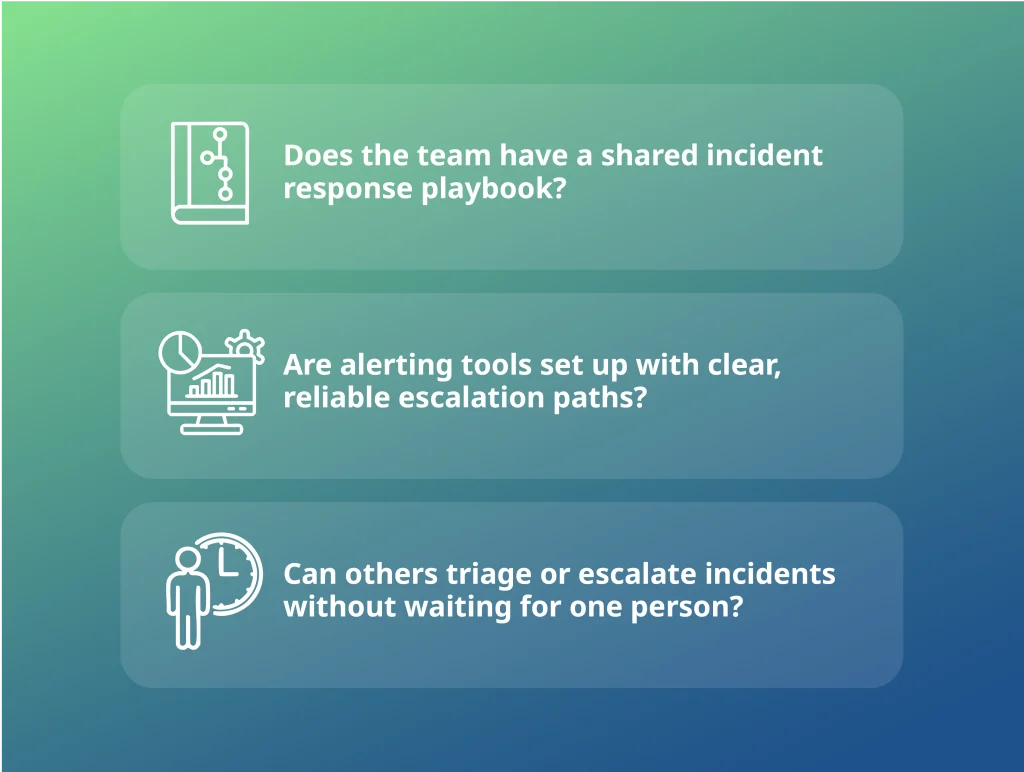
A working system should never pause because someone is offline, asleep, or unavailable. When incident management depends on a single person’s knowledge and presence, every alert becomes a potential outage, and every delay carries risk.
Start by building a shared on-call rotation. Use a calendar-based schedule and keep it visible.
Document clear response steps and store them where everyone can access them. Run simulated incidents regularly, so the team builds muscle memory.
A resilient incident response system spreads responsibility and reduces panic, making outages shorter, safer, and less disruptive.
Risk #4: Security Is Always “Phase Two”
Security can’t wait.
When DevOps is under-resourced and security is not clearly defined as a responsibility, it’s easy for critical tasks to slip through the cracks. Mismanaged credentials, unscanned dependencies, and overly broad access controls become default behaviour.
These questions reveal the gaps:

Security gaps often stay hidden until they escalate into incidents. Without baked-in security practices, your team might be shipping vulnerabilities along with every release.
Use automated tools like Snyk, Trivy, or AWS Inspector to catch issues early.
Store sensitive credentials in systems built for that purpose, like AWS Secrets Manager or HashiCorp Vault.
Integrate security scans and policy checks into your CI/CD pipeline—before anything reaches production.
Security is a default setting that should run in the background of every change you make.
Risk #5: DevOps Doesn’t Have a Roadmap
A stable system without a plan is just a temporary pause before the next problem.
Without a roadmap, DevOps turns reactive, fixing immediate issues but never improving long-term performance. Over time, technical debt grows, delivery slows, and engineers lose confidence in the platform.
What to evaluate:

When DevOps efforts aren’t tracked against clear goals, progress stalls. Teams often stay stuck in maintenance mode, and strategic improvements, such as platform automation or reliability engineering, never make it onto the agenda.
Teams that operate without a roadmap rarely reach high performance. According to the 2022 DORA report, high-performing DevOps teams recover services within a day and keep change-failure rates below 15%. That level of stability doesn’t happen by accident. It’s the result of focused, goal-driven improvement over time.
Define DevOps goals with measurable outcomes. Focus on areas that directly affect delivery velocity and system reliability.
Align these goals with business objectives, whether that’s faster releases, lower incident rates, or improved onboarding for new engineers.
A well-defined roadmap transforms DevOps from a reactive expense into a strategic driver of growth.
Risk #6: Time Off Isn’t an Option
If taking a break feels risky, the system is already fragile.
When one engineer believes they can’t step away without things falling apart, it signals a deeper problem. Dependence, lack of redundancy, and unsustainable pressure lead to burnout or turnover.
Consider the following:
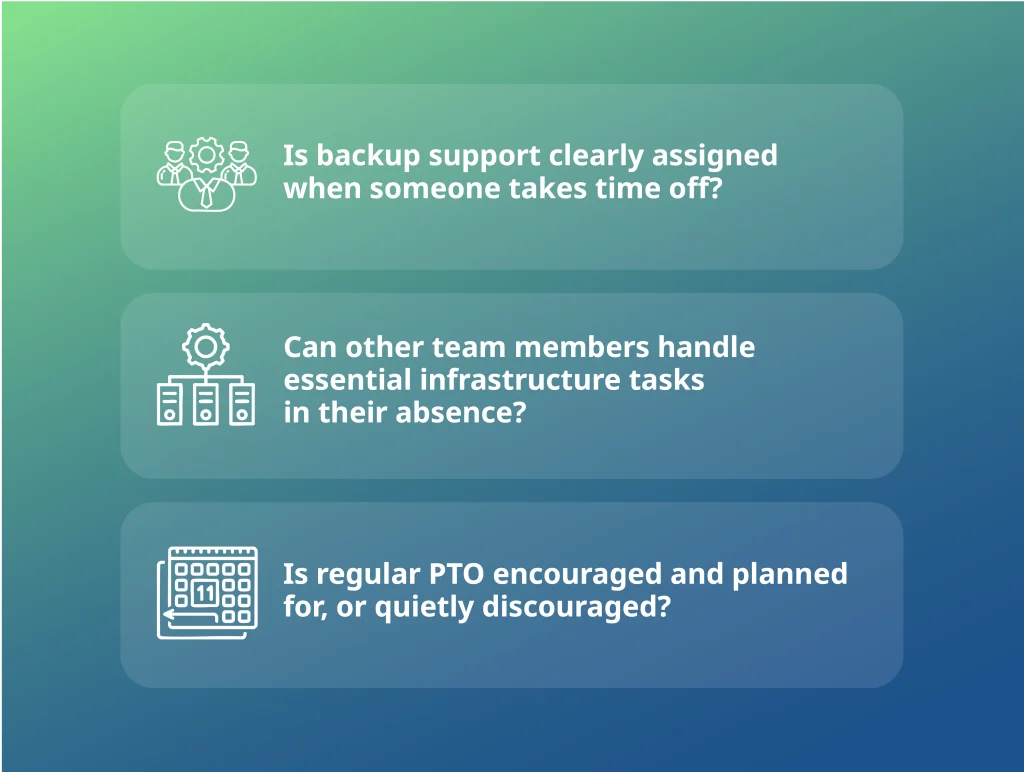
Cross-train engineers on core systems and routines. Use Infrastructure as Code to ensure repeatable setups and fewer surprises.
Create clear handover plans before scheduled time off, and foster a culture where taking a break is part of running a healthy and resilient team.
A resilient DevOps setup keeps moving forward even when key people are offline, on leave, or out of the office.
What CTOs Can Do This Quarter
Fixing DevOps risk doesn’t always mean hiring more people. The fastest gains come from removing bottlenecks, distributing knowledge, and reducing fragility with targeted action.
Deployflow’s DevOps as a Service model brings in a pod of experienced engineers who stabilise systems, embed automation, and improve delivery without the overhead of hiring full-time.
One client described it simply in this G2 review:
“Deployflow has an amazing talent pool who demonstrated an extraordinary level of professionalism and transparency right from our initial interaction.”
This kind of partnership turns DevOps from a single-person risk into a scalable, resilient capability.
- Build Resilience Without Expanding Headcount: Start by making critical knowledge visible. Document key workflows, rotate responsibilities, and give other engineers access to what matters. When knowledge is shared, availability isn’t a risk.
- Bring in a DevOps Pod, Not Another Unicorn: You don’t need a second all-in-one engineer. What you need is a repeatable system that works whether your lead DevOps is online or not.
- Automate What Slows You Down: Every manual step in your pipeline is a delay waiting to happen. Automate tests, deployments, provisioning, and rollbacks so your team can focus on building, not fixing.
- Make Security a Default, Not a Phase: Security shouldn’t come after delivery. Deployflow helps teams shift left with automated scanning, secrets management, and access controls embedded into your existing pipeline.
Deployflow’s DevOps as a Service delivers a pod-based model with CI/CD stability, security baked in, and team-aligned workflows.
What DevOps as a Service Looks Like in Practice
A strong example is Deployflow’s work with Little Journey, a health tech platform that supports pediatric patients and their families.
As the company expanded, its internal team faced a surge in demand without the DevOps capacity to scale infrastructure, enforce security, or reduce manual deployment overhead. Deployflow stepped in with a tailored solution powered by Terraform, enabling the rapid creation of secure, fully segregated cloud environments in just two hours (a task that previously took several days).
By introducing centralised controls, automating key processes, and ensuring full compliance with medical regulations, Deployflow helped Little Journey reduce manual labour by 70% and boost infrastructure scalability by 50%.
According to the CTO, the transformation allowed them to deliver a more consistent, secure, and efficient platform, without overwhelming their team.
If your DevOps still depends on one engineer holding everything together, now is the time to build a system that scales and survives without them.
Stop Relying on One Engineer: Build Resilient DevOps with DaaS
According to DaaS market analysis by Future Market Insights, “The global data as a service (DaaS) market is projected to grow from USD 20.8 billion in 2025 to USD 124.6 billion in 2035, at a robust CAGR of 22.8% from 2025 to 2035.”
Deployflow is already delivering on what this growth trend promises: operational scalability, stability, and expert support without the overhead of building large in-house teams.
Wassim Melhem, Founder of Blueshift Consulting Dubai, shared:
“Their team offers direction on the best technologies to use and can produce scalable and long-lasting infrastructures. Deployflow’s work hardly had any issues after deployments we made and would offer 24/7 support post-projects. They also stuck to their promises and resolved any concerns quickly.”
If your current setup relies on one engineer to hold everything together, now is the time to replace that risk with a repeatable system. Deployflow’s DevOps as a Service makes that possible, sustainably and securely, sprint by sprint.
Ready to stabilise your stack and scale DevOps with confidence?
Read Deployflow’s DevOps whitepaper to see proven strategies for building a resilient, scalable foundation.
Frequently Asked Questions About DevOps as a Service (DaaS)
What is DevOps as a service?
DevOps as a service (DaaS) is a fully managed DevOps delivery model where external experts design, build, and operate CI/CD pipelines, infrastructure automation, and security processes. It removes internal bottlenecks and gives teams enterprise-grade delivery without building in-house expertise.
What is an example of a DevOps service?
An example of a DevOps service is a fully automated CI/CD pipeline that integrates code, runs automated tests, performs security scans, and deploys applications to production with built-in rollback capabilities.
What are the 7 phases of DevOps?
The 7 phases of DevOps are planning, development, building, testing, releasing, deploying, and operating, forming a continuous delivery loop that drives fast, reliable software releases.
What is the biggest challenge in DevOps?
The biggest challenge in DevOps is breaking down organisational silos, as successful DevOps requires deep collaboration between development, operations, and security teams to maintain speed, stability, and security.
If your team is facing these DevOps challenges, get in touch with Deployflow to build a stable, fully managed delivery process that removes bottlenecks.
Explore our BLOG
Recent articles

Is Claude Down? Anthropic Outage: Protect Your Cloud Infrastructure
Claude.ai has spent 2026 fighting its own success. Twenty-one incidents landed between 12 August and...
read full article

AI Experimentation vs AI Engineering: The Difference That Decides Whether Your AI Budget Survives
Experimentation buys you knowledge. Engineering buys you a system that still works next quarter, when...
read full article

Why Most Agentic AI Projects Fail Before They Scale
Has your agent been three months from production for nine months? Agentic projects break at...
read full article