


Small and mid-sized businesses (SMBs) often face unique challenges when it comes to managing technology projects. While time and material (T&M) contracts offer flexibility, they often lead to inefficiencies and rising costs if goals aren’t aligned. It’s like hiring a dodgy builder who charges by the hour without a clear blueprint – you’re left with a half-finished job and a bigger bill.
A deliverables-first approach offers a clear solution, making project management more predictable and ensuring that outcomes align with business goals.
In this blog, we’ll explain why a “deliverables-first” approach is a smarter approach for businesses of all sizes and how Deployflow’s approach has helped clients achieve real value – without the headaches.
Simplifying Budgeting for SMBs
For SMBs, budget control is crucial, and the flexibility of time and material models can often lead to unexpected costs. With a deliverables-first approach, the cost is based on clearly defined outcomes rather than hourly rates, simplifying budgeting and ensuring the project stays within financial constraints.
Real-Life Example: Saving Time and Money with a Deliverables-First Model
Let’s look at an example of how this approach has worked for a small business. Imagine an SMB in the retail sector that needed to develop an e-commerce platform. Using a T&M model, they initially estimated the cost but soon saw the price escalate as additional features were requested. The development took longer than expected, and costs spiraled due to hourly billing and scope changes.
Switching to a deliverables-first model, they worked with a provider like Deployflow. From the start, the scope of the project was clearly defined, including the key deliverables and fixed costs. The team worked in sprints; every milestone came with a set price, keeping the budget predictable. The project was completed ahead of schedule and within budget, with zero unexpected costs.
This approach brings several advantages for smaller companies:
- Predictable Costs: You know exactly what you’re paying for at every stage of the project. This removes the risk of budget overruns, allowing SMBs to make informed decisions.
- Clear Timelines: You receive a fixed timeline for each deliverable, ensuring the project stays on track and is completed without delays.
- Higher ROI: Since you’re focusing on specific deliverables that directly contribute to your business objectives, the project delivers more value, faster.
As the CTO, you’re likely focused on three key concerns: scalability, accountability, and vendor reliability. When choosing between contract models, these concerns should be front and center, particularly when comparing Time & Material (T&M) versus a more structured, deliverables-first approach.
Scalability: Growing with Your Business
In a T&M arrangement, the costs can increase dramatically if you add new features or need to pivot. This can limit your ability to scale efficiently, especially when the timeline becomes unpredictable.
“In an enterprise environment, scalability isn’t just about growing the tech stack—it’s about growing with certainty. When you have clear deliverables, you can better plan your next steps. T&M contracts often add uncertainty, which is the last thing you need when scaling.”
Thomas Radosh, CTO at Deployflow
With the deliverables-first model, you’re locking in milestones, ensuring that scaling your project is predictable and measurable. The pricing is fixed per deliverable, meaning your costs remain predictable, and growth doesn’t lead to a runaway budget.
Accountability: Who Owns the Results?
Accountability is a big concern for any CTO, as you’re tasked with ensuring that projects are delivered on time, within budget, and to the desired level of quality. In a T&M contract, accountability can be diffused—you’re paying for time, not results.
In my experience, when providers focus too much on time logged, it shifts the focus away from results. We prefer working in a deliverables-first framework because it’s about the impact and quality of the work, not how many hours were spent.” Albert Prat Amigo at Deployflow
This is where a deliverables-first model excels. By clearly defining what success looks like (e.g., fixed deliverables for each sprint), your provider is held accountable for delivering specific results. As the CTO, this means you’re not left in the dark about progress—there’s always a tangible milestone to measure against, which builds trust and ensures accountability on both sides.
Vendor Reliability: Trusting Your Partner
Vendor reliability comes down to trust, and ensuring that your partner is delivering quality work on time, every time. T&M models, because of their flexible nature, can create friction when it comes to setting expectations. The project could end up stretched out indefinitely, leading to delays and missed deadlines.
This is where a deliverables-first model can help. With clear milestones, deadlines, and fixed costs per deliverable, you’re ensuring that both parties are aligned and that there’s an end in sight.
Addressing Common CTO Objections to Deliverables-First Approach
CTOs often raise concerns when considering a shift from T&M to a deliverables-first approach. Here are some common objections and practical ways to counter them:
Objection #1: “The deliverables-first model might not give us enough flexibility.”
- Counterpoint: While T&M contracts offer flexibility, this often comes at the cost of predictability and control. With a deliverables-first model, flexibility is built into the planning stages with clear, defined sprints.
Objection #2: “How can we be sure the provider will meet deadlines?”
- Counterpoint: One of the core advantages of a deliverables-first model is the clear accountability structure it provides. By setting milestones upfront and linking them directly to costs, you have clear visibility into progress. As CTO, you can trust that each milestone is aimed at achieving a tangible result, with no surprises down the line.
Objection #3: “How do we ensure the project quality with a fixed price?”
- Counterpoint: Quality control is built into the deliverables-first approach. Providers like Deployflow ensure that quality assurance (QA) is embedded throughout the development process, from automated testing to code reviews, so the final product meets your expectations. You’re not compromising quality for cost—you’re ensuring high standards with measurable, quality-first deliverables.
How to Spot a Quality-First Provider (Avoiding T&M Traps)
When you’re looking to work with a provider, it’s important to know how to choose a software provider and what to look for to ensure they prioritise quality and deliver results that align with your goals. We have asked Deployflow experts to share key things to consider when evaluating potential partners.
1. How Success is Defined
Look for: Measurable KPIs, clear deliverables. A quality-focused provider should be clear from the get-go about what success looks like. This means setting measurable Key Performance Indicators (KPIs) upfront, so everyone knows what needs to be delivered, when, and what the impact should be.
Red flag: Focus on hours logged. If a provider spends too much time focusing on how many hours they’ve worked instead of what they’ve accomplished, it’s a warning sign. This often happens with T&M contracts, where the focus shifts to billing rather than the quality or outcome of the work. While tracking time is sometimes necessary, it can lead to delays and inflated costs if it becomes the primary metric.
Example:
Providers who obsess over hours logged usually end up with cost overruns, and still no guarantee of quality. For us, success is about the impact we create, not just the time we spendAlbert Prat Amigo, Senior IT Lead at Deployflow.
2. Quality Control Processes
Look for: Automated/manual testing and built-in QA. Quality control in IT project management should never be an afterthought. A good provider will have built-in quality assurance (QA) practices, whether that’s automated testing, code reviews, or regular quality checks during development. This ensures the final product is reliable, bug-free, and scalable—no surprises at the end.
Example:
QA isn’t something we tack on at the end; it’s embedded throughout the development process. Automated tests run with every code commit, and we do manual testing for user experience and edge cases. This approach helps us minimise defects and maintain high-quality standardsAjdin Garibovic, DevOps Engineer at Deployflow.
Red flag: Treating QA as an “extra” cost. If a provider treats QA as an optional add-on, that’s a major red flag. You can’t cut corners on quality and expect a solid product. Skipping proper QA usually leads to bugs, unhappy customers, and expensive fixes later down the line.
3. Sprint Structure
Look for: Defined milestones, transparent tracking. A quality provider will have a clear sprint structure with well-defined milestones and transparent tracking. This keeps things on schedule and makes it easier for stakeholders to see where things stand at any point. You want to know how progress is being tracked so there are no surprises down the line.
Red flag: Open-ended, indefinite development cycles. Stay away from providers who can’t commit to specific milestones or dates. If they don’t set clear expectations, it’s usually a sign that they’re not managing the project well. This lack of clarity leads to delays and cost overruns and leaves you in the dark about when or if the project will ever be completed.
Example:
When a provider can’t commit to specific dates or milestones, it’s often a sign that their project management is struggling. Open-ended timelines tend to lead to delays, and in the end, clients end up paying for inefficienciesThomas Radosh, CTO at Deployflow.
Provider Evaluation Checklist for SMBs & CTOs: T&M vs. Deliverables-First
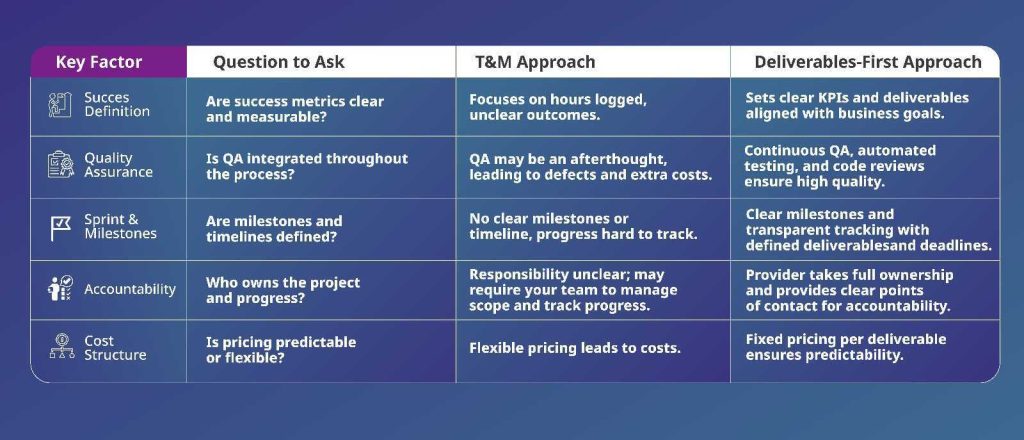
Real-World Proof: How Deployflow Delivers Results
When Zilch needed to integrate new features quickly and efficiently, they turned to Deployflow for a solution that would break the mold of traditional development models.
Instead of the typical time-and-materials approach, Deployflow’s deliverables-first model focused on speed, quality, and clear outcomes.
IT Project Success Story: How Deployflow Helped Zilch
Challenge: The Problem with Time & Materials (T&M)
Zilch, a fast-growing financial tech company, was facing significant challenges with its previous approach to development. They were relying on the Time & Materials (T&M) model, which worked for smaller, more exploratory projects. However, for their need to rapidly integrate new features and stay competitive, T&M proved to be inefficient. The flexibility it offered led to a lack of clear scope and accountability, resulting in:
- Unclear timelines: Project completion dates were constantly shifting.
- Escalating costs: Scope changes led to unexpected hours and higher bills.
- Quality control challenges: The focus was on hours logged, not on the outcome, leading to rework and technical debt.
Zilch needed a solution that provided more clarity, better cost control, and faster delivery. Traditional T&M methods were slowing them down.
Solution: Deployflow’s Deliverables-First Approach
Deployflow introduced a deliverables-first model, which contrasted sharply with the flexibility of T&M. We provided the following key adjustments:
- Clear Milestones & Fixed Costs: We set a clear scope upfront with fixed costs for each deliverable. This allowed for full transparency and eliminated budget surprises.
- Sprint-Based Execution: We structured the project into clearly defined sprints with measurable outcomes—focusing on tangible, outcome-driven goals rather than tracking time worked.
- Automated Environment Setup: To speed up deployment, we automated infrastructure setup, reducing manual effort and time-to-launch.
- Quality-First Development: Our development process included continuous automated testing and manual reviews, ensuring high-quality, bug-free releases without the need for costly rework.
- Clear Accountability: Deployflow took full ownership of the process, ensuring that the project stayed on track and within scope. We maintained direct communication with Zilch’s CTO, ensuring complete visibility.
Outcome: Quantifiable Results
By shifting to a deliverables-first approach, Zilch was able to realise the following measurable outcomes:
- 1 month to MVP Launch: Zilch’s MVP was ready in just one month, a 50% reduction in time compared to typical development timelines.
- Zero Defects: All integrations and features were delivered with 100% success—no defects or delays.
- Cost Control: Zilch saved 20% on the total project budget by eliminating unexpected costs associated with the T&M model. With fixed deliverables, they could better forecast and manage their expenses.
- Faster Feature Integration: The agile, sprint-based model allowed for faster feature rollouts, allowing Zilch to keep up with competitors in a fast-moving market.
Before vs. After: T&M vs. Deliverables-First

Read the full success story here.
Practical Advice for Vetting Providers: Must-Ask Questions
To make the transition to a deliverables-first approach, here are key questions to ask your potential provider:
- How do you define success for a project?
Look for: Measurable KPIs and outcomes. Avoid providers that focus on hours worked as a measure of success.
- Can you provide examples of fixed-cost, deliverables-based projects?
Look for: Case studies showing successful, outcome-driven results.
- How do you ensure quality throughout the development process?
Look for: Automated and manual QA to ensure that quality is maintained at every stage.
- How do you manage project scope and avoid unexpected costs?
Look for: Clear processes for handling scope changes without impacting cost or timeline.
- What are your timelines for delivering key milestones?
Look for: Realistic, defined milestones and an ability to commit to specific deadlines.
How Deployflow Saves You Money While Driving Consistent Results
With Deployflow’s deliverables-first approach, we answer each of these questions with a focus on clear, measurable outcomes and accountability.
From fixed pricing to clear sprint structures and quality-first development, we ensure that you don’t get stuck in a cycle of endless hours or shifting timelines. Our commitment is to deliver results efficiently and without surprises—so you can trust that your project will be completed on time, within budget, and to the highest standards.
Ready to experience a streamlined, outcome-focused approach? Let’s talk and see how Deployflow can help you achieve your goals without the unnecessary complexity of traditional time-and-materials models.
FAQs
What makes a deliverables-based model more cost-effective than T&M?
A deliverables-based approach ensures predictable costs, eliminating unnecessary billable hours. It aligns development efforts with business objectives, preventing budget overruns.
How does a deliverables-based model ensure better quality?
With clear acceptance criteria and structured QA processes, each sprint delivers a completed, tested, and validated outcome, reducing the need for rework and improving efficiency.
How do I transition from a T&M model to a deliverables-first approach?
Begin by defining clear project milestones, acceptance criteria, and performance metrics. Work with a provider experienced in fixed-scope delivery models to ensure a smooth transition.
What should I look for in a provider using a deliverables-based approach?
Choose a provider with a proven track record, well-defined sprint structures, and a focus on measurable outcomes. Avoid those who rely on open-ended contracts with no accountability.
Explore our BLOG
Recent articles

ISO 42001 Explained: Requirements, Certification and What Your Engineering Team Must Build
ISO 42001 is the international standard that demonstrates your organisation governs AI properly, and enterprise...
read full article

Is Claude Down? Anthropic Outage: Protect Your Cloud Infrastructure
Claude went down across every surface on 29 September 2026. From 14:00 to 14:59 UTC,...
read full article

Top 10 Healthtech Companies in 2026: What Their Growth Means for AI and DevOps
Every software change that reaches a hospital has to clear regulatory, legacy system, and clinical...
read full article