


The recent Coldplay concert kiss cam scandal and leadership shake-up at Astronomer grabbed headlines, but the real lesson goes beyond workplace drama. It exposed a deeper problem in modern data teams: orchestration fragility.
When data pipelines aren’t modular, documented, or operable by multiple engineers, a single point of failure (whether a vendor or a key employee) can bring operations to a halt.
For many CTOs, the scandal is a wake‑up call to ask:
If a core vendor or your lead engineer disappeared tomorrow, would your pipelines keep running?
Astronomer and Apache Airflow: The Enterprise Orchestration Layer
Astronomer is best known for offering an enterprise-ready layer on top of Apache Airflow, the open-source platform that powers modern data orchestration.
Airflow allows teams to author, schedule, and monitor workflows as Directed Acyclic Graphs (DAGs), essentially connected tasks that move data from point A to point B while keeping track of every dependency along the way.
For data engineering teams, this translates into end-to-end pipeline management, including:
- Data ingestion and extraction from APIs, databases, and streaming sources
- ETL and ELT transformations to clean, enrich, and prepare data for analytics or production
- Workflow scheduling and orchestration across hybrid environments, from on‑prem systems to the cloud
Astronomer made Airflow more accessible, scalable, and cloud‑friendly.
Instead of stitching together your own environment, teams could rely on Astronomer’s managed services, integrations, and monitoring tools to get orchestration running faster and with fewer headaches.
But there’s a trade‑off.
This convenience centralises operational knowledge inside the platform. If a single engineer, vendor, or the platform itself falters, the entire orchestration layer can become a single point of failure, and that’s exactly the risk many companies are now facing.
A recent viral scandal at Astronomer, and the company’s unexpected PR response featuring Gwyneth Paltrow (learn more in the BBC’s full story about Astronomer’s viral PR move), highlights how quickly data orchestration platforms can become household names for reasons far beyond their technology.
The Hidden Risk in Data Orchestration: Brittle Pipelines
The Astronomer Coldplay concert scandal may have made the headlines, but the deeper story is technical fragility.
Many organisations quietly depend on either Astronomer itself or just one or two senior engineers to keep their orchestration layer alive. Everything runs smoothly… until a single failure brings it all down.
When orchestration lives in the hands of a single platform or a small group of people, the risks compound quickly:
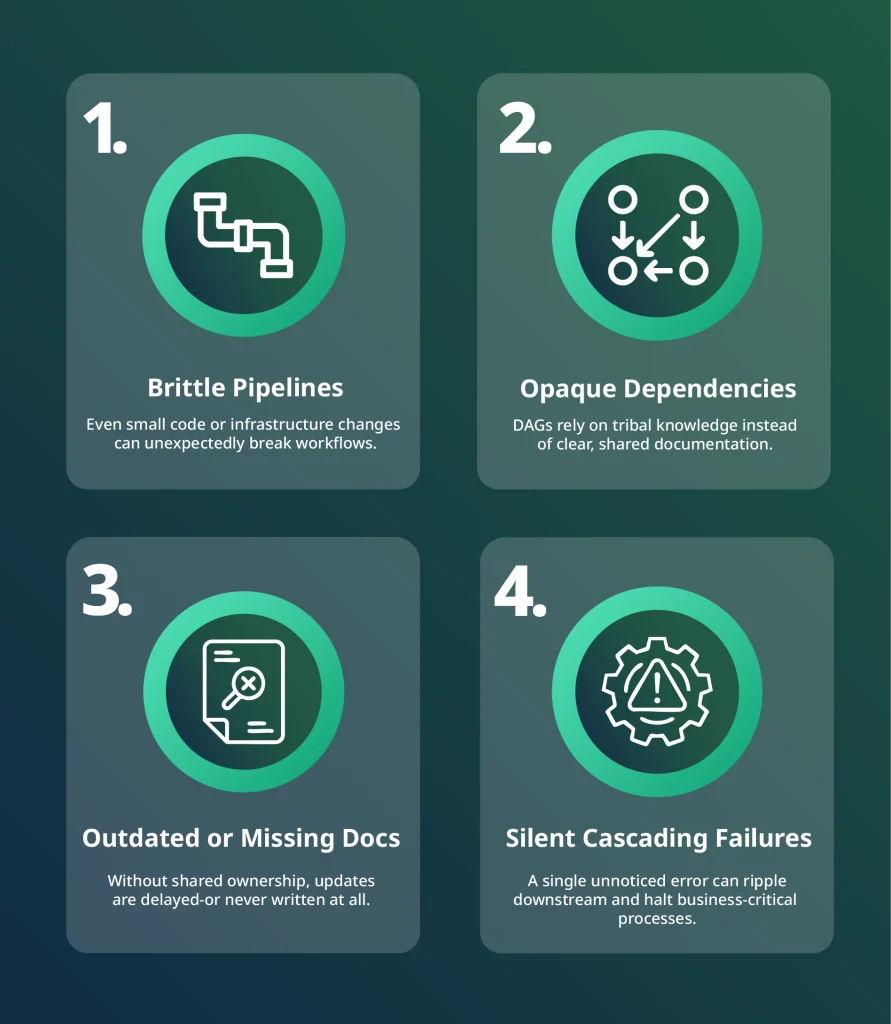
The Astronomer scandal didn’t cause these weaknesses; it simply exposed them. It reminded teams of a question many prefer to avoid:
“What happens if our orchestrator (or the one person who knows it best) suddenly disappears?”
For most organisations, the honest answer is uncomfortable. And for CTOs, founders, and IT executives, that’s the wake‑up call.
Data Leaders: How to Eliminate Hidden Risks in Your Orchestration
True resilience in data engineering is about ownership, visibility, and continuity. When your orchestration layer is fragile, your team is exposed to turnover, vendor lock‑in, and sudden platform outages.
If you’re seeing any of these warning signs, your pipelines are at risk:
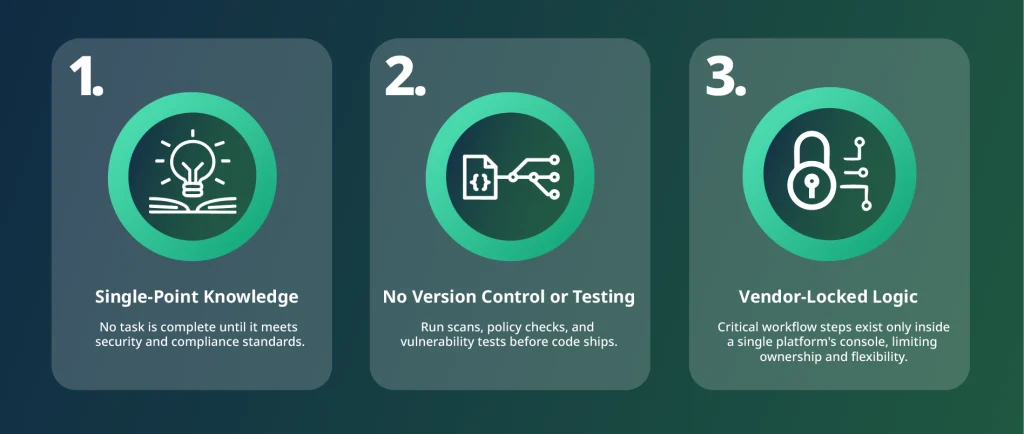
If this feels familiar, your team doesn’t own its orchestration. You’re renting it.
A striking example of vendor dependency risk came in 2017, when British Airways suffered a two‑day IT outage that grounded every flight worldwide. A single vendor‑managed system failed after a power surge, triggering cascading downtime across the airline’s operations and an estimated $68 million in losses. (source: BBC)
And with cloud tools evolving rapidly and engineers moving on faster than ever, rented workflows can collapse overnight.
To eliminate these risks:
- Document and share knowledge so that no pipeline depends on one engineer.
- Adopt version control and testing to track changes and prevent regressions.
- Keep workflows modular and portable, avoiding vendor‑locked logic.
By taking these steps, your orchestration becomes resilient, auditable, and capable of surviving team turnover or platform shifts.
The Astronomer scandal is a clear signal: resilient data pipelines come from modular design, shared knowledge, and workflows that can survive change, no matter who leaves or what vendor falters.
The One Question Every CTO Should Be Asking About Orchestration
If your orchestration vanished tomorrow (whether a vendor went down, a core tool failed, or your lead engineer left), would your data workflows survive?
For many organisations, the honest answer is “no.” Workflows are often brittle, undocumented, and too dependent on single points of failure.
Asking this question now is a safeguard. Identifying these risks today prevents the costly outages, delays, and operational chaos that come when reality forces the issue.
Building Future-Proof Orchestration
Astronomer and Apache Airflow remain powerful tools, but no vendor or single engineer should ever become a dependency your business can’t survive without. Real resilience comes from designing replaceable, observable, and modular pipelines that can keep running even as teams change, vendors pivot, or cloud stacks evolve.
What Future‑Proof Orchestration Looks Like
- Modular and Documented Pipelines
Every workflow should be broken into small, independent DAGs (Directed Acyclic Graphs that define tasks and their dependencies) with clear dependencies and peer‑reviewed code. When pipelines are modular, small changes don’t ripple into catastrophic failures, and documentation ensures anyone can understand or update the system quickly.
- Platform‑Agnostic Design
Orchestration should never live entirely inside a single console. By using Infrastructure as Code (IaC), containerised tasks, and standardised APIs, pipelines can be migrated or rebuilt on other platforms without downtime. This prevents vendor lock‑in and keeps control in the team’s hands.
- Full Observability, Versioning, and Testing
Future‑proof pipelines are auditable and safe to change. Version control, automated testing, and real‑time monitoring ensure that new releases don’t break existing workflows and that failures are caught before they cascade downstream.
Why Leading Data Teams Shift to Full‑Stack Squads
Organisations are realising that isolated engineers and vendor‑managed orchestration create hidden risks, like knowledge silos, brittle pipelines, and limited agility.
To overcome these challenges, leading data teams are adopting full‑stack, sprint‑based delivery models that distribute ownership and accelerate innovation.
In this approach:
- Cross‑Functional Squads Own Orchestration End‑to‑End: Each squad is a full‑stack delivery team that includes front‑end and back‑end engineers, solution architects, cloud managers, project managers, QA testers, DevOps experts, and data engineers, working within the same sprint cycles. This ensures orchestration design, infrastructure, and testing are handled collaboratively rather than scattered across teams or vendors.
- Knowledge Is Shared, Not Trapped: With structured documentation, peer reviews, and shared coding standards, no single departure or vendor change can halt operations. Any squad member can understand and update a DAG, keeping orchestration resilient and future‑proof.
- Agility and Reliability Increase Together: Sprint‑based delivery allows teams to iterate on workflows quickly, test changes safely, and deploy improvements aligned with evolving business needs. Pipelines evolve continuously instead of staling or breaking under pressure.
- Business Value Is Continuous: Cross‑functional squads treat orchestration as a living system that adapts to new data sources, compliance requirements, and platform updates, without downtime or dependency risks.
A sprint‑based, full‑stack delivery model powered by P‑Suite allows orchestration systems to remain stable even during major changes.
By integrating development, QA, operations, and design into one cross‑functional squad, organisations can avoid single‑person dependencies and ensure orchestration evolves smoothly as needs grow.
Explore how a custom squad could support your orchestration strategy and long‑term scalability. Download your free P-Suite guide.
The Real Lesson Behind the Astronomer Scandal
While the Astronomer sex scandal grabbed headlines, the deeper story for CTOs and data leaders is a wake‑up call: fragile data pipelines and single‑point dependencies can break a business long before workplace drama ever does.
Future-proofing your orchestration means building modular, documented DAGs, ensuring platform-agnostic design, and adopting full-stack squads that share ownership end-to-end.
This shift transforms orchestration from a fragile dependency into a resilient, living system that can survive turnover, vendor changes, and rapid cloud evolution.
Scandals grab headlines, but brittle pipelines fill your error logs.
Fix the logs before you ever make the news.
Frequently Asked Questions About Orchestration, CI/CD, and Vendor Dependencies
What is multi‑agent orchestration?
Multi‑agent orchestration is the coordination and management of multiple autonomous software agents that work together to complete complex tasks or workflows. Each agent is responsible for a specific role, such as data processing, monitoring, or decision‑making, and the orchestration layer ensures they operate in the right sequence and share information efficiently.
Key aspects include:
- Task distribution: Assigning responsibilities to the appropriate agents.
- Dependency management: Ensuring tasks run in the correct order with the required data.
- Error handling and recovery: Detecting and resolving issues if an agent fails.
Multi‑agent orchestration is common in AI workflows, data pipelines, robotic process automation (RPA), and microservices environments, where multiple independent components must function as a cohesive system.
What is the difference between CI/CD and orchestration?
CI/CD (Continuous Integration and Continuous Delivery/Deployment) and orchestration both deal with automation, but they solve different problems:
- CI/CD focuses on the software delivery pipeline, automating code builds, testing, and deployment to production.
- Orchestration coordinates broader operational workflows across infrastructure, services, and applications, often outside the scope of a single deployment pipeline.
In practice:
- A CI/CD pipeline ensures that new code is automatically tested and deployed.
- Orchestration ensures that all services, resources, and data flows work together after deployment, managing dependencies, scaling, and error recovery.
For example, CI/CD might deploy a new microservice, while orchestration ensures that the service connects properly with databases, queues, and other services in production.
What is a vendor dependency?
A vendor dependency occurs when a company relies on a third‑party vendor or service for a critical part of its operations, software, or infrastructure. This reliance can become a risk if:
- The vendor experiences downtime or performance issues.
- The vendor changes pricing, features, or access policies.
- The business has no internal capability to operate without that vendor.
Examples include:
- Depending on a single cloud provider for hosting and storage.
- Relying on one SaaS tool for key workflows without alternatives.
- Using a managed orchestration platform without in‑house expertise to run pipelines independently.
Minimising vendor dependencies typically involves multi‑vendor strategies, internal knowledge retention, and backup solutions.
What does the company Astronomer do?
Astronomer provides an enterprise orchestration platform for Apache Airflow, an open‑source tool used to manage data pipelines and workflows. Its platform helps data teams:
- Author and schedule data pipelines in a scalable environment.
- Monitor and troubleshoot workflows with visual dashboards and logging.
- Deploy Airflow in the cloud or hybrid setups with enterprise‑grade support.
Astronomer positions itself as a managed solution for Airflow, offering reliability, security, and support features that reduce the operational burden of running Airflow at scale.
Explore our BLOG
Recent articles

ISO 42001 Explained: Requirements, Certification and What Your Engineering Team Must Build
ISO 42001 is the international standard that demonstrates your organisation governs AI properly, and enterprise...
read full article

Is Claude Down? Anthropic Outage: Protect Your Cloud Infrastructure
Claude went down across every surface on 29 September 2026. From 14:00 to 14:59 UTC,...
read full article

Top 10 Healthtech Companies in 2026: What Their Growth Means for AI and DevOps
Every software change that reaches a hospital has to clear regulatory, legacy system, and clinical...
read full article