


Cloud computing is reshaping modern agriculture and farm technology in ways that were unthinkable a decade ago. When data, insights, and decision-making move into the cloud, farmers gain something priceless: clarity.
TL;DR
Cloud adoption in agriculture is no longer experimental but directly tied to measurable gains in yield stability, cost control, and risk reduction. This article reveals where cloud platforms create the biggest real-world impact in FarmTech, from precision decision-making to scalable systems that support long-term food security.
Real-time weather trends become easier to read, soil behaviour becomes predictable, crop performance becomes measurable, and collaboration across regions becomes effortless. The result is smarter planning, healthier yields, and farming that feels less reactive and far more controlled.
At scale, these benefits strengthen entire agricultural ecosystems.
- Cloud-powered analytics improve food security, reduce waste, remove unnecessary costs, and raise the overall quality of cultivation.
- Farmers, agronomists, suppliers, and policymakers all gain the same thing: a more resilient and sustainable way to grow.
Let’s dig in.
How Cloud Computing is Transforming Agriculture: Critical Benefits
The shift toward digital and cloud-enabled agriculture is already visible in the numbers.
The global smart agriculture market is projected to grow from $25.9 billion in 2025 to $60.9 billion by 2034, expanding at a rapid CAGR of around 10.8%. (source: Global Market Insights)
At the same time, the global agriculture cloud market alone was valued at approximately $3.2 billion in 2024 and is expected to reach about $10.8 billion by 2033, growing at a 14.5% CAGR, reflecting strong demand for cloud-native solutions in farming. (source: Market Intelo)
This surge is powered by the widespread adoption of IoT sensors, precision farming platforms, satellite and drone monitoring, and cloud-based analytics that translate raw farm data into actionable decisions.
This is what drives this growth: cloud computing gives farmers something they’ve historically lacked, and that is real-time visibility.
When soil sensors, weather stations, irrigation systems, drones, and machinery all send live information to the cloud, farmers gain a full, constantly updating picture of their fields. That clarity leads to better timing, fewer input losses, stronger yields, and more predictable planning.
This momentum is also reflected in farmer behaviour. Adoption rates for digital tools continue to rise globally because cloud platforms remove the traditional barriers: expensive hardware, siloed tools, and complex infrastructures.
With the cloud, even smaller producers can access capabilities that used to belong only to large agribusinesses.
In other words, the market isn’t just growing but shifting the entire mindset of how agriculture operates. Cloud-powered farming reduces risk, increases efficiency, and builds resilience into food systems that increasingly depend on precision, speed, and sustainability.
Here are the key benefits cloud computing brings to agriculture.
Centralised Farm Data for Faster, Smarter Decisions
Cloud computing removes one of agriculture’s biggest historical limitations: fragmented, hard-to-reach information.
Farmers no longer have to depend on scattered spreadsheets, isolated sensors, or manual field notes. With cloud platforms, they can collect, store, and analyse everything in one place, from hyperlocal weather data and soil health to moisture levels, growth patterns, equipment performance, and historical yield trends.
This constant stream of real-time data gives farmers something they’ve never had at scale: instant clarity. Decisions about irrigation, fertiliser use, planting windows, and disease prevention become faster and far more accurate.
The cloud also makes collaboration effortless. Agronomists, suppliers, researchers, co-ops, and even neighbouring farms can securely share insights, compare patterns, and solve problems together, all without sitting in the same room.
The result is a fully connected agricultural ecosystem where decisions are informed, timing is precise, and every action is backed by data instead of guesswork.
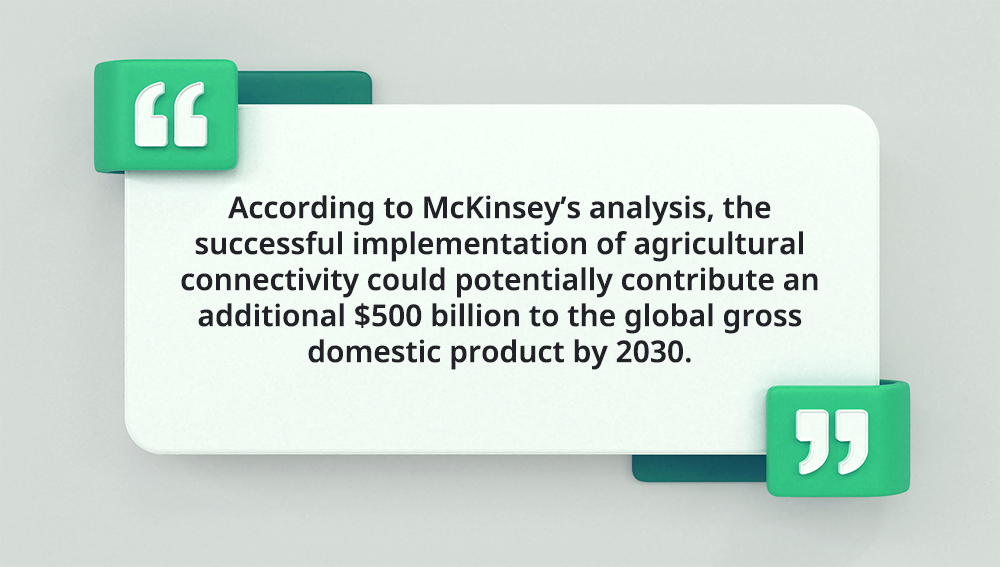
Real-Time Knowledge Sharing Across the Global Agriculture Network
Cloud technology removes the geographical barriers that once limited agricultural progress.
Farmers, researchers, and industry specialists can now connect instantly, share insights, and compare results in real time. This global flow of knowledge helps farmers adopt better practices faster, from pest management ideas to new irrigation methods. Cloud platforms essentially create a shared agricultural community where expertise travels freely, regardless of location.
Lower Costs, Higher Efficiency, and More Predictable Farm Economics
Cloud computing and precision-farming tools are already delivering measurable gains.
In the UK alone, around 60% of farms are now using satellite and drone imagery to track crop health and detect early signs of problems, and 53% are adopting IoT sensor networks to monitor soil conditions in real time, showing that digital technologies are no longer fringe tools but mainstream aids on UK farms. (source: RDP)
A recent review of modern smart farming techniques found that farms using cloud and AI-enabled agriculture saw yield improvements, reduced input waste, and greater resource efficiency.
For example:
- Smart irrigation and data-driven resource use helped some farms cut water usage by up to 96% and reduce fertiliser use by around 40%, while still increasing overall productivity.
- Predictive analytics and real-time monitoring allow accurate yield forecasts, allowing farmers to plan better, reduce waste, and buffer against negative surprises like extreme weather or disease.
By removing heavy upfront infrastructure costs and replacing them with scalable, cloud-based services, even small and resource-limited farms can adopt these tools. That means smarter, more efficient, and more predictable production, which translates directly into better food security and stronger economic resilience for farming communities.
Data-Driven Farming for Consistent Yields and Long-Term Food Security
Food security depends on consistency. Cloud computing helps FarmTech move toward predictability by giving farmers a clearer view of what’s happening in their fields and what’s likely to happen next. When data from weather systems, soil sensors, crop models, and supply chains flows into a single platform, risks become visible earlier and easier to manage.
Instead of discovering problems after damage is done, farmers can spot early warning signs, adjust inputs in time, and make smarter trade-offs when conditions change. This reduces sudden losses, limits waste, and stabilises output across seasons. At a broader level, these improvements ripple through the food system, supporting more dependable production, steadier pricing, and greater resilience in the face of climate pressure and growing demand.
Cloud-enabled farming helps ensure food is grown more reliably, year after year.
Precision-Driven Cultivation for Healthier, More Consistent Crops
Crop quality is shaped by thousands of small decisions made throughout the growing cycle. Cloud platforms give farmers the ability to fine-tune those decisions with far greater confidence. By continuously analysing field conditions, plant responses, and input timing, cloud systems help farmers maintain the narrow sweet spot where crops perform at their best.
Instead of applying water, nutrients, or treatments uniformly, farmers can adjust conditions crop by crop and zone by zone.
This level of precision reduces stress on plants, improves consistency across fields, and limits the overuse of resources that often lead to waste or long-term soil damage.
The outcome is better-quality produce, improved sustainability, higher yields, and farming practices that support long-term land health while meeting modern quality standards.

From Farm to Cloud: Practical Use Cases in Modern Agriculture
Cloud computing becomes most powerful when it’s applied to specific, everyday farming decisions. The following use cases show how cloud platforms move beyond theory and deliver practical value directly in the field.
As FarmTech platforms scale, the technology itself is only part of the challenge. Choosing the right way to build and maintain those systems matters just as much. This is especially true when deciding between freelancers, agencies, or dedicated engineering squads designed for FarmTech growth, where delivery speed, domain knowledge, and long-term ownership directly affect outcomes.
1. Crop Intelligence and Performance Analysis
Cloud platforms turn everyday farm data into long-term intelligence. Instead of treating each season as a fresh start, farmers can analyse how crops performed across different conditions, inputs, and locations over time. This historical and real-time insight helps reveal patterns that are impossible to spot manually.
By understanding which crops perform best in specific soils, climates, and rotations, farmers can plan future seasons with far more confidence.
Planting decisions become data-backed rather than instinct-driven, input strategies become more targeted, and long-term productivity improves without increasing risk.
2. Hyperlocal Weather Intelligence for Smarter Field Timing
Weather impacts almost every farming decision, but generic forecasts rarely reflect what’s happening in a specific field. Cloud and edge computing solve this by delivering location-aware, real-time weather insights that adjust as conditions change. Instead of reacting to sudden shifts, farmers can align irrigation, spraying, and harvesting with precise short- and mid-term forecasts.
Accuracy improves timing, reduces unnecessary interventions, and helps farms stay productive even during volatile weather patterns. Better forecasts protect schedules, resources, and margins.
3. Deep Soil Insights That Support Long-Term Land Health
Soil isn’t static, and cloud platforms treat it that way. By aggregating soil data over time, farmers gain visibility into how their land responds to different crops, inputs, and environmental conditions.
Trends in nutrient balance, moisture retention, and pH shifts become clear long before problems surface in the field.
Armed with this insight, farmers can fine-tune soil management strategies, prevent degradation, and maintain productivity year after year. The result is healthier land, more stable yields, and cultivation practices that support sustainability rather than exhaust it.
4. Continuous Crop Growth Tracking and Early Issue Detection
Healthy crops show subtle failure signals long before visible damage appears. Cloud-based growth monitoring makes those signals visible.
By analysing regular updates from field data, imagery, and sensors, farmers can track development stages, spot irregular growth patterns, and measure progress against expected benchmarks.
This ongoing visibility allows small corrections at the right moment (adjusting inputs, spacing, or timing) instead of large, costly interventions later. The result is steadier crop development, fewer surprises during the season, and stronger performance at harvest.
5. On-Demand Access to Agricultural Expertise
Not every challenge can be solved with software alone. Cloud and edge computing make it easier for farmers to tap into expert knowledge exactly when it’s needed.
Through connected platforms, farmers can share real-time field data, images, or observations with agronomists and specialists who can provide targeted guidance.
This immediate access shortens response times, improves decision quality, and reduces trial-and-error in the field. Over time, it also strengthens knowledge transfer across the agricultural community, helping farmers solve problems faster and farm more confidently.
6. Regional Agricultural Data for Smarter Policy and Planning
When farm data is aggregated at scale, it becomes a strategic asset.
Cloud platforms make it possible to analyse trends across regions, climates, and production types without exposing individual farmers.
This broader view helps decision-makers understand where productivity lags, which practices work best, and where support or infrastructure investment is most needed.
For policymakers and agricultural organisations, this insight allows targeted, evidence-based interventions instead of one-size-fits-all programs. The outcome is smarter planning, better resource distribution, and policies that reflect real conditions on the ground rather than assumptions.
7. Cloud-Enabled eCommerce and Demand-Driven Farming
Cloud-based systems give farmers a more direct connection to the market.
By selling through digital channels, producers can reach buyers without relying on long chains of intermediaries, improving pricing transparency and market access, especially in rural areas.
What makes this powerful is the feedback loop. Sales data, demand trends, and buyer behaviour can flow back into farm planning systems, helping farmers align production with what the market actually wants. Over time, this supports better crop selection, leaner supply chains, and farming strategies shaped by demand instead of guesswork.
How Cloud Migration Delivers Measurable Results for Agriculture and FarmTech
If cloud migration doesn’t reduce manual work or improve decisions, it’s just expensive paperwork. In agriculture, results have to show up in the field.
That’s what happened for Hall Hunter, a UK-based grower supplying major retailers with berries across hundreds of acres. The business relied on manual forecasting and a legacy on-premise setup that limited visibility, scalability, and accuracy.
Deployflow supported Hall Hunter’s transition to cloud-based environment, replacing fragmented systems with a more flexible and data-accessible foundation. The impact was immediate and tangible:
What changed after moving to the cloud:
- Around 30% reduction in IT costs after migrating from on-premise infrastructure
- Improved forecasting accuracy, replacing unreliable manual counting
- Clear, centralised access to operational data, supporting faster decisions
- Fewer support issues thanks to a more stable, modern system
- Greater flexibility to scale systems as operations evolved
The results show how cloud migration supports agricultural efficiency, cost control, and long-term resilience, not just IT modernisation.
For agricultural organisations facing similar challenges, cloud migration is often the most effective first step. It creates the technical foundation needed for analytics, automation, and smarter farming workflows, without disrupting daily operations.
For teams exploring how cloud migration could work in their own environment, a short conversation with Deployflow can help clarify the right starting point and next steps.
A focused migration strategy turns existing systems into something they were never designed to be: a reliable foundation for growth.
Frequently Asked Questions About Cloud Computing in Agriculture
Is cloud computing suitable for small and mid-sized farms, or only large agribusinesses?
Yes, cloud computing is increasingly designed with small and mid-sized farms in mind.
Modern platforms are modular, pay-as-you-go, and don’t require heavy upfront investment in infrastructure. This makes it possible to start small (for example, with weather analytics or soil monitoring) and expand over time. Many FarmTech tools are now built specifically to lower the barrier to entry for smaller producers. The key is choosing solutions that match the farm’s scale and operational maturity.
How secure is farm data stored in the cloud?
Cloud platforms generally offer stronger security than traditional on-premise systems when configured correctly.
Leading providers use encryption, access controls, continuous monitoring, and regular security updates that most farms couldn’t realistically maintain on their own. The biggest risks usually come from poor configuration or lack of governance, not the cloud itself. Working with an experienced cloud partner helps ensure data is protected and compliant with regional regulations.
How long does it take to migrate agricultural systems to the cloud?
The timeline depends on the complexity of existing systems and the scope of the migration. Simple data platforms or analytics tools can move in weeks, while full migrations of legacy infrastructure may take several months.
Some FarmTech organisations shorten timelines by using sprint-based, full-stack delivery squads, where cloud and DevOps experts work together in focused cycles. This approach supports phased migrations, delivers usable outcomes early, and reduces disruption to daily operations. In cloud migration, steady progress and clear ownership usually matter more than raw speed.
Do farms need in-house IT or DevOps teams to run cloud-based FarmTech platforms?
Not necessarily. Many farms and agri-organisations operate cloud platforms successfully without dedicated internal IT teams. Managed cloud services and external engineering partners can handle infrastructure, monitoring, and optimisation. This approach lets farming teams focus on production and strategy instead of maintenance. Over time, organisations can decide whether to build internal capability or continue with managed support.
Explore our BLOG
Recent articles

ISO 42001 Explained: Requirements, Certification and What Your Engineering Team Must Build
ISO 42001 is the international standard that demonstrates your organisation governs AI properly, and enterprise...
read full article

Is Claude Down? Anthropic Outage: Protect Your Cloud Infrastructure
Claude went down across every surface on 29 September 2026. From 14:00 to 14:59 UTC,...
read full article

Top 10 Healthtech Companies in 2026: What Their Growth Means for AI and DevOps
Every software change that reaches a hospital has to clear regulatory, legacy system, and clinical...
read full article