


TL;DR:
A smart toilet marketed as “end-to-end encrypted” turned out to be anything but. Researchers uncovered how familiar security language masked server-side access, exposing a wider problem with how IoT vendors describe privacy, encryption, and data control. The details matter more than the label.
A toilet camera promising privacy should never end with the vendor being able to see everything you flush.
Yet, that’s what happened with Kohler’s Dekoda device, a smart toilet advertised as “end-to-end encryption” that never delivered on that promise.
Researchers found that every image was decrypted on Kohler’s servers, giving the company full visibility despite the reassuring marketing language.
You rely on accurate IoT security terminology to judge whether a device is safe to introduce into your environment.
When a vendor uses familiar words (especially loaded ones like end-to-end encryption), you assume they’re describing the same protection you expect from secure messaging apps or zero-visibility architectures. When that assumption is wrong, your risk assessment becomes unreliable.
Misleading encryption language doesn’t just confuse consumers but puts technical teams in a position where decisions are made on incomplete or inaccurate information. Trust becomes fragile, and the gap between marketing and reality turns into a security liability you didn’t consent to.
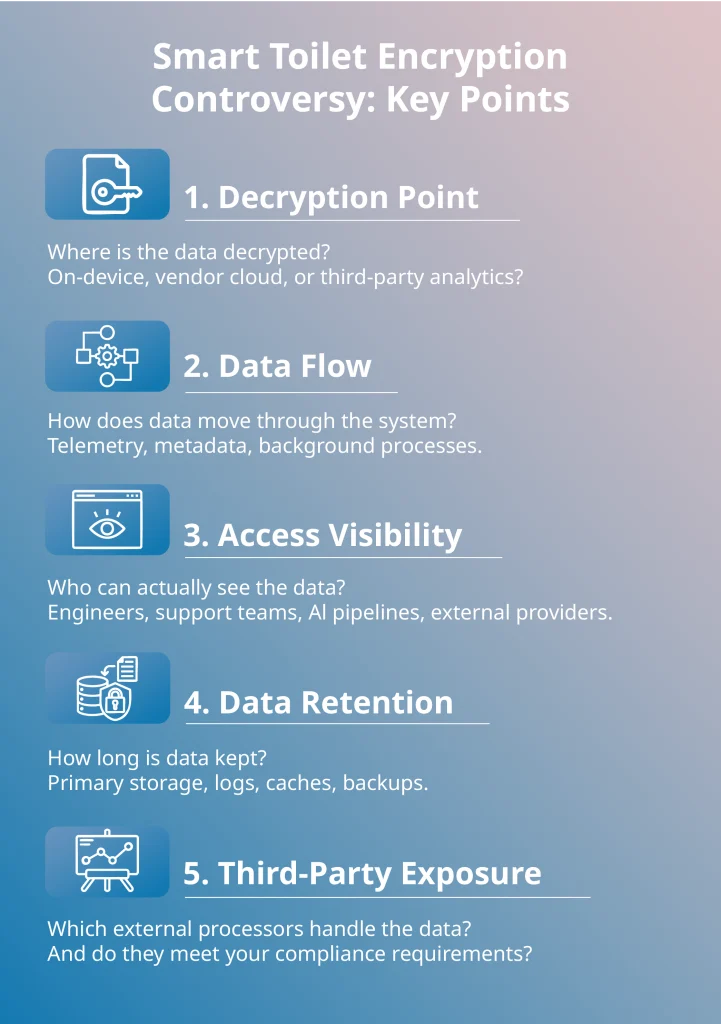
What Researchers Found: TLS, Server-Side Decryption, and Misused “E2EE”
Researchers uncovered a fundamental mismatch between what Kohler claimed and what the device actually did.
Instead of implementing true end-to-end encryption, the Dekoda camera relied on standard TLS (Transport Layer Security) to protect data in transit and then decrypted every image on Kohler’s servers.
That means the company had full access to the photos users assumed were private.
This is why the terminology matters. TLS keeps data secure while it moves, but it doesn’t protect anything once it reaches the vendor. Actual end-to-end encryption prevents anyone (not even the service provider) from decrypting user data. IoT devices rarely operate this way because cloud-side processing requires full visibility into the data being analysed.
The gap between marketing language and technical reality became clear once researchers reviewed the device’s behaviour and privacy policy, as reported by TechCrunch.
When an IoT vendor can decrypt user data, the product is not end-to-end encrypted, no matter how confidently the phrase appears in the documentation.
Another Real-World Example: Wyze’s Security Breach That Let Users See Inside Other People’s Homes
A recent Wyze incident shows how fragile IoT privacy becomes when vendors oversell security or underestimate how their systems behave at scale.
In early 2024, Wyze publicly apologised for a breach that allowed roughly 13,000 customers to see live video feeds from other users’ security cameras, a scenario that instantly destroys trust in any connected-device platform.
The company attributed the issue to a flaw in its backend architecture that exposed video streams during a system update.
To the affected customers, the explanation didn’t matter.
They bought a security camera under the assumption that their home footage was private, protected, and isolated. Instead, strangers were briefly able to access real-time video inside their homes.
Security failures like this aren’t limited to consumer devices. Organisations across the UK faced similar lessons in 2025 when high-impact breaches exposed weaknesses in visibility, monitoring, and vendor assurance. For a practical breakdown of what technical leaders should take from these incidents, read the report about the UK cyberattacks in 2025.
The Wyze example mirrors the core problem you face when evaluating IoT products: vendors often frame their systems as “secure” without delivering the controls users believe they’re getting.
Whether the promise is “end-to-end encryption,” “zero-knowledge,” or simply “your data stays private,” the gap between marketing and reality can be wide enough to turn a trusted device into a serious risk for privacy, compliance, and your overall security posture.
The Bigger Problem: How IoT Vendors Misrepresent Security and Privacy
IoT vendors ship assumptions about privacy, encryption, and data handling. And too often, those assumptions are shaped by inflated claims or terminology that feels secure but actually isn’t.
Words like “end-to-end encryption,” “secure by design,” and “zero-trust” appear in marketing long before they appear in the product architecture.
You’ve already seen how dangerous that gap can be. The Wyze breach, where a system flaw let 13,000 customers view video from other people’s homes, showed how quickly a “secure” IoT product can betray user expectations.
And that’s the bigger pattern: Misrepresentation doesn’t always look like a lie. Sometimes it’s just the absence of clarity. But the impact is the same: you make decisions based on the wrong threat model.
When vendors oversell security, the consequences hit your team first:
- Privacy exposure: Data ends up accessible at layers you didn’t know existed.
- Compliance gaps: DPIAs break, documentation becomes inaccurate, and regulators lose patience quickly.
- Engineering risk: Devices integrate into your environment under assumptions that don’t match reality.
- Loss of trust: Once the truth surfaces, it’s impossible to treat the vendor’s claims at face value again.
When marketing promises outpace technical reality, your environment absorbs the risk.
AI Training and Data Handling Risks in Connected Devices
AI is the new engine behind most connected devices, and that creates a data problem most users never see.
IoT vendors often need access to raw device data to train, improve, and validate their models. That data doesn’t stay on the device but moves into cloud pipelines, analytics systems, and training environments where visibility expands far beyond what customers expect.
The pattern is consistent across the industry:
- Devices collect sensitive sensor data.
- Vendors process it server-side to generate insights.
- The same data becomes training fuel for future AI models.
This is why many IoT companies emphasise “de-identified” data when asked about privacy. But de-identification sounds stronger than it is.
Most datasets can be partially or fully re-identified when combined with logs, metadata, timestamps, user behaviour patterns, or other signals already sitting inside the vendor’s systems.
For you, this creates two major risks:
- You lose control over where your data travels once it leaves the device. Even if the vendor promises responsible use, training pipelines often involve multiple services, storage layers, and third-party processors.
- You inherit privacy exposure you didn’t plan for. De-identified data can still reveal patterns about individuals, households, or environments when matched with adjacent datasets.
The smart toilet incident highlighted this. A device marketed as private still fed images into a system where the vendor (not the user) retained full visibility and potential AI training value.
Remember:
If a vendor can decrypt or process your data, that data can also train their AI. And the term “de-identified” isn’t a guarantee of privacy but a starting point for questions.
What the Smart Toilet Scandal Means for CIOs, CISOs, and Engineering Teams
Incidents like the Dekoda smart-toilet case are warnings. When a vendor misrepresents encryption or quietly retains visibility into user data, the risk doesn’t stay in the consumer market. It follows every organisation that adopts connected devices, integrates IoT sensors, or relies on cloud-processed data streams.
For you, this means one thing: trusting the marketing page is no longer an option.
You need concrete proof of how the device handles data, where encryption ends, and which systems can see the raw feed.
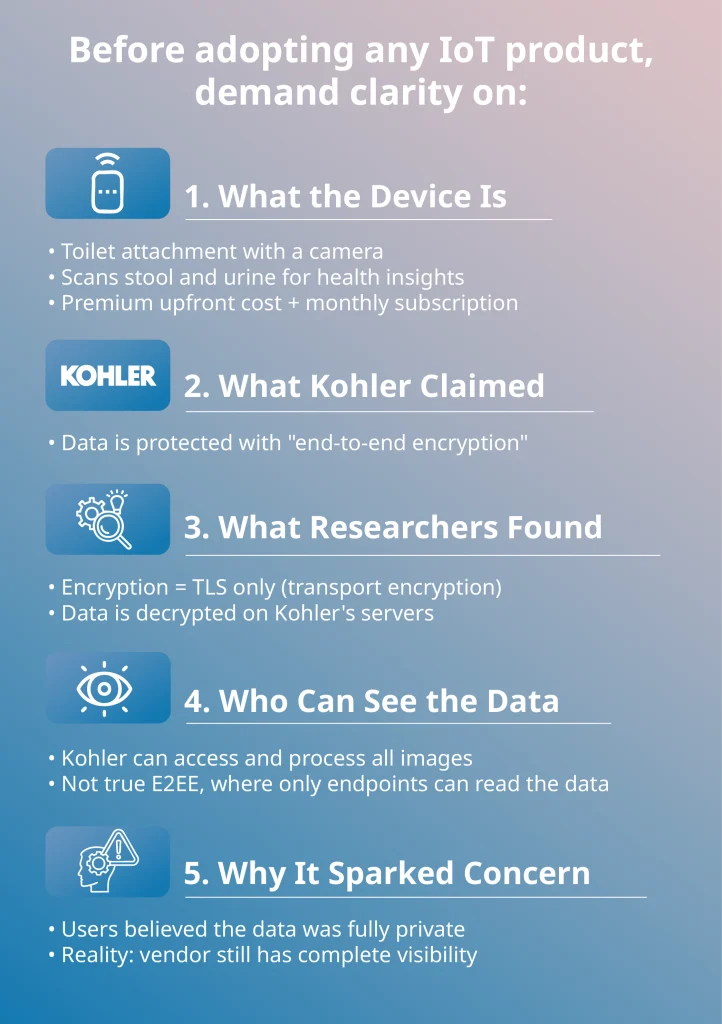
These are your baseline for evaluating IoT privacy, compliance alignment, and architectural safety. If the vendor hesitates or answers vaguely, treat that as a signal.
The smart toilet case revealed the truth: Any data a vendor can decrypt becomes accessible to attackers the second that vendor is breached.
And if you only discover the real data flow after deployment, the exposure is already yours to manage.
Stronger evaluation frameworks only work when the teams behind them operate at speed, with clarity, and with shared ownership. Organisations can improve both security and delivery outcomes by adopting smaller, outcome-driven engineering squads.
To see why this structure consistently outperforms large, slow-moving teams, explore these findings on small-team performance in DevOps, cloud, and SaaS delivery.
A Practical IoT Security Review Framework (VANT)
Strong IoT security starts with how you evaluate the vendor behind the device. The VANT framework gives your team a clear, repeatable way to validate every claim before a product enters your environment.
VANT: Your IoT Security Reality Check
Verify
- Map where encryption starts and ends
- Identify exposure points across transfers, processing layers, and cloud paths
Assess
- Determine who can access decrypted data
- Check retention: primary storage, logs, caches, backups
- Confirm whether data feeds AI training pipelines
Negotiate
- Define limits on data use, retention, AI training, and third-party processing
- Require documented responsibilities before adoption
Test
- Inspect real traffic, device behaviour, and backend interactions
- Validate claims through observation, not marketing language
Complex IoT environments depend on cloud architectures where data moves across multiple services, logs, and analytics layers. To make VANT fully effective, organisations often need a clear, end-to-end view of how that data actually behaves.
Deployflow’s cloud security assessment helps teams map real data flows, validate encryption boundaries, and uncover hidden risks before a device enters production. Paired with VANT, it gives you a factual, evidence-backed picture of every IoT product the moment it touches your infrastructure.
Precision in Encryption Claims Is a Security Control
Accuracy in security language is part of your defence strategy. When a vendor uses terms like end-to-end encryption loosely, you inherit assumptions that shape how you evaluate risk, document compliance, and design your architecture around the device. If the terminology is wrong, every downstream decision is built on sand.
This smart toilet incident makes that point impossible to ignore.
A single misleading phrase created a false sense of privacy, hid server-side visibility, and blurred the reality of how user data moved through the system.
IoT security depends on transparency: where data goes, who can see it, and what happens when it leaves the device. Without that clarity, even small products introduce outsized risk.
Precision doesn’t slow teams down; it protects them from surprises that arrive only after the device is deployed and deeply integrated into your environment.
Frequently Asked Questions About IoT Security and Encryption
Is TLS encryption enough to protect sensitive data from IoT devices?
No, TLS alone is not enough to protect sensitive data collected by IoT devices.
TLS only protects the data while it’s moving between the device and the server, not after it arrives. Once decrypted on the vendor’s systems, the data becomes fully accessible to anyone with internal access or who compromises the vendor. Sensitive health or home-camera data requires stronger controls, such as local processing or true E2EE.
How can I tell whether an IoT product actually uses actual end-to-end encryption?
You can confirm true E2EE by checking whether the vendor can decrypt your data at any point.
If the company can access or process the raw content, it is not end-to-end encrypted. True E2EE means only the device and the user hold the keys, and even the vendor cannot see what’s collected. Always review technical documentation, not just marketing language.
Do IoT devices store data locally, or does everything go to the cloud?
Most IoT devices store and process data in the cloud, not locally.
Cloud processing allows vendors to analyse data, run AI models, and deliver insights at scale, but it also increases exposure. Where the data flows and where it’s retained should always be part of your evaluation. Local processing, or edge computing, reduces this risk but remains uncommon in consumer IoT.
What should organisations look for when evaluating the security of a new IoT vendor?
Organisations should look for clear documentation on encryption, data flow, retention, and access controls.
A credible vendor will show where data is decrypted, who can see it, and how long it stays in logs, backups, or analytics pipelines. You should also verify how the product behaves during testing, not just rely on claims. Any gaps or vague answers during evaluation should be treated as a warning.
Can DevOps managed services help reduce security risks when deploying IoT devices?
Yes, DevOps managed services can significantly reduce IoT security risks by improving the deployment and monitoring of devices, cloud environments, and data pipelines.
These teams ensure that encryption boundaries, access controls, and logging configurations are implemented correctly from the start. They also help standardise infrastructure, eliminate misconfigurations, and create continuous monitoring practices that catch issues early. For organisations adopting IoT at scale, DevOps managed services provide the operational discipline needed to maintain security across fast-moving, distributed systems.
Explore our BLOG
Recent articles

ISO 42001 Explained: Requirements, Certification and What Your Engineering Team Must Build
ISO 42001 is the international standard that demonstrates your organisation governs AI properly, and enterprise...
read full article

Is Claude Down? Anthropic Outage: Protect Your Cloud Infrastructure
Claude went down across every surface on 29 September 2026. From 14:00 to 14:59 UTC,...
read full article

Top 10 Healthtech Companies in 2026: What Their Growth Means for AI and DevOps
Every software change that reaches a hospital has to clear regulatory, legacy system, and clinical...
read full article