



A 40% drop in misconfiguration findings may sound impressive, but that number alone does not tell a CTO what really changed.
In testing Prowler for AWS security scanning, the more important question was whether the result pointed to lower cloud risk, better remediation, stronger governance, or simply a different scan scope.
Security tools can produce cleaner reports without materially improving the resilience or control of the AWS estate. For leadership teams, what matters is whether the issues that carry real weight are being identified, prioritised, and fixed in a way that reduces exposure.
The Main Lessons From Testing Prowler for AWS
- A 40% drop in findings only matters if the comparison stayed consistent.
- Prowler helped surface meaningful AWS control gaps, but lower volume did not prove lower risk on its own.
- The stronger signal came from where findings remained concentrated and how easy they were to remediate.
- The real outcome was not a cleaner report, but a clearer view of which weaknesses still needed governance attention.
Prowler for AWS Test Method and Scope
This test was designed to check whether fewer findings reflected better AWS control or simply a different scan shape.
We ran Prowler for AWS security scanning across the same core AWS environment twice: first to establish a baseline, then again after a remediation cycle.
The review focused on the control areas most relevant to cloud risk and governance, including IAM, S3 access, logging, encryption, network exposure, and detective or preventive controls.
To keep the comparison meaningful, both scans followed the same broad scope, benchmark logic, and severity approach. The goal was to see whether Prowler produced a signal strong enough to support remediation, governance review, and better decision-making at the CTO level.
What Changed Between the Two Scans
The 40% reduction mattered less than where the findings changed and where they did not.
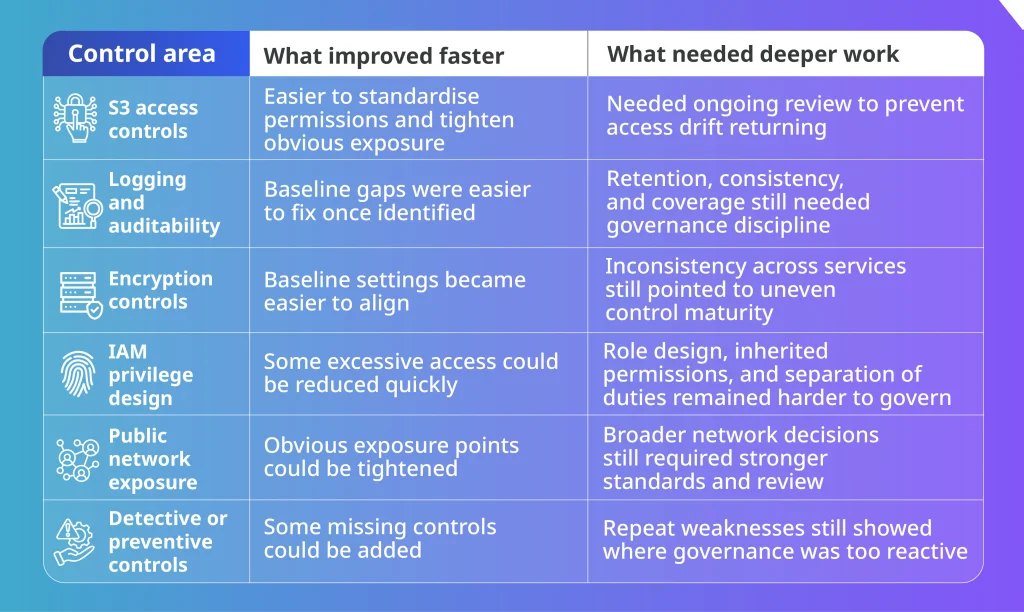
The second scan showed cleaner results in areas that were easier to standardise, such as parts of storage access, logging, and baseline encryption control.
The weaker areas were more structural. IAM privilege design, public exposure, and missing detective or preventive controls still carried the most weight because they pointed to governance issues rather than isolated misconfigurations.
That made the result more useful than a simple headline number. It showed that some weaknesses were responsive to remediation, while others needed stronger ownership, better standards, and more disciplined control across the AWS estate.
How to Interpret a 40% Drop in AWS Misconfiguration Findings
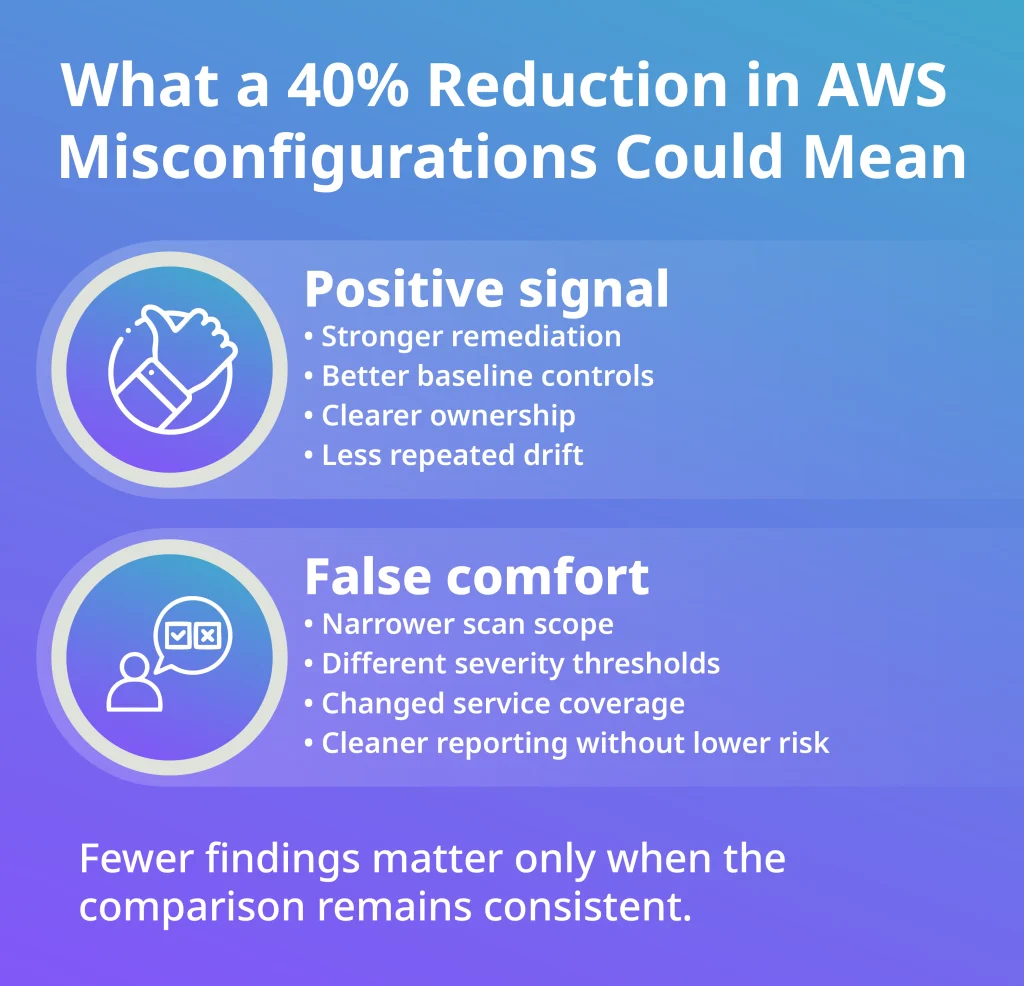
A 40% reduction in findings is useful only when the comparison behind it is stable.
In the best case, it points to stronger remediation, better baseline control, and less repeated drift across the AWS estate.
In the worst case, it reflects a narrower scope or cleaner reporting without much real reduction in risk.
The AWS Misconfigurations That Carried the Most Risk
The most important finding from this test was where meaningful weaknesses continued to cluster.
That pattern reflects a wider reality. CISA and NSA have described common cybersecurity misconfigurations as systemic weaknesses across many networks, which is exactly why recurring access, exposure, and control gaps matter more than the headline number alone.
- IAM Privilege Issues: IAM carried the most weight where access design had become broader and harder to govern than intended. That mattered because it increased blast radius and made access control more difficult to defend at scale.
- S3 Exposure and Access Controls: Storage risk is rarely limited to obvious public access. Weak bucket policies, inconsistent permissions, and loose access boundaries can quickly become governance and data exposure problems.
- Logging and Audit Gaps: Gaps in logging weakened both accountability and visibility. Where audit trails were incomplete or inconsistent, the AWS estate became harder to investigate and harder to defend under scrutiny.
- Encryption Weaknesses: Uneven encryption settings pointed to inconsistent control maturity. The issue was not only missing protection, but the fact that standards were not being applied consistently enough across services or teams.
- Public Network Exposure: Public exposure expanded the attack surface in ways that were often avoidable. Those weaknesses are especially hard to justify in a risk review because they usually stem from decisions that stayed in place too long.
- Missing Detective or Preventive Controls: Missing controls allowed drift and repeated mistakes to survive longer than they should. That made the issue a governance weakness as much as a security one.
Where AWS Controls Improved and Where Governance Stayed Weak
Why the Real Risk Sat Beyond the Headline Number
The deeper insight from the test was seeing which control areas improved cleanly and which ones still pointed to structural weakness. That made the result more useful than a simple reduction in findings.
Where Prowler Helped and Where It Fell Short
Prowler added value by improving visibility across AWS controls, but it did not remove the need for context, prioritisation, or ownership.
It was most useful as a baseline assessment tool. It made configuration drift, policy gaps, and control weaknesses easier to see across the AWS estate, which made the findings more useful in governance reviews and compliance discussions.
Its limits were just as clear. Not every finding carried the same risk weight, and some issues needed engineering context before they could be judged properly. Without clear ownership and prioritisation, the output could still become more noise than action. Most importantly, fewer findings did not automatically mean lower business exposure.
Prowler vs Real AWS Risk: Why Finding Volume Is the Wrong Success Metric
A cleaner report is not the same as a safer AWS estate.
More findings can reflect broader coverage or better visibility into weaknesses that were already there. Fewer findings can reflect a narrower scope or cleaner reporting while material exposures remain unresolved.
For CTOs, the better questions are simpler.
- Are critical issues still open?
- Do the same weaknesses keep returning?
- How quickly are important findings remediated?
- Are standards being enforced consistently across accounts and teams?
Those answers say far more about real AWS risk than finding volume alone.
How CTOs Should Evaluate AWS Security Scanning Tools
CTOs should look for six things: a strong signal across multi-account AWS estates, checks that map to real cloud risk, support for repeatable governance, findings that turn clearly into remediation work, value in audits and reviews, and a fit with engineering workflows.
That means the tool should surface meaningful weaknesses consistently across accounts, focus on real exposures rather than low-value noise, and support governance as an ongoing discipline rather than a one-off assessment.
That same governance question becomes even clearer when cloud choice enters the discussion, as our comparison of AWS, Azure, and GCP shows that IAM complexity, policy enforcement, and drift risk often matter more than provider branding alone.
An AWS security scanning tool should support clear prioritisation, defined ownership, and structured remediation, while still giving leadership useful audit and reporting visibility.
A scanner that only feeds a dashboard will always be less useful than one that helps teams improve control across the AWS estate.
From AWS Security Findings to Better Cloud Governance
Give each control area a clear owner.
IAM findings should go to the team responsible for identity and access. Logging gaps should go to the team that owns monitoring and auditability. Storage, encryption, and network issues should follow the same logic. When ownership is vague, findings stay open longer, and governance gets weaker.
Prioritise material weaknesses. Do not work through the list in order or focus on total volume. Start with the findings that create the most exposure, affect critical systems, or keep appearing across accounts. That gives leadership a clearer view of what is actually being reduced.
Look for repeat issues. If the same problems keep coming back, the answer is usually not another fix. It is a weak platform standard, a missing policy, or a gap in how teams build and change infrastructure. That is where scan results should feed into better guardrails and stronger default configurations.
Use scans in regular governance reviews rather than during clean-up periods or under audit pressure. The point is to track whether critical issues are closing, whether the same gaps are returning, and whether control is becoming more consistent across the AWS estate. As our analysis of the October 2025 AWS outage argues, resilience depends on proactive design, tested failover, and reducing hidden dependencies before disruption exposes them.
Lastly, move important findings into sprint-based remediation. Give teams a defined set of fixes, owners, and timelines, then review progress properly. That is how scan results start improving governance. They move from static reporting into structured action.
That follow-through matters both financially and operationally. IBM reports that organisations with fully deployed security automation saw an average breach cost of $2.45 million, compared with $6.03 million for those without it, which reinforces the case for turning findings into structured remediation rather than leaving them in dashboards.
Security scanning helps most when findings move into a delivery model that can resolve them through ownership, standards, and repeatable follow-through.
Why AWS Security Scanning Needs Strong Cloud Security Delivery Behind It
Security scanning creates value only when the organisation can turn findings into better control. That is where many AWS security programmes slow down. The tool identifies issues, but the harder part is deciding what matters most, assigning ownership, and fixing weaknesses in a way that improves governance without disrupting delivery.
Deployflow brings more than reporting. With full-stack delivery squads, sprint-based execution, and strong operational ownership across cloud, platform, and application layers, the focus stays on reducing material risk rather than just reviewing findings.
In one AWS-based engagement, Deployflow helped Strike improve cloud environment stability by 70%, reduce downtime by 60%, and improve release reliability by 55% after addressing critical platform weaknesses and introducing a more resilient operating model.
Deployflow’s delivery model makes it easier to move from misconfiguration visibility to structured remediation, clearer standards, and stronger control across the AWS estate.
For teams that need more than another dashboard, Deployflow’s cloud security is the next relevant step. It helps organisations assess weaknesses, prioritise meaningful risks, and improve their cloud security posture while supporting governance, resilience, and delivery.
Start With an AWS Security Review
Prowler is useful, but the bigger question is what the organisation should do with the findings. A security scan can highlight gaps, but it does not decide which weaknesses matter most, where governance is breaking down, or what should be fixed first to improve control without slowing delivery.
An AWS security review helps answer those questions. It can show where misconfiguration risk is concentrated, which findings carry the most weight, and what actions will strengthen the AWS estate fastest.
That gives leadership something more useful than another report. It gives them a clearer path to better cloud control.
Final Takeaways for CTOs
- Fewer findings did not prove lower risk.
- The result only mattered if the comparison stayed consistent.
- The strongest signal came from the remaining findings.
- IAM, exposure, and missing controls mattered more than the headline number.
- Prowler improved visibility, not ownership.
- Remediation still determined the outcome.
- Better AWS security depended on what happened after the scan.
- Stronger standards, clear ownership, and repeatable follow-through made the difference.
Frequently Asked Questions About Prowler for AWS Security Scanning
Is Prowler suitable for multi-account AWS environments?
Yes, Prowler can be useful in multi-account AWS environments.
That matters because most CTOs are not trying to assess one isolated account. They need visibility across shared services, production workloads, and platform accounts without losing consistency. In practice, the real question is not whether Prowler can run across multiple accounts, but whether the organisation can interpret the results in a way that supports governance across the whole estate.
Can Prowler help with AWS compliance assessments?
Yes, Prowler can support compliance assessment work.
It can help surface control gaps that are relevant to internal reviews, audit preparation, and broader compliance conversations. That said, it should not be treated as a complete compliance answer on its own. A scan can show weaknesses, but leadership still needs context, ownership, and evidence of remediation before controls are truly defensible.
How often should AWS security scans be run?
AWS security scans should be run regularly and never treated as a one-off exercise.
The right cadence depends on how often the environment changes, how many teams are deploying into it, and how much compliance pressure the organisation faces. Fast-moving estates usually need more frequent review because drift and weak settings can appear quickly. The main point is consistency, because long gaps between scans make it harder to catch repeated weaknesses early.
What is the difference between AWS security scanning and AWS cloud security management?
AWS security scanning identifies weaknesses, while cloud security management deals with how those weaknesses are governed and reduced over time.
That difference matters because many organisations are reasonably good at finding issues and much weaker at fixing them in a structured way. A scan can highlight exposure, but cloud security management is what assigns ownership, sets standards, tracks remediation, and prevents the same problems from returning. CTOs need both, but they serve different roles.
Can AWS misconfigurations return after they have been fixed?
Yes, AWS misconfigurations can return if the underlying standards and controls are weak.
That is why one successful remediation cycle does not necessarily mean the problem is solved. Teams often fix the visible issue, but the same weakness comes back later because the platform standard, policy, or review process was never strengthened. For heads of IT, repeated drift is often a stronger warning sign than the original finding.
Explore our BLOG
Recent articles

ISO 42001 Explained: Requirements, Certification and What Your Engineering Team Must Build
ISO 42001 is the international standard that demonstrates your organisation governs AI properly, and enterprise...
read full article

Is Claude Down? Anthropic Outage: Protect Your Cloud Infrastructure
Claude went down across every surface on 29 September 2026. From 14:00 to 14:59 UTC,...
read full article

Top 10 Healthtech Companies in 2026: What Their Growth Means for AI and DevOps
Every software change that reaches a hospital has to clear regulatory, legacy system, and clinical...
read full article