



Weeks lost to compliance checks. That’s the reality for HealthTech teams trying to push life-changing features into the hands of patients and doctors. By the time environments are approved, innovation has slowed, investors are restless, and users are still waiting.
In the next few minutes, you’ll understand:
- Why compliance often slows down HealthTech delivery
- How outcome-based teams accelerate deployment without cutting corners
- The real-world results from a pediatric support platform that reduced environment setup from days to hours
HealthTech doesn’t have the luxury of delays. Every wasted week means patients waiting longer for support, companies losing ground to competitors, and teams drowning in manual work.
This piece shows how shifting to outcome-based delivery can turn compliance from a roadblock into a launchpad, giving your organisation the power to deploy faster, scale securely, and stay trusted in the eyes of regulators.
The Challenge: Compliance Bottlenecks in HealthTech
You can design the smartest feature in the world, but if compliance drags, it never sees the light of day. Frameworks like GDPR, HIPAA, and NHS standards demand airtight processes, and meeting them can take weeks before a single environment goes live.
The pain points are clear:
- Endless manual work
- Limited DevOps expertise
- Slow environment setup
- Scaling that breaks under sudden demand
Traditional delivery models make the problem worse. They put compliance at the finish line instead of the starting point, forcing teams to build first and then untangle regulations later. By then, deployment slows to a crawl, and momentum is already lost.
And this isn’t a theoretical issue. 67% of UK HealthTech companies expect delays in bringing innovation to market, rising to 86% for those working with in-vitro diagnostic devices (source: ABHI).
In 2024, more than half of HealthTech companies in the UK delayed launching innovations because regulatory and compliance approvals took too long, which is a clear sign that bottlenecks aren’t isolated incidents but a systemic drag on delivery (source: ABHI).
The data shows what teams already know: compliance bottlenecks are one of the biggest drags on HealthTech delivery.
When core teams are maxed out, sprint-based squads act as reinforcements you can plug in without chaos. They embed into existing workflows, carry shared sprint goals, and let you surge capacity just when it’s needed.
The article on how sprint-based squads fill gaps without disrupting flow shows how this model helps teams maintain momentum even under pressure.
What Is Outcome-Based Delivery?
Outcome-based delivery flips the way teams measure success. Instead of counting tickets closed or lines of code written, progress is judged by business outcomes: how fast a new environment can be deployed, whether it’s compliant from day one, and how easily it scales as demand grows.

Example: Two HealthTech Startups
- Startup A (output-focused): sets goals like “ship 10 features this quarter.” They deliver code fast, but each release stalls in weeks of compliance reviews and fixes. What looked like speed turns into delay.
- Startup B (outcome-focused): sets goals like “deploy environments in under 24 hours with no compliance gaps.” They automate security, embed compliance as code, and build repeatable templates. Fewer lines of code, but every release is ready for auditors and patients.
This contrast shows what outcome-based delivery really means: measuring success by results that matter, not just activity.
For HealthTech, this approach is truly essential. Patient safety, regulatory trust, and deployment speed have to coexist. Measuring outputs alone hides the real risks; measuring outcomes makes sure innovation reaches patients securely and on time.
Case Study: Little Journey’s Transformation
Little Journey, a pediatric eSupport platform, was scaling fast. Families depended on it, demand kept rising, and the team knew their infrastructure had to grow stronger without slowing delivery, all while staying within strict security and compliance boundaries.
These were the main challenges:
- Strict security mandates and regulatory requirements
- Surging user demand that stretched existing systems
- Limited in-house DevOps expertise to handle rapid growth
Outcome-based delivery approach:
To address these issues, the team began with collaborative workshops to map business needs into technical requirements.
From there, environment setup was automated with Terraform, removing repetitive manual tasks and ensuring every build was consistent.
Full data segregation and tailored security controls were added, creating a system that could be deployed quickly while staying fully compliant.
Impact
- 80% faster deployments: setup reduced from days to just 2 hours
- 50% increase in scalability: systems could handle growth without bottlenecks
- 100% compliance: audit-ready environments from day one
- 70% less manual labour: engineers focused on innovation instead of firefighting
“I enjoy working with the Deployflow team and appreciate their adaptiveness and responsiveness – they offer strategic advice and do a good job at balancing the need to put security first whilst also developing and maintaining our services in a way that meets our users’ needs.”
Ian Knott, Regulatory and Governance Lead, Little Journey
This transformation proved that with sprint-based squads driving outcome-focused delivery, HealthTech platforms like Little Journey can scale securely, stay compliant, and still move at the speed patients and clinicians expect.
From Compliance to Deployment in Hours: How It Works
The real change comes when teams stop seeing compliance as the finish line and start treating it as part of the sprint. Instead of rebuilding from scratch, environments are created from secure templates, automated, consistent, and ready to scale at speed.
The Engine Behind Faster, Safer HealthTech Delivery
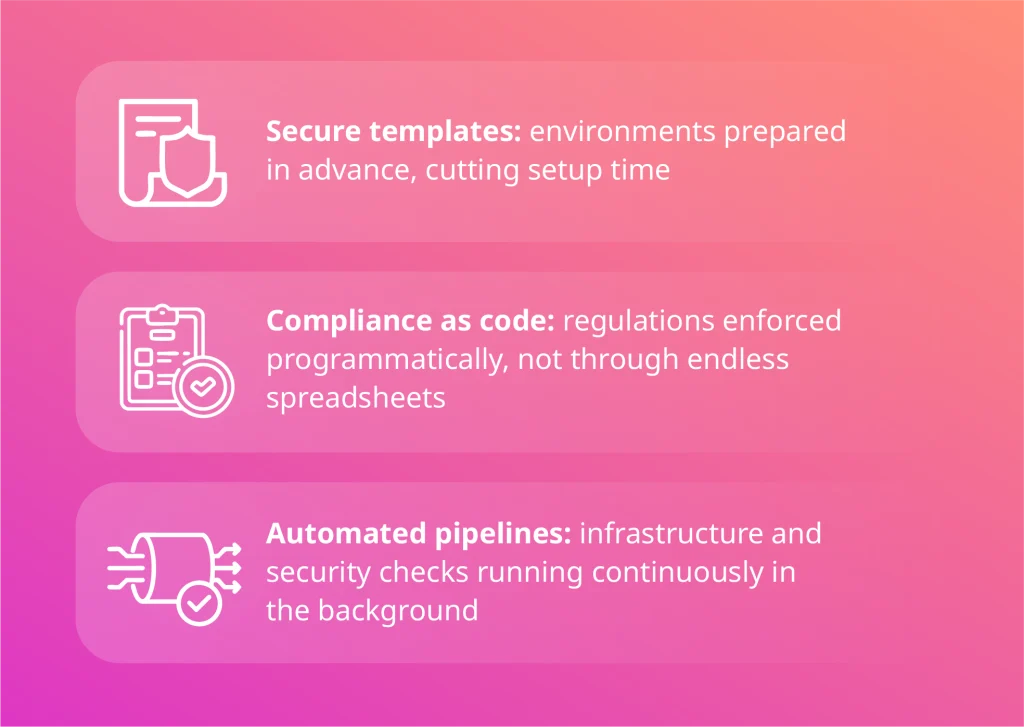
The outcome is evident: new environments move from audit-ready to live in hours, giving HealthTech teams the confidence to innovate without delays. Sprint-based squads make this rhythm sustainable, balancing regulatory demands with the pace of real-world delivery.
When secure templates and compliance-as-code aren’t enough, you need infrastructure that can defend itself. Deployflow’s cloud security services layer provides protections like Zero Trust, threat detection, and encryption across every endpoint, so environments are compliant and resilient.
Teams stop patching holes post-launch, and instead ship with built-in safeguards.
Why Outcome-Based Teams Win in HealthTech: The NHS App Case
When HealthTech delivery works at the outcome level, the ripple effects touch every corner of the ecosystem.
Outcome-based delivery creates impact that goes far beyond speeding up pipelines.
For businesses, it builds investor confidence, strengthens the case for funding, and accelerates time-to-market.
For patients, it means faster access to digital support tools that can make a real difference in their care. And for IT teams, it reduces rework, enables repeatable and secure environments, and reinforces trust with regulators.
A clear example is the NHS App.
NHS Digital didn’t measure success by the number of features shipped, but by outcomes that mattered in the middle of a health emergency: secure patient access, airtight compliance with health data regulations, and scalability to handle sudden spikes in usage.
COVID-19 made those priorities unavoidable: the app became essential for booking vaccinations, viewing test results, and later storing digital COVID passes. By focusing on outcomes rather than outputs, NHS Digital was able to transform the NHS App from a useful service into a national platform with more than 34 million users by late 2024 (source: NHS England).
That level of adoption wouldn’t have been possible with an output-driven model that valued volume over results.
HealthTech leaders can take note: the metrics that really matter are not how many features were released or how many tickets were closed, but how fast environments can be deployed, how consistently compliance is met, and how efficiently resources are used. These outcome-driven measures are what build resilience, attract investment, and improve patient trust.
The UK DevOps market is projected to grow from about USD 550 million in 2025 to nearly USD 1.83 billion by 2035, reflecting how organisations are investing heavily in faster, more reliable delivery practices to stay competitive. (source: Market Research Future)
Delivery squads aren’t just transforming HealthTech. Industries like FinTech and PropTech are moving away from traditional agencies because squads deliver outcomes faster.
As Deployflow explains in Why tech leaders in FinTech and PropTech are choosing delivery squads over traditional agencies, embedded squads break down silos, reduce hand-offs, and keep accountability inside the organisation, making delivery smoother and faster.
Practical Takeaways for HealthTech Leaders
Shifting to outcome-based delivery requires a mindset change.
For HealthTech leaders, adopting this approach means scaling without hitting compliance roadblocks, winning investor confidence, and delivering digital tools patients can rely on.
Key steps HealthTech leaders can take:
- Define outcomes upfront: Agree on measurable goals before a single line of code is written. For HealthTech, that might mean audit-ready environments in under 24 hours or zero compliance failures per release. Clear targets create alignment across engineering, compliance, and leadership.
- Build with programmatic infrastructure: Tools like Terraform, Ansible, and GitLab make infrastructure repeatable and predictable. Instead of reinventing environments manually, teams apply templates that guarantee consistency and reduce human error.
- Bake compliance into the pipeline: Regulations should be treated as code, enforced automatically at every stage. This ensures teams don’t “pass the buck” to auditors at the end, but prove compliance continuously. It reduces rework and builds confidence that every deployment is safe for patients and defensible to regulators.
- Work with outcome-driven squads: Sprint-based delivery squads organised around business outcomes can move quickly while still maintaining control. By combining governance expertise with DevOps capability, they ensure HealthTech companies avoid the classic trade-off of “secure but slow” versus “fast but risky.”

The real advantage of these practices isn’t just operational efficiency but resilience. HealthTech organisations that adopt outcome-based delivery become better at scaling under pressure, securing investment, and serving patients without delays.
If you want a blueprint to move from slow, output-driven delivery to outcome-focused squads, this P-Suite guide is your playbook.
It lays out how UK tech leaders are building smarter, launching faster, and using sprint-based squads without ballooning costs. You’ll find real use-cases, cost comparisons, and a readiness checklist that shows exactly what to change.
HealthTech Delivery Without the Wait
In HealthTech, compliance is often seen as the brakes. Outcome-based delivery changes that perspective. Compliance becomes the engine that pushes teams forward.
When environments are audit-ready by design, deployment flies.
Curious how fast your team could really move?
You can cut setup time from days to hours, with every sprint leaving regulators impressed and patients supported.
Talk to a DevOps specialist and see what outcome-based delivery can unlock for your HealthTech journey.
When speed and compliance work together, patients get care sooner, teams achieve more, and innovation never slows down.
Frequently Asked Questions on Outcome-Based Delivery in HealthTech
Is outcome-based delivery only relevant to large HealthTech organisations?
No. In fact, smaller startups often stand to gain the most.
Without large compliance or IT departments, they can’t afford delivery bottlenecks. By adopting outcome-based delivery early (embedding compliance checks as code, automating infrastructure, and working in sprint-based squads), startups can scale cleanly as demand grows.
This prevents the typical “rebuild” phase that many small teams face when their ad-hoc processes collapse under growth pressure.
How does outcome-based delivery impact costs in HealthTech projects?
There’s usually an upfront investment: automation tools (Terraform, Ansible), skilled DevOps resources, and compliance integration. But this is offset by major savings over time:
- Reduced rework: No more fixing compliance failures after deployment.
- Fewer penalties: Audit-ready environments reduce regulatory risk.
- Lower operational overhead: Manual reviews shrink, freeing engineers for innovation.
For investors, faster time-to-market translates into earlier revenue streams. For CFOs, costs are predictable because infrastructure is repeatable and scalable. In other words, outcome-based delivery shifts spending from reactive fixes to proactive, controlled growth.
Can outcome-based delivery adapt quickly to new or changing regulations?
Yes. And this is one of its biggest strengths. Because compliance is written into code and pipelines, new rules can be added as policies rather than retrofitted through paperwork and manual checks.
For example, if a new NHS data-handling requirement emerges, it can be coded into the deployment pipeline so every new environment enforces the rule automatically.
This adaptability is critical in HealthTech, where regulations evolve constantly across regions, and it allows organisations to remain compliant without halting delivery.
What role do clinicians and non-technical staff play in outcome-based delivery?
They’re essential. Outcomes in HealthTech are clinical and user-focused. Compliance officers, governance leads, and clinicians help define what “success” looks like: secure patient data, reliable access for staff, and minimal downtime during care.
Their involvement ensures that DevOps teams don’t optimise only for speed or efficiency but for patient impact and regulatory trust. This alignment is what makes outcome-based delivery work in HealthTech; outcomes are defined by people who feel the impact, not just by engineers.
Explore our BLOG
Recent articles

ISO 42001 Explained: Requirements, Certification and What Your Engineering Team Must Build
ISO 42001 is the international standard that demonstrates your organisation governs AI properly, and enterprise...
read full article

Is Claude Down? Anthropic Outage: Protect Your Cloud Infrastructure
Claude went down across every surface on 29 September 2026. From 14:00 to 14:59 UTC,...
read full article

Top 10 Healthtech Companies in 2026: What Their Growth Means for AI and DevOps
Every software change that reaches a hospital has to clear regulatory, legacy system, and clinical...
read full article