


You can bridge the Grokipedia governance gap by isolating LLM decision-making from AI-generated knowledge, making sure every decision in your business is backed by a 100% traceable UK regulatory audit trail.
The latest ChatGPT model now pulls information from Elon Musk’s Grokipedia. (source: Guardian)
When ChatGPT influences decisions, what it knows matters. As its answers increasingly come from AI-generated sources, traceability disappears, and liability appears.
TL;DR for CTOs and IT Heads
- The Problem: ChatGPT is consuming Grokipedia (synthetic AI data), breaking your data lineage.
- The Risk: You cannot prove why your AI made a decision, making you liable under DPA 2018/UK GDPR.
- The Solution: Decouple reasoning (the LLM) from knowledge (your private cloud).
- The Result: 100% explainable AI that behaves like an audited production dependency.
The gap appears when you try to trace how your AI forms its answers. You will find responses that cannot be linked to an approved internal document, policy, or dataset.
Explainability becomes an assumption instead of a proof. Governance becomes intent instead of control.
In regulated environments, this turns ChatGPT from a productivity tool into an unmanaged risk surface.
This article shows how the ChatGPT-Grokipedia loop creates a blind spot most AI strategies miss, and how CTOs are closing it by rebuilding AI systems around controlled, auditable knowledge sources.
The goal is to keep using AI while ensuring every answer can be traced, explained, and defended.
What Grokipedia Means for AI Trust and UK Compliance
Grokipedia is a growing pool of AI-generated knowledge created for AI systems to consume. Instead of learning mainly from human-written sources, ChatGPT is increasingly exposed to content produced by other AI models. That changes the trust model.
When ChatGPT answers a business question, that answer may now be based on AI-written material rather than on a policy, standard, or primary source you can verify. The system still sounds confident, but the origin of its knowledge is harder to prove.
In engineering terms, you’ve added an upstream dependency you cannot version, audit, or own.
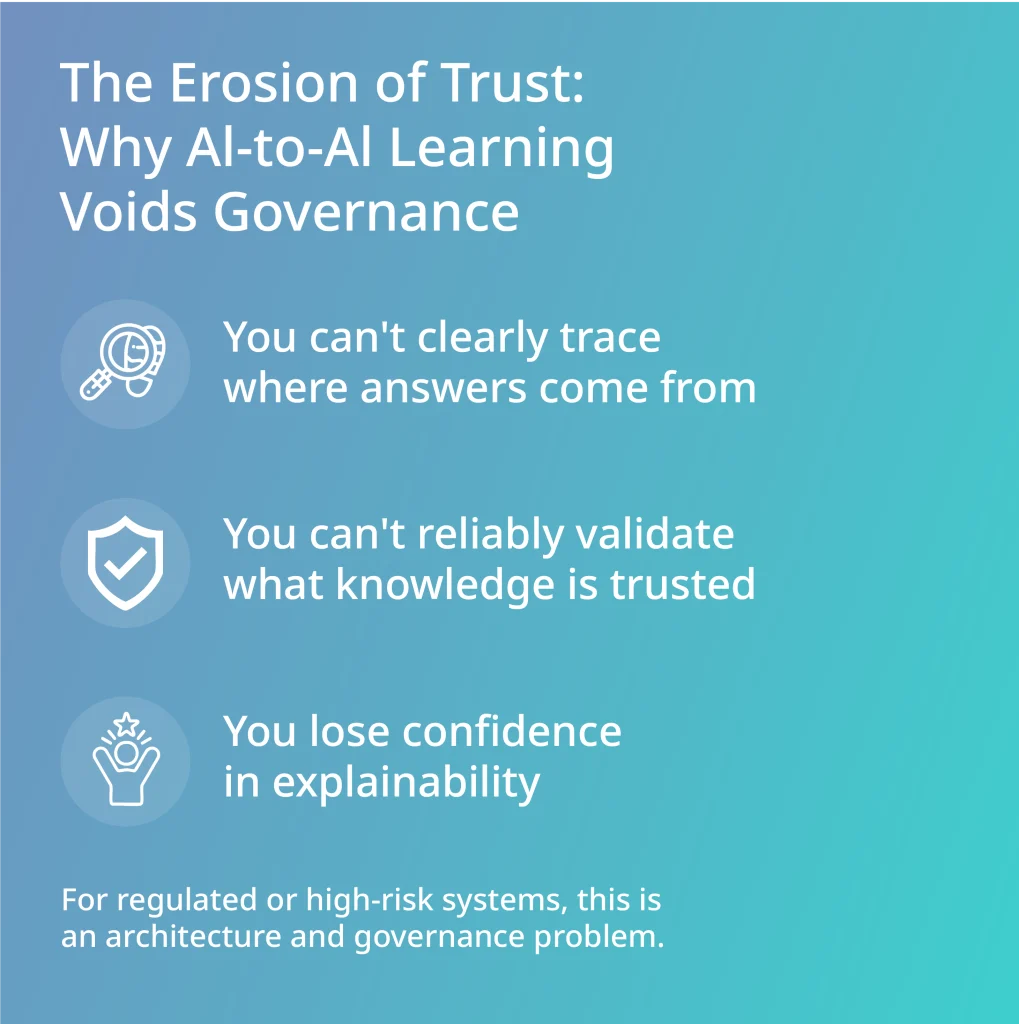
ISACA’s 2025 research shows how exposed most organisations already are: 83% report that employees use AI at work, yet only 31% have a formal, comprehensive AI policy in place. That gap between usage and governance is exactly where untraceable knowledge sources become dangerous.
How ChatGPT and Grokipedia Break Data Lineage in Practice
Imagine your team asks ChatGPT a simple compliance question:
“What controls are required for customer data retention?”
ChatGPT returns a confident answer.
That answer is based on content generated by another AI system.
That AI system learned it from a mix of synthetic summaries and secondary AI-written sources.
None of it points back to an actual regulation, internal policy, or owned document.
At that point, the knowledge path looks like this:
AI → AI → AI → unknown origin
There is no document to reference, no dataset to verify, and no source you can put in front of an auditor.
Data Leak vs Knowledge Leak: Why Grokipedia Creates a New Failure Mode
Data leak: Sensitive data leaves your system.
Knowledge leak: Untrusted or AI-generated knowledge enters your system.
With ChatGPT drawing on Grokipedia, contaminated knowledge enters like this:
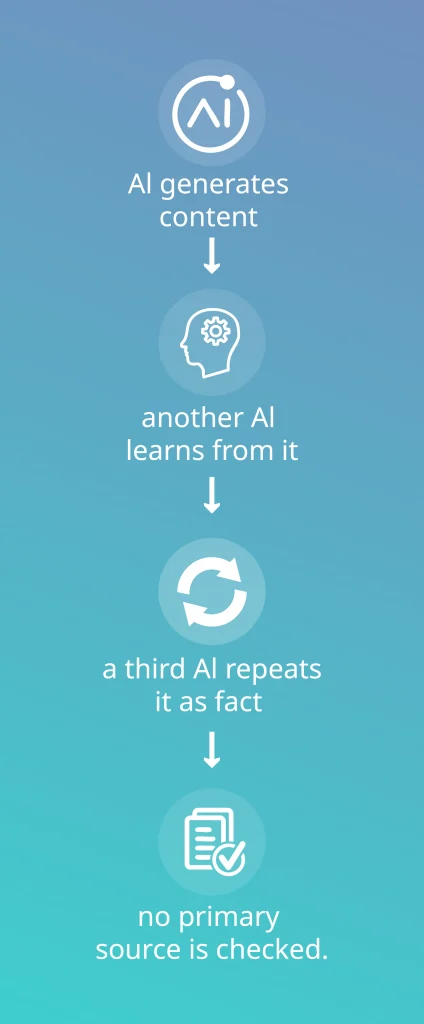
Resulting risks:
- Product logic drift: Systems change behaviour without code changes
- Regulatory misinterpretation: AI wording becomes policy
- Subtle model bias: Synthetic patterns reinforce themselves
Why is this worse than hallucination?
Hallucinations are visible errors. Knowledge leaks sound correct, but can’t be proven.
Why Regulated CTOs Should Treat ChatGPT and Grokipedia as Untrusted Dependencies
You already manage external risk in other parts of your stack:
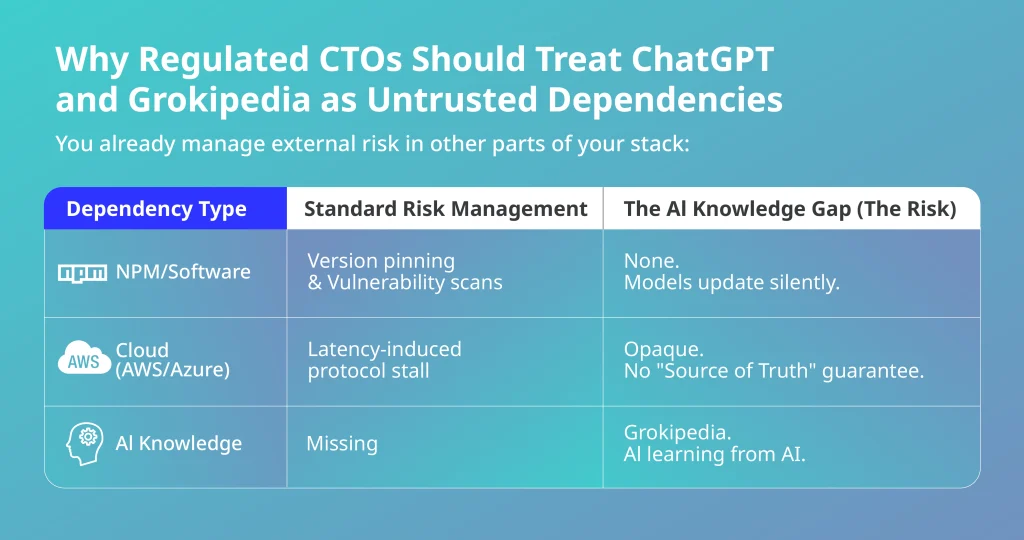
ChatGPT and Grokipedia behave like a new kind of dependency in your stack. They influence how your system thinks. And because you can’t see or verify their sources, they act as an authority you’re expected to trust without being able to inspect.
That makes them closer to a black-box service than a simple tool.
Saying “just don’t use it” doesn’t work in practice. AI is already woven into search, support, reporting, and even product logic. Turning it off slows teams down, but it doesn’t remove the pressure to use it.
That immaturity is measurable. McKinsey found that nearly two-thirds of organisations have not yet begun scaling AI across the enterprise.
In practice, this means AI is already shaping decisions before governance exists.
What actually works is changing how AI is placed in your architecture.
Generative AI can improve cloud ROI when it is treated as part of the system and governed like any other production dependency. This is explored in more detail in this guide about how generative AI can transform cloud ROI.
You contain where public models are allowed to influence decisions. You define which knowledge is trusted. And you keep public AI separate from internal truth.
The real question is no longer whether AI is used, but where it is allowed to reason.
Waiting for regulation to clarify this is not a strategy. By the time guidance arrives, your architecture is already in scope.
🚩For UK firms, the FCA’s focus on operational resilience means an untraceable AI response isn’t just a glitch but a potential Section 166 skilled person review waiting to happen.
What a Defensible AI Architecture Looks Like
A defensible AI architecture is built around one simple rule: AI can only reason on knowledge you own and approve. Public models are still useful, but they don’t get to decide what is true inside your system.
In practice:
- Knowledge is treated like code. It is versioned, reviewed, and changed deliberately.
- Sources are explicit. Every important answer can point back to a document, policy, or dataset.
- Public AI is sandboxed. It can assist, but it cannot define internal truth.
In practical terms:
Public AI = general intelligence
Private AI = business intelligence
That’s why elite UK teams are moving toward sovereign AI stacks: models running inside their own cloud, connected only to datasets they can audit. By keeping ChatGPT out of critical decision paths, teams can still use it where it adds value without giving it authority.
Early Warning Signs Your AI Is Out of Control
You don’t need a full-blown incident to spot the governance gap. IBM’s 2025 Cost of a Data Breach research calls this the “AI oversight gap”: 63% of organisations lacked AI governance policies to manage AI and prevent shadow AI, and 97% reported an AI-related security incident while lacking proper AI access controls.
The early signals are already common in real deployments:
- Inconsistent answers to regulated queries: Variations in model responses over time are a known explainability issue, and organisations with poor data lineage lack the ability to justify those changes to auditors. Only about 30% of companies report full visibility into their AI data pipelines, meaning most cannot trace how inputs became outputs.
- AI can’t reliably point to internal policy or documentation: Unlike traditional systems, where outputs clearly tie to a source, AI often reasons from patterns, a core challenge regulators in the financial sector have identified.
- Legal and compliance guidance slowly drifts: Without traceable evidence, answers that once aligned with internal standards can shift subtly as underlying data context changes.
- Engineers’ prompt-fix behaviour instead of fixing data: When there’s no audit trail, teams patch outputs instead of remediating the root cause – knowledge ownership.
- No one owns what the model is allowed to know: Governance assumes ownership of data and logic. When knowledge has no owner, auditors have nothing material to review.
The issue is no longer accuracy but trustworthiness and accountability. And when knowledge has no owner, governance has nothing to attach to.
The Deployflow Framework for Defensible AI
Right now, your AI is either part of your system or a very confident stranger giving advice. The Deployflow Framework is how you decide which one it is.
Engineering a Way Out: The Deployflow Framework for Defensible AI
Deployflow’s experts get involved when AI moves from curiosity to production. Not to sell another model, but to make sure the one you’re using doesn’t behave like a mysterious external brain but like part of your system.
The first step is mapping how knowledge flows into your AI. That means looking at what data it reads, which documents shape its answers, and where external models like ChatGPT are influencing outcomes. Most teams know what model they use. Far fewer know what actually informs its decisions.
Owning the Knowledge Layer (RAG 2.0)
AI is separated from the knowledge it is allowed to use, so reasoning power does not become a new source of truth. Your system answers from approved internal data, not from whatever a public model has absorbed.
This is what a defensible RAG 2.0 architecture looks like in practice:
flowchart LR
U[User / App] –> Q[Query]
Q –> PE[Policy & Access Control]
PE –> RET[Controlled Retrieval]
RET –> KB[Versioned Knowledge Base<br/>(Approved Internal Documents)]
KB –> CTX[Curated Context<br/>(Traceable Sources)]
CTX –> LLM[LLM Reasoning Engine]
LLM –> OUT[Answer + Citations]
subgraph Governance Layer
PE
LOG[Audit & Lineage Log]
end
RET –> LOG
LLM –> LOG
OUT –> LOG
RAG 2.0 separates reasoning from knowledge, ensuring every AI answer is grounded in approved, auditable sources.
The knowledge layer remains within your cloud environment (e.g., AWS or Azure), preserving data residency and access controls.
Proprietary logic is never used to train public models. The architecture prevents internal knowledge from leaking into external training pipelines.
Every response is traceable to a specific, version-controlled document, providing audit-ready lineage instead of black-box answers.
Private and Hybrid AI in Your Cloud
Instead of sending sensitive queries to a public endpoint, private LLMs run directly inside your VPC. Low-risk, high-speed work like drafting and summarisation can still use public models, while regulated logic, risk analysis, and customer PII are handled by hardened, sovereign models. The result is GenAI productivity without weakening the security posture of your core systems.
Delivery That Matches Reality
What makes a controlled AI system practical is how it’s delivered:
- Discovery and audit to find where AI helps and where it creates risk
- Sprint-based development to ship working AI features quickly
- MLOps and AI-driven DevOps automation to keep models observable and controlled
- Governance baked into pipelines, not written in policy decks
You aren’t pushed into a single platform or vendor. You keep full ownership of your AI models and data, and your team gets real knowledge transfer instead of inheriting another black box.
If GenAI is moving from experiment to production in your organisation, it needs architecture, not guesswork. Deployflow helps teams build GenAI systems that run on their own data, inside their own cloud, with governance designed in from day one.
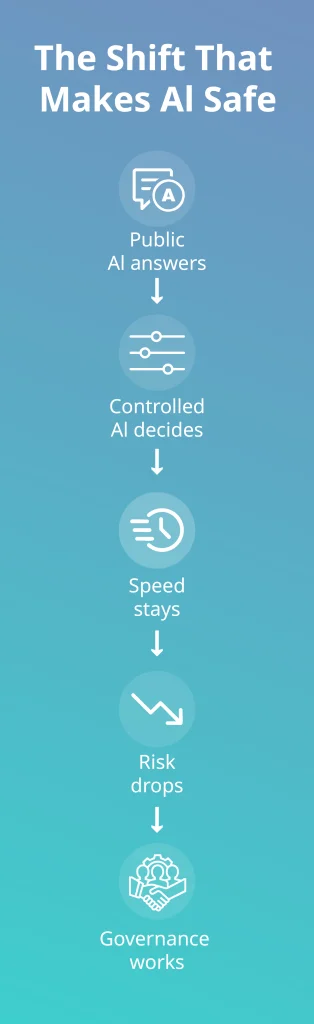
From Black-Box AI to Audit-Ready AI
Grokipedia and public AI aren’t going away, and they shouldn’t. The real win is making sure they work for you.
Working with Deployflow means your AI doesn’t grow up on mysterious knowledge. Your AI grows up on data you own, rules you define, and systems your team actually understands.
You still get the speed, automation, and innovation everyone wants, just without having to cross your fingers every time the model answers a serious question.
That is the difference between AI that helps and AI you can defend in front of a regulator.
The safest AI is the one that can show its work when someone important asks.
And with the right architecture in place, you don’t have to defend AI with opinions.
You defend it with sources.
If your AI is already influencing real decisions, now is the right time to make it defensible. Book a 20-minute AI Knowledge Leak Audit call and map where your AI gets its knowledge and how to bring it under control before someone else asks the same questions.
Frequently Asked Questions About AI Governance and Knowledge Control
Can ChatGPT be used safely in regulated industries like finance or healthcare?
Yes, ChatGPT can be used safely in regulated industries, but only when it is kept out of critical decision paths and paired with controlled knowledge sources.
Public models are not designed to meet regulatory requirements for traceability or explainability on their own. They do not guarantee the source of knowledge or the formation of answers. In regulated environments, AI must be treated as an assistive layer instead of an authority. True safety is created by how AI is designed into the system, not by confidence in the model itself.
What is the difference between data governance and AI knowledge governance?
Data governance controls how raw data is stored, accessed, and protected.
AI knowledge governance controls what an AI system is allowed to learn from and reason on.
Traditional data governance focuses on security, privacy, and retention. Knowledge governance focuses on provenance, trust, and explainability of outputs. An organisation can have strong data security and still run AI on unverified or synthetic knowledge. That is why knowledge governance is becoming a separate architectural concern.
How do auditors assess AI systems in practice?
Auditors assess AI systems by looking for traceability, documented controls, and repeatable decision logic. They do not evaluate whether the model is smart, but whether its outputs can be explained and tied back to approved sources.
This usually means showing which data was used, which policies apply, and how the system prevents unauthorised reasoning. Black-box answers without documented lineage are treated as operational risk. In practice, this pushes organisations toward controlled datasets and restricted model behaviour.
Is running private or sovereign AI always more expensive than using public models?
No, private or sovereign AI is not always more expensive than using public models when long-term operational and compliance costs are included.
Public AI appears cheaper because infrastructure is externalised, but hidden costs often emerge in compliance reviews, incident response, and manual oversight. Private AI shifts spending from unpredictable usage fees to predictable infrastructure and engineering investment. It also reduces the cost of audits, disputes, and regulatory exposure. Over time, cost predictability becomes part of the ROI.
Explore our BLOG
Recent articles

ISO 42001 Explained: Requirements, Certification and What Your Engineering Team Must Build
ISO 42001 is the international standard that demonstrates your organisation governs AI properly, and enterprise...
read full article

Is Claude Down? Anthropic Outage: Protect Your Cloud Infrastructure
Claude went down across every surface on 29 September 2026. From 14:00 to 14:59 UTC,...
read full article

Top 10 Healthtech Companies in 2026: What Their Growth Means for AI and DevOps
Every software change that reaches a hospital has to clear regulatory, legacy system, and clinical...
read full article