


Governed AI in financial services gives UK firms a safer way to get more value from AI. The FCA’s AI in financial services guidance makes clear that adoption is already well underway, with 75% of firms using AI and 84% assigning accountability for their AI approach.
AI is already entering regulated workflows across financial services, but most firms still have a gap between adoption and control.
That gap usually shows up later, when an AI-assisted process affects customer outcomes, operates within a critical service, depends on a third party, or produces outputs that no one can properly trace.
Governed AI is what turns AI from an interesting capability into something the business can safely rely on. It establishes a framework for determining where AI belongs, how it should be reviewed, who bears the risk, and what happens when a model, provider, or workflow fails.
What UK CTOs Gain From Governed AI
- Faster approval for AI use cases that are clearly owned and documented
- Fewer delays caused by unclear accountability, weak vendor visibility, or missing fallback paths
- Better control over embedded and third-party AI inside important business services
- A more credible route from pilot to production for high-value operational use cases
- Stronger evidence for internal audit, board oversight, and regulatory scrutiny
Governed AI adds value because it removes uncertainty from rollout. It gives teams a clearer way to test, approve, monitor, and scale AI without creating new control gaps.
What Governed AI Requires in Financial Services
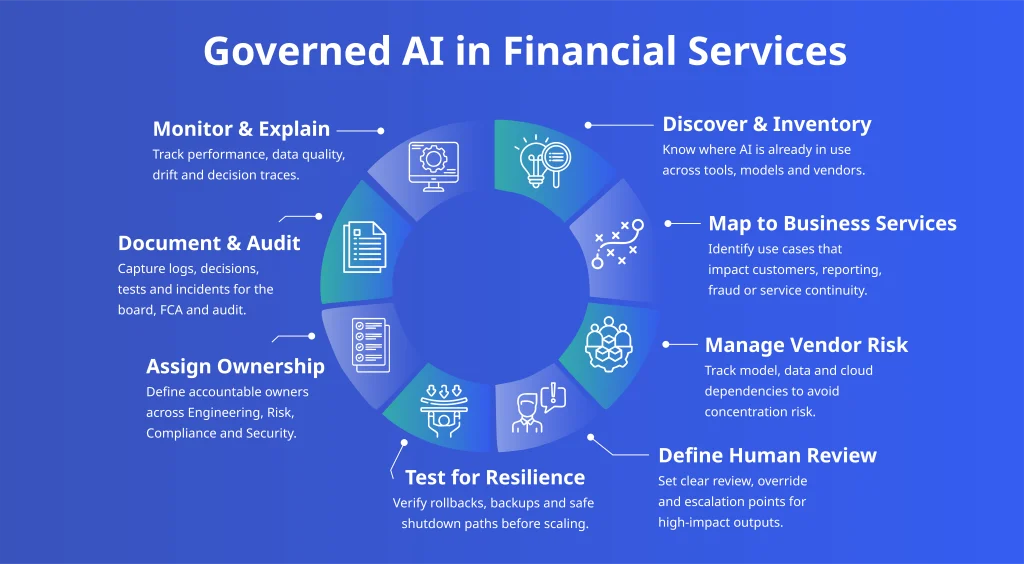
Governed AI means treating AI as part of operational delivery. No material use case should go live without a named owner, a review path, monitoring, fallback options, and evidence that it can operate safely inside the business service it affects.
In financial services, that standard matters more because AI can influence customer outcomes, reporting, fraud controls, service continuity, and third-party exposure. Once that happens, AI stops being a tooling choice and becomes part of the firm’s control environment.
A workable model does not need to be overengineered, but it needs to be clear. Teams should know what AI is in use, where it sits, what risk it introduces, who signs off on it, and what happens if it fails.
The UK Signals CTOs Cannot Ignore on AI Governance
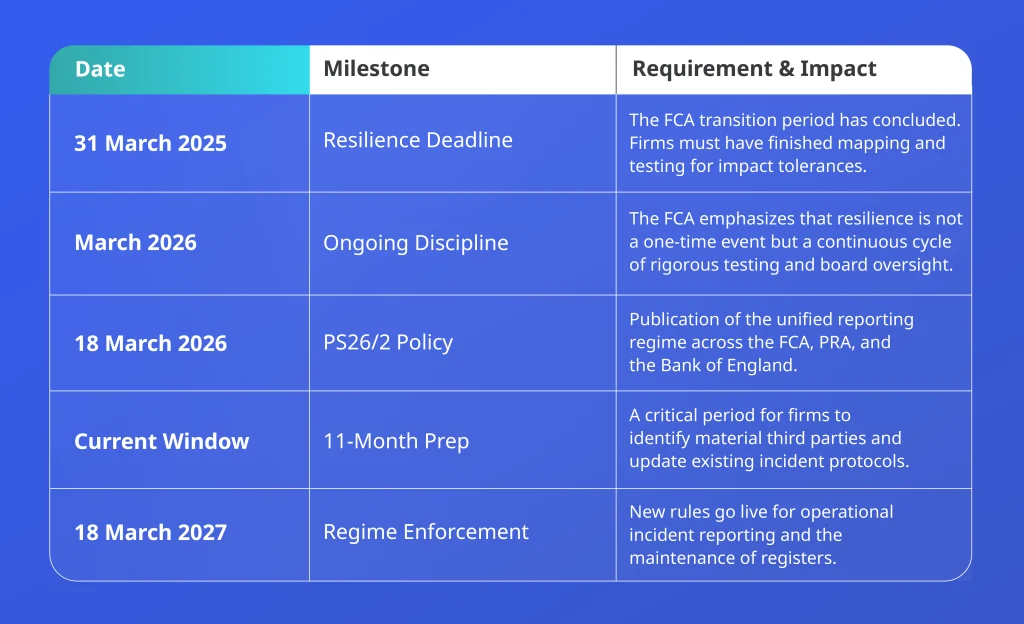
AI Governance & Resilience: Compliance Timeline 2025–2027
Operational Resilience Is Already Live
The FCA’s operational resilience transition period ended on 31 March 2025, and firms in scope were expected to complete mapping and testing so they could stay within impact tolerances for each important business service.
In its March 2026 observations, the FCA made clear that this is now an ongoing discipline, with continued focus on testing, self-assessment, board oversight, and third-party vulnerabilities.
Third-Party Reporting Is Getting Stricter
AI often sits within critical business services or relies on external providers, bringing it directly within the scope of resilience and third-party oversight. Once it affects customer outcomes, service continuity, or operational decision-making, it cannot be treated as separate from change control or senior accountability.
The next signal is PS26/2, published on 18 March 2026. It creates a single FCA, PRA, and Bank of England regime for operational incident and material third-party reporting, with the rules taking effect on 18 March 2027.
Firms in scope now have an 11-month preparation window, and the regime raises the bar on incident reporting, material third-party identification, FCA notifications, and annual register maintenance.
The FCA Expects Firms to Act Now
The wider FCA direction is still practical. In its February 2026 AI approach update, the FCA said it wants to support the safe and responsible adoption of AI, remains principles-based and outcomes-focused, and does not plan to introduce extra regulations for AI, instead relying on existing frameworks such as Consumer Duty and SM&CR.
The message for CTOs: there is no reason to wait for a bespoke AI rulebook before putting workable controls in place.
Where Governed AI Delivers Value First
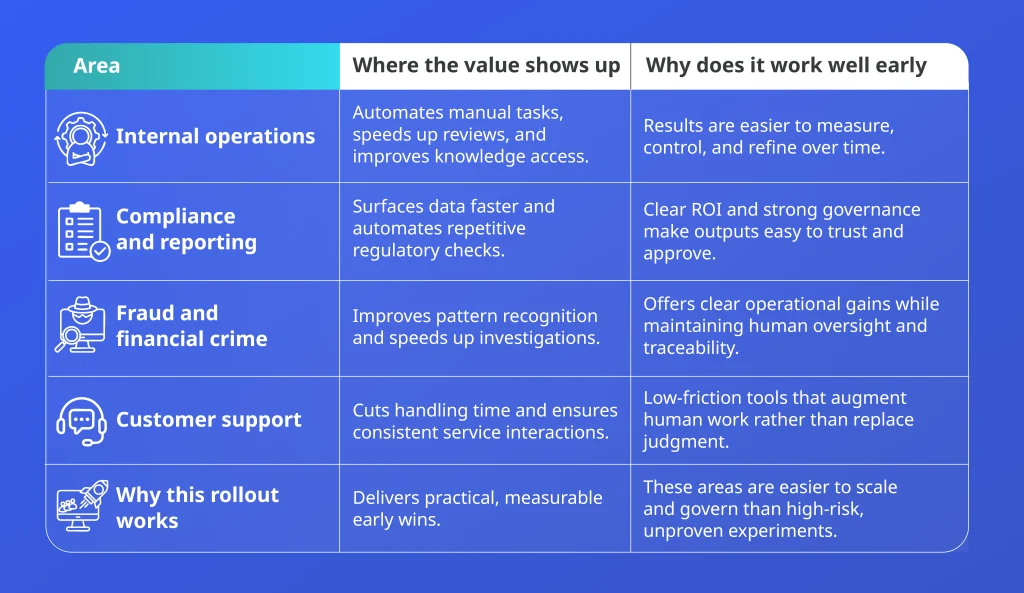
What a Production-Ready AI Governance Model Looks Like
A production-ready AI governance model usually has six moving parts.
- Live inventory: Every material use case, model, vendor, and embedded feature should be visible. That inventory should show the business service involved, the data used, the owner, the supplier, and the fallback if the tool fails.
- Risk-based controls: Controls should increase with business impact. A low-risk internal productivity tool does not need the same scrutiny as AI that influences customer outcomes, fraud operations, regulated reporting, or service continuity.
- Clear ownership: Engineering, risk, compliance, security, and operations all need defined roles. Every material use case should have a decision-maker, an approval path, and an escalation route.
- Monitoring and rollback: Teams need to be able to trace outputs, detect problems, test changes, and reverse risky behaviour. If rollback is unclear, the workflow is not production-ready.
- Human challenge where it matters: Higher-risk outputs need review, intervention thresholds, and override rights. The more sensitive the workflow, the less acceptable it is for AI to operate without a clear challenge mechanism.
- Evidence: Approvals, test records, incidents, remediation steps, vendor documentation, and monitoring outputs make governance real. Without evidence, firms are left with confidence rather than control.
For readers who want a clearer picture of how those controls work in day-to-day delivery, Deployflow’s guide to governed AI engineering explains how review, security, and operational discipline keep AI useful without making it harder to trust.
UK firms are not being asked to wait for a separate AI rulebook. The FCA’s approach remains principles-based, with existing frameworks expected to carry most of the governance load around accountability, resilience, and control.
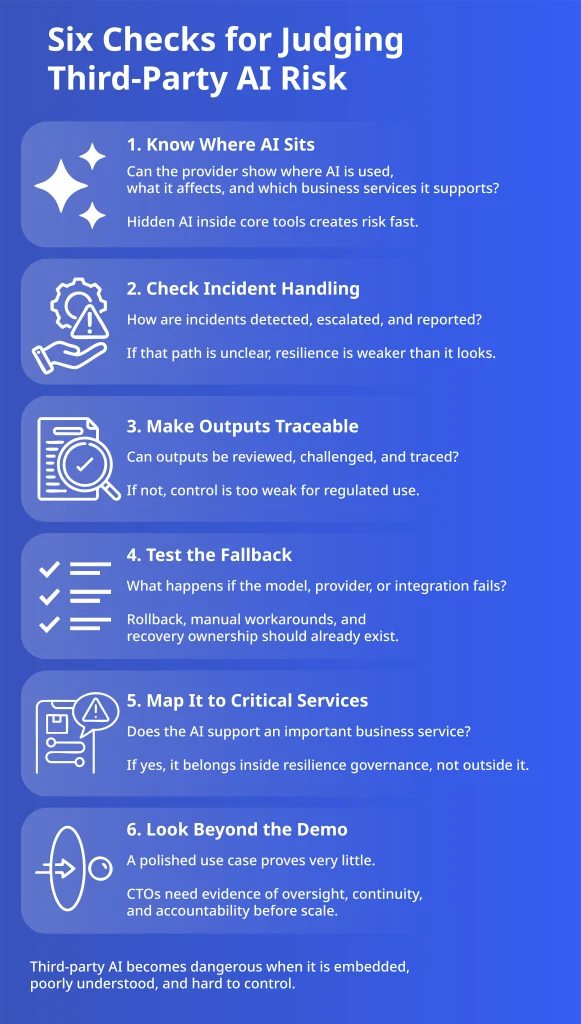
How CTOs Should Assess Third-Party and Embedded AI Before It Creates Resilience Problems
Many firms focus on what their teams are building and miss the AI already entering through vendors, copilots, workflow platforms, and embedded product features.
That is where resilience risk can build up, especially when no one can clearly explain how the tool works, what it affects, or how incidents would be handled.
A Practical CTO Checklist for Governed AI in Financial Services
Governed AI becomes real when teams can answer a few operational questions clearly and quickly.
- Do we know where AI is already in use? Models, copilots, embedded features, and vendor tools should all be visible.
- Which use cases touch important business services? Anything affecting customer outcomes, reporting, fraud, or service continuity needs tighter control.
- Which vendors create model or concentration risk? Watch for dependencies across models, cloud, data, and workflow tooling.
- Where do we need human review? Higher-risk outputs should have clear review, override, and escalation points.
- Can we trace outputs and decisions? Teams should be able to review how outputs were produced and where they were used.
- What evidence could we show today? Approvals, logs, test results, incidents, and remediation should be easy to produce for the board, the FCA, or internal audit.
- Can we roll back safely if something fails? Every material workflow should have a fallback, workaround, or shutdown path.
- Who owns each use case? Engineering, risk, compliance, security, and operations should all know their role.
- Are controls strong enough for wider rollout? A pilot that works is not always a use case that is ready to scale.
If a firm can answer these questions with confidence, it is in a far stronger position to scale AI without losing control.
What UK CTOs Should Do in the Next 90 Days
For most firms, the first step is creating enough structure to reduce blind spots.
- In the first 30 days, identify where AI is already in use. That includes internal tools, copilots, embedded vendor features, and any workflow where AI is already influencing outputs or decisions.
- In days 30 to 60, separate those use cases by business impact. Focus first on anything touching customer outcomes, fraud, reporting, service continuity, or important business services. These are the use cases that need explicit ownership, review, and fallback planning.
- In days 60 to 90, put minimum controls in place. That means named owners, approval paths, human review thresholds, logging expectations, and rollback routes for material use cases.
Governed AI Is How Financial Firms Scale AI Without Losing Control
The firms that win with AI will be the ones that can explain it, test it, monitor it, and keep it safe inside real financial workflows. For UK CTOs, governed AI is what makes AI usable in real business operations.
That becomes much easier when AI is built into delivery with the right controls from the start, which is why it helps to look at how teams can accelerate AI delivery without sacrificing governance.
Deployflow’s AI engineering and automation services are built for the shift from pilot to production. The focus is on embedding AI into products and workflows, automating manual processes, and running secure AI systems in production with built-in governance and monitoring. It covers workflow automation, custom AI applications, generative AI solutions, platform integration, and responsible AI implementation.
Anyone who wants to see how that approach translates into a regulated environment can look at Deployflow’s piece on AI-powered engineering squads for FinTech, which shows how faster delivery and stronger control can support each other.
“They assembled a dedicated workforce, enabling us to transform our vision into reality. Their seamless team-building and thorough knowledge transfer have been instrumental in bringing our product to life.”
Sean Hederman, CIO at Zilch, a UK FinTech double unicorn
A Governance-First AI Platform for National-Scale Energy Operations
Deployflow has also delivered governance-first AI platforms in other high-stakes environments. For a national-scale AI energy client in the UAE, this resulted in a secure, repeatable platform that processes more than 1 PB of subsurface data in real time across H100 GPU clusters.
New AI workloads could be launched without re-engineering the core environment, while governance, security, and networking controls were inherited automatically.
It is a strong example of how AI becomes easier to scale when operational control is built in from day one.
Tighten AI Governance Before Risk Spreads
Weak AI governance stays invisible until the business is already exposed. By that point, the problem is missing ownership, an unclear fallback, weak traceability, or a hidden third-party dependency.
The goal is not to slow AI down, but to make sure AI can survive contact with real operations, real scrutiny, and real failure scenarios.
A free AI governance assessment is a practical way to identify where control is already strong, where exposure is building, and what needs to be tightened before wider rollout.
Frequently Asked Questions About Governed AI in Financial Services
What should be included in an AI inventory for a financial services firm?
An AI inventory should show each material use case, the model or vendor involved, the business service affected, the data used, the owner, and the fallback if the tool fails.
That inventory becomes the starting point for governance because firms cannot control what they cannot see. It also helps separate low-risk experimentation from AI that sits inside critical services or sensitive workflows. Without that visibility, accountability, and reporting break down quickly.
When does an AI use case become high risk in financial services?
An AI use case becomes high risk when it can affect customer outcomes, regulated reporting, fraud controls, service continuity, or other important business services.
Risk is shaped by operational impact. A simple embedded feature can create more governance pressure than a complex internal assistant if it influences a sensitive workflow. That is why firms need thresholds tied to business impact rather than just the model type.
Does AI governance slow down innovation in financial services?
No, good AI governance usually helps firms move faster by removing confusion around ownership, approval, and risk.
When teams know who signs off, what evidence is needed, and where human review sits, fewer projects get stuck in uncertainty. That matters in financial services, where delays often come from control gaps rather than a lack of ideas.
Governance also makes it easier to move promising use cases from pilot to production without creating new operational or compliance problems. In practice, it gives firms a clearer path to scale AI with confidence.
Can banks, insurers, and fintech firms use ChatGPT or Microsoft Copilot safely?
Yes, but only when those tools are used within clear rules around data, oversight, access, and acceptable use.
The real issue is what people enter into the tools, how outputs are used, and whether anyone is checking where mistakes could affect customers, reporting, or internal decisions. Firms need policies for sensitive data, clear boundaries for staff use, and a way to review high-impact outputs. If those controls are missing, even a popular tool can introduce avoidable risk.
What is the difference between AI governance and AI compliance?
AI governance is the broader control system, while AI compliance is the part that makes sure the firm meets regulatory and internal requirements.
Compliance focuses on whether the firm is meeting its obligations. Governance covers the wider operating model behind that, including ownership, monitoring, escalation, approval, testing, and accountability. A firm can meet a narrow compliance requirement and still have weak day-to-day control over AI. Strong governance gives compliance something solid to stand on.
How often should AI systems be reviewed in financial services?
AI systems should be reviewed regularly, with more frequent checks for use cases that affect customers, important business services, or regulated processes.
A one-time sign-off is not enough because models, vendor features, usage patterns, and business context can all change after rollout. Reviews should happen when a system is updated, when a vendor changes functionality, when incidents occur, or when the use case moves into a more sensitive workflow. Higher-risk uses may need recurring monitoring, structured testing, and formal review cycles. Lower-risk internal tools may need a lighter approach, but they still should not be left unmanaged.
Can smaller financial firms govern AI without a large internal team?
Yes, smaller firms can build workable AI governance by starting with clear ownership, a simple control model, and a shortlist of higher-risk use cases.
They do not need a huge specialist function to begin. What they do need is visibility into where AI is being used, basic rules for staff and vendors, a way to assess risk, and documented fallback paths for material workflows.
Many firms overcomplicate this by assuming governance has to be large to be effective. In reality, a lean and disciplined approach is often enough to create much better control early on.
For firms that want outside support without building a large internal AI function, Deployflow’s AI engineering services are built to help teams introduce AI into workflows, products, and operational systems with governance and monitoring already in place.
Explore our BLOG
Recent articles

ISO 42001 Explained: Requirements, Certification and What Your Engineering Team Must Build
ISO 42001 is the international standard that demonstrates your organisation governs AI properly, and enterprise...
read full article

Is Claude Down? Anthropic Outage: Protect Your Cloud Infrastructure
Claude went down across every surface on 29 September 2026. From 14:00 to 14:59 UTC,...
read full article

Top 10 Healthtech Companies in 2026: What Their Growth Means for AI and DevOps
Every software change that reaches a hospital has to clear regulatory, legacy system, and clinical...
read full article