


AI is already embedded in many UK enterprise workflows, long before governance has caught up. The EU AI Act can still affect UK organisations when their systems, products, or outputs reach EU users.
This is not only about custom-built AI. It includes copilots inside everyday tools, AI-assisted decisions in hiring or support, embedded features in SaaS products, and automated systems already influencing real outcomes.
Do you know where AI is running, who owns it, and how it is controlled?
What CTOs must know:
- The EU AI Act can still apply to UK organisations with EU-facing products, services, or outputs.
- Major obligations land in phases, with August 2026 being a key date for many high-risk systems.
- The biggest governance gaps are usually found in ordinary tools and workflows, not only bespoke AI projects.
- Using third-party AI does not remove responsibility for how it is used in your environment.
- The core risk is not AI adoption itself, but weak ownership, visibility, and control.
Most exposure will come from systems that are already live. The advantage of acting early is that you get time to identify what is running, reduce blind spots, and put governance in place before the issue becomes regulatory, contractual, or reputational.
Why the EU AI Act Still Reaches Many UK Enterprises
Exposure is defined less by where your company sits and more by where your AI is used and where its effects land.
The Act can apply across the AI lifecycle, including providers, deployers, distributors, and importers. That means a UK enterprise can fall into scope through multiple roles, sometimes without recognising it early enough.
Where Exposure Starts
Selling into the EU is the clearest case. If your product includes AI and is used by EU customers, the Act can apply.
The same is true in day-to-day operations. Supporting EU customers through AI-driven workflows, generating outputs that reach EU users, or running recommendation and decision systems that shape EU user experiences can all create exposure.
What Triggers Scope
Distribution is only part of the picture. User interaction matters too. If your systems analyse behaviour, generate outputs, or influence decisions connected to EU individuals, the location of your headquarters matters less.
There is also a downstream question. A system operated in the UK can still create EU exposure if its outputs are later used in the EU.
Why Vendor Usage Does Not Reduce Risk
Third-party AI does not create distance. Embedding external models or using AI-powered tools still places your business inside the chain of responsibility.
The assumption that breaks most often:
A common assumption is that regulation follows where a company is based. In practice, it follows where AI is used and where its impact lands.
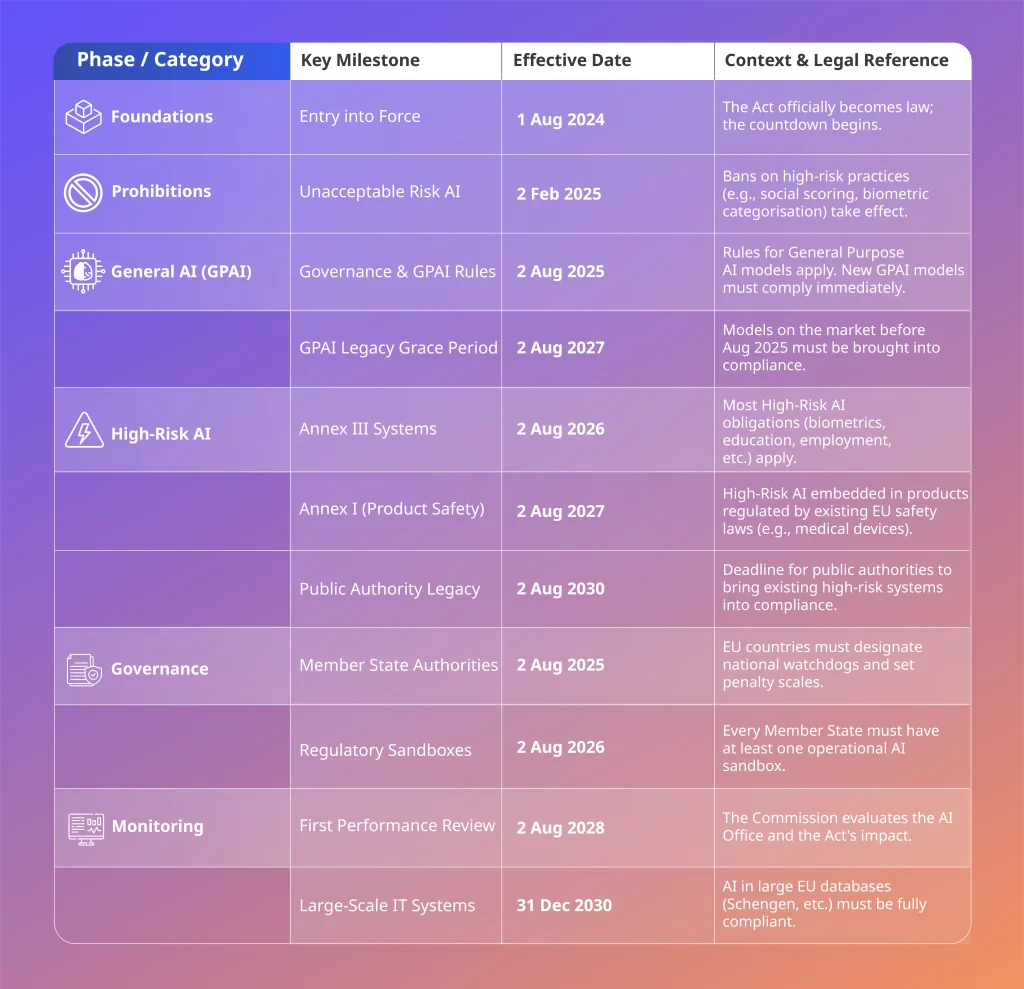
EU AI Act Compliance Timeline: Key Deadlines and Implementation Phases
The Act does not apply all at once. Its obligations are phased, with dates varying by system type, role, and risk level.
For most enterprise readers, the key point is that some obligations are already in force, and August 2026 is the date by which many high-risk system requirements become much harder to ignore.
Defining Ungoverned AI in the Modern Enterprise
In a practical business environment, an ungoverned AI system is not necessarily a rogue supercomputer; it is more often a standard piece of software running without an audit trail.
Identifying these systems is the first step toward aligning with the act’s risk-based structure.
An AI system is considered ungoverned if it lacks the following operational pillars:
- Documented purpose: no clear record of why the system was introduced or what business problem it is meant to solve
- Named ownership: no accountable owner for performance, outputs, risk, or compliance
- Risk classification: no assessment of whether the use case falls into a prohibited, high-risk, or lower-risk category
- Human oversight: no defined path for review, intervention, escalation, or override
- Monitoring and incident response: no way to detect drift, identify failures, or respond when outputs create risk
- Supplier due diligence: no review of vendor documentation, controls, or compliance claims
- AI literacy: staff use the tool, but do not understand its limits, risks, or failure modes
The Act changes AI from a background feature into a governed business system. If you cannot show how a system is controlled, it is already a risk.
High-Risk AI Systems: Where UK Enterprises Are Most Exposed
High-risk AI often enters the business through ordinary projects. It does not need to look experimental to create serious obligations.
For most UK enterprises, the greatest exposure begins where AI affects access, opportunity, safety, or rights. That is why routine systems can move into high-risk territory faster than leaders expect.
Hiring and Workforce Management
Employment is one of the clearest pressure points. AI used for CV screening, candidate ranking, interview analysis, promotion decisions, task allocation, or performance scoring can quickly fall into a high-risk category. Once a system starts shaping who gets hired, managed, or retained, the stakes rise sharply.
Education and Training Access
This is not only a concern for schools and universities. Enterprises working in education technology, certification, assessment, or training platforms can face greater exposure when AI is used to determine access, evaluate performance, or place individuals on learning paths.
Essential Services
Risk increases when AI affects access to services people materially depend on. That can include financial assessments, insurance-related decisions, credit-related processes, housing-related systems, or other workflows where automated outputs influence whether a person can obtain something important.
Law Enforcement and Public-Sector Interfaces
Most private companies are not building policing tools directly, but exposure can still appear through contracts, integrations, analytics support, or software used by public bodies. If an enterprise supports systems connected to identification, monitoring, or enforcement activity, the regulatory weight increases.
Migration and Border-Related Contexts
This will be highly relevant for certain vendors, service providers, and government-facing technology businesses. AI used in visa-related processes, border decisions, or identity assessment sits in a far more sensitive category than a standard enterprise workflow.
Products Linked to Safety Regulation
Some of the most serious exposure comes from AI embedded in regulated products. Medical devices are the clearest example, but the broader issue is any product in which AI has consequences for health, safety, or regulated performance. That moves the conversation well beyond software convenience.
The point is to recognise the pattern. High-risk exposure starts when AI influences access, safety, employment, identity, or other outcomes with real consequences for individuals. That is why a system that looks operational on the surface can create major regulatory obligations underneath.
Prohibited AI Practices and Enterprise Red Flags
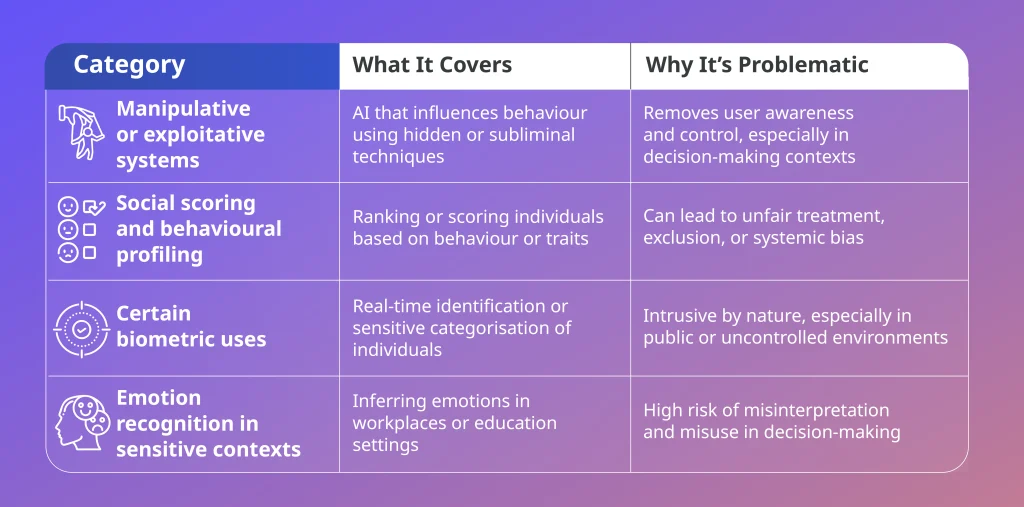
Some AI uses create obligations. Others are banned outright. The difference matters.
High-risk systems may still be used if the required controls are in place. Prohibited systems cannot be legitimised through better process, stronger documentation, or tighter review. Under the Act, they are simply not allowed.
What Makes This Different From High-Risk Systems
High-risk systems come with obligations. Prohibited systems come with consequences. High-risk AI can be operated with the right controls in place. Prohibited AI cannot be used at all under the Act.
🚩The Red Flags to Watch For
The pattern is usually clear before the legal analysis is. Risk becomes unacceptable when AI is used to manipulate behaviour without meaningful awareness, score people in ways that affect treatment or access, identify individuals intrusively, or infer highly sensitive traits in contexts where that inference can shape decisions.
If a system is influencing outcomes through covert pressure, behavioural scoring, invasive identification, or sensitive inference, it is already beyond a normal governance conversation. It is moving into prohibited territory.
Third-Party Models, SaaS Tools, and Vendor Risk Under the AI Act
Most enterprises are not building every AI system themselves. They are buying AI through SaaS platforms, embedded features, copilots, APIs, and workflow tools. That does not remove responsibility. It redistributes it.
If your business uses AI in production, embeds third-party models into products, or relies on AI outputs inside EU-facing workflows, you are still part of the accountability chain.
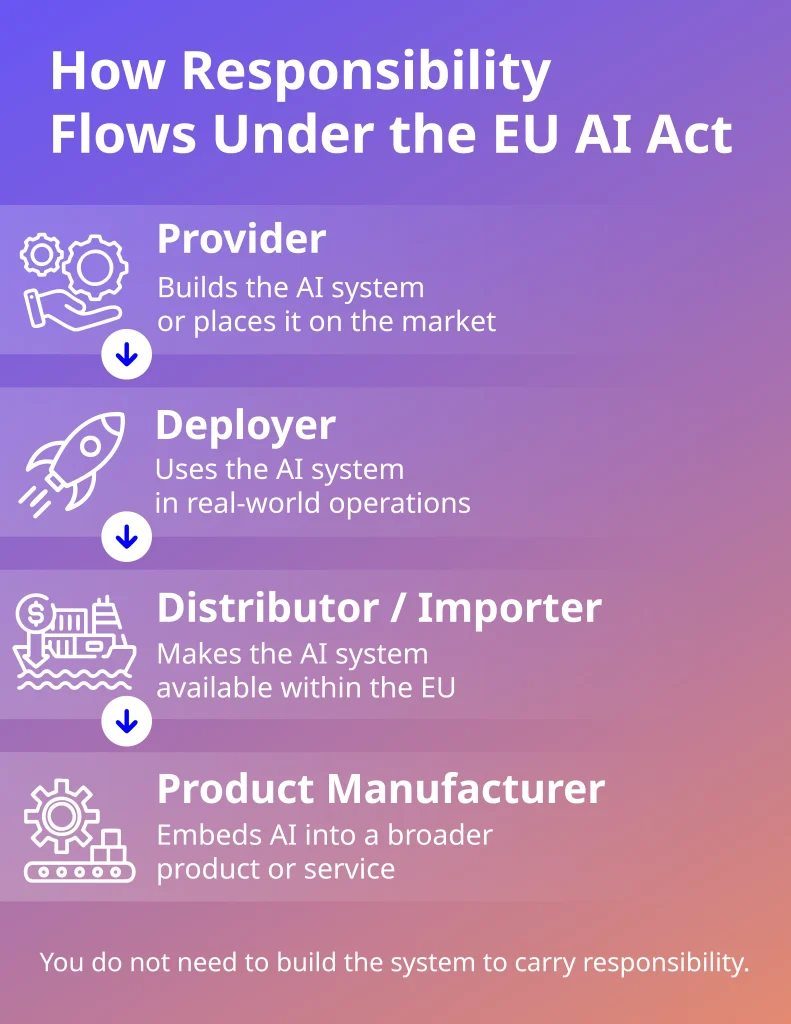
A single enterprise can sit in more than one role at the same time. That is where risk becomes harder to see clearly.
Where Vendor Risk Actually Shows Up
The biggest problems usually start in ordinary procurement decisions.
- A SaaS tool with AI features can still create governance obligations in your environment.
- A third-party model embedded into your product still connects your organisation to its outputs.
- AI-generated decisions or content used in EU-facing workflows can still create exposure, even when the underlying model is not yours.
The vendor does not absorb that responsibility. At best, it shares part of it.
The Common Failure Point
The biggest mistake is assuming the vendor has it covered.
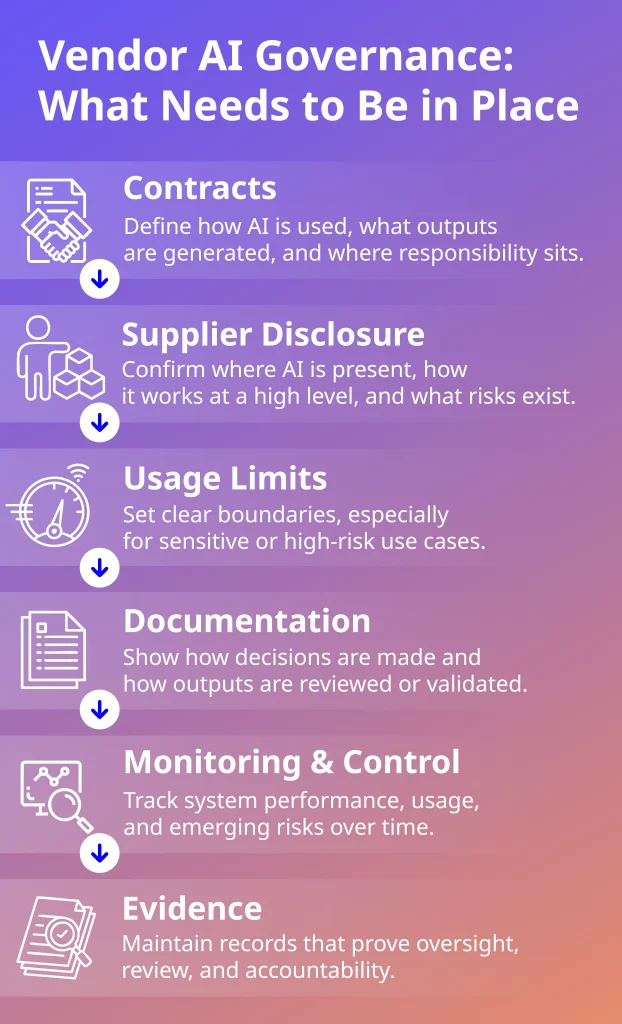
Vendors manage their systems. You are responsible for how those systems are used in your environment, with your data, and in your workflows. That distinction becomes critical under the Act. If AI is part of your stack, even indirectly, it is part of your responsibility.
AI Governance, Data Protection, and Accountability for UK Organisations
The EU AI Act does not replace data protection. It raises the standard for organisations already using AI in ways that affect people.
If your systems process personal data, infer traits, rank individuals, or shape decisions, GDPR-style duties still apply. The AI Act adds another layer of governance, oversight, and proof.
The ICO puts the accountability point plainly: organisations “must be able to demonstrate their compliance.” That matters even more with AI, where weak ownership and poor records create risk quickly.
This gives some UK organisations a better starting point than they think. If you already work to meet ICO expectations for lawfulness, fairness, and transparency, part of the governance foundation is already in place.
The real divide is simpler than most teams admit. Some organisations treat AI as a governed system. Others treat it as a loose layer of tooling. That difference shows up fast.
- Who owns the system?
- What data does it use?
- How are outputs reviewed?
- Who steps in when something goes wrong?
If those answers are unclear, the problem is operational.
That kind of control usually depends on the operating model behind the tooling, which is why this breakdown of platform engineering vs traditional cloud delivery is relevant for teams trying to scale AI governance in practice.
A Practical Readiness Checklist for UK Enterprises Before August 2026
Preparation starts with visibility. You cannot govern what you have not identified.
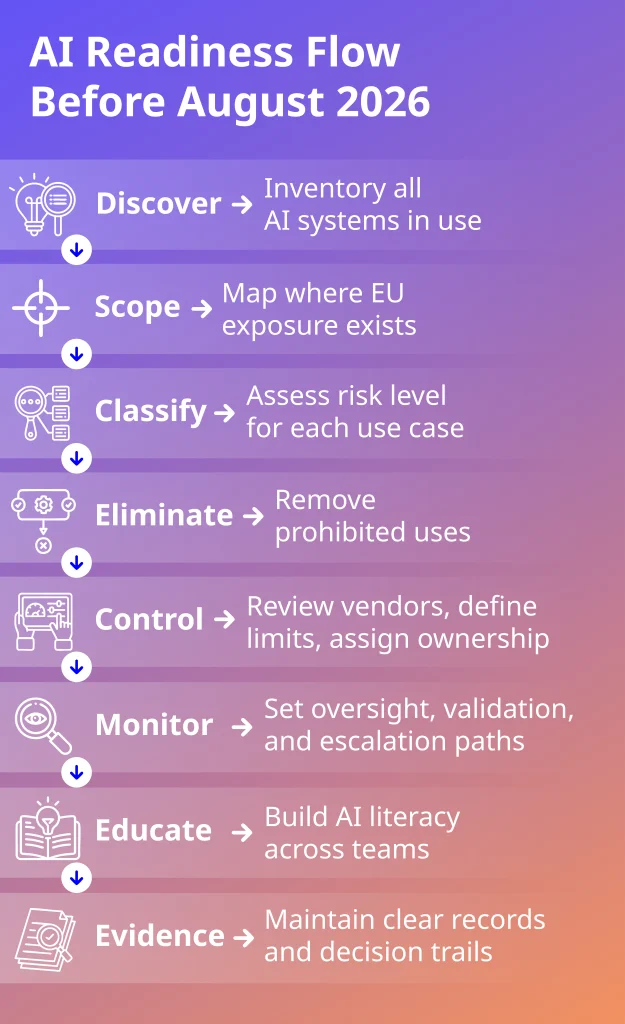
Each step builds on the previous one. Skipping one creates blind spots later, usually where it matters most.
The real advantage is control. Teams that understand what is running, where it is used, and how it is governed move faster with fewer surprises.
Governance only works when it is built into delivery, and this guide on accelerating AI delivery without sacrificing governance shows what that looks like in practice.
If your organisation is already using AI in production, book a free AI governance review with Deployflow to identify where AI is running, where exposure sits, and what needs attention before August 2026.
Frequently Asked Questions About the EU AI Act for UK Enterprises
What are the penalties for getting this wrong?
Penalties can be severe enough to move this out of the legal team and into board-level risk.
The European Commission says the highest penalties under the AI Act apply to prohibited practices, with fines of up to €35 million or 7% of worldwide annual turnover, whichever is higher.
Other breaches, including certain obligations for operators or providers, can still attract major fines, so the practical issue is not only whether a rule exists but also whether your organisation can demonstrate control, oversight, and responsible use when challenged.
Do open-source AI models fall outside the Act?
No, open-source does not mean out of scope. The Commission’s guidance states that some providers of free and open-source GPAI models may be exempt from certain first-layer obligations in specific circumstances, but that exemption is conditional, not a blanket carve-out.
The protection weakens further once a model creates systemic risk, is placed on the market in a commercial context, or is embedded downstream in products and services that create real-world impact.
For UK enterprises, the mistake is assuming “open-source” means “low responsibility.” It often just means the responsibility shifts and becomes harder to track.
Do internal pilots or proofs of concept matter if they are not customer-facing yet?
Yes, they matter earlier than most teams expect. The ICO’s AI guidance makes the accountability point clear: if an AI system processes personal data, you are responsible for complying with data protection law and demonstrating that compliance, and a DPIA is often the right place to start.
In practice, internal pilots are where weak habits form: unclear ownership, copied data, loose prompts, untested outputs, and no review path before a system starts spreading into real operations. A pilot may feel temporary, but if it touches personal data or shapes decisions, the governance burden starts long before the tool becomes customer-facing.
Do UK providers ever need an EU representative?
Yes, in some cases they do. The AI Act imposes obligations on providers established outside the Union, and the regime may require an authorised representative in the EU, depending on the business’s role and how the system is placed on the market.
That matters because many UK firms assume distance reduces responsibility, when in reality, provider status can increase it. Once your organisation is no longer simply using AI internally and is instead supplying, embedding, or placing an AI system on the EU market, the compliance model becomes more formal and more demanding.
What evidence should a UK enterprise be able to produce if challenged?
You should be able to show that AI governance exists in practice, not only in policy documents. The ICO’s accountability guidance says accountability is about taking responsibility for what you do with personal data and demonstrating the steps you have taken to protect people’s rights.
For AI, that usually means a named owner, records of which systems are in use, documentation of data and its purpose, risk assessments, approval and review paths, vendor information, incident reporting routes, and evidence that controls are monitored over time. The standard is not perfection. It is whether your organisation can show that AI use is understood, governed, and actively supervised.
Explore our BLOG
Recent articles

ISO 42001 Explained: Requirements, Certification and What Your Engineering Team Must Build
ISO 42001 is the international standard that demonstrates your organisation governs AI properly, and enterprise...
read full article

Is Claude Down? Anthropic Outage: Protect Your Cloud Infrastructure
Claude went down across every surface on 29 September 2026. From 14:00 to 14:59 UTC,...
read full article

Top 10 Healthtech Companies in 2026: What Their Growth Means for AI and DevOps
Every software change that reaches a hospital has to clear regulatory, legacy system, and clinical...
read full article