


Paperwork kills products and careers. In regulated industries, even a week-long delay in securing compliance sign-off can cost you hundreds of thousands, even millions, and shake investor confidence.
For a product with projected annual sales of $50 million and a 30% profit margin, a single month delay can cost as much as $1.4 million (source: SPK and Associates).
Here’s what you’ll take away from this blog:
- Where compliance actually slows down regulated tech delivery
- What a compliance sprint is and how to run one
- How squads keep oversight and audits on track without drowning launches in paperwork
- The key metrics that prove the cost of delays (and how to use them in business cases)
- Practical steps, tools, and squad setups for launching securely and on time
If you’re a CTO, founder, or IT leader who’s tired of synchronised watches, endless approvals, and missed market windows, this guide is for you.
We’re going to expose what’s holding you back, and show you a roadmap so you can launch securely, faster, and more reliably.
Tech leaders underestimate how much delivery models shape outcomes. If deadlines keep slipping despite strong engineering teams, the root cause often lies in how teams are structured, as explored in this analysis of delivery models and missed deadlines.
What Is a Compliance Sprint and Why Does It Work
A compliance sprint is a time-boxed cycle where regulation, security, and documentation move in lockstep with code. It removes the artificial wall between “building” and “proving,” so the product is both launch-ready and regulator-ready by the end of each sprint.
At its core, a compliance sprint means building regulation into the rhythm of development.
Instead of pausing to deal with compliance at the end, the product ships with oversight baked in. That means fewer delays, fewer audit surprises, and a faster path to market.
Sprint Anatomy: Security, Documentation, and Audit Steps Built In
Different industries require different checkpoints, but the principle is the same: compliance is codified, automated where possible, and validated in real time.
For example:

The Secret to Making Compliance Move Faster
Traditional delivery saves compliance for the finish line, which is why teams slam into delays.
Compliance DevOps sprints move checks inside the track. Each one is smaller, automated, and repeatable, so by the time you cross the line, approval is already in hand.
Secure Launch Strategies for Regulated Industries
Security. Automation. Alignment.
These three levers turn compliance from a drag on delivery into an engine for secure launches.
Security From the Start
Every sprint must treat security as code. Vulnerability scans run automatically, static and dynamic analysis tools flag risky changes, and secrets get detected before they slip into repositories.
The payoff is massive: problems surface within hours instead of months, and security debt doesn’t pile up. Teams can prove, sprint by sprint, that their product is hardened for regulated environments.
Security from sprint one is non-negotiable, but making it practical is often the stumbling block. Our breakdown of GDPR-ready DevOps pipelines shows how automated checks and logs can satisfy regulators without slowing teams down.
Automating Policy and Audits
Manual checklists are the graveyard of momentum. By encoding compliance policies directly into pipelines, squads replace subjective reviews with automated gates. Non-compliant builds never make it through, while compliant ones leave a trail of machine-generated audit evidence.
Automation reduces human error, satisfies regulators with real-time logs, and frees engineers to focus on building.
Streamlining and automating manual processes saves time and removes the hidden costs of compliance altogether.
In the UK, 65% of compliance leaders say automation is the single most effective lever to cut both cost and complexity (source: ISMS).
For tech teams under regulatory pressure, that number should be the wake-up call: automation is survival.
Real-Time Alignment
When product teams, compliance officers, and regulators operate in different timelines, launches stall. Real-time alignment easily fixes this. Shared dashboards show compliance status as it evolves, open audit logs remove the mystery of “what’s happening now,” and sprint checkpoints bring regulators into the rhythm of delivery. Approvals no longer wait for end-of-quarter paperwork; they flow with the work itself.
Case Study Insights: Regulated Tech Delivery at Speed
Real-world examples demonstrate how sprint-based squads integrate compliance into the launch cycle, rather than treating it as a roadblock. Two projects (one in healthtech, another in fintech) highlight how this works under strict regulation.
Healthtech: Building Secure Environments for Pediatric Care
A fast-growing eSupport platform for pediatric patients, Little Journey, needed scalability, efficiency, and airtight security to keep pace with demand. By partnering with Deployflow’s delivery squad, they shifted from manual infrastructure management to programmatic environments powered by Terraform and Azure.
- 80% reduction in deployment time — from days to hours
- 100% compliance with medical data segregation requirements
- 70% less manual labour thanks to automation
This allowed the platform to scale quickly while maintaining trust with patients, families, and regulators.
“Working with Deployflow has been transformative for Little Journey. Deployflow’s team addressed our critical needs for scalability, efficiency, and security by simplifying our cloud infrastructure management.”
Azim Palmer, CTO at Little Journey
Fintech: From Legacy Burden to Future-Ready Platform
A fintech startup faced a double challenge: modernising after an acquisition while launching a new wealth-building product in a heavily regulated market. Their in-house engineering team was strong, but lacked DevOps expertise to build a secure, automated, and scalable environment at speed.
Deployflow’s squad stepped in to deliver:
- Optimised AWS cloud architecture with compliance baked in
- Automated CI/CD pipelines enabling 35% faster deployments
- A scalable infrastructure built for rapid growth and regulatory peace of mind
- Continuous monitoring and support so the client’s engineers could focus on features
The result was a secure launch ahead of schedule, proving that compliance and speed don’t have to be at odds.
FinTech and PropTech firms in particular are shifting away from traditional agencies because they need faster, more accountable delivery squads. A closer look at why leaders in these sectors are making the switch highlights how squads provide both speed and compliance assurance.
What the Numbers Show
Across these cases, the pattern is clear:
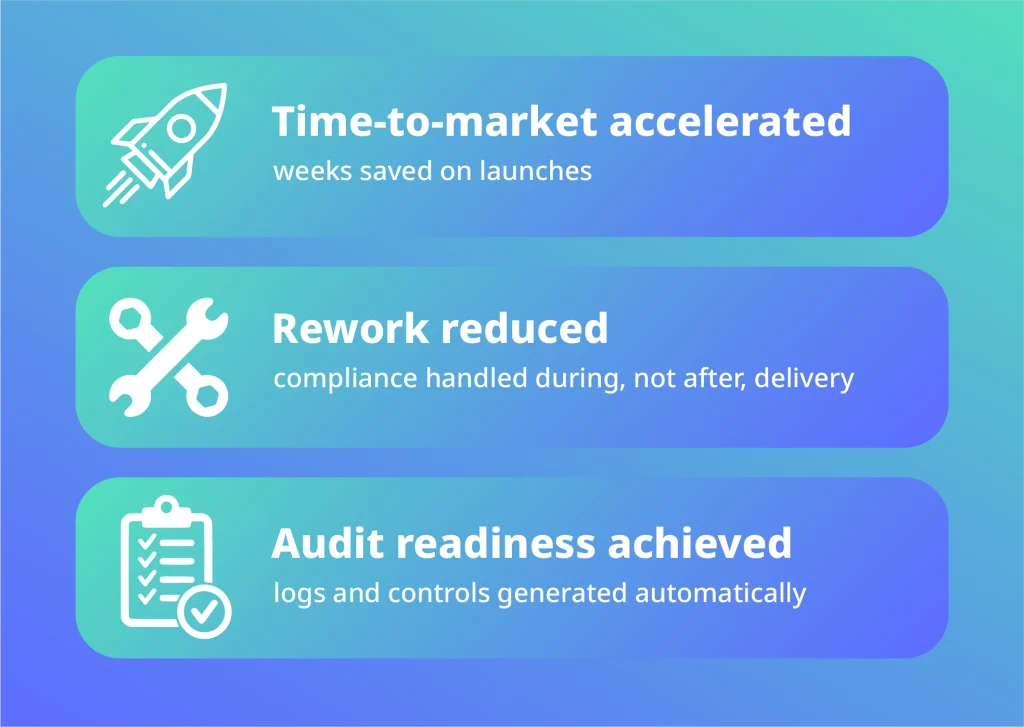
In both healthtech and fintech, squads turned compliance from a bottleneck into a built-in accelerator, proving regulated tech delivery doesn’t have to crawl.
With the right squad structure, secure launches become routine instead of rare exceptions. If you’re facing similar challenges (whether it’s scaling a fintech platform or securing healthtech environments), now is the time to act.
The quickest way to explore what this could look like for your organisation is to speak directly with experts who’ve built these models before. Contact Deployflow’s team and see how your next product launch can move faster while staying fully compliant.
Beyond Compliance: Business Value of Sprint-Based Squads
Compliance is a growth issue. PwC’s Global Compliance Study 2025 found that 77% of companies say compliance complexity has already hurt their ability to grow.
That number underlines why sprint-based squads matter: they don’t just keep you audit-ready, they protect revenue and market share.
Sprint-based squads’ real impact shows up in financial returns, stakeholder confidence, and the ability to keep scaling without tripping over regulations.
Faster ROI Through Secure Launches
A product launch delayed by months results in lost revenue to competitors. Squads that integrate compliance into every sprint cut this delay dramatically.
✅ Features reach customers earlier.
✅ Revenue lands sooner.
✅ Development teams stop wasting cycles on retroactive fixes.
Trust That Outlasts Audits
Regulated markets thrive on confidence. Customers, regulators, and investors all want to see proof, not promises. Sprint-based squads generate:
✅ Continuous audit logs that regulators can inspect at any time
✅ Transparent security practices that customers actually feel when using your product
✅ Measurable compliance metrics investors can trust in board discussions
When oversight isn’t just performed but demonstrated daily, credibility compounds. This is how startups punch above their weight in markets where trust is everything.
Long-Term Scalability of Compliance-as-Code
Laws evolve. Markets expand. Companies acquire or merge. The only way to keep up is to make compliance programmable. With compliance-as-code:
✅ A new regulation becomes a code update, not a six-month program.
✅ Entering a new geography reuses the same proven controls.
✅ Scaling infrastructure doesn’t multiply risk — the rules scale with it.
Instead of treating compliance as a series of one-off projects, squads set you up with a foundation that flexes with the future.
How to Adopt Sprint-Based Squads in Your Organisation
Not every organisation can flip the switch overnight. But adoption doesn’t have to be overwhelming if you focus on three essentials: pilot, tooling, and knowing when to bring in specialists.
Start With a Pilot, Not a Transformation
Choose one workflow where compliance pain is most visible; perhaps regulatory reporting, customer data handling, or security sign-offs.
Run a compliance sprint there. Treat it as a trial balloon. Define checkpoints, assign owners, and measure results.
If you cut approval cycles in half or eliminate rework, you’ll have evidence to take upstairs.
Tooling: The Invisible Backbone
Squads thrive on automation. Without it, you just shift bottlenecks around.
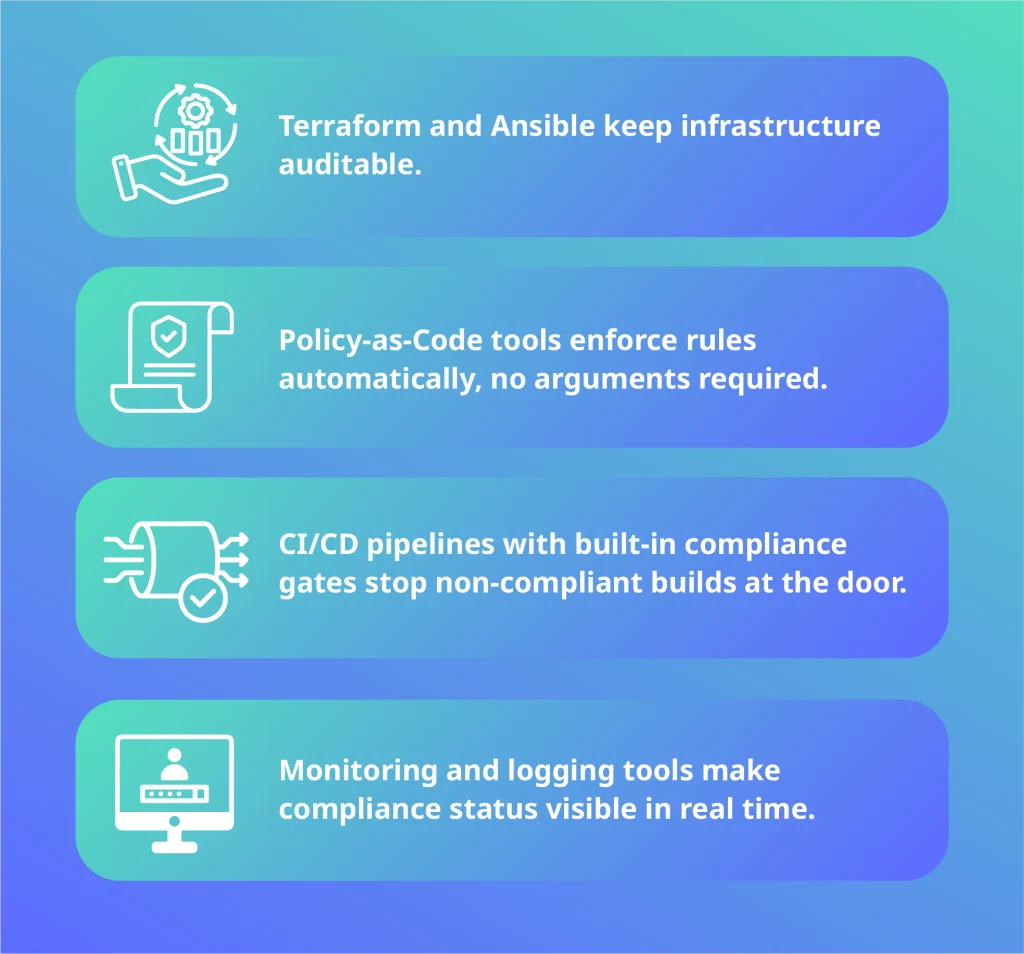
According to PwC’s Global Compliance Study 2025, 64% of organisations say compliance technology improves their visibility into risk, exactly the outcome squads deliver when these tools are wired into every sprint.
Cloud environments are often the first compliance risk to tackle. If you’re not sure where to begin, this overview of practical cloud security approaches explains how to harden infrastructure while keeping it scalable.
When to Bring in Specialists
Building DevOps and compliance muscle in-house takes time that most startups and scaleups don’t have.
- External squads can stand up pipelines in weeks instead of quarters.
- They bring proven playbooks already tested in regulated industries.
- Your engineers keep building features while compliance runs in the background.
Think of it less as outsourcing and more as acceleration.
For companies that can’t afford to wait months to build internal DevOps capacity, partnering through managed DevOps services is often the fastest route to compliance-ready delivery.
Where Compliance Meets Growth: The Squad Advantage
Deadlines in regulated industries aren’t flexible, but too many companies still act as if compliance must slow them down.
Sprint-based squads challenge that assumption. By embedding oversight into every sprint, they cut delays, reduce rework, and keep launches moving without last-minute panic.
The market is already shifting. A recent survey found that 99% of financial services organisations now rely on compliance technology, and 55% are using AI/ML for compliance tasks (source: StockTitan).
This is the standard. If your delivery model still treats compliance as a separate step, you’re competing at a disadvantage.
The advantages of sprint-based squads go beyond audit checklists:
- Faster ROI: Products launch on schedule, and revenue comes in sooner.
- Trust as a differentiator: Regulators and customers see transparent evidence, not promises on paper.
- Scalability without friction: Compliance-as-code grows with the business and adapts as regulations evolve.
The leaders of tomorrow will be those who stop seeing compliance as a constraint and start using it as an accelerator. Sprint-based squads are working in fintech, healthtech, and beyond right now.
P-Suite turns this theory into practice. It’s a planning tool that gives you an estimate of what your squad would look like for a specific project, who’s in it, how many sprints you’ll need, and the scale required to launch securely.
Instead of separate streams for product, security, and compliance, P-Suite unifies them. Infrastructure is coded and repeatable, policies are automated, and every sprint produces the evidence regulators need.
The result is not another “methodology,” but a working model that reduces risk, speeds up launches, and makes compliance part of everyday delivery.
The approach is fast because there’s no rework, secure because guardrails are coded in, and proven because it’s already running in sectors where mistakes are unforgivable.
P-Suite helps companies quickly estimate what a sprint-based delivery squad would look like for their specific situation.
The whitepaper walks through how it works in practice, with playbooks and metrics you can take to your board. Download the P-Suite whitepaper to discover how compliance can finally fuel growth instead of stalling it.
Will you adapt before your competitors do? Explore delivery squad models today and turn compliance into a growth advantage instead of a bottleneck.
Compliance Sprints: High-Value FAQs for Regulated Tech Delivery
How do compliance sprints support standards like ISO 27001, SOC 2, HIPAA, or GDPR?
Compliance frameworks aren’t abstract checklists — they’re enforceable rules. In sprint-based delivery, controls are mapped directly into code and pipelines:
- ISO 27001 clauses on encryption → automated policies that block non-encrypted storage.
- SOC 2’s “least privilege” → IAM rules that deny wildcard access.
- HIPAA requirements for PHI → restrictions on where data can be stored.
- GDPR Article 32 → policies that block deployments outside approved regions.
By building these rules into IaC templates and CI/CD gates, every sprint produces software that’s already aligned with regulatory standards, with evidence generated automatically. This means audits stop being a panic project and become a by-product of delivery.
How do squads handle segregation of duties (SoD) without slowing delivery?
Regulators often expect that no single individual can code, approve, and deploy changes — but squads solve this with smart separation of identities and approvals. Pipelines enforce who can build, who can approve, and who can promote to production, all tracked in audit logs.
- Developers write and review code, but production deploys run only on service accounts tied to signed artefacts.
- Protected branches and mandatory peer reviews ensure sensitive changes get extra eyes.
- Ephemeral credentials and signed artefacts prove that what’s tested is exactly what’s deployed.
This balances speed with regulatory assurance: teams still release multiple times a day, while SoD requirements are baked into the workflow.
How can audit evidence be automated to prevent audit reviews from derailing sprints?
In traditional delivery, evidence is gathered in spreadsheets right before an audit — causing stress and wasted time. Compliance sprints flip this: every pipeline run generates machine-readable proof. Test reports, IaC scans, and access reviews are stored immutably, tagged with control IDs, and bundled into an “audit pack” per release.
This makes audit readiness continuous. Auditors get a complete, tamper-evident history of compliance activities, and engineers avoid the dreaded “all-hands audit week.” The sprint rhythm doesn’t break, and reviews happen in parallel with delivery.
When should a company consider external squads instead of building in-house?
Not every organisation has the time or budget to build DevOps, compliance, and security expertise internally. External squads make sense when:
- Launch timelines are aggressive, and in-house hiring would take months.
- Regulatory scope (e.g., GDPR + HIPAA + PCI) is wider than your team’s current experience.
- Your engineers are bogged down in audit prep instead of feature delivery.
Specialist squads bring playbooks already proven in regulated industries, set up pipelines in weeks, and let internal teams focus on innovation. The result is acceleration, not outsourcing.
Explore our BLOG
Recent articles

ISO 42001 Explained: Requirements, Certification and What Your Engineering Team Must Build
ISO 42001 is the international standard that demonstrates your organisation governs AI properly, and enterprise...
read full article

Is Claude Down? Anthropic Outage: Protect Your Cloud Infrastructure
Claude went down across every surface on 29 September 2026. From 14:00 to 14:59 UTC,...
read full article

Top 10 Healthtech Companies in 2026: What Their Growth Means for AI and DevOps
Every software change that reaches a hospital has to clear regulatory, legacy system, and clinical...
read full article