



Has your agent been three months from production for nine months? Agentic projects break at one point: the move from a system someone is watching to a system nobody is watching. Everything holding your pilot up disappears there, and it goes all at once.
Below is what breaks, why, and three questions that tell you whether yours will survive the crossing. Most projects fail on question two.
Key Takeaways: Why Agentic AI Projects Fail
- You funded a demo and expect a system. A pilot proves the agent can do the job once, with someone watching. Production means doing it reliably with nobody watching.
- Longer tasks break agents. At 80% reliability, agents handle tasks around five times shorter than at 50%. Your pilot was scoped at the lower bar.
- Steps multiply; they do not average. Ten steps at 95% accuracy each leave you at 60% end-to-end.
- You cannot forecast the spend. Agents pick their own retries and loops at runtime, so cost tracks success rate rather than call volume.
- There is no rollback. Agent actions land in live systems with no transaction boundary.
- Nobody reviews agent access. Agents never trigger the joiner, mover, and leaver events that prompt an access review.
Why Your AI Agent Pilot Still Needs a Person
Your pilot has a person in it. That person rewrites the bad prompt, spots the wrong answer before it ships, and retries the run that timed out. Their time never reached the business case because, in a pilot, they were already on the payroll.
Measuring Agents in Production, an ICML 2026 study, sought to understand what deployed agents actually look like. Twenty case studies, 86 practitioners running real systems, 26 domains. What they found is far smaller than the launch videos:
- 68% of agents execute at most ten steps before a human intervenes
- 74% depend primarily on human evaluation to judge whether the output was right
Both lines are human gates holding the system up. Reliability came out as the top development challenge, and those gates are how teams solved it.
The ceiling is not a confidence problem either. Carnegie Mellon and Duke put agents inside a simulated software company with 175 realistic tasks spanning engineering, HR, and finance. The strongest agent tested achieved 30.3% unaided, as measured by TheAgentCompany benchmark.
Which leaves you with the question the business case never asked: who does the other 70%, and what do they cost at fifty agents instead of one?
AI Agent Reliability Collapses as Tasks Get Longer
Agents do not degrade gently as tasks get longer. They fall off a cliff.
METR, a non-profit evaluation lab, measures agents in a unit you can actually use: how long the same task takes a human expert. Their paper reports that this 50% time horizon has roughly doubled every seven months since 2019. METR now tracks it live, which is worth a bookmark, since any figure printed in an article is out of date within a quarter.
Look at the 80% curve instead of the 50% curve, and the horizon is roughly five times shorter. That is the whole problem in one line.
50% is a demo standard. 80% is barely a production standard. Your pilot was scoped against the first while your operations team assumed the second, and since both curves double at the same seven-month rate, the distance between them stays fixed at about 16 months of model progress. Waiting closes the horizon gap. It does not make agents behave more predictably. Nor does prompt engineering.
Two findings from the same work further sharpen this. METR scored their tasks for “messiness,” meaning underspecified, context-heavy, closer to real work. Each point on that scale cut mean success rates by around 8.1%, so clean benchmarks systematically flatter what an agent will do inside your business. And the failures are not evenly distributed.
On tasks taking a human 90 minutes to three hours, one frontier agent succeeded every single time on about a third of them, failed every single time on another third, and was inconsistent on the rest.
Two thirds of that set had a knowable answer before anyone built anything. So the cheapest useful thing you can do before funding phase two is a sorting exercise.
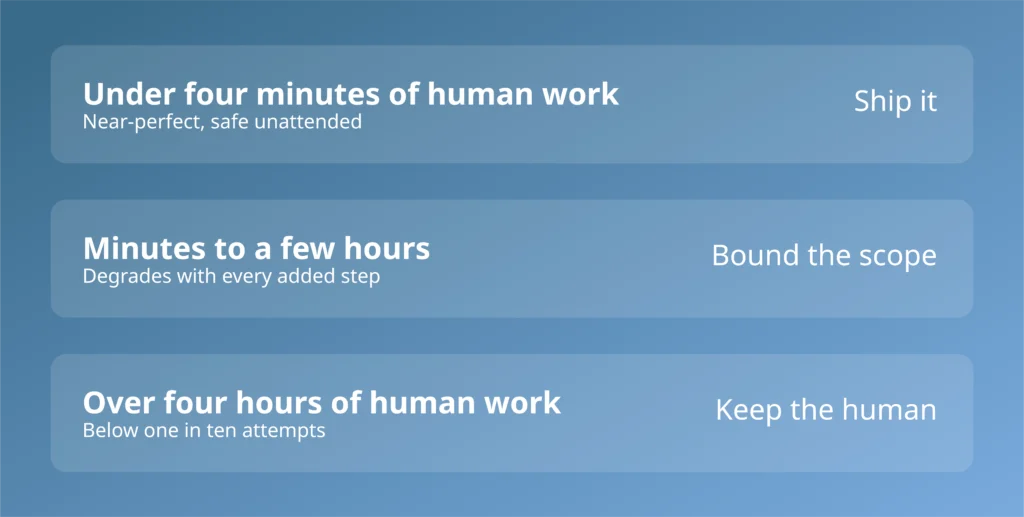
Rank every candidate workflow by how long it takes a competent human, then check the reliability you actually need. Anything long, messy, and high-stakes is a research project with a delivery timeline attached.
How Errors Compound in Multi-Step AI Agent Workflows
Pipelines multiply reliability. They never average it.
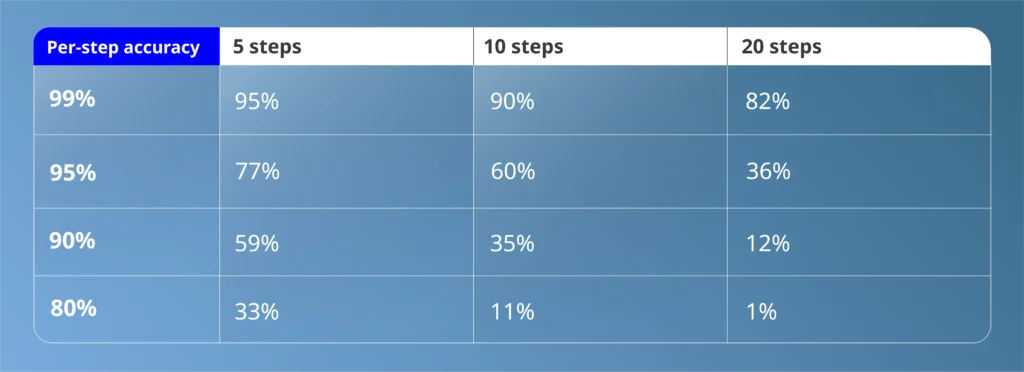
Real pipelines are messier, since agents retry and route around failures, and a single poisoned tool response can take a whole run down. Treat the table as the shape of the problem, not a forecast.
Two things follow, and both cut against instinct. A 3% gain at the step level reads as noise in a status report. Take a twenty-step pipeline from 95% to 98% per step, and end-to-end success goes from 36% to 67%. Adding another agent to look more sophisticated makes the system worse unless it earns its slot.
Failures also cluster in specific areas. Agents rarely break mid-reasoning. They break at the seams, and each seam has a control that catches it. A malformed tool call is caught by schema validation before it is sent. A response that is well-formed but wrong is caught by a confidence gate that escalates rather than proceeds. An irreversible write is caught by a dry run that commits only on the second pass.
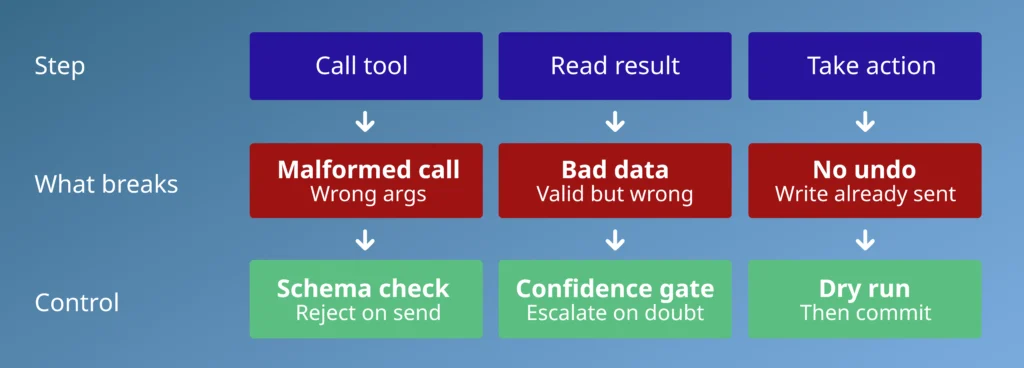
Seams belong to the integration layer, and the integration layer is exactly what nobody was assigned during the pilot. Closing those gaps is the whole distance between experimentation and AI engineering.
Agentic AI Cost Control: Why Spend Stops Being Predictable
Ordinary systems consume bounded compute per transaction. Agents pick their own loop count, tool calls and retries at runtime, so spend is emergent rather than planned.
Which breaks the only metric anyone is watching. Cost per API call stays flat while your real unit cost climbs.
Cost per outcome equals cost per attempt divided by success rate. Nothing else. A drop from 85% completion to 60% raises your cost per finished task by 42%, with no change to any invoice line. Halve your success rate, and you double your unit cost.
Nothing on the invoice moves while that happens. The first visible symptom is a quarterly overrun nobody can attribute.
Three controls belong in the architecture.
- Hard ceilings on calls and spend per session, enforced at the infrastructure level rather than requested in a prompt.
- Spend velocity alerts, since a retry loop can eat weeks of budget before a monthly threshold trips.
- Span-level tracing on every call, so a forming loop is visible while it is still cheap.
AI Agent Blast Radius: Why There Is No Rollback
A failed deployment rolls back. An agent that has already updated your CRM, charged the customer, and emailed them about it has no transaction boundary to unwind. The email in particular is gone.
Reversibility is an architectural property. You design it in, or you do not have it. Pilots almost never do, because a sandbox has no blast radius by definition.
Platform engineering already gave you the tools. Give each agent a service level objective and an error budget, then use them as the gate on how much autonomy it gets:
Read-only → Propose and approve → Act with reversal → Act unattended
Promotion is earned against the error budget, never against a deadline. An agent that has not held its SLO at one rung does not move to the next, whatever the roadmap says.
An agent shipped without that ladder has no brakes, which is why the ladder is a design decision taken before the build rather than a policy written after it. Building the rungs costs a fraction of what it costs to add brakes to an agent already running unattended, which is why agentic AI development starts with the ladder instead of the model.
Agent Sprawl: The Non-Human Identities Nobody Reviews
Access governance has a blind spot shaped exactly like an AI agent. Reviews fire on events, and agents generate none of them.
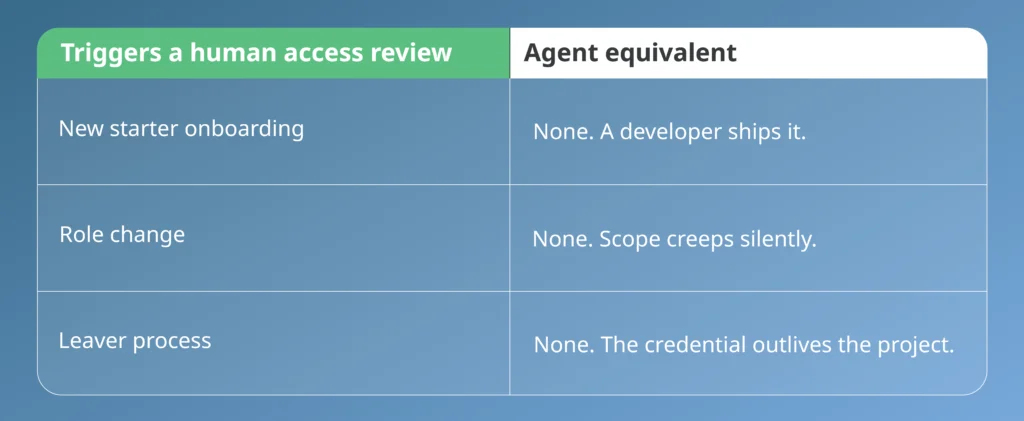
Cloud Security Alliance research puts a number on the gap. In its January 2026 survey, 78% of organisations had no documented policy for creating or removing AI identities at all. More than 16% do not track when new ones appear. Only 12% were highly confident they could prevent an attack through a non-human identity, down from 15% in 2024.
August 2025 showed what that costs. Attackers took OAuth tokens belonging to Drift, an AI chat integration, and used them to query the Salesforce environments of more than 700 organisations, among them Cloudflare, Google, and Zscaler. The tokens were valid, so multi-factor authentication was never applied. Exfiltration ran for roughly ten days before anyone revoked it.
Every agent you deploy is a credential with that reach. Fold them into your AI governance framework rather than keeping a separate register nobody opens.
AI Agent Evaluation: What Benchmark Scores Miss
Benchmarks measure whether an agent succeeds. Production cares how it fails.
A single pass rate cannot tell you whether an agent behaves consistently across runs, withstands small changes to its input, fails predictably, or keeps the damage bounded when it does. Princeton’s reliability dashboard scores agents on exactly those dimensions, and the pattern it exposes is uncomfortable: recent capability gains have produced only small improvements in reliability.
Set that beside the horizon data from earlier. Agents handle longer work each quarter while behaving no more predictably. That combination is what turns an impressive pilot into a fragile production system.
Evaluation belongs in CI, running against golden datasets and replayed production traces, alerting on drift rather than certifying once a year. Skip it, and the first sign of a model change will be a customer complaint. Build it before the agent ships.
What Every Production AI Agent Needs on File
Governance sounds heavy until you reduce it to a single record per agent, covering who owns it, how it behaves, and what it costs.
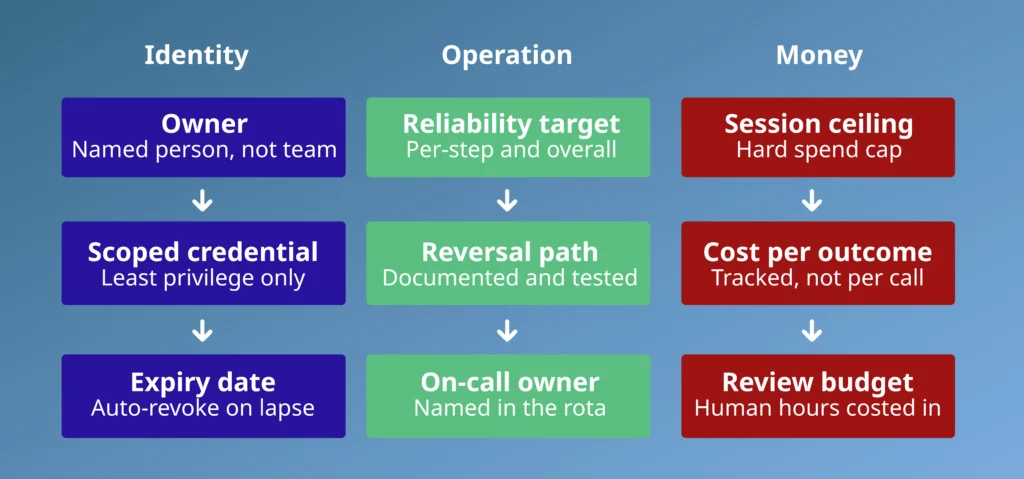
Ten minutes per agent. Cheaper than any incident. If you cannot complete the record, the agent is not ready to leave the pilot.
Three Questions Before You Fund the Next Phase
Most AI projects fail before anyone writes code because nobody agrees on what problem is being solved. These three close that gap.
- What financial outcome does this agent change, in one sentence? If the sentence needs a clause about productivity or enablement, the outcome has not been found yet.
- What is the worst action the agent can take, and how do you reverse it? No answer means no production.
- What does one resolved task cost at target volume, including human review? Count the subsidy you are about to remove.
Getting Agentic AI into Production Without the Rework
Organisations fund a demonstration and expect a production system. The gap shows up late, when changing course costs the most.
Two Deployflow programmes show the alternative. On a national AI platform for a UAE public-sector body, every phase was a gate, not a formality. Data foundations before AI pipelines, pipelines before the executive layer, nothing promoted until the previous stage was proven. Proof of concept to production took six to twelve months at a national scale.
On a national energy project, the constraints were absolute: an air-locked network, petabytes of subsurface data, H100 clusters. Every change to that environment is tracked through GitOps, which is what makes it defensible to a regulator, and new AI workloads land on it without re-engineering the core.
The first session costs nothing. One conversation with Deployflow’s AI engineering team, covering a reliability baseline for one workflow, a blast radius assessment, and a costed route to production, including the human review you are currently paying for without counting it.
One session is enough to tell whether a workflow belongs in production this quarter or next year. Book a free review.
Why Agentic AI Projects Fail: Frequently Asked Questions
What is agentic AI, and how is it different from a copilot?
An agent chooses the sequence of steps and carries them out. A copilot suggests, and a person decides whether to act.
That difference sounds small, but it changes everything downstream. A copilot’s mistakes get caught by the human who was going to do the work anyway. An agent’s mistakes land in live systems with nobody in between. Accountability moves from the person at the keyboard to the system design. That is why agents need service levels, audit trails, and reversal paths that copilots never required. The capability is comparable. The engineering burden is not.
How long does it take to move an AI agent from pilot to production?
Budget two to three times what the pilot cost, and three to nine months for a single bounded workflow.
The variance sits almost entirely outside the model. Integration with real systems, evaluation infrastructure, access provisioning, observability, and sign-off consume the bulk of it. Teams that scope a narrow workflow with one clear owner move at the fast end of that range. Teams attempting a broad, multi-department agent rarely finish at all. Shorten the timeline by shrinking the workflow rather than accelerating the build. A reliable agent doing five steps beats an ambitious one doing twenty badly.
Should you build AI agents in-house or buy a platform?
Build the layer that touches your data and workflows. Buy the infrastructure underneath it.
Most teams running agents in production end up writing their own orchestration rather than leaning on a framework, and the reason is control. Frameworks abstract away the exact layer you need visibility into when something misbehaves at three in the morning. Buying makes sense for models, observability, tracing and identity management, where the problem is the same for everyone. Building makes sense wherever your business logic or compliance obligations are specific to you. Treat it as several decisions rather than one, and judge each layer on its own.
Do UK companies need to comply with the EU AI Act when deploying agents?
Often yes. The Act applies to any provider or deployer placing AI on the EU market or whose AI outputs are used within the EU.
Geography does not decide it. Your customers and your data flows do, so a London company serving EU users is usually in scope. Obligations depend on how the system is classified, with transparency duties arriving earlier than the heavier requirements for high-risk systems, and several deadlines have already moved once. Domestically, the picture is different again. The UK has no standalone AI statute and no AI bill before Parliament, so existing sector regulators apply existing law to AI systems. Check your specific use case with counsel before assuming either regime leaves you alone.
What team do you actually need to run agents in production?
An accountable owner, platform engineering capability, and someone responsible for evaluation. A research team is optional.
Most production teams prompt off-the-shelf models rather than fine-tuning them, so deep ML expertise matters far less than integration, observability and operational discipline. Human review stays in the loop for far longer than anyone plans, which makes review capacity a permanent running cost rather than a launch expense. Budget it that way. Then put the agent on an on-call rota with a runbook, the same as any other production service. Agents that lose their owner when the pilot team disbands are the ones that quietly stop working.
Explore our BLOG
Recent articles
ISO 42001 Explained: Requirements, Certification and What Your Engineering Team Must Build
ISO 42001 is the international standard that demonstrates your organisation governs AI properly, and enterprise...
read full article

Is Claude Down? Anthropic Outage: Protect Your Cloud Infrastructure
Claude went down across every surface on 29 September 2026. From 14:00 to 14:59 UTC,...
read full article

Top 10 Healthtech Companies in 2026: What Their Growth Means for AI and DevOps
Every software change that reaches a hospital has to clear regulatory, legacy system, and clinical...
read full article