


Eliminate up to 35% of cloud overspend and reduce reported emissions by embedding Governance-as-Code directly into your delivery pipelines, before waste scales with every release.
While many UK boards estimate cost leakage at around 25%, data from the 2024 State of the Cloud report suggests the actual rate often exceeds 35% once uncontrolled sprawl is fully audited.
TL;DR for CTOs & Finance Leaders
The Leak: 35% of UK cloud budgets are wasted on ghost resources and unoptimised architectures.
The Risk: Beyond the P&L, inefficient cloud usage is now a liability for UK ESG and Carbon Reduction Commitment (CRC) reporting.
The Fix: Shift from point-in-time optimisation to Governance-as-Code.
The fix requires governance, automation, and sustainability controls built directly into the cloud operating model.
This article explains managed cloud services, where carbon inefficiency originates, why environmental sustainability now affects financial performance, and how the right cloud consulting approach can stop the loss before it appears on the bill.
Cloud Cost Optimisation UK: Where 35% Waste Actually Comes From
Cloud sprawl becomes visible when engineering teams cannot quickly answer three simple questions:
Who owns this resource?
Why is it still running?
What happens if it is removed?
When those answers are unclear, unnecessary infrastructure remains active by default, increasing both cost and environmental impact.
In many production environments, the problem shows up in practical ways:
- Development environments that stay online after releases
- Storage snapshots are retained without lifecycle policies
- Kubernetes workloads are sized for peak traffic but never right-sized
- Legacy services are kept alive because no formal decommissioning process exists
None of these issues is complex individually, yet together they create a persistent layer of waste that grows month after month.
Solving cloud sprawl requires operational discipline rather than large platform changes.
Start by assigning clear ownership for every workload, enforcing automatic shutdown and lifecycle rules, and introducing policy-based provisioning so resources cannot be created without cost and sustainability accountability.
Once these controls are embedded into everyday delivery workflows, cloud environments begin to scale only when they generate value and not simply because they were never instructed to stop.
The Opportunity Cost: Waste is a Talent Drain
For every hour your senior engineers spend cleaning up the cloud or investigating surprise bills, they are losing an hour of innovation.
In the UK, forcing high-level engineers to perform manual decommissioning is a recipe for burnout and attrition.
The Shift: By automating the resource lifecycle, you move your team from “Cloud Janitors” to “Cloud Architects.” You aren’t just saving 35% on spend; you are reclaiming 20% of your engineering velocity.
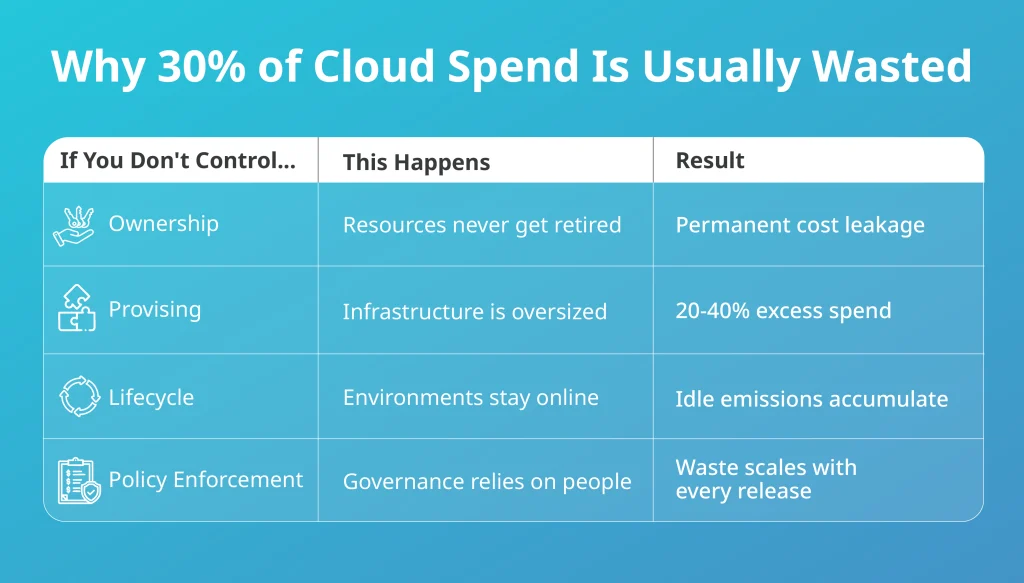
Carbon inefficiency is most often generated during the design and provisioning stages, not during day-to-day operations.
If governance, automation, and operational efficiency controls are not defined at the start, every new workload inherits the same inefficiencies, multiplying cost leakage as the platform grows.
Three systemic factors typically drive most unnecessary spend.
- First, unclear ownership means resources remain active because no team is responsible for reviewing or retiring them.
- Second, manual provisioning decisions lead to oversized infrastructure built for worst-case scenarios instead of real usage patterns.
- Third, missing sustainability controls prevent automatic enforcement of cost and carbon efficiency, allowing workloads to scale without accountability.
Once inefficient patterns are built into deployment templates and pipelines, finance teams only see the consequences months later.
Addressing the problem requires redesigning provisioning standards, ownership models, and policy-driven automation so that every new deployment is aligned with cost and sustainability targets.
The Lift-and-Shift Hangover
Many of the 35% cost leakage figures seen today stem from lift-and-shift migrations in which legacy data centre mindsets were applied to the cloud. Static provisioning in a dynamic environment is the primary driver of the Cloud Sprawl mentioned above.
How to fix this? You must move beyond simple migration toward Modernisation-as-Code. This means refactoring workloads to be serverless or containerised, ensuring they consume energy and budget only when they are actively performing a task, not while they sit idle in a London or Dublin availability zone.
SECR and ESG Compliance: Why Cloud Architecture Now Affects Statutory Reporting
Environmental sustainability now directly affects financial exposure, regulatory posture, and supplier eligibility.
UK organisations are increasingly evaluated through ESG reporting requirements, supply-chain sustainability audits, and investor scrutiny focused on operational emissions, which means inefficient cloud usage is no longer just an engineering concern. It becomes a measurable business risk.
So what does this mean in practice?
Workloads that run unnecessarily, oversized infrastructure, and duplicated environments increase both cloud spend and reported emissions at the same time, placing pressure on both finance and sustainability targets.
Reducing cloud waste is one of the fastest ways to lower operational emissions without slowing delivery, because every unused compute hour eliminated immediately improves both cost efficiency and net zero alignments metrics.
SECR Compliance Cloud Risk: Why Architecture Now Impacts Statutory Reporting
More than 11,000 UK companies are now required to report under SECR (Streamlined Energy and Carbon Reporting), making cloud efficiency a core part of statutory compliance. Under SECR, large companies are required to disclose their energy use and carbon emissions.
Inefficient cloud architecture (specifically zombie servers and over-provisioned databases) directly inflates your Scope 3 emissions.
A governed cloud operating model provides the granular data required for auditors, turning your IT department from a reporting liability into a leader in corporate responsibility.
The Cloud Sustainability Blind Spot in Most Organisations
According to McKinsey, 90% of cloud transformations fail to deliver their full ROI. The common denominator is a lack of Governance-as-Code, with cost and carbon treated as afterthoughts rather than core engineering requirements.
If you cannot tell which workloads generate the most emissions, sustainability cannot be controlled, only reported. This is the core blind spot affecting cloud platforms today: engineering teams are expected to optimise cost and environmental sustainability without the visibility or controls to do so.
In practical terms, this means carbon impact is not tracked per workload; FinOps and GreenOps operate in parallel instead of as one operating model, and provisioning pipelines lack enforced rules to shut down, right-size, or decommission resources automatically.
Sustainability is discussed after deployments, not during design decisions, where it would actually prevent cost leakage.
So what happens?
Every new release scales cost and emissions by default. Without sustainability and cost controls built into engineering workflows, platforms grow faster than governance, leading to predictable overspend and rising environmental exposure.
The fix is embedding lifecycle automation and sustainability policies directly into how cloud resources are created and managed.
Moving from Reactive Clean-Ups to Governance-by-Design
If carbon inefficiency keeps returning after every cost-optimisation exercise, the platform itself is working against you. Modern Cloud consulting in UK focuses on changing how the environment is designed and governed, so cost leakage cannot be created in the first place.
That starts with architecture decisions that limit sprawl by default. Resources are provisioned through policy-as-code, ensuring cost and carbon efficiency rules are enforced automatically rather than reviewed manually.
Every workload follows a defined lifecycle model (create, scale, retire), so unused infrastructure cannot linger indefinitely. Cost and carbon visibility are then directly linked to teams and services, making ownership explicit and actionable.
So, what changes day to day?
Waste prevention becomes part of normal delivery, not a quarterly clean-up led by finance. Teams ship faster with clearer boundaries, leadership gains predictable spend and sustainability outcomes, and cloud platforms scale only when they deliver real value.
FinOps Strategy UK & GreenOps Framework: One Operating Model, Two Outcomes
Treating FinOps and GreenOps as separate initiatives creates friction instead of results. Cost optimisation on its own delivers short-term savings but often pushes inefficiencies elsewhere, while sustainability efforts without cost controls turn into reporting exercises with little operational impact.
In both cases, the platform continues to scale without enforceable limits.
When FinOps and GreenOps operate as one cloud operating model, the effect is immediate and practical:
- Workloads are right-sized by default
- Idle resources are removed automatically
- Teams see the cost and environmental impact of their decisions in real time
This leads to lower cloud spend, reduced carbon emissions, and predictable growth, while making ESG reporting a by-product of good engineering.
Most importantly, it eliminates the need for repeated emergency cost-cutting exercises because efficiency is enforced continuously, not retrospectively.
Measurable Results UK Teams Typically See
When cloud consulting fixes the operating model and not just your bill, results appear fast and stay consistent.
- Up to 30% lower cloud spend as idle and unused resources are automatically eliminated
- Immediate reduction in cost leakage across compute, storage, and non-production environments
- Clear cost and environmental sustainability ownership per team and service
- Predictable month-to-month billing, no surprise spikes
- Lower operational emissions without slower releases, because efficiency is enforced by design
Cloud platforms scale only when they create value. Spend stabilises, emissions fall, and delivery speed remains intact without recurring clean-up projects or emergency controls.
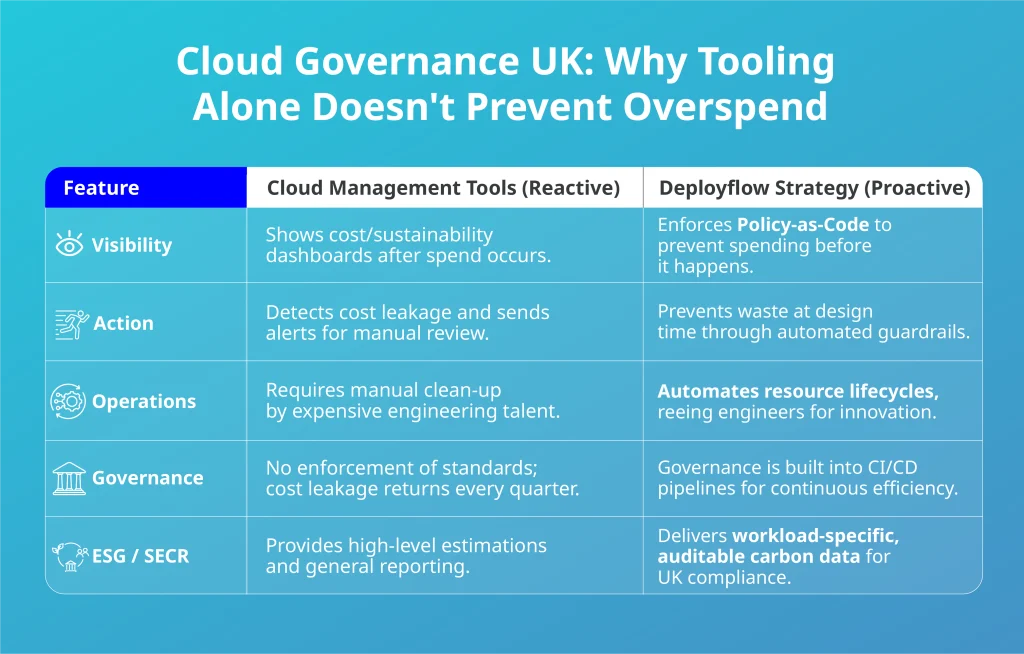
Tools reveal cloud waste. Consulting eliminates it.
What to Look for in a Cloud Consulting Partner
The right cloud consulting partner designs the platform as a governed system.
✔️ Start with partners who design cost, security, and operational efficiency together, so trade-offs are handled at the architecture level instead of patched later.
✔️ Prioritise automation first, where policies are enforced by pipelines and infrastructure code, not reviewed in dashboards after the fact.
✔️ Governance must be embedded directly into CI/CD and provisioning workflows, ensuring every deployment follows the same rules without relying on individual discipline.
✔️ Finally, accountability matters. Look for clear ownership models tied to teams and services, and a proven ability to reduce cloud spend and environmental impact at the same time, without slowing delivery.
That combination: automation, governance, and measurable outcomes, is what turns cloud consulting from advice into operational control.
Environmental Sustainability as a Competitive Cloud Advantage
When engineered into the cloud operating model, carbon efficiency delivers immediate, measurable gains.
- Cloud costs drop below competitors’ levels, operational emissions fall in parallel, and growth becomes predictable instead of risky.
- Every deployment either aligns with cost and carbon policy, or it does not launch.
- ESG positioning strengthens through real, auditable outcomes and not estimates or assumptions.
- Compliance conversations become faster and simpler because sustainability metrics are traceable to governed engineering processes.
- Teams scale workloads cleanly and confidently, without triggering cost spikes or environmental sustainability setbacks.
For leadership, this creates one outcome that matters most: confidence that cloud growth supports the business.
From Cloud Waste to Controlled Growth
Cloud cost leakage is a signal that the platform was never designed to govern itself.
Deployflow has helped organisations move from reactive cost control to built-in governance and sustainability.
For Hall Hunter, this meant migrating to a governed cloud platform that reduced IT costs by around 30% while stabilising operations and eliminating manual overhead.
For Little Journey, it meant replacing ad-hoc environments with Terraform-driven infrastructure, cutting deployment time from days to just two hours and enforcing security, cost, and sustainability controls by default.
If cloud spend keeps surprising finance, and environmental sustainability feels like a reporting exercise instead of an engineering outcome, the issue is the operating model.
Fix the system at its source, lock cost and sustainability controls into delivery, and regain predictability.
If cloud spend still surprises finance and sustainability remains a reporting exercise, your platform lacks governance.
Book a 30-minute Cloud Efficiency Review to identify where 35% of spend is leaking and how to prevent it permanently.
Frequently Asked Questions on Cloud Cost Optimisation and SECR Compliance in the UK
How quickly can cloud cost optimisation UK initiatives deliver measurable savings?
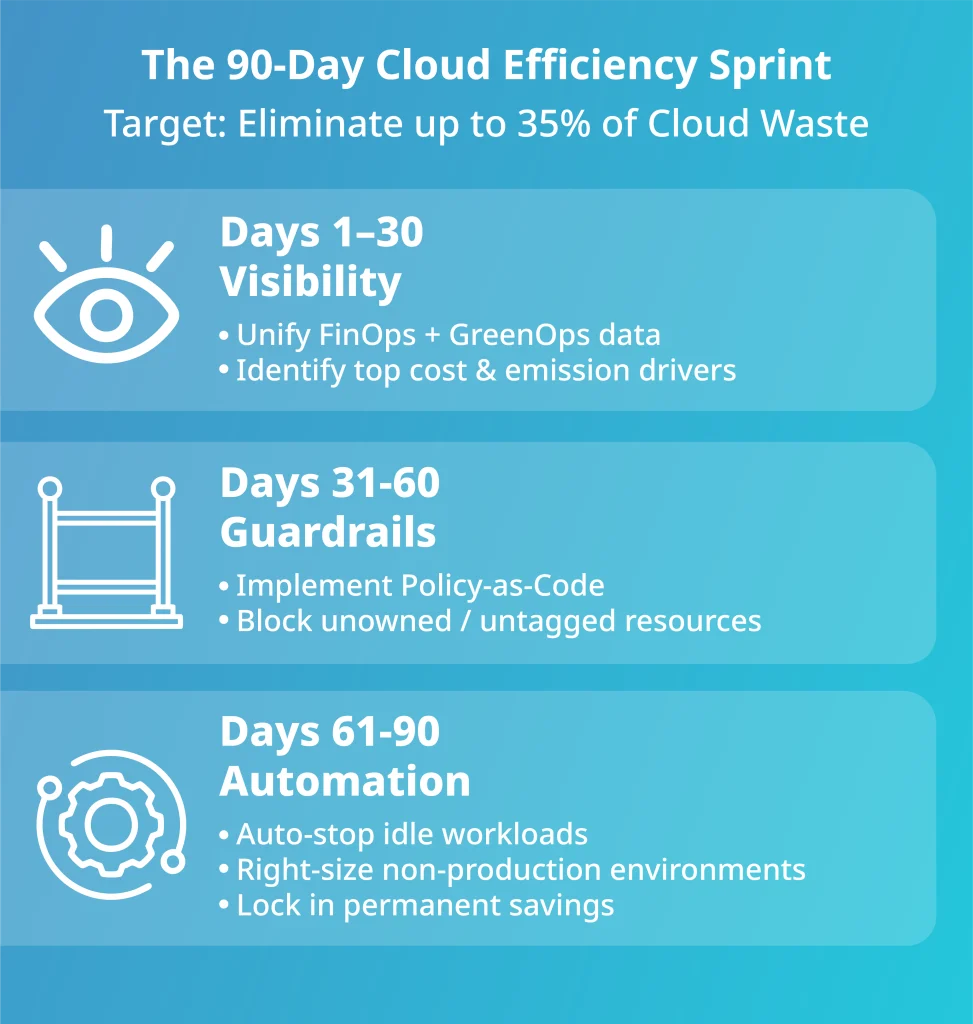
Cloud cost optimisation can begin delivering measurable savings within 30 to 90 days.
Early improvements typically come from eliminating idle non-production environments, right-sizing compute, and enforcing tagging and ownership policies.
However, sustained savings depend on embedding governance-as-code into CI/CD and provisioning workflows. Without automated guardrails, new workloads inherit the same inefficiencies. Long-term cost predictability only happens when prevention replaces quarterly clean-ups.
Does SECR compliance apply to cloud infrastructure and Scope 3 emissions?
Yes, cloud infrastructure can contribute to Scope 3 emissions under SECR reporting requirements.
UK organisations are responsible for disclosing indirect emissions linked to outsourced cloud services. Over-provisioned workloads, zombie servers, and duplicated environments inflate reported energy usage.
Without workload-level carbon visibility, sustainability reporting relies on estimates rather than defensible data. A governed cloud operating model enables accurate, auditable carbon reporting aligned with SECR expectations.
What is the difference between a FinOps strategy and a GreenOps framework?
A FinOps strategy focuses on financial accountability for cloud usage, while a GreenOps framework extends accountability to environmental impact.
Treated separately, they create reporting layers instead of operational control. When integrated through shared policy-as-code enforcement, cost and carbon efficiency are managed at provisioning. This ensures workloads are right-sized by default and scale within defined limits. The outcome is predictable cloud spend alongside measurable sustainability improvement.
Why does cloud waste return after cost optimisation projects?
Cloud waste returns because the underlying governance model has not changed. One-time optimisation exercises remove visible inefficiencies but do not prevent new uncontrolled resources from being deployed.
Without governance-as-code embedded in pipelines, policies depend on manual review and individual discipline. As engineering velocity increases, unmanaged provisioning reintroduces overspend and carbon exposure. Sustainable cloud cost optimisation requires prevention at design time, not reactive correction.
Explore our BLOG
Recent articles

ISO 42001 Explained: Requirements, Certification and What Your Engineering Team Must Build
ISO 42001 is the international standard that demonstrates your organisation governs AI properly, and enterprise...
read full article

Is Claude Down? Anthropic Outage: Protect Your Cloud Infrastructure
Claude went down across every surface on 29 September 2026. From 14:00 to 14:59 UTC,...
read full article

Top 10 Healthtech Companies in 2026: What Their Growth Means for AI and DevOps
Every software change that reaches a hospital has to clear regulatory, legacy system, and clinical...
read full article