



Speed and control look like opposing forces, right up until you watch a well-run programme deliver both.
RAND Corporation found that more than 80% of AI projects fail, which is twice the failure rate of conventional IT projects. The reason is the delivery architecture: scaling without governance, deploying without cost controls, and building on a foundation that cannot survive an audit. The teams shipping AI fastest tend to hold the cleanest audit trail, and the two facts are connected.
TL;DR
- The four ways unstructured AI scaling fails (cost overruns, compliance retrofits, technical debt, and team erosion) and the exact point at which each one enters your programme, so you can close it before it compounds.
- A five-move delivery framework that gives you speed, cost control, and compliance from the same cadence, not as trade-offs against each other.
- Why ISO 42001 shortens regulated and public sector procurement rather than adding to your timeline, and how to turn it into a commercial advantage before your competitors do.
- National-scale proof: a UAE public-sector AI platform built from POC to production in 6 to 12 months, a petabyte-scale energy AI programme with zero manual governance steps, and a medtech deployment cut from days to two hours.
Your board wants AI in production. Your peers are already shipping. Get the delivery model right, and that pressure becomes an advantage.
Governed vs. Ungoverned AI Acceleration: What the Difference Costs at Scale
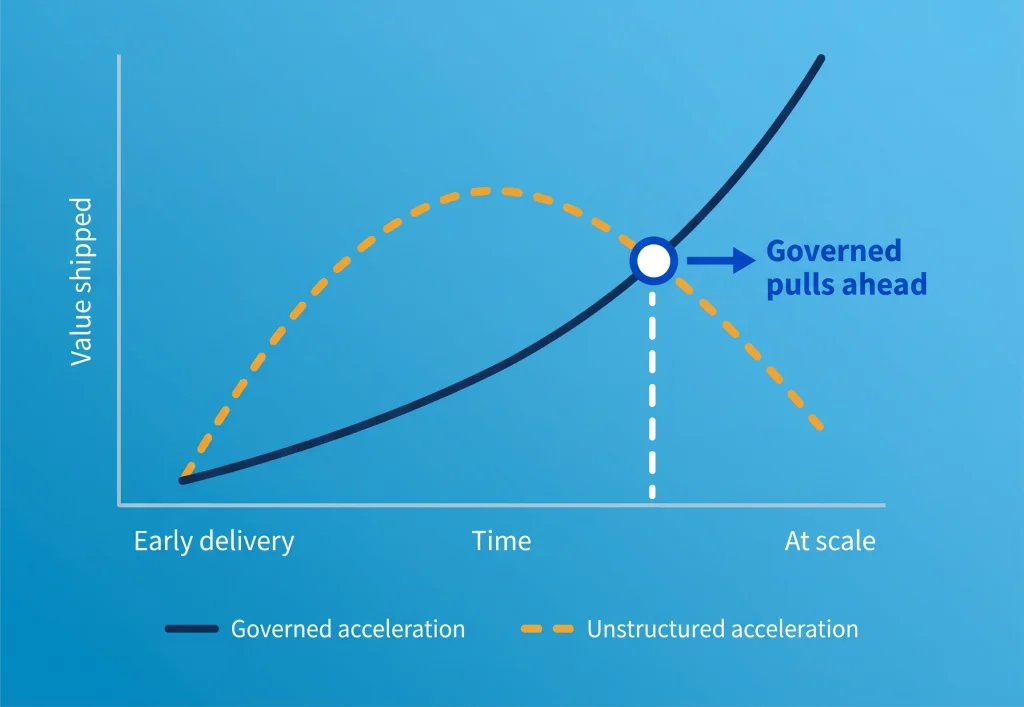
Why AI Projects Fail at Scale: Four Compounding Risks CTOs Underestimate
You can manage any one of these. The problem is they rarely arrive alone, and they compound on each other faster than a single fix can keep up.
Costs Climb Faster Than Your Reporting Shows
AI spend is consumption-based and retrospective. The meter runs on every token and every call, and the bill lands a month later. By the time a dashboard shows the trend, three sprints of spend are already committed.
Shadow usage widens the gap, as engineers run API calls against budgets nobody is tracking. Flexera’s 2026 State of the Cloud Report found that wasted cloud spend rose to 29%, its first increase in five years, with surging AI workloads named as the cause.
EU AI Act and ISO 42001: The Cost of Treating Compliance as a Late-Stage Gate
The EU AI Act introduced binding risk tiers. ISO 42001, the international standard for AI management systems, now appears in procurement requirements across regulated and public sector contracts. Ship ahead of either, and compliance becomes a retrofit: re-architecting audit logs, rebuilding documentation for data flows, and pausing a launch you had already promised.
Retrofits cost more than building it in from the start, and they surface at the worst moment: the week before go-live.
AI Technical Debt: How Demo-Phase Shortcuts Become Production Architecture Problems
The fastest route to a working demo rarely survives contact with production. A language model wrapper bolted onto a legacy system without an architecture review holds up until the day you swap providers or hit real traffic, then breaks in ways that are expensive to trace. The prototype’s quick authentication shortcut becomes the security review that blocks your launch.
Every shortcut you take at integration sets the size of the rebuild later.
The People Cost of Ungoverned AI Scaling
DORA’s 2025 research found that AI amplifies the delivery foundation it lands on. Teams with mature pipelines and testing get measurably faster. Teams without them see rework and failed deployments rise, because AI ships larger changes and larger changes break more often. Scale an AI programme on weak foundations, and you multiply the dysfunction faster than the output.
Context switching climbs, on-call load grows, and deployment frequency on the core product slips. Burnout follows, and the people you most need to scale the programme are the first to start looking elsewhere.
For a detailed breakdown of how each of these compounds across your stack, and a self-assessment to find your current exposure, the AI governance guide for engineering leaders covers the full picture.
How to Scale AI Safely: Five Moves That Close Every Structural Risk
Five moves give you speed you can defend. Each one closes a specific risk before it compounds. Together, they build a programme that the board trusts, the auditor signs off on, and your engineers can sustain.
Start With an AI Readiness Audit
A readiness audit tells you how fast you can safely move before you commit budget to scaling. In a few weeks, it answers the questions that set the programme’s pace. What state is your infrastructure in? Where do the data pipelines break? How is access scoped for non-human actors? How does your team’s real AI delivery capacity compare with what leadership assumes it to be?
The payoff is certainty at the point it costs least. Every gap the audit surfaces is one you fix on your own timeline, rather than during an incident or a failed compliance check on the eve of go-live. Treat the audit as your first delivery milestone, and you enter the first sprint knowing the programme will hold.
Case in point: UAE national scale. Before a single use case went live, the data architecture, governance model, and pipeline design were settled. That groundwork made a 6-12 month national deployment timeline credible. The proof of concept was the foundations. The full story is in the case studies below.
Run Delivery in Governed Sprints
Governed sprints give you a clear view of the programme without slowing it down. Each cycle has defined scope, a fixed time box, review gates between phases, and a working output at the end. The same cadence that drives pace keeps oversight in place.
You see progress every sprint, in the form of a working result, a cost report, and a governance checkpoint. Leadership gains confidence. Your engineers gain a clear runway. Problems that would otherwise derail the programme surface in week two, while they are still cheap to fix, rather than as a costly pivot halfway through.
The two-loop sprint model explains exactly how engineering and governance operate in parallel within a single cycle, including the gate criteria that keep both moving.
Instrument Cost From Day One
Set your cost controls at first deployment, and AI spend stays predictable however large the programme grows. Tagging strategy, environment-level tracking, alert thresholds, and model selection rules are quick to implement at the start and save you a quarter of the recovery cost later. You keep shipping features instead of chasing an invoice nobody can explain.
Day-one cost data also sharpens every AI decision you make. When the board asks what a use case costs to run, you answer with a real figure rather than a guess.
Treat ISO 42001 as an Accelerator
ISO 42001 alignment shortens your sales cycle and qualifies you for work that rules out suppliers who lack it. A working AI management system puts defined accountability, audit trails, logging, and explainability in place ahead of demand. Those are the exact controls that regulated buyers, enterprise procurement, and public sector frameworks require before they sign.
Build them in early, and compliance stops being a gate at the end of delivery. You move through procurement faster and turn what looks like an overhead into a commercial advantage.
Name a Single Owner for AI Governance
A named owner keeps decisions fast and accountability obvious. Give one person real authority over scope, sign-off, and escalation, and the programme stops stalling in committee while approvals circulate. Questions get answered in hours rather than at the next steering meeting.
Clear ownership is what lets you hold pace without losing control. When a call needs making, the board knows who makes it, and so does the delivery team.
Programmes running governed sprints typically reach first production deployment in six to eight weeks; ungoverned programmes often reach the same milestone after a compliance retrofit adds months.
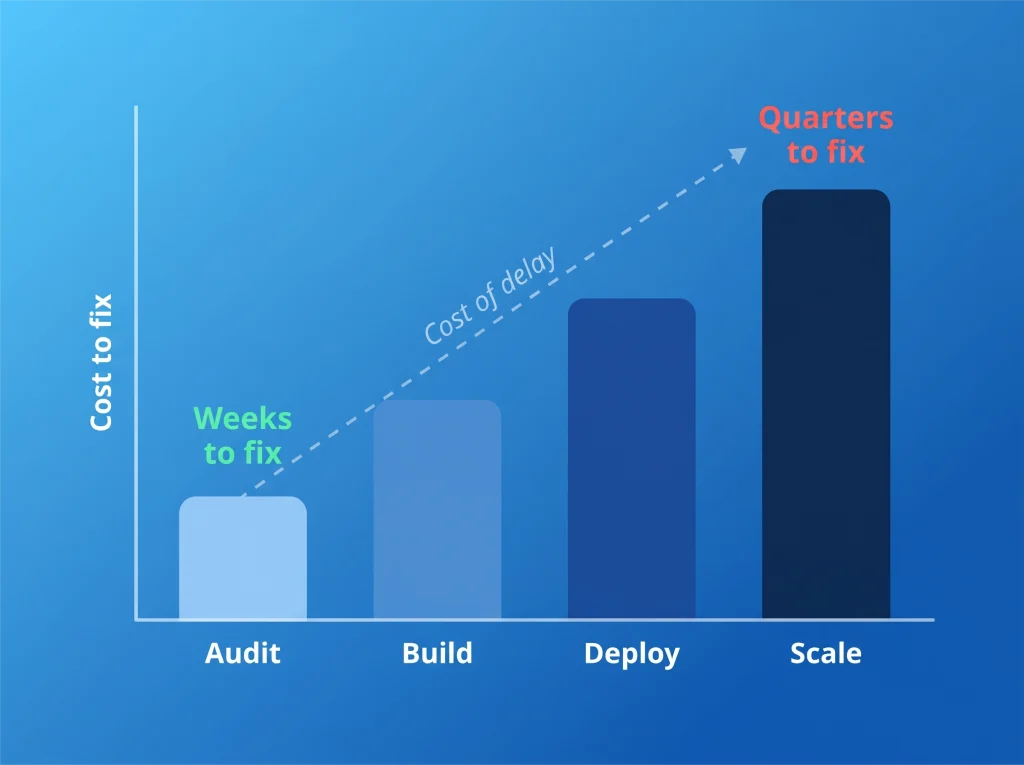
The Cost of AI Governance Gaps: Why Every Stage of Delay Is More Expensive Than the Last
The same gap costs more at every stage you let it slide.
Governed AI at National Scale: Three Case Studies From High-Stakes Regulated Environments
Here is what the moves above deliver when the stakes are national and the margin for error is zero.
Decision-Intelligence Platform Case Study: How Governance Made the Timeline Credible
One of the UAE’s largest public-sector organisations (responsible for monitoring social and economic wellbeing at national scale) came to Deployflow with data fragmented across surveys, spreadsheets, and disconnected regional platforms. Leadership had no unified view of community conditions or how policy decisions moved the numbers.
Deployflow designed a phased decision-intelligence platform: data foundations first, then AI pipelines to classify incoming signals, and finally an executive layer that aggregates indicators across family health, economic health, and social cohesion.
The approved proof of concept established the foundations. From there, full national deployment was scoped to 6–12 months, a timeline made credible because the data architecture, governance model, and pipeline design were resolved before a single use case went live.
The result was 24/7 real-time data ingestion replaced manual reporting, and a single unified layer merged what had been multiple disconnected systems.
Energy Sector AI Platform Case Study: Zero Manual Governance Steps at Petabyte Scale
For an energy-sector AI platform operating at national scale on H100 GPU clusters, Deployflow built a governance-first architecture where every environment inherits its security and networking policies automatically:
- 0 manual steps to apply governance to a new environment
- 100% air-locked, reachable only from the customer network
- Every change tracked via GitOps, satisfying the regulator by default
- New AI use cases land without re-engineering the core
The benefit lands where it counts: new AI workloads ship faster because the controls are already in place.
When to Use an AI Delivery Partner: What the Fastest CTOs Decide and Why
Architecture, legacy modernisation, and compliance alignment rarely deliver fastest when built from scratch in-house. The gap shows up in two places: experience and infrastructure.
Senior engineers who have delivered AI at enterprise scale have already made the hard calls under pressure. Hiring for that background takes time your programme does not have. A delivery partner brings it on day one and works inside your platform engineering function, which is how knowledge transfers rather than walks out at the end of the engagement.
In medtech, Little Journey cut environment deployment from days to around two hours while maintaining full data segregation and security compliance. Its CTO attributed the result directly to simplified cloud infrastructure management. Complexity compounds at scale the same way cost does. Reducing the operational surface area of your platform at scale determines delivery pace.
Choosing a delivery partner for the work outside your core is a velocity decision. The strongest CTOs treat it as one.
Why CTOs in Regulated Sectors Choose a Dedicated AI Delivery Partner
Holding speed and control together at scale is the hard part, and it is the part Deployflow is built for. The programmes behind this article ran in regulated, high-stakes environments where a single mistake carries real consequences.
✔️ Senior engineers who have done this before. The people on your programme have delivered at the scale of Vodafone and Lloyds Banking Group, so the hard calls get made by people who have already made them under pressure.
✔️ A team that embeds with yours. Deployflow engineers work inside your platform engineering function rather than from a distance, which is how the knowledge transfers and delivery keeps moving after the engagement ends.
✔️ Governance built in as standard. Security, networking, and audit controls come baked into the delivery model, so compliance stops being a gate at the end and speed stops fighting safety.
✔️ A track record where AI has to be safe. Fintech, medtech, public sector, and critical national infrastructure: Deployflow has shipped AI and cloud platforms across the sectors with the least room for error.
Deployflow’s AI engineering and automation services exist to do one thing well: get AI into production fast, on a foundation your board and your auditor both trust.
Start with a free consultation. In one session, you get a clear read on where your AI delivery is exposed, which of the five checks above you are missing, and the fastest route to close the gaps. The findings are yours to keep, with no commitment beyond the conversation.
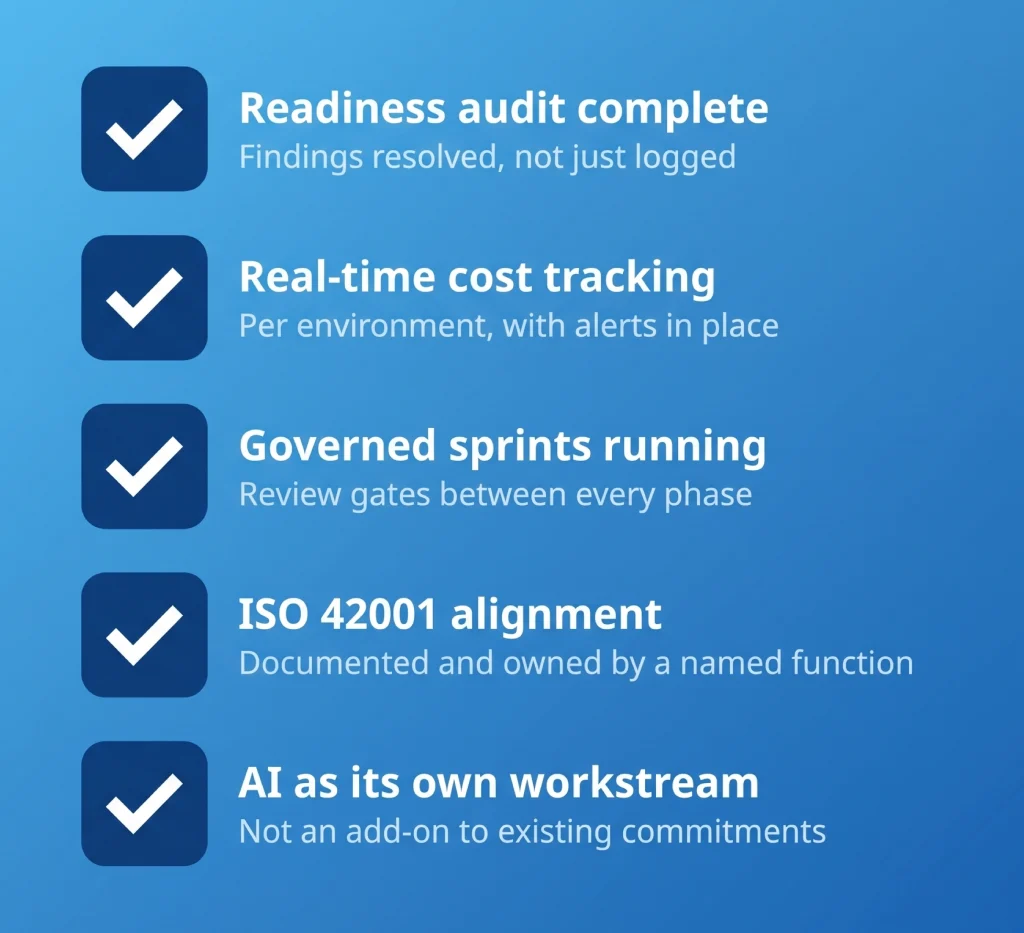
AI Readiness Checklist: Five Structural Controls Every CTO Must Have in Place Before Scaling
Run through these before you scale. Each item represents a structural control that, left unresolved when the programme accelerates, becomes a compliance retrofit, a cost recovery exercise, or a sprint failure.
A single gap is manageable. Two or more means the programme has structural problems that will surface. The only question is whether before go-live or after.
AI Acceleration for CTOs: Frequently Asked Questions
What are the biggest risks of accelerating AI without governance?
Four risks compound fastest. Cost climbs as inference and shadow usage stack across teams, often invisible until the invoice lands. Compliance falls behind when delivery outpaces policy, turning ISO 42001 and EU AI Act readiness into a last-minute retrofit. Shortcuts taken to ship a demo harden into architectural debt that blocks the next release. The fourth and least visible risk is your team, because unscoped AI work bolted onto core delivery creates competing priorities, which DORA research links to rising burnout and attrition. Each one is cheap to prevent early and expensive to unwind once it surfaces.
How does an AI readiness audit speed up delivery?
A readiness audit accelerates delivery by collapsing the discovery phase before the programme is moving. It maps infrastructure state, data pipeline gaps, access scoping for non-human actors, and actual team capacity against the plan, the four variables that determine how fast you can safely move.
Each gap closed at audit costs weeks. The same gap surfaced during a sprint, an incident, or a pre-launch compliance check costs months. Programmes that treat the audit as their first delivery milestone enter the first sprint on a foundation already tested. That is what removes the unknowns that would otherwise stall the next three.
Does ISO 42001 slow down an AI delivery programme?
For organisations selling into regulated sectors, ISO 42001 accelerates delivery. A working AI management system puts accountability, audit trails, logging, and explainability in place ahead of demand. Those are the exact controls public sector frameworks and enterprise procurement teams ask for before they sign. Meeting them early removes compliance as a late-stage gate and shortens the sales cycle. Built in from the start, governance becomes a commercial advantage rather than an overhead.
What is sprint-based AI delivery?
Sprint-based AI delivery applies the discipline of reliable software engineering to AI work. Each cycle has a defined scope, a fixed time box, review gates between phases, and a working output at the end. Added to that are AI-specific checkpoints: model performance reviews, governance sign-off, and a cost report every sprint.
For a CTO, the value is visibility without micromanagement, because progress, spend, and risk stay observable at each stage. Misaligned expectations surface in week two, while they are still cheap to correct.
How do you prevent AI cost overruns while scaling?
Cost control is an engineering decision made at the first deployment. Set the tagging strategy, environment-level tracking, alert thresholds, and model selection rules at the start, and spend stays legible however large the programme grows. Leave them until later, and a quarter goes on recovery instead of features. Early cost data also sharpens every AI decision, because a use case can be judged on what it truly costs to run.
Explore our BLOG
Recent articles

Is Claude Down? Anthropic Outage: Protect Your Cloud Infrastructure
Claude went down across every surface on 29 September 2026. From 14:00 to 14:59 UTC,...
read full article

Top 10 Healthtech Companies in 2026: What Their Growth Means for AI and DevOps
Every software change that reaches a hospital has to clear regulatory, legacy system, and clinical...
read full article

How to Build an AI Engineering Capability Without Hiring 20 People
You don’t need 20 hires to run AI in production. Three to five people can...
read full article