


Reduce AWS OpEx by 25% and eliminate deployment friction with a governance-first migration.
Cloud migration is a risky decision. It directly affects cost predictability, incident recovery, compliance exposure, and delivery speed.
If you’re moving to AWS, the outcome must be measurable. Otherwise, you’re just relocating complexity.
TL;DR for UK CTOs
A structured AWS migration should deliver:
- Lower change failure rate through standardised environments
- Faster MTTR with unified monitoring and clearer incident ownership
- Predictable monthly cloud spend with enforced tagging and cost allocation
- Reduced IAM exposure through role rationalisation and least-privilege design
- Stronger audit readiness aligned with UK GDPR and FCA operational resilience expectations
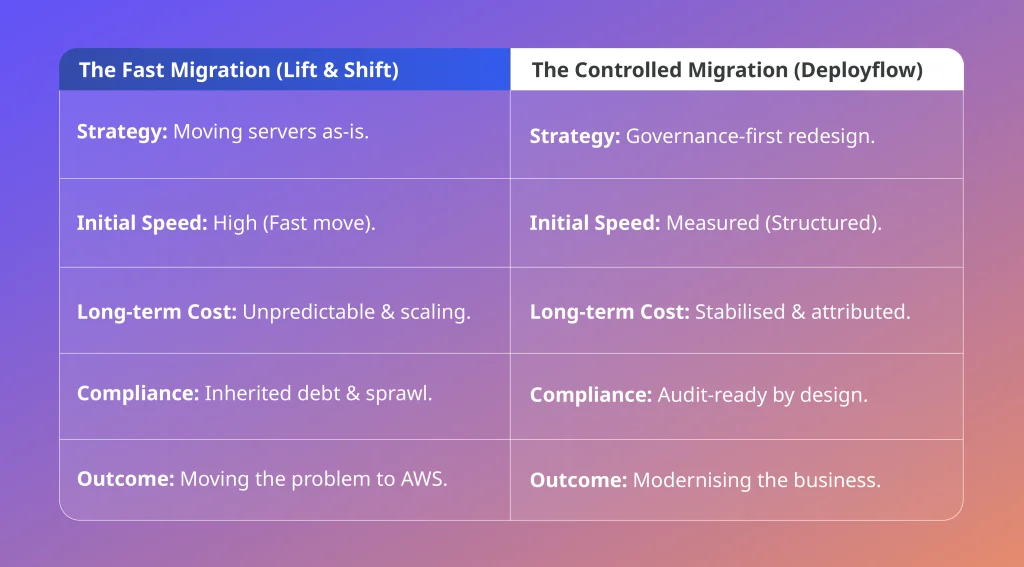
Migration is an operating model upgrade. If your MTTR doesn’t drop post-migration, you haven’t migrated; you’ve just changed the billing address of your technical debt.
AWS offers flexibility and scale. Governance, architecture discipline, and infrastructure standardisation determine whether migration strengthens delivery performance or increases volatility.
Read this before approving budget, architecture, or board reporting commitments.
Why UK Cloud Migrations Fail Even When AWS Is the Right Platform
Choosing AWS is not what creates risk, but migrating without redesign does.
Lift-and-shift without refactoring = legacy in the cloud.
Moving workloads unchanged into AWS feels efficient because it’s fast. But speed upfront often means friction later. You inherit the same architectural bottlenecks, the same operational shortcuts, and the same dependency chains, now wrapped in consumption-based billing. Delivery performance rarely improves because nothing has been structurally changed. You just moved the problem into a different cost model.
No tagging discipline = cost chaos.
Cloud cost predictability depends on visibility. Without enforced tagging by environment, product, and owner, you cannot see cost per workload or attribute spend accurately. That makes forecasting unreliable and undermines financial control. Under FCA operational resilience expectations, unclear cost ownership also weakens your ability to evidence controlled service management.
No IAM redesign = expanded attack surface.
Identity becomes the largest risk surface in AWS. If roles are migrated as-is, permissions accumulate quickly. Over-privileged service accounts and policy sprawl increase both breach exposure and audit friction under the UK GDPR accountability principle. Security risk grows quietly through complexity, not through obvious failure.
No environment standardisation = higher MTTR and change failure rate.
If staging and production differ, configuration drift becomes inevitable. Incidents take longer to diagnose because behaviour cannot be reproduced reliably. Changes fail more often because parity is missing. DORA metrics reflect this immediately: lead time increases, MTTR stretches, and change failure rate creeps upward.
Regulators will not assess whether AWS was technically capable. They will assess whether your migration strengthened resilience, recovery speed, and governance. If those indicators do not improve, the issue was not the platform. It was the migration design.
Why DORA Metrics Should Guide AWS Migration Decisions
Migration earns its budget only when delivery performance improves. DORA metrics make that visible.
- Deployment Frequency: Infrastructure as Code removes provisioning bottlenecks. When environments are created through Terraform or CloudFormation instead of tickets and manual steps, releases stop waiting on infrastructure. Deployment becomes repeatable and less dependent on individual engineers. Frequency increases because friction decreases.
- Lead Time for Change: Standardised environments eliminate configuration inconsistency. When dev, staging, and production use the same infrastructure templates, you avoid the delays caused by environment differences. Lead time shortens because changes move through predictable infrastructure.
- Mean Time to Recovery (MTTR): Unified observability and autoscaling reduce blast radius. Centralised logging, metrics, and tracing allow faster root-cause identification. Well-architected scaling policies prevent local failures from cascading into wider outages. Recovery becomes procedural rather than improvisational.
- Change Failure Rate (CFR): Pre-production parity reduces misconfiguration risk. When infrastructure definitions are version-controlled and validated before production release, fewer surprises reach live environments. Failures decline because variability declines.
Treating cloud migration as a simple capacity upgrade is a missed fiduciary opportunity.
True migration success is found when DORA improvements translate into a lower Cost per Feature and the ability to pivot your product roadmap without infrastructure-induced delays.
If your delivery velocity remains stagnant, you haven’t bought into the cloud; you’ve just rented someone else’s bottlenecks at a premium.
FCA Operational Resilience & AWS: A Blueprint for Regulated UK Enterprises
Security risk in AWS is primarily an identity and audit problem.

The Compliance Reality: The FCA doesn’t care that you’re on AWS; they care if you can prove portability and recoverability. Our framework ensures your Landing Zone meets the rigorous Operational Resilience requirements of UK finance.
4 Phases of a Structured AWS Migration Programme
Migration succeeds when it follows a controlled sequence. Without structure, risk simply moves into the cloud.
Phase 1: Discovery & Risk Baseline
Start with evidence.
Audit the current infrastructure to understand architectural debt and operational bottlenecks. Establish a cost baseline so post-migration improvements can be measured. Review IAM exposure to identify privilege sprawl and inherited risk. Measure current DORA metrics to define a performance benchmark.
If you cannot quantify today’s risk and delivery performance, you cannot prove improvement tomorrow.
For a comprehensive technical deep-dive into the fundamentals of the process, explore Deployflow’s cloud migration guide.
Phase 2: Architecture Redesign
Redesign before you rebuild.
Define a standardised VPC structure aligned to security boundaries and workload separation. Rationalise IAM roles and enforce least privilege from the outset. Establish a mandatory tagging taxonomy tied to financial ownership. Segment environments clearly to prevent drift and reduce blast radius.
This is where governance is embedded into architecture rather than added later.
Phase 3: Controlled Migration
Move workloads based on risk.
Prioritise systems by operational criticality and compliance exposure. Validate in parallel before full cutover. Define rollback strategies before migration windows begin. Controlled execution reduces change failure rate and protects delivery stability.
Speed matters less than predictability.
Phase 4: Post-Migration Governance
Stability comes from ongoing discipline.
Implement drift detection to prevent configuration entropy. Review the cost monthly at the environment level. Conduct quarterly IAM audits to control identity sprawl. Track DORA metrics continuously to confirm that delivery performance improves rather than degrades.
Migration is not complete at go-live. It is complete when governance becomes routine.
Why Your AWS Migration Must Prioritise Delivery Velocity Over Speed
Migration is successful when operational risk decreases, and delivery performance improves.
A properly executed AWS migration for a UK organisation should result in:
- A properly executed AWS migration improves delivery metrics, stabilises cost behaviour, and strengthens audit traceability.
- If MTTR, change failure rate, and cost volatility do not improve, infrastructure has moved, but operations have not.
If those indicators do not improve, the programme did not transform your operating model. It only relocated infrastructure.
Deployflow approaches migration as a governance-first transformation, not a hosting project.
Every engagement begins with measurable baselines (cost, IAM exposure, and DORA performance), so improvement is provable.
Architecture is standardised before workloads move. Identity is rationalised before the permissions scale. Cost controls are embedded before invoices compound.
The objective is not to “move to AWS.”
The objective is to deliver a more resilient, predictable, and auditable operating environment.
If AWS cloud migration does not strengthen control and performance, it is cosmetic. If it does, it becomes a strategic advantage.
Key Takeaways: AWS Migration Strategy for UK CTOs
- Governance determines outcome; provider choice isn’t crucial.
- Measure DORA metrics before and after migration.
- Refactor architecture; do not lift and shift debt.
- Enforce IAM least privilege from day one.
- Standardise environments to reduce MTTR and change failure rate.
- Implement mandatory tagging tied to cost ownership.
- Track cost per environment monthly, not quarterly.
- Embed FinOps as an operating discipline.
- Align logging and access controls with GDPR and FCA expectations.
- Treat post-migration governance as ongoing, not optional.
Migration should reduce risk, stabilise cost, and improve delivery performance, or it has not delivered value.
How Governance-First Migration Delivered a 25% OpEx Reduction: A UK Success Story
Results matter more than architecture diagrams.
When Strike, a UK property platform, lost its internal DevOps capability, instability increased, and outages became routine. The issue was not AWS itself. It was governance, delivery discipline, and environment control.
Deployflow rebuilt operational stability around structured infrastructure, Terraform automation, and delivery process improvement inside AWS.
The numbers tell the story:
70% improvement in cloud environment stability
60% reduction in downtime, with outages nearly eliminated
55% improvement in release reliability
25% reduction in overall costs
✔️ Stability improved because environments were standardised.
✔️ Downtime fell because infrastructure was controlled rather than reactive.
✔️ Release reliability increased because deployment pipelines were disciplined and reproducible.
This is what migration and cloud maturity should produce: fewer incidents, faster delivery, lower volatility, and controlled cost behaviour.
If results are not visible in these dimensions, the migration has not delivered operational value.
Build a Resilient, Audit-Ready AWS Environment Today
Deployflow approaches AWS migration as an operating model redesign. Architecture, identity, cost control, and delivery metrics are aligned before scale increases. The outcome is controlled, resilient execution.
If you want clarity on whether your migration will strengthen performance or introduce new volatility, start with a structured review.
AWS Cloud Migration: Frequently Asked Questions
How long should an AWS migration take for a UK organisation?
A well-structured AWS migration typically takes 3 to 9 months, depending on complexity and regulatory exposure.
The timeline depends less on workload volume and more on architectural debt, IAM sprawl, and compliance constraints. Highly regulated environments require more upfront redesign before workloads move.
Using sprint-based delivery squads accelerates progress without sacrificing control, because architecture, security, and automation are executed in structured iterations rather than long waterfall phases. Rushing increases long-term instability; disciplined, sprint-led execution delivers measurable improvement at each stage instead of a single high-risk cutover.
How do you minimise operational disruption during migration?
You reduce disruption by migrating in controlled phases with rollback planning and parallel validation.
Critical workloads should never be moved without fallback options and environment parity testing. Migration waves must be prioritised by business impact instead of technical convenience. Observability should be strengthened before cutover. Stability is protected through sequencing.
Should we modernise during cloud migration or after?
Modernisation should begin before cloud migration, not after it.
Moving legacy architecture unchanged into AWS locks in inefficiencies and increases long-term spend. Identity rationalisation, tagging enforcement, and environment segmentation should be redesigned early. Refactoring everything at once is unnecessary, but structural weaknesses should not be transferred into the new environment. Migration is the cleanest opportunity to correct architectural drift.
How do we know if our organisation is ready for AWS migration?
Readiness is defined by governance maturity.
If IAM ownership is unclear, cost visibility is weak, or DORA metrics are not measured, migration will amplify instability. A baseline assessment of infrastructure, identity exposure, cost behaviour, and delivery performance is essential. Migration works best when operating discipline is defined before infrastructure changes. Without that foundation, cloud complexity grows faster than control.
Explore our BLOG
Recent articles

Is Claude Down? Anthropic Outage: Protect Your Cloud Infrastructure
Claude went down across every surface on 29 September 2026. From 14:00 to 14:59 UTC,...
read full article

The SOC 2 Remediation Roadmap: From Compliance Dashboard to Passed Audit
This SOC 2 remediation roadmap takes you from a red compliance dashboard to a clean...
read full article
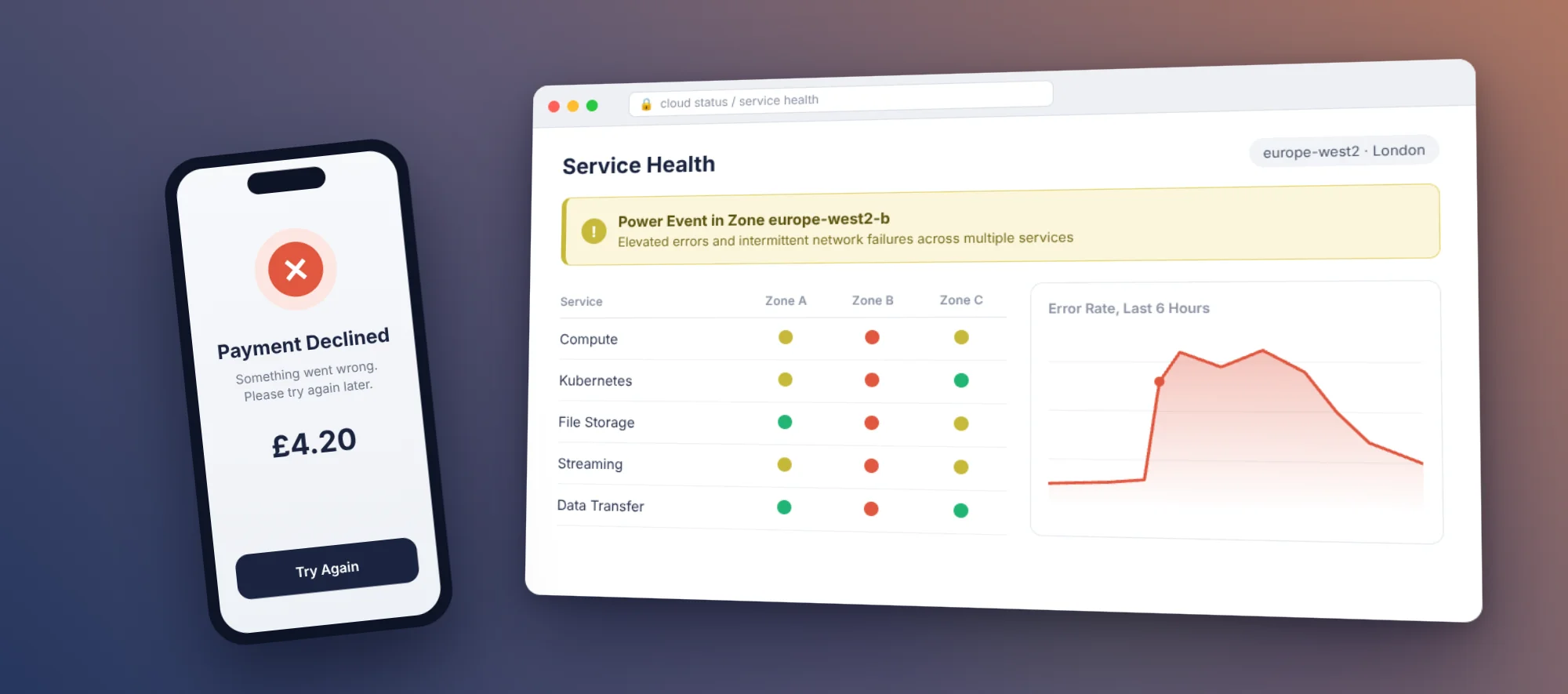
Is Google Cloud Down? The GCP Outage That Froze Revolut Cards and What CTOs Should Fix Now
Yes, Google Cloud went down in London. A major Google Cloud outage hit the europe-west2...
read full article