



You can keep your agentic AI programme out of the 40% set to be scrapped by 2027, and this guide shows you how.
Gartner expects more than 40% of agentic AI projects to be cancelled by the end of 2027. The reasons don’t change. Costs climb, business value stays unclear, and risk controls arrive too late. Model quality is almost never on the list.
Deloitte’s 2026 survey of 3,235 business and IT leaders shows why. Close to three-quarters of companies plan to deploy agents within two years. Only 21% have a mature model to govern them. Ambition has outrun readiness, and the space between the two is where projects fail.
That space is also your advantage. Agents that plan, act, and hold memory break the controls you built for static models, and UK regulators have already begun to respond. The programmes that reach production share one habit: the governance layer goes live with the first agent, not after the first incident.
Executive Summary
- Where agents earn back their cost first, across engineering, customer service, and finance, plus the use cases that quietly burn budget.
- The four risks that actually get programmes cancelled, mapped to OWASP’s 2026 agentic risk list.
- A plain-English UK compliance checklist covering automated decision-making rules under the Data (Use and Access) Act 2025 / UK GDPR and incoming ICO guidance on agents.
- The five controls that keep agents safe in production: inventory, least agency, human oversight, monitoring, and kill switches.
- Three steps to move from scattered agents to one governed, measurable pilot.
- The metrics that prove agents are working, so the board signs off the next phase.
What Agentic AI Actually Is, and Why Your Old Controls Just Broke
An agent does not suggest. It acts. Give it a goal, and it plans the steps, calls tools and APIs, holds memory across the task, and can hand work to other agents, often with little human input between the goal and the result.
Picture an agent assigned to a failing service. It reads the logs, finds the cause, restarts the component, and closes the ticket, all before anyone opens the alert. You see the outcome. The decision behind it stays invisible.
Four capabilities make that possible, and each one opens a risk:
- Planning invites goal drift. The agent can quietly change what it is working towards.
- Tool use hands the agent real permissions on your live systems. It can act on them directly.
- Memory turns a bad input today into a live flaw next week.
- Delegation creates behaviour no single team owns, as agents pass work between them.
Those same capabilities land hard on the controls you rely on today. Your permission model was built to identify human users, then trust them, and an agent inherits that trust while moving far faster than a person. Your approval gates sit where a human would naturally pause, but an agent has no reason to. Your audit trail assumes a system that behaves the same way twice, and agents rarely do.
Agentic AI breaks these controls at once, so rebuilding them for autonomy is the real project. The guide to deploying multi-step agentic systems sets out what changes.
Where Agents Pay Off First, and Where They Drain Budget
Agents pay off where two things are true: the output is easy to check, and a bad action is easy to undo. Where neither holds, they burn money. That one test predicts your winners better than any vendor demo.
Engineering pays off first. Engineers check the output and roll a bad run back, which most teams outside IT cannot. Code generation, ticket triage, incident enrichment, and CI failure diagnosis show the fastest return.
Customer service comes next. Agents handle tier-one queries and pull context from your ticketing and CRM. The catch is integration depth. An agent that reads tickets but cannot update them just adds a job for a human.
Finance starts read-only and safe. Invoice matching, expense triage, and vendor onboarding move quickly once you map the exceptions. Read-only means a mistake costs nothing to reverse, so you can start this week.
Budget drains in the opposite conditions. Open-ended research against messy data, or any task where no one can quickly tell whether the agent got it right, tends to fail. Scope to a clear output, or do not start.
BCG’s 2026 analysis of enterprise leaders found the front-runners cutting costs by 15% to 20% across functions. The same study lands one point hard. Success runs about 70% on people and change management. The model is rarely the hard part.
The Four Risks Putting Agentic Programmes on the Chopping Block
A programme dies two ways. The board cancels it, or an incident ends it. These four risks lead to one of those two exits, and they feed each other, so ignoring one speeds up the rest.
Governance failure gets you cancelled. Gartner’s cancellation figure is about programmes with no clear owner, no cost discipline, and no proof of control. No one can name who owns the agent or the number it is meant to move. Buying the wrong thing is a second road to the same exit, since only around 130 of the thousands of vendors claiming agentic features actually deliver them. A relabelled chatbot never produces the value that keeps a programme funded.
Shadow agents build up where no one is looking. Agents enter your estate three ways: internal code, SaaS updates that switch on agentic features, and team experiments that touch production data. You tend to discover them from an invoice or an incident rather than a plan. Every agent you cannot list is one you cannot govern.
Identity sprawl turns each unseen agent into exposure. Every agent, tool, and pipeline is an identity with real access, and many enterprises now run dozens of machine identities for every human one. The systems granting that access were built for people who log in, not for software that appears on demand and acts on someone’s behalf. Each shadow agent adds one more over-permissioned identity that nobody is watching.
Security threats hit exactly those weak points. OWASP’s 2026 Top 10 for Agentic Applications names what attackers go after: goal hijack, tool misuse, identity and privilege abuse, memory poisoning, and rogue agents. Read the list against the risks above, and the pattern is obvious. The threats target agents that are ungoverned, over-permissioned, and unwatched, which is precisely what the first three risks leave lying around. The defence is short: autonomy should be earned, never switched on by default.
Left alone, the four become a chain. Shadow agents you cannot see turn into sprawling identities you cannot constrain, which turn into the attack surface OWASP maps, and with no owner in place, nobody catches any of it before the board does.
Your UK Compliance Checklist for Agentic AI
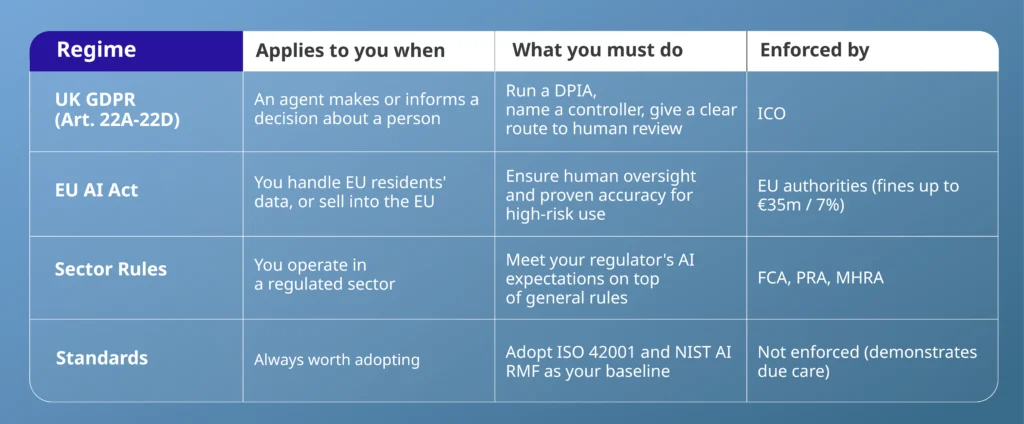
UK law already binds your agents, but not every rule binds every agent. Which regimes apply depends on three things: what your agent decides, whose data it touches, and the sector you work in. Find your position in the map below, then read the detail that matches.
UK GDPR: Any Agent That Decides About People
The Data (Use and Access) Act 2025 rewrote the rules on automated decisions. Articles 22A to 22D (came into force on 5 February 2026) replaced the old near-ban with a conditions-based approach and new transparency duties.
Your obligations are concrete: run a Data Protection Impact Assessment, name a controller, and give people a clear route to human review.
The ICO has named agentic AI a priority for 2026/27, with an AI code of practice and dedicated guidance on the way. Waiting for the final version is a poor plan, because the direction is already set and enforcement follows direction.
The EU AI Act: Any Agent Touching EU Data or Markets
Process data on EU residents, or sell your product into the EU, and the Act reaches you wherever you are based. Articles 14 and 15 already govern high-risk uses, demanding human oversight and proven accuracy and security. The penalty ceiling is the part boards notice: for the most serious breaches, up to €35 million or 7% of global turnover.
Sector Rules: Extra Duties From the FCA, PRA and MHRA
Financial services sit under the FCA and PRA, and the Bank of England has asked for more work on agents in payments and markets. MedTech falls under the MHRA wherever an agent counts as a medical device. Sector duties stack on top of the general regimes, never in place of them.
Voluntary Standards: Adopt ISO 42001 and NIST Anyway
Two frameworks give you a defensible baseline and a shared language with auditors: ISO/IEC 42001 for the management system, and the NIST AI Risk Management Framework for structure. Neither is enforced, but both are evidence you took reasonable care, which is exactly what a regulator or board asks for the day something goes wrong.
The through line makes this manageable. Every regime rewards the same three artefacts: a documented assessment, a named owner, and a logged trail of what the agent did. Build those once, and you cover most of what any of them asks.
An Agentic AI Governance Framework: Five Controls for Production
Five controls decide whether an agent is safe to run in production. Each one covers a gap the others leave open, so the set works as a stack. Skip one, and the rest cannot close the hole it leaves.
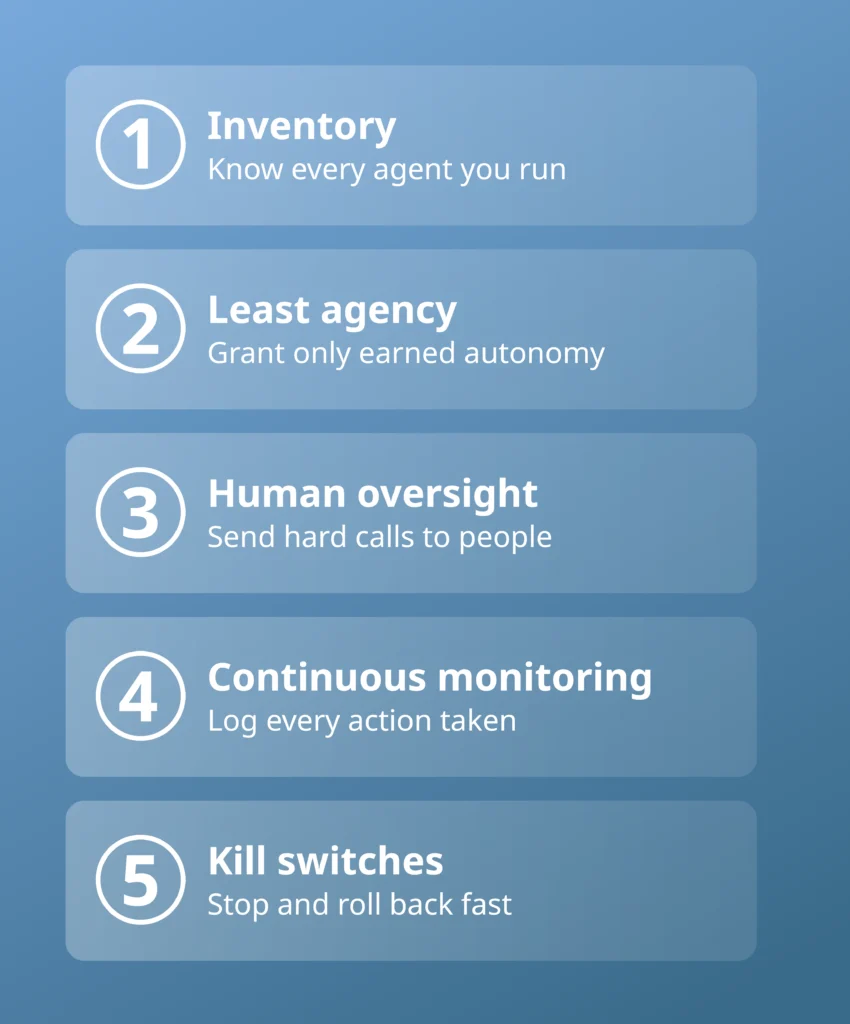
Inventory comes first. You cannot govern what you cannot see. Keep a live register of every agent touching your systems, including agents inside SaaS products. Give each one a unique identity, a named owner, a stated purpose, a data scope, and permissions that map to your existing access system.
Least agency comes second. Autonomy is a dial. Decide what each agent can read, update, approve, route, and escalate. Keep payments, customer record edits, access changes, and any irreversible action behind human sign-off by default. Treat autonomy as a budget an agent earns, and one you can pull back at once.
Human oversight comes third, and it belongs in the design. Article 14 and the ICO both demand oversight you can prove. A review queue bolted on at the end rarely passes. Route missing data, conflicts, and policy grey areas to a human who already has the context and a suggested next step.
Continuous monitoring is next. Static checks do not fit systems that change how they act between runs. Log every action: which agent ran, under whose authority, on what data, with what result. That audit trail is what compliance and regulators will ask to see.
Kill switches come last, with rollback and a clear escalation path. Test each one on a schedule. An untested kill switch is paperwork. Getting all five right is the core of running autonomous agents in production without nasty surprises.
Build, Buy, or Partner: How to Get Agents Without Getting Burned
Once the controls are set, one decision drives the rest: how you acquire the agent. The right route depends on how much the workflow sets you apart and how fast you need it. Each route has a trap.
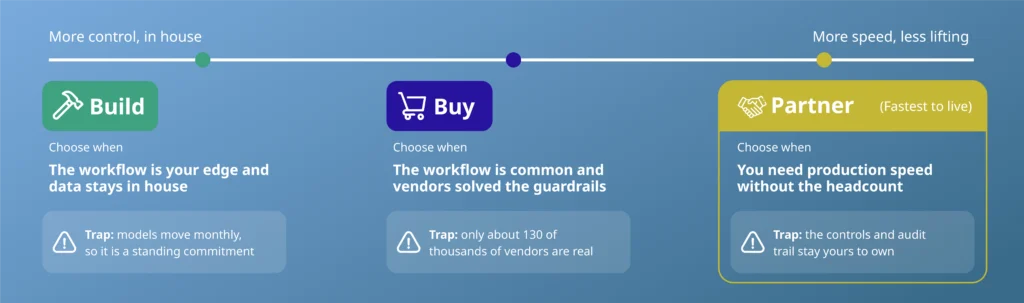
Most CTOs mix all three: build the one or two agents that carry real advantage, buy the commodity cases, and partner on the rest. That last path, production speed with governance built in, is where a delivery partner earns its place, and it leads straight into the question your next move should answer.
Measuring Agentic AI ROI: Metrics That Prove Agents Work
Numbers are how you keep an agent funded, and how you know when to scale it. But not all numbers carry equal weight. A pilot earns the right to scale only when it clears three gates, and productivity is just the first.
Gate One: Business Outcomes
Does the agent move a number the business cares about?
Track cycle time on the target workflow, cost per completed task against baseline, containment rate, quality against a human-graded sample, and the revenue or margin the agent earns. Measure against a control group. Without one, you cannot prove the agent caused the gain rather than something else.
Gate Two: Safety Signals
Is the agent behaving, and can you show it?
Track the escalation rate to humans, incidents by OWASP category, time to detect and roll back a bad run, and the share of actions with a full audit record. These are the signals a board or regulator will want on the day of an incident.
Gate Three: Unit Economics
Do the numbers hold at scale?
Break cost per task into inference, tool calls, memory, evaluation, and human review. Agent costs climb in ways monthly billing hides, so a programme that cannot show this on demand is not ready to grow.
Scale only when all three gates are green. Scaling on business outcomes alone, with safety and cost unproven, is the exact path onto the list of the 40% Gartner expects to be cancelled.
Agentic AI: The Bottom Line for CTOs
Agentic AI earns its place when you can show three things together: real business outcomes, defensible governance, and predictable unit costs. The capability is proven, and the adoption curve is not slowing, so waiting carries its own risk.
Build the governance layer at the same pace as the capability, and the rest follows. Leave it for later, and later costs more.
Getting Started With Agentic AI
Wherever you are with agents, three steps lower the risk from here.
- Run a governance readiness review. Check your position against ISO 42001, NIST, and OWASP’s 2026 risk list, mapped to UK law.
- Start with one scoped pilot, with controls built in from day one: one workflow, one owner, and an audit trail from the first run.
- Give the board the evidence it will ask for: an agent inventory, DPIAs, escalation logs, and a clear link between spend and value.
Deployflow works with UK CTOs on all three. You can read more about our AI agent development services, or get in touch to talk through a pilot.
Frequently Asked Questions About Agentic AI Risks and Governance
What is the difference between agentic AI and generative AI?
Generative AI produces content in response to a prompt. Agentic AI takes an action to reach a goal. Ask generative AI to write an email, and it drafts one; ask agentic AI, and it drafts the email, checks the recipient’s calendar, and sends it.
The distinction that matters for a CTO is autonomy. Generative AI waits for a human at each step, so the human stays in control of every output. Agentic AI runs a chain of steps on its own, deciding what to do next based on what it finds. That is what makes agents more useful and harder to govern: the decision points that a human would normally review happen inside the run, out of sight. Most agents are built on generative models, so agentic AI is better understood as a layer on top of generative AI, adding planning, memory, and the ability to use tools, rather than a separate technology.
How much does it cost to build an AI agent?
There is no fixed price, but the cost that surprises teams is not the build. It is the running cost and the upkeep.
A simple agent on an existing platform can be stood up in weeks for a modest sum. A custom agent that acts across your core systems is a much larger project. The figure most budgets miss is per-task cost at scale: every run consumes model inference, tool calls, and memory retrieval, and a chatty multi-agent design can cost many times a single-agent one for the same result.
On top of that sits maintenance, because the underlying models change every few months, so a custom agent is an ongoing commitment rather than a one-off. Model the cost per completed task before you commit, not the monthly licence, and you will avoid the bill that gets agentic programmes cancelled.
Can AI agents replace employees?
Not wholesale, and the teams treating agents as a straight headcount swap are the ones seeing projects fail. Agents replace tasks, not roles.
An agent handles the repetitive, rules-based parts of a job well: triaging tickets, matching invoices, gathering context. It struggles with judgment, ambiguity, and anything where being confidently wrong is expensive. The pattern that works is agents taking the routine volume so people move to the exceptions and the higher-value work, which changes what a role looks like rather than removing it.
Are AI agents safe to use with sensitive or customer data?
They can be, but only with controls built for autonomy, not the ones you use for a hosted chatbot.
An agent acting on sensitive data is a principal with real permissions, so the risk is not just what it can see but what it can do with it, and how fast. Safe use rests on a few basics: give each agent its own identity and the least access it needs, keep irreversible actions behind human sign-off, log every action for a full audit trail, and run a Data Protection Impact Assessment wherever the agent decides about people. Under UK GDPR, that assessment is not optional for consequential decisions.
Get those controls in place first, and sensitive data is manageable. Skip them, and every agent becomes an unmonitored account with more access than it needs.
Which industries benefit most from agentic AI?
The sectors seeing the fastest returns are the ones with high volumes of repetitive, rules-based work sitting on systems an agent can already reach.
Financial services lead on invoice matching, reconciliation, and compliance checks. IT and software teams use agents for ticket triage, incident response, and code work. Customer-heavy sectors like retail and telecoms apply them to tier-one support. Healthcare and life sciences use them in knowledge retrieval and research, though under tighter regulatory constraints. The common thread is not the industry label but the shape of the work: benefit tracks tasks that are frequent, structured, and easy to check, wherever they sit. A regulated sector adds a compliance layer on top, but it does not remove the opportunity.
Explore our BLOG
Recent articles

Managed Cloud Services Explained: What They Are and What You’re Actually Paying For
Your managed cloud services fee buys six things: engineering time, tooling, round-the-clock cover, cross-client expertise,...
read full article
The CTO’s Guide to Agentic AI: Opportunity, Risk and Governance
You can keep your agentic AI programme out of the 40% set to be scrapped...
read full article

What a Mature AI Engineering Function Actually Looks Like
Your AI programme probably demos well and ships slowly. That gap is not a technology...
read full article