



The wrong development partner costs you a year; the right one ships in a quarter. Their websites won’t tell you which is which, because every custom software development company promises the same lifecycle in the same words.
What separates them is the delivery model, where the engineering sits, and who owns the outcome after go-live.
10 Custom Software Development Partners Reviewed
The 10 companies below are ordered by scenario, from regulated-environment delivery to offshore scale. Each profile opens with a verdict on when to hire the firm and when to look elsewhere, followed by the facts that decide a shortlist: what they build, scale, pricing and proof.
Regulated environments (Deployflow):
Fintech under FCA rules, public sector, healthcare: software judged by the audit, and only then by the demo. Sign-off sits with reviewers who run their own calendar, so the partner has to build the controls in from the first sprint. Retrofitting them later is what turns a 12-week project into a 12-month one.
1. Deployflow
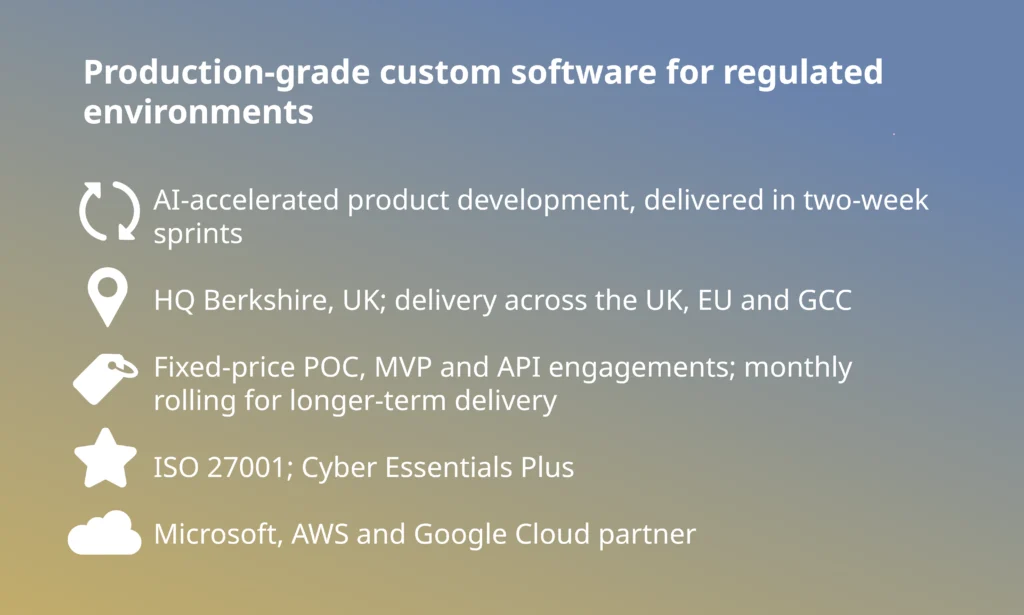
Best fit when custom software has to reach production in a regulated environment and keep running there.
Look elsewhere if what you want is staff augmentation slotted into your own management structure.
What they build: Custom software for organisations where the compliance review decides the launch date: fintech under FCA rules, public sector, healthcare, cross-border payments, and energy.
Delivery model: P-Suite, Deployflow’s AI-accelerated approach to product development, with engineers, architects, testers and project managers embedded in your workflows on two-week sprints, each one closing with defined, measurable outcomes.
Scale and footprint: Founded in 2018 and now with over 80 people, headquartered in Berkshire with delivery across the UK, the EU and the GCC, and US expansion underway.
Engagement and pricing: Fixed pricing on POC, MVP and API integration work, so cost and scope are locked before anything gets built. Ongoing delivery moves to a monthly rolling model, and the number for both models comes out of a scoping call; there is no public rate card.
Proof: Little Journey, a digital health platform: 80% cut in deployment time, 50% lift in infrastructure scalability, 100% data segregation compliance. For Vodafone, a SEPA-compliant payment system across nine Eurozone markets, moving €1.5 billion a month at 99.5% uptime, with platform failures down 85%. And at the infrastructure end, an AI platform inside a national energy programme’s air-gapped network, running H100 GPU clusters over petabyte-scale data.
Compliance: ISO 27001, Cyber Essentials Plus, and partner status with Microsoft, AWS and Google Cloud.
Worth checking: Fixed pricing covers POC, MVP and API scopes, and longer builds move to the monthly rolling model, so ask early how a project transitions between the two.
Enterprise scale (Nagarro, ELEKS):
Multi-country rollouts, dozens of workstreams, procurement with its own gravity: programmes that outgrow a single team. Scale and governance decide the shortlist here. Both firms carry that weight, and both will be oversized for a single-product build.
2. Nagarro
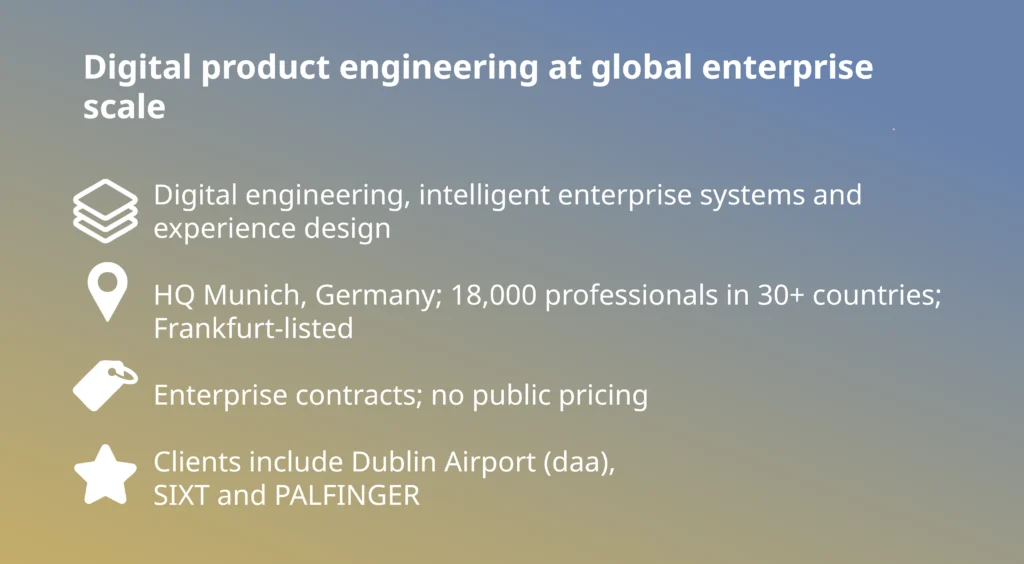
Best fit when the build spans business units, countries and legacy estates at once.
Look elsewhere if you need a small senior team that moves without programme governance.
What they build: Digital products and enterprise platforms across automotive, banking, telecoms, travel and retail. The range runs from a digital marketplace ecosystem for Dublin Airport, which folds retail, services and personalisation into one platform, to connected-equipment systems for industrial clients.
Scale and footprint: Around 18,000 professionals in more than 30 countries, headquartered in Munich and listed on the Frankfurt Stock Exchange, with vertical depth few custom development firms can match.
Engagement and pricing: Enterprise programmes on enterprise contracts, with no public pricing and procurement, onboarding and governance overhead to match.
Proof: PALDIAG, an advanced diagnostics platform built for PALFINGER’s connected service operations, and a unified real-time mobility platform for SIXT.
Worth checking: Nagarro signed a business combination agreement with Persistent Systems in June 2026, with closing expected around the turn of 2026/27 and a Frankfurt delisting to follow. Ask how the merger affects your account team, delivery continuity and contract terms before signing anything long-term.
3. ELEKS
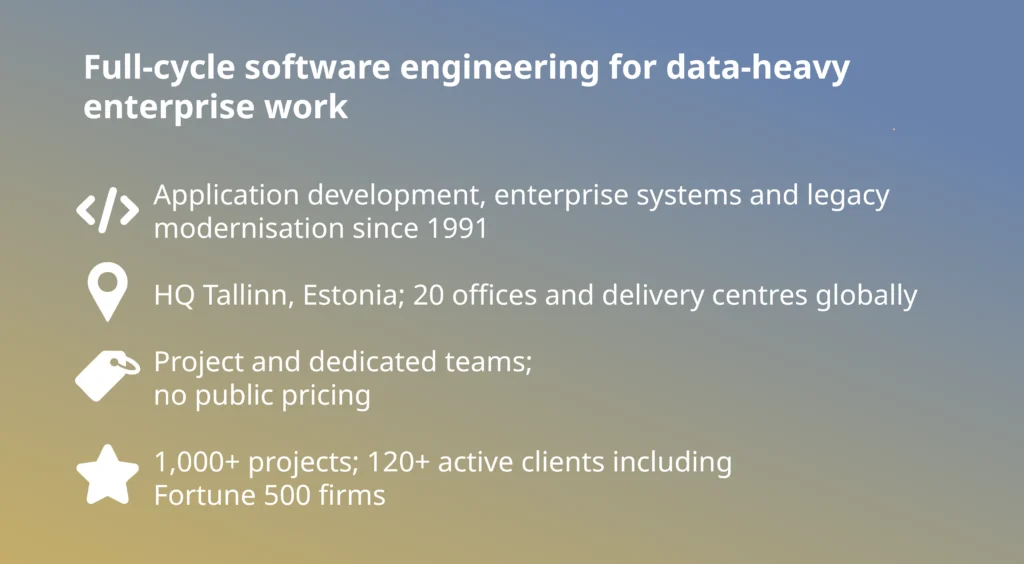
Best fit when a data-heavy enterprise system needs engineering depth with consulting on top.
Look elsewhere for a lightweight MVP build.
What they build: Custom applications, enterprise systems and legacy modernisation across fintech, healthcare, energy, government, insurance and logistics, with product design, QA and data science wrapped around the engineering.
Scale and footprint: Engineering software since 1991, the longest track record on this list. Headquarters sit in Tallinn, with 20 offices and delivery centres worldwide, and the record runs to more than 1,000 delivered projects and 120+ active clients, Fortune 500 names among them.
Engagement and pricing: Project and dedicated teams with no public pricing. Scoped PoC development is offered as a standalone service, which gives you a low-commitment way to test the fit.
Proof: A member application for David Lloyd, Europe’s largest leisure club chain, serving 2 million app users, and custom motion control software for TAIT that has powered performances on all seven continents. Aramex’s CTO credits the firm with building the courier’s consumer-facing web and mobile applications.
Worth checking: Delivery concentrates in Europe, so confirm overlap hours if your team sits in North America. With a catalogue this wide, also pin down which practice and delivery centre would own your build.
Products from zero (Atomic Object, Mind Studios, Hashrocket):
A greenfield product lives or dies on decisions made before the first sprint: what to build, what to skip, which stack carries it. The three firms here earn their fees in that early phase. Expect them to argue with your roadmap, and pick them because of it.
4. Atomic Object
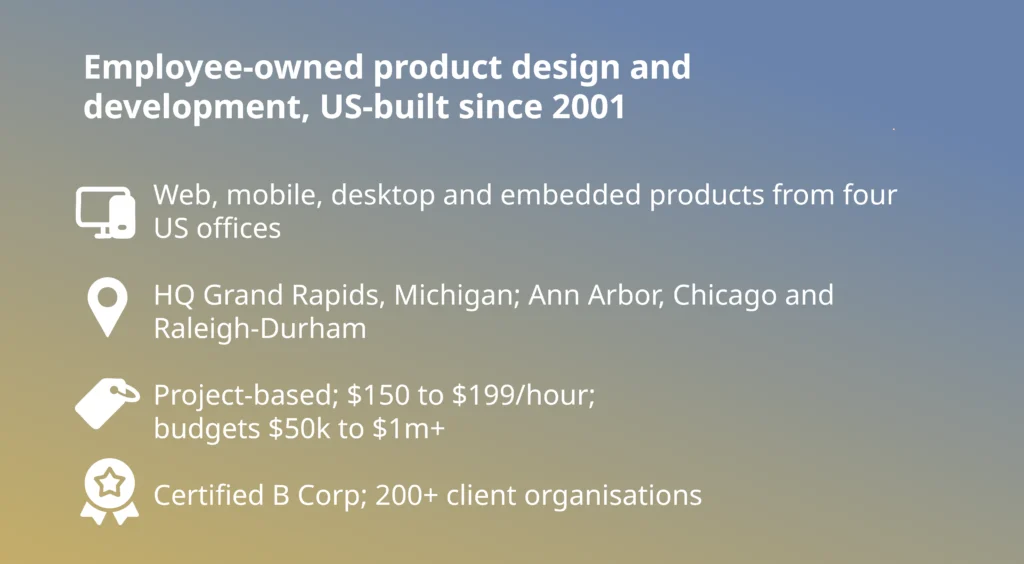
Best fit when a product idea needs design and engineering in one accountable team.
Look elsewhere if offshore rates are a requirement.
What they build: Custom software products across web, mobile, desktop and embedded, with a focus on the early phases of product design and development where scope, stack and UX get decided.
Scale and footprint: Employee-owned and founded in 2001 in Grand Rapids, with offices in Ann Arbor, Chicago and Raleigh-Durham, around 140 people in total. The ownership structure shows up as low turnover and long relationships across more than 200 organisations, many spanning multiple years and projects.
Engagement and pricing: Projects typically run 3 to 18+ months on budgets from $50,000 to over $1 million, at $150 to $199 per hour with a $25,000 minimum, per its Clutch profile.
Proof: WECC selected the firm to build a large-scale renewable energy tracking platform. B Corp certification and employee ownership back the continuity claim in a market where account teams usually rotate.
Worth checking: Capacity is the constraint, since a consultancy of this size fills its schedule quickly. The rate card is fully onshore in the US, so budget accordingly.
5. Mind Studios
Best fit when a growing product needs a technology partner who stays past launch.
Look elsewhere for a one-off fixed-scope build.
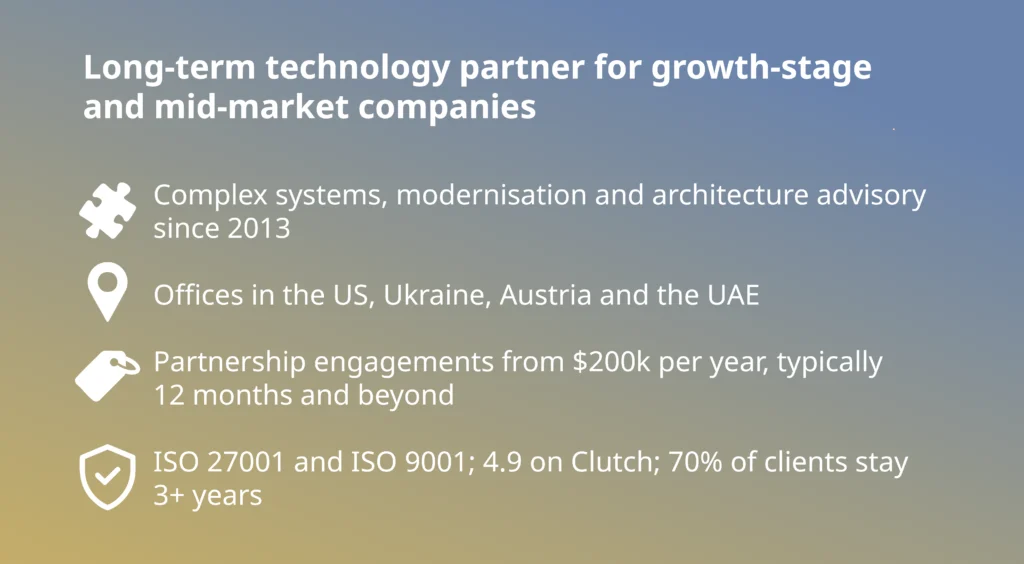
What they build: Platforms, marketplaces and data-intensive applications for growth-stage and mid-market companies, plus legacy modernisation and architecture advisory. Industry depth sits in logistics, healthcare, real estate and fitness.
Scale and footprint: In business since 2013, with offices in Fairfax, Dnipro, Vienna and Dubai, and ISO 27001 and ISO 9001 certification behind the delivery process. Retention backs the positioning: 70% of clients stay three or more years, and the average engagement runs past the two-and-a-half-year mark.
Engagement and pricing: Partnerships typically run 12 months and beyond, for companies investing $200,000 or more annually in their technology. The firm says openly that one-off builds are the wrong fit.
Proof: Fitr, a fitness coaching platform, is a seven-year partnership worth $3.8 million in total. AnyCurb’s predictive property model hit 85% accuracy in independent testing, and the technology was a key factor in the company’s acquisition. The firm also delivered an account management system for the Austrian Federal Economic Chamber under formal procurement.
Worth checking: The commercial floor is real, so smaller scopes will be turned away. Ask how business continuity is planned across delivery locations.
6. Hashrocket
Best fit when the product belongs on Rails or Elixir, and you want senior pairs writing it.
Look elsewhere for a stack they do not live in.
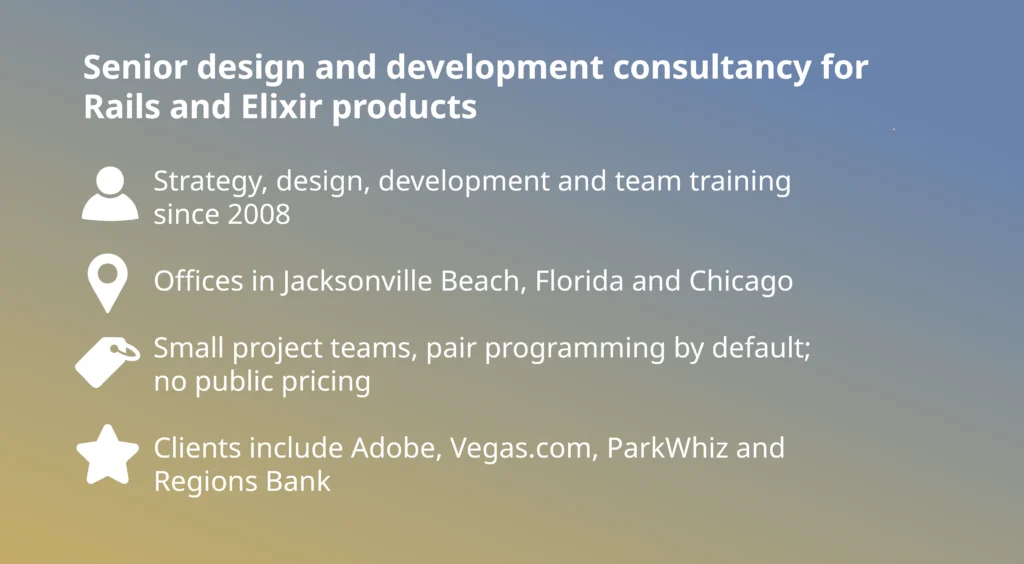
What they build: Web and mobile products on Ruby on Rails, Elixir, React, React Native, iOS and Android. Services run from strategy and design through development to in-person team training.
Scale and footprint: A consultancy since 2008, running a deliberately small senior team from Jacksonville Beach and Chicago. The firm has launched hundreds of products.
Engagement and pricing: Project teams with pair programming as the default, which keeps knowledge shared and code quality consistent. No public pricing. Expect premium US consultancy rates.
Proof: Client work includes a deal manager for Brad’s Deals, a mobile experience for Vegas.com, a large-scale admin system for ParkWhiz, and projects for Adobe. Regions Bank, Verisign and Engine Yard also sit on the client list. The open-source record, from decent_exposure to Today I Learned, carries real weight in the Rails community.
Worth checking: The specialism is the point. Confirm your long-term stack matches theirs, and expect boutique capacity, not a large bench.
Operational systems (Chetu, Fingent, AppIt Ventures):
ERP, point of sale, field service, claims processing: systems judged on uptime and fit with how the business already works. The three firms here build operational software as their core trade.
7. Chetu
Best fit when an industry-specific system needs a large, flexible bench behind it.
Look elsewhere if you want a small fixed team you know by name.
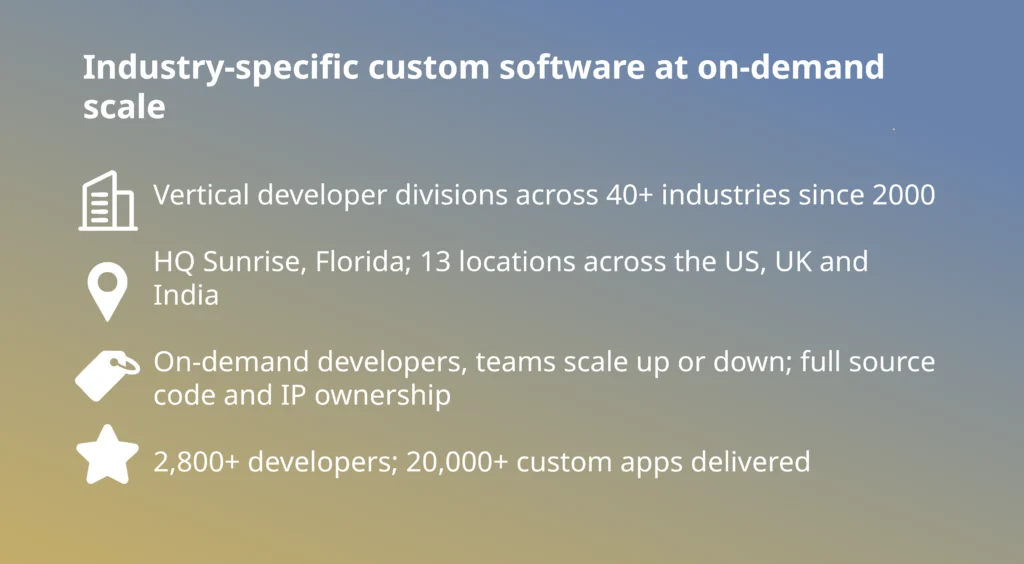
What they build: Operational systems across more than 40 industries, from ERP, CRM and POS to payments, healthcare and supply chain platforms. Developers sit in vertical divisions, so the team already knows the sector’s rules.
Scale and footprint: Building since 2000 from Sunrise, Florida. The numbers run to 13 locations, 2,800+ dedicated developers, 20,000+ custom apps and 7,000+ global customers. Delivery spans the US, UK and India.
Engagement and pricing: On-demand teams that scale up or down, with US and UK-based project management over global delivery. Clients receive full source code and IP ownership. Pricing on request.
Proof: Client logos include Johnson & Johnson, Siemens, Marriott, DIRECTV and Memorial Healthcare System. Analyst recognition comes from Everest Group, ISG and IDC.
Worth checking: Clutch reviews praise the value for money and note occasional timeline slips. Fix milestones and reporting cadence in the contract, and confirm the offshore-delivery model fits how your team works.
8. Fingent
Best fit when a business system has to fit a specific vertical without an enterprise price tag.
Look elsewhere for board-level transformation consulting.
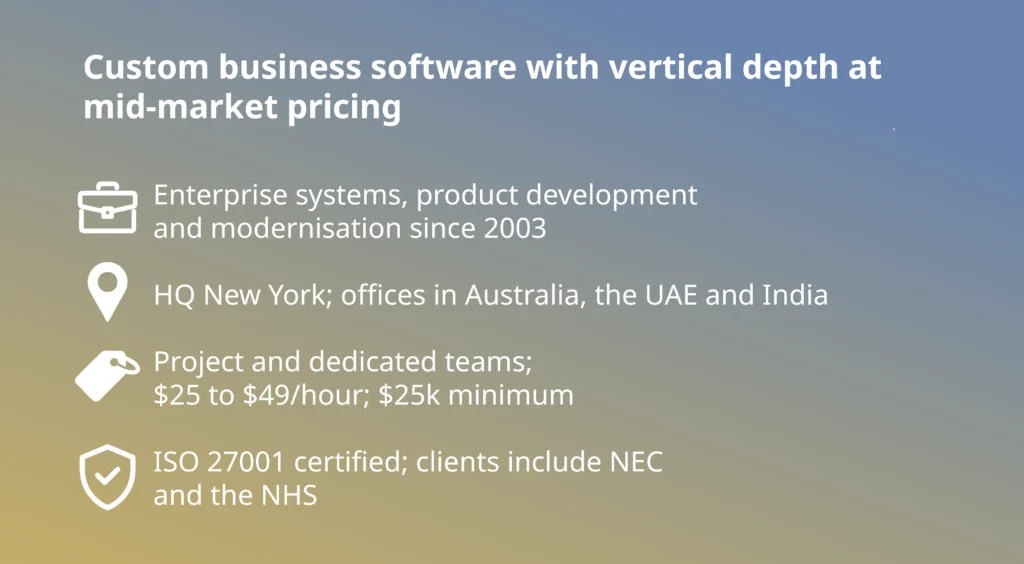
What they build: Custom and enterprise software, product development, web and mobile applications, and system integration, with vertical depth in real estate, financial services, logistics, healthcare and education.
Scale and footprint: Delivering since 2003, with more than 450 professionals and offices in New York, Melbourne, Sydney, Dubai, Kochi and Bangalore. The firm is ISO 27001 certified.
Engagement and pricing: Project teams, dedicated teams and staff augmentation. Rates run $25 to $49 per hour with a $25,000 project minimum, which puts enterprise-grade work within mid-market reach.
Proof: A unified self-service payment portal for NEC Financial Services. A cloud replacement for one client’s 25-year-old legacy system. Data visualisation work for the NHS.
Worth checking: Confirm which office actually delivers your project and how time zones split between US-facing management and India-based engineering. Marketing materials also claim 50% faster delivery; the figure is self-reported, so ask what it would mean for your scope.
9. AppIt Ventures
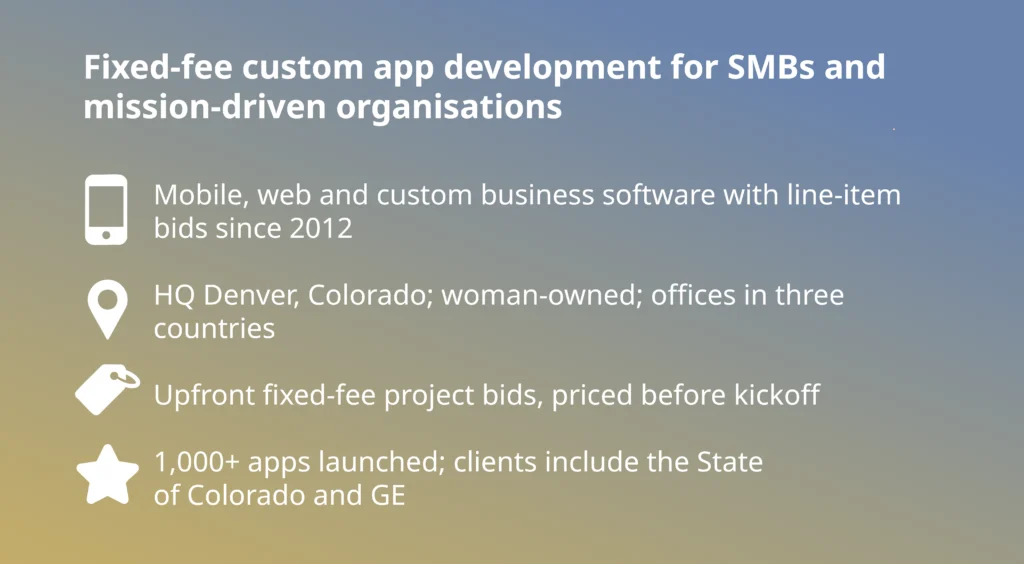
Best fit when a locked budget matters more than anything else.
Look elsewhere for programmes that need hundreds of engineering months.
What they build: Custom mobile apps, web apps and business software for small and medium businesses and NGOs, with legacy upgrades, code reviews and AI features alongside. The firm is intentionally agnostic on industry and technology.
Scale and footprint: Denver-based and woman-owned, building since 2012. The record stands at 1,000+ apps launched, 20+ awards and six international locations.
Engagement and pricing: One of the few US product development firms still offering up-front, fixed-fee project bids, with line-item estimates and timelines delivered before work starts. That shifts scoping risk onto the vendor. Delivery then follows four steps: discovery, design, development, and deployment.
Proof: Client logos include the State of Colorado, GE, Sandvik and Liebherr, alongside a run of 5.0-rated Clutch reviews.
Worth checking: The sweet spot is SMB-scale builds, so pressure-test capacity before bringing an enterprise-sized backlog. Fixed bids live or die on requirements quality, so expect a demanding discovery phase and come prepared for it.
Budget efficiency (Saigon Technology):
Offshore delivery has matured past the body-shop era. The question worth asking has changed too: can the engineering and the communication hold at a third of onshore rates? The right partner here proves it with named clients and a trial period before you commit.
10. Saigon Technology
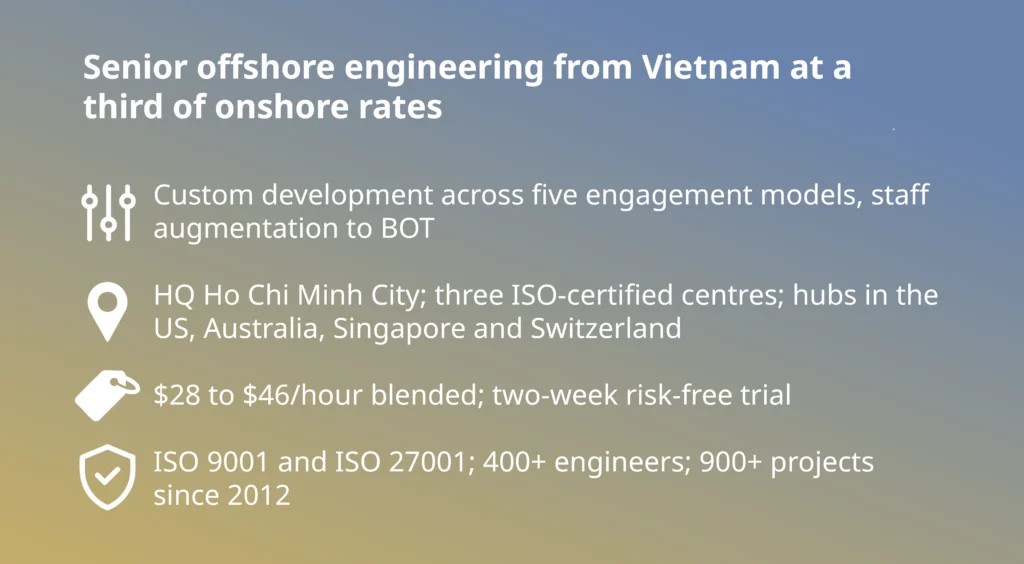
Best fit when you need senior offshore engineering at a fraction of onshore rates.
Look elsewhere if daily in-person collaboration is non-negotiable.
What they build: Custom software, web and mobile applications, MVPs and enterprise systems across fintech, logistics, healthcare, e-commerce and the legal sector, with teams working as an extension of yours.
Scale and footprint: An ISO-certified Agile firm headquartered in Ho Chi Minh City, with three development centres and over 400 engineers, plus support offices in the US, Australia, Singapore and Switzerland. VINASA lists it among Vietnam’s Top 10 ICT companies.
Engagement and pricing: Five engagement models, from staff augmentation and dedicated teams to fixed price and build-operate-transfer. Blended team rates run $28 to $46 per hour, roughly a third of onshore equivalents, with shift patterns built to give US teams 10 to 12 hours of daily overlap. Most engagements start with a two-week risk-free trial.
Proof: A six-year build-operate-transfer for a Netherlands IT company, ending with the team, IP and operations transferring in-house. The wider record runs to 900+ production systems for 300+ clients since 2012.
Worth checking: Confirm the seniority mix on your named team, since the pitch leans on senior-first staffing. Agree on communication cadence and overlap hours in writing before kickoff.
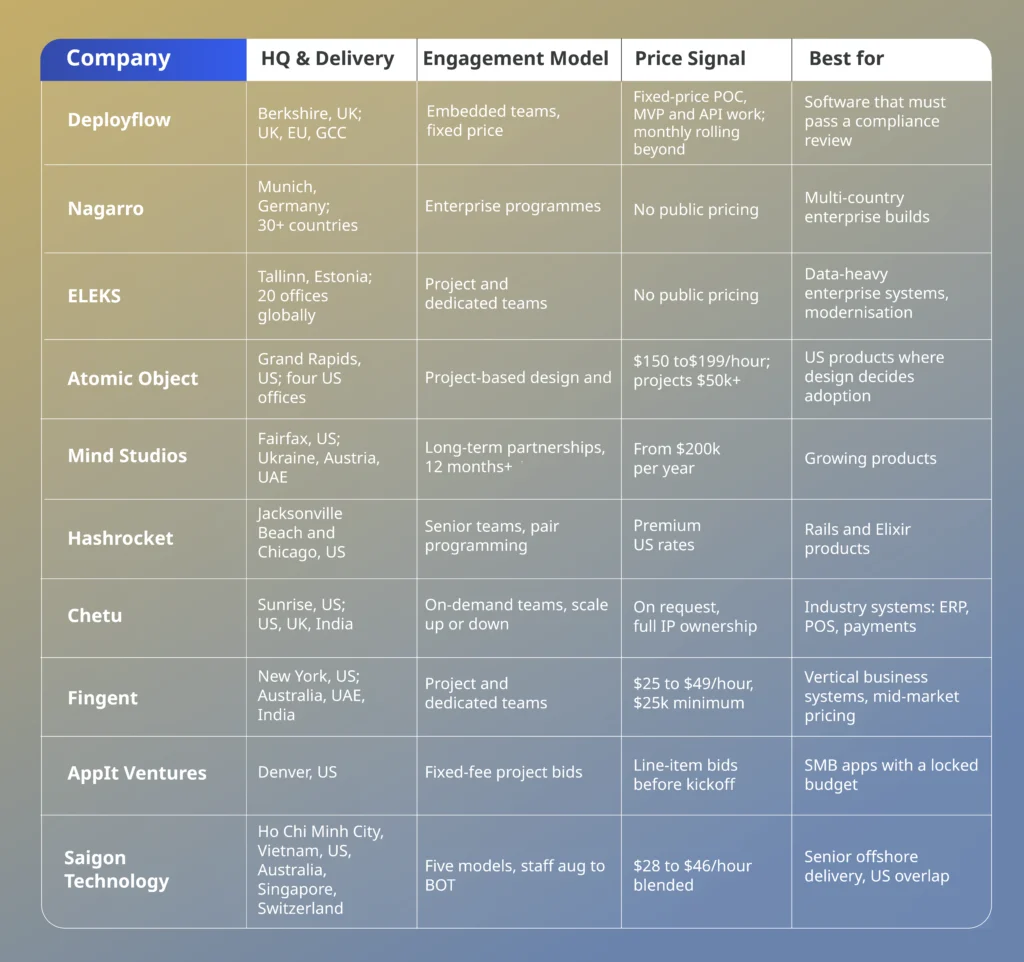
Quick Comparison of the Top Custom Software Development Companies
How We Selected These 10 Companies
The shortlist began with more than 40 custom software development companies. Each went through the same three checks:
- Public case studies with named clients and verifiable outcomes
- Certification records
- Verified reviews on Clutch and G2
Logos without references and percentages without context were dropped. Custom software development also had to be the lead offer. Firms built primarily around DevOps or AI consulting were left out because mixing categories produces lists that help nobody shortlist anything.
Full disclosure: Deployflow commissioned this article and appears in it. The same three checks applied, and the Worth checking line under its profile is as honest as everyone else’s.
What Custom Software Development Costs in 2026
Demand sets the floor. Gartner forecasts IT services, including application implementation and managed services, as the largest spending category of 2026, surpassing $1.87 trillion (Gartner, April 2026).
Labour costs explain the rest: the US Bureau of Labor Statistics puts the median software developer wage at $133,080 a year as of May 2024, with employment projected to grow 15% through 2034, much faster than the average for all occupations (BLS Occupational Outlook Handbook).
A fully loaded US engineer costs a firm roughly double the wage once benefits, overheads and bench time are factored in. That is why onshore agency rates start where they do and why offshore delivery keeps its price advantage.
The companies on this list show the resulting spread. Atomic Object publishes $150 to $199 per hour on Clutch at the onshore premium end. Fingent’s blended onshore and offshore delivery lands at $25 to $49 per hour. Saigon Technology prices Vietnam-based teams at $28 to $46 blended.
Deployflow’s delivery data puts a focused, production-ready build at SME scale between £30,000 and £50,000, roughly $40,000 to $65,000, over 6 to 12 weeks. Enterprise platforms with multiple integrations move into six and seven figures, across quarters rather than weeks.
Three things move the total more than the rate card: how ready your data and requirements are, how many existing systems the software has to plug into, and who runs the system after launch. A vendor quoting a precise figure before understanding all three is guessing.
Five Questions That Separate Builders From Stallers
| The Question | Shippable Answer |
| What is your step-by-step process from specification to production? | Named sprint length, deliverables per cycle, sign-off gates, and a date |
| Who owns the code and architecture, and what do exit terms look like? | Full IP and documentation are yours, written into the contract, and the handover is defined |
| Who exactly will work on the account, and what happens when someone leaves? | Named individuals with availability, plus a continuity plan |
| How are security and compliance built in from the first sprint? | Certifications with dates, controls inside the definition of done |
| Can you show a live production system in my industry and the results? | A named client, a running system, a number |
The Right Partner Depends on the Job You Are Hiring For
Ten firms, five situations, one decision. Match the group first, then the firm, then ask the five questions to everyone left standing.
If the job is custom software that has to clear a compliance review and stay in production afterwards, Deployflow is built for exactly that: sprint-based delivery, fixed-price entry engagements, and regulated-sector proof from FCA-regulated fintech to national-scale public infrastructure.
Book a free scoping call and leave with an honest view of cost, timeline and the fastest route to live.
Frequently Asked Questions About Custom Software Development Companies
What does a custom software development company do?
A custom software development company designs, builds, tests, deploys and maintains software shaped around one organisation’s workflows. Off-the-shelf configuration works the other way around, bending your processes to fit the product.
A typical engagement covers the full lifecycle: requirements and architecture, UX and UI design, development, QA, deployment and post-launch support. Delivery models range from fixed-price projects and time-and-materials contracts to dedicated long-term teams, and the better firms also handle system integration, legacy modernisation and the managed run after launch. The output belongs to you: bespoke code built for your processes, your integrations and your compliance requirements.
How long does a custom software project take?
A custom software project takes 6 to 12 weeks for an MVP, 6 to 12 months for the first production release of an enterprise platform, and runs multi-year, where the vendor also operates the system.
Two things stretch timelines more than the build itself: integration with existing systems and compliance sign-off. Both show up late when left unplanned, which is why vendors who design for deployment from the first sprint ship faster than those who treat it as a final phase. Scope changes are the third clock-killer, so a fixed, written definition of done protects the date more than any methodology.
When does custom software beat off-the-shelf?
Custom software beats off-the-shelf when workflows are too specific for existing products, integrations span multiple internal or legacy systems, or the software itself is the competitive edge.
Off-the-shelf wins on speed and upfront cost for standard processes like accounting or HR, where configuration gets you 90% of the way. The tipping point usually arrives when subscription tools start blocking work: a feature the vendor will not build, a compliance control they do not support, or an integration they have never heard of. At that point, you are paying licence fees for software that limits you, and a custom build starts returning its cost.
Which country is best for custom software development outsourcing?
No single country is best; the right region depends on what the project needs.
- Vietnam and India lead on cost for volume work, with senior rates around a third of US equivalents and mature delivery ecosystems behind them.
- Eastern Europe and Latin America sit in the mid-tier, trading slightly higher rates for deeper seniority and time-zone overlap with the EU and the US.
- Onshore partners in the US and UK win where regulation, data residency or close design collaboration rule out remote delivery.
Match the region to project complexity and compliance requirements first, then compare rate cards within the shortlist, because the cheapest hour is rarely the cheapest outcome.
Do custom software development companies use AI to build software?
Yes, most serious custom software development companies now use AI across the delivery lifecycle, and that will separate vendors more than geography does.
Leading firms embed AI in requirements validation, coding, testing and documentation, and several on this list pair senior engineers with AI tooling to raise output per head and not pad teams with juniors. Three questions tell you whether the adoption is real: do the productivity gains reach your price, how is AI-generated code reviewed before it ships, and what governance controls the tools and their access to your data? Vendors without clear answers are experimenting with your budget.
Explore our BLOG
Recent articles

AI Experimentation vs AI Engineering: The Difference That Decides Whether Your AI Budget Survives
Experimentation buys you knowledge. Engineering buys you a system that still works next quarter, when...
read full article

Why Most Agentic AI Projects Fail Before They Scale
Has your agent been three months from production for nine months? Agentic projects break at...
read full article

Is Claude Down? Anthropic Outage: Protect Your Cloud Infrastructure
Claude.ai has spent 2026 fighting its own success. The latest run came between 12 and...
read full article