



For UK fintech and SaaS leaders, the real differentiator in cloud success is not the provider alone, but the model used to deliver and evolve the platform.
Traditional managed cloud services are often effective at maintaining stability, but they can become limiting when the platform needs to scale, adapt, and support faster engineering change.
The stronger approach is one built around ongoing engineering ownership, where the platform is developed deliberately rather than simply kept running.
TL;DR: Why Engineering-Led Delivery Changes the Outcome
- Lifecycle Continuity: Platforms evolve through migration, stabilisation, optimisation, and evolution; fragmented support across these stages creates technical debt.
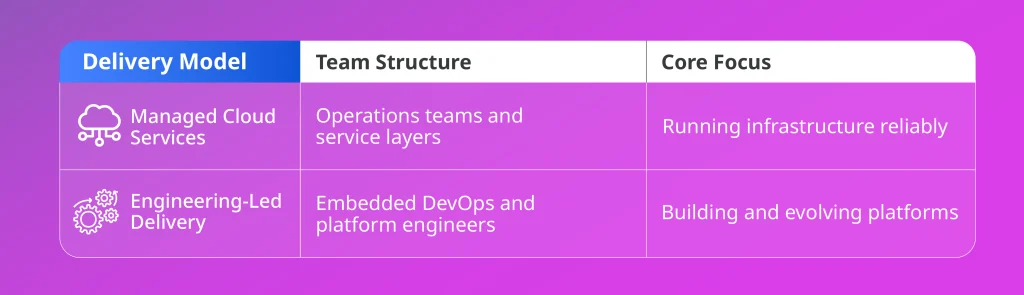
- Model Distinction: Managed services prioritise reliable infrastructure runs, whereas engineering-led delivery focuses on building and evolving the platform.
- Integrated Expertise: Deployflow maintains a single engineering team across the entire lifecycle, ensuring the architects who build your system are the ones scaling your Internal Developer Platform (IDP).
- Enterprise Scaling: Engineering-led models are specifically designed for high-scale, regulated environments where infrastructure inertia is the primary threat to growth.
This guide helps clarify whether your current model is supporting platform evolution or holding it back.
Cloud Delivery Does Not End at Migration
Building a cloud platform is a continuous lifecycle where the delivery model selected at the outset dictates the technical debt accrued tomorrow. Organisations that treat cloud adoption as a static destination often find themselves trapped in rigid operational structures that cannot adapt to shifting engineering demands.
For many UK organisations, that shift also depends on app modernisation, since legacy applications and outdated architecture often become the biggest blockers to platform scale, automation, and engineering velocity.
Understanding the Four Stages of Platform Growth
Platforms typically move through four stages:
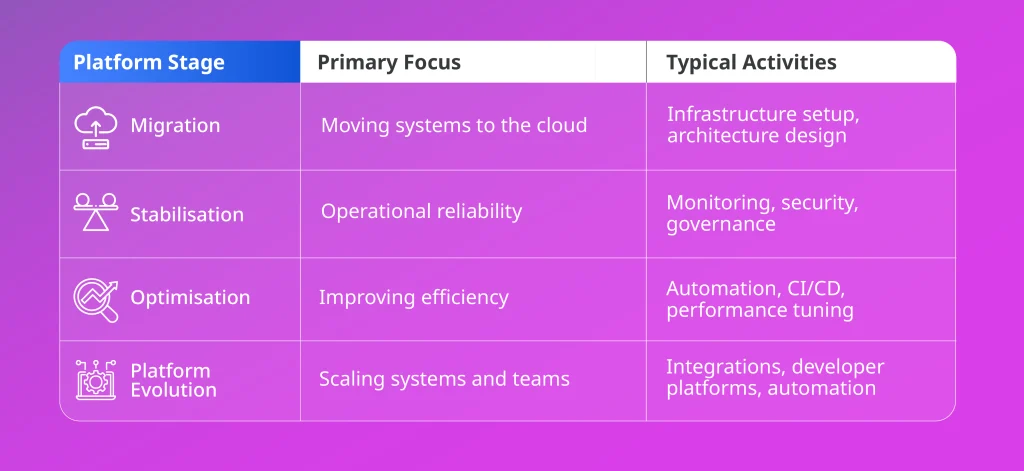
Many providers are strong in one phase of the cloud journey, but not across the full platform lifecycle. The risk is the specialist gap, where a provider can complete the migration yet cannot support the deeper engineering work required for optimisation, integration, and platform evolution.
Deployflow supports all stages with the same engineering team, helping preserve engineering continuity from migration through platform evolution.
Managed Services and Engineering-Led Delivery Compared
For UK technology leaders, the delivery model will shape platform flexibility, engineering velocity, and long-term technical resilience.
What Managed Services Are Designed to Do
Managed services are built to keep infrastructure stable, secure, and well supported. Providers such as ANS Group play an important role in the UK market by helping organisations operate cloud environments reliably.
But when the next phase requires faster automation, tighter integration, and ongoing platform evolution, operational support alone may not provide the engineering depth needed to move the platform forward.
Why Engineering-Led Delivery Scales Better
An engineering-led delivery model embeds DevOps and platform engineers into the platform itself. The focus is not just on running infrastructure, but on continuously improving and evolving it. Deployflow uses this model to build technical maturity from the start, so the platform can scale with complexity rather than struggle against it.
“They were able to give us another vision, another way of doing things. It took only a couple of days for them to understand the whole methodology. And it was amazing, because not many people are able to do that. I can see Deployflow as a long-term technological partner that will bring a lot of innovation.”
Marta Juega,
Co-Founder at PI Concept
Why CTOs Need a Platform Engineering Model
As systems grow, infrastructure complexity starts to drain engineering velocity. Managing Kubernetes, CI/CD pipelines, access controls, and cloud operations adds cognitive load that pulls feature teams away from building the product.
Platform engineering addresses this by giving developers a self-service Internal Developer Platform instead of a ticket queue.
DORA’s research found that internal development platforms improve developer productivity and are more common in larger organisations, where delivery complexity is harder to manage manually.
With the right tooling, teams can deploy faster, work with less friction, and scale delivery without being blocked by infrastructure overhead.
How Deployflow Supports the Entire Platform Lifecycle
Deployflow is a technically mature engineering partner built to support enterprise environments at every stage of growth.

A unified approach reduces handover friction across migration, operations, and development. With the same engineering context maintained throughout the lifecycle, the platform can evolve without losing architectural consistency.
Engineering Maturity in Complex Cloud Environments
In complex enterprise environments, especially in regulated sectors such as fintech and healthtech, the delivery model must support both reliability and compliance at scale.
Engineering-led delivery is specifically designed for these scenarios. It provides the technical depth required to manage large-scale integrations and the operational maturity to ensure security and governance are automated directly into the platform.
Navigating High-Scale Systems and Architectural Bottlenecks
Relying on rigid ticketing systems and predefined SLAs often fails to account for the fluid, iterative nature of modern software delivery. When your infrastructure is gated by a service desk, engineering velocity inevitably stalls.
An engineering-led model places platform expertise closer to day-to-day delivery and long-term scale. This transition from a reactive service to proactive engineering leads to:
✔️Automated Compliance: Governance and security protocols are built into the platform code, ensuring compliance in regulated industries without manual oversight.
✔️Architectural Flexibility: The platform is designed to absorb complex integrations and traffic spikes through automation rather than constant manual intervention.
✔️Engineering Ownership: Your internal teams gain a platform engineered for evolution and scale, moving beyond the mentality of basic stability.
How to Choose the Right Delivery Model for Your Infrastructure
The best model depends on your need for control, your internal engineering capacity, and the complexity of your roadmap. What matters is not just who runs the platform today, but who can help it evolve tomorrow.
Most organisations fit into one of three models:
- Managed Services: Reduces operational overhead and supports stable day-to-day infrastructure, but offers less flexibility for fast platform change.
- Engineering Ownership: Gives engineers direct responsibility for building, improving, and scaling the platform as a strategic asset.
- Hybrid Model: Separates platform stability from platform evolution, combining managed operations with dedicated engineering support.
Moving Towards a More Scalable Platform
If the platform is becoming harder to scale, automate, or evolve, the issue may not be the cloud strategy itself but the model that delivers it.
Engineering continuity is exactly what allows platforms to move from static support to real progress. As one client put it:
“They assembled a dedicated workforce, enabling us to transform our vision into reality. Their seamless team-building and thorough knowledge transfer have been instrumental in bringing our product to life.”
Sean Hederman
CIO at Zilch
A platform that is easier to scale, adapt, and improve over time is much more achievable when the team shaping it is also equipped to evolve it.
Book a platform maturity assessment with Deployflow to evaluate where your current approach is creating unnecessary operational and engineering drag.
FAQs About Cloud Delivery and Platform Scale
Is platform engineering the same as DevOps?
No, platform engineering is not the same as DevOps.
DevOps is a broader operating philosophy focused on improving collaboration, automation, and software delivery across development and operations.
Platform engineering is a more specific discipline that builds the internal platforms, tooling, and self-service capabilities that make DevOps work at scale. In practice, platform engineering often becomes the structural layer that helps DevOps move from theory into repeatable delivery.
Can a managed services provider also support platform engineering?
Yes, but not always in a deep or continuous way.
Some providers can add engineering support, but that does not mean platform engineering is built into how they deliver. The key question is whether engineering capability is central to the relationship or added only when needed. That distinction often shapes how well the platform can evolve over time.
Does every cloud platform need an Internal Developer Platform?
No, not every platform needs an Internal Developer Platform straight away.
Smaller teams or simpler environments can often work well without a formal internal platform layer. The need usually appears when complexity, team size, compliance pressure, or deployment frequency starts to create friction. At that point, an IDP can reduce inconsistency and make delivery easier to scale.
Is a hybrid approach a long-term solution or just a transition stage?
It can be either, depending on the organisation.
Some teams use a hybrid structure during a migration or platform redesign, while others keep it permanently because it balances operational coverage with engineering depth. The deciding factor is whether responsibilities are clearly split between running and evolving the platform. Without that clarity, hybrid approaches can become messy.
What should CTOs assess before changing their cloud delivery approach?
They should assess where delivery is slowing down, where ownership is unclear, and how much engineering capacity the roadmap really demands.
It is also important to look at handover points, operational dependencies, and how easily the platform can support future change. The goal is not just to compare providers, but to understand whether the current setup still fits the next stage of growth.
Explore our BLOG
Recent articles

Is Claude Down? Anthropic Outage: Protect Your Cloud Infrastructure
Claude.ai has spent 2026 fighting its own success. Twenty-one incidents landed between 12 August and...
read full article

AI Experimentation vs AI Engineering: The Difference That Decides Whether Your AI Budget Survives
Experimentation buys you knowledge. Engineering buys you a system that still works next quarter, when...
read full article

Why Most Agentic AI Projects Fail Before They Scale
Has your agent been three months from production for nine months? Agentic projects break at...
read full article