


Stop paying £100k+ salaries for senior engineers to manually approve pull requests and fix configuration drift.
For UK IT leaders, the bottleneck is the manual intervention required to keep pipelines moving.
While traditional automation provides the pipes, Agentic AI provides the brain, allowing your DevOps environment to self-correct, audit, and deploy without human hand-holding.
This guide is written for UK founders, CTOs and Heads of IT who recognise these patterns:
- Releases require senior engineer approval
- Incidents still depend on humans to diagnose
- Compliance is verified after deployment, not during
- Infrastructure changes move through ticket queues
TL;DR: The Executive Summary
Problem: Scripted DevOps breaks under change, forcing UK teams into manual intervention.
Solution: AI agents replace rigid logic with autonomous control of CI/CD and infrastructure.
Impact: DORA Metrics improve with 30% faster releases and 60% lower MTTR.
Strategic Fix: Platform Engineering delivers Operational Resilience without growing headcount.
If delivery speed depends on specific people being available, DevOps has become a scaling risk rather than a growth engine.

For UK CTOs, AI agents make DevOps predictable by reducing risk before deployment. Faster releases come from building a platform that supports safe change at scale, rather than trading speed for stability.
The Scaling Wall: Why Senior Engineering Time is Leaking
UK SMBs often hit a ceiling where every new release demands more manual DevOps effort. Innovation is currently capped by operational friction; senior engineers (the most expensive assets) are trapped reviewing pull requests and chasing false alerts.
How Much Does Manual DevOps Cost?
When senior engineers spend time reviewing routine changes, diagnosing predictable failures, or approving infrastructure requests, the cost is not only in salary but also in lost product velocity.
Each manual gate adds:
- Waiting time between commits and releases
- Recovery delays during incidents
- Audit the effort to reconstruct what happened
- Opportunity cost from work that never ships
This creates a hidden tax on growth. Delivery does not slow down because teams lack skill. It slows because every decision must pass through a human bottleneck.
Many UK teams already have green pipelines on paper, but that false sense of safety often hides serious delivery risk, which is a pattern explored in depth in our breakdown of why compliant-looking CI/CD pipelines still leak millions in lost velocity.
Agentic DevOps shifts the burden from human judgment to autonomous outcomes. Unlike script-based tools that only follow predefined steps, an agent works toward a specific goal (such as a safe, compliant deployment) and determines the actions needed to achieve it.
This removes routine judgment calls, turning DevOps from a bottleneck into a high-throughput engine.
What an AI Agent Should Not Control?
An AI agent does not replace engineering authority. It executes decisions defined by humans.
Engineers still define:
- Security policies
- Infrastructure standards
- Deployment rules
- Compliance boundaries
The agent only enforces them consistently and continuously.
Driving DORA Metrics: From Standard to Elite Performance
For a CTO or Head of IT, infrastructure only matters if it moves DORA Metrics. An AI agent does more than report on delivery speed and recovery time; it improves them by removing human waiting from the critical path.
30% Faster Lead Time for Changes
In most pipelines, the longest delay is waiting for reviews, scans, and approvals.
The Action: Introduce an AI agent to perform autonomous pre-reviews. It checks code against platform standards, fixes basic issues, and patches known vulnerabilities before a human ever touches the request.
The Benefit: Pull requests move faster, and developers stay in flow instead of sitting idle. Lead time drops because decisions happen continuously.
Where Does the AI Agent Operate?
In practice, an AI agent sits between your delivery systems and your cloud platform:
- It observes CI/CD pipelines
- It evaluates changes against policy
- It monitors the infrastructure state
- It reacts to incidents through controlled actions
- It interfaces with your Internal Developer Platform
This makes enforcement part of the platform itself rather than a checklist performed by people.
60% Reduction in MTTR (Mean Time to Recovery)
When systems fail at night, the real cost is not only downtime. It is fatigue, confusion, and slow diagnosis.
The Action: Use an AI agent to detect and remediate incidents. It correlates logs and metrics, identifies the failure pattern, and automatically applies a fix, such as restarting a service or scaling capacity.
The Benefit: Recovery becomes automatic. Systems heal before customers notice, and Operational Resilience becomes a property of the platform.
Operational Resilience: Speed Without the Security Risk
Leaders assume that faster delivery increases security risk. An AI agent in the DevOps pipeline provides continuous enforcement instead of periodic checks.
Manual audits only confirm compliance at a single point in time. The next deployment can invalidate them. Operational Resilience depends on validating every change as it happens.
- Continuous Compliance: The agent monitors the configuration continuously. If a developer opens a port or changes a setting that violates policy, the agent detects the violation and immediately reverts the change.
- Vulnerability Remediation: Instead of only reporting a vulnerable dependency, the agent identifies the patch, tests it safely, and prepares a ready-to-merge fix.
Security stops being a release blocker. Platform rules are enforced automatically, allowing teams to ship quickly without creating compliance gaps or exposure to zero-day risk.
Why Operational Resilience Matters for UK Organisations?
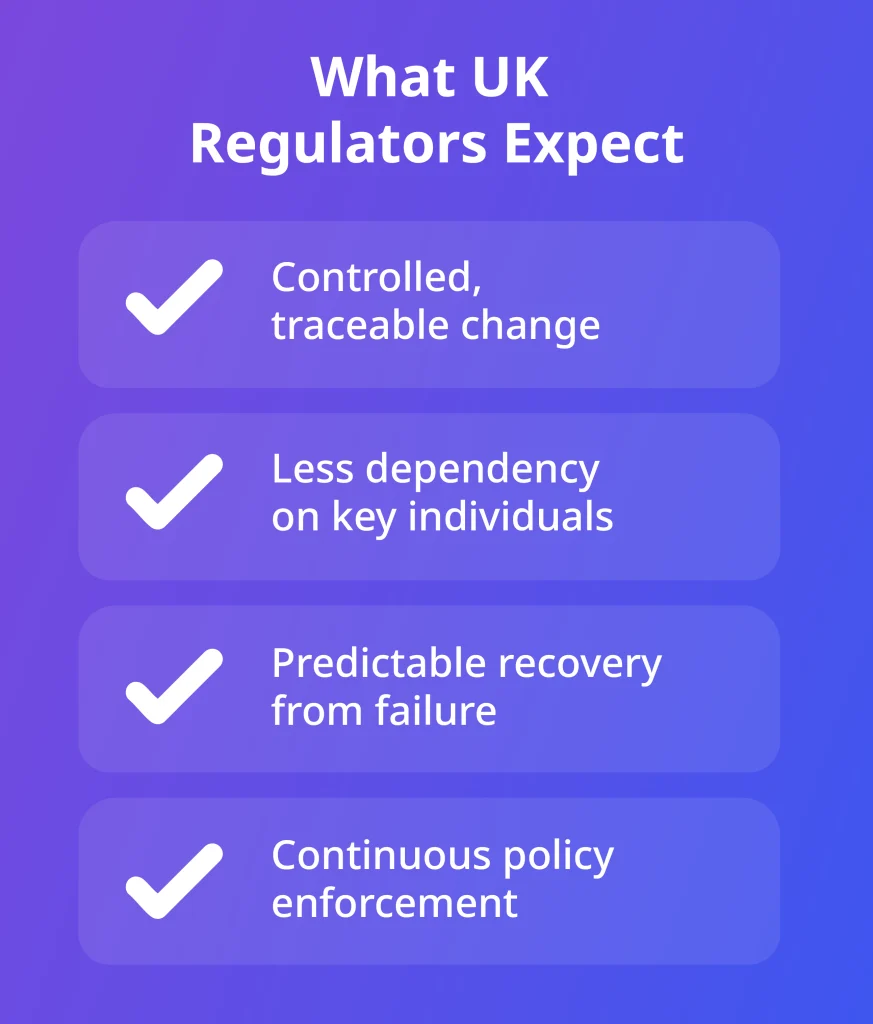
Autonomous systems generate audit trails by design. Compliance becomes continuous.
When Agentic DevOps Fails?
Agentic DevOps does not repair weak foundations. It amplifies whatever structure already exists.
If delivery pipelines are undocumented, standards are undefined, environments behave differently, or no one clearly owns policy decisions, autonomy will magnify confusion rather than remove it.
In those conditions, an agent has nothing reliable to enforce.
Autonomy only works when the platform itself is well designed. Platform engineering must come first. The agent does not replace the platform; it enforces it consistently and without delay.
Platform Engineering: Erasing Ticket Culture
As your organisation grows, the distance between development and operations can turn into a queue of Jira tickets.
Platform Engineering eliminates the wait between development and operations by creating a self-service environment where routine tasks no longer depend on human approval.
What platform engineering changes are in practice?
If a developer waits 24 hours for a staging environment, delivery slows before any code is written. These delays don’t show up in sprint reports, but they remove the speed advantage leadership expects from DevOps investment.
Using an AI agent as the interface to your Internal Developer Platform (IDP) enables intent-based infrastructure. A developer says, “I need a Kubernetes namespace for a new API,” and the agent provisions it automatically using your approved standards.
High-Level Benefit: Senior DevOps engineers move away from routine provisioning and focus on platform architecture that directly supports revenue and scale.
How a UK SaaS Company Cut Release Time by 30% with Agentic DevOps
A UK B2B SaaS company was operating in the cloud, but delivery still depended heavily on people being available at the right moment.
Releases slowed while senior engineers reviewed changes. Incidents required manual investigation. Security checks ran as separate steps instead of part of one coordinated process.
This created two risks at once:
- Slow delivery
- High operational exposure
Every change introduced a delay, and every failure depended on human diagnosis. As demand increased, effort scaled faster than output.
Deployflow introduced an AI agent inside the DevOps pipeline to take over routine judgment and execution.
The agent reviewed pull requests against platform standards, validated infrastructure changes before deployment, and applied approved fixes during incidents.
Engineers defined the rules. The agent enforced them.
The shift removed waiting from the delivery path and replaced reactive firefighting with automated control.
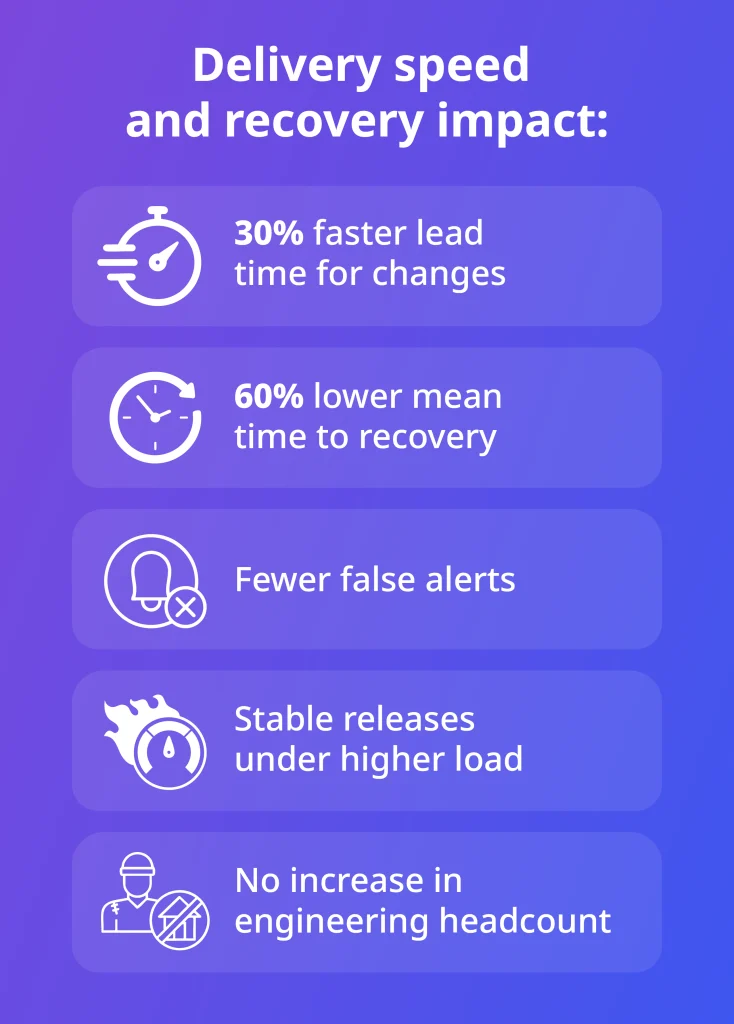
For this growing UK organisation, agentic DevOps turned delivery into a platform capability rather than a dependency on individual engineers.
The gap between the elite performers and the rest of the UK market is widening. By the end of 2026, autonomous DevOps will be the standard.
Deployflow helps UK businesses replace operational guesswork with enforced logic through managed DevOps services designed for autonomous delivery.
Request a platform control review to identify where human dependency exists in your delivery path and what can be automated safely without increasing risk.
Leadership is about building systems that work when everything else is under pressure.
Frequently Asked Questions About Agentic DevOps and AI Agents
Is agentic DevOps safe for production systems?
Yes, agentic DevOps can be safe for production when agents are limited to enforcing predefined policies rather than inventing their own rules.
The safety comes from scope control: the agent only acts within boundaries set by engineers, such as approved remediation steps or deployment standards. Every action can be logged and audited, which is often stronger than human-driven change. Risk increases only when organisations allow agents to operate without clear policy ownership or rollback controls. In mature setups, autonomy reduces risk because it removes inconsistent human judgment from critical paths.
How much does it cost to implement agentic DevOps?
It usually costs less than hiring additional senior engineers to handle reviews, incidents, and compliance manually.
Most of the investment goes into platform readiness: defining standards, policies, and observability that the agent can enforce. The agent itself is not the main cost driver; the structure around it is. For UK SMBs, the business case is typically justified through reduced MTTR, fewer failed releases, and lower dependency on on-call staff. The return is measured in delivery speed and avoided operational risk, not just tooling spend.
Do I need to fix my DevOps pipeline before using AI agents?
Yes, agentic DevOps only works on top of a well-defined delivery platform.
Agents need clear signals about what good looks like, which means documented pipelines, stable environments, and agreed standards. If pipelines are inconsistent or policies are informal, the agent has nothing reliable to enforce. In those cases, autonomy will amplify disorder instead of removing it. Platform engineering is therefore a prerequisite, not an optional step.
What tools are typically used with agentic DevOps?
Agentic DevOps usually sits on top of existing CI/CD, cloud, and observability tools rather than replacing them.
The agent integrates with pipelines, infrastructure APIs, security scanners, and monitoring systems to make decisions based on their signals. It also connects to an internal developer platform to provision and validate resources in a controlled way. This means organisations do not throw away their toolchain; they change how decisions are made across it. The shift is architectural, not purely technological.
Explore our BLOG
Recent articles

Is Claude Down? Anthropic Outage: Protect Your Cloud Infrastructure
Claude.ai has spent 2026 fighting its own success. Twenty-one incidents landed between 12 August and...
read full article

AI Experimentation vs AI Engineering: The Difference That Decides Whether Your AI Budget Survives
Experimentation buys you knowledge. Engineering buys you a system that still works next quarter, when...
read full article

Why Most Agentic AI Projects Fail Before They Scale
Has your agent been three months from production for nine months? Agentic projects break at...
read full article