


You could almost feel the AI ecosystem wobble. Nvidia, a company whose valuation towers above most of the tech world, found itself having to explain things it hasn’t been asked about in ages.
Not because its chips suddenly got worse, but because Google might finally put its own TPUs (Tensor Processing Units) on the open market, with Meta reportedly preparing to spend billions on them.
Nvidia publicly insisted it was “a generation ahead” and the only platform that “runs every AI model everywhere computing is done.”
Google countered by saying it would continue supporting both its own hardware and Nvidia’s, a polite way of saying, we’re ready to compete in your strongest territory.
Investors understood the signal: Nvidia’s stock slid nearly 6% (source: BBC), Alphabet’s surged almost the same amount. And in the background, Amazon and Microsoft reminded the world they also have AI chips coming.
This is a warning shot for every CTO who’s building (or planning to build) GenAI (Generative AI) systems.
If the AI hardware landscape is about to fragment, GenAI strategies built around one vendor, one cloud, or one type of silicon won’t survive the next two years.
It also raises a broader question every CTO faces while planning GenAI systems: how do you balance hardware decisions with the actual return on your cloud investment, especially as GenAI pushes costs upward? The answer isn’t obvious, but our guide shows how generative AI can reshape cloud ROI in ways most teams don’t expect.
Let’s focus on the real story hiding behind the headlines, and it’s the one engineering leaders need to prepare for.
The Real Friction: GenAI Strategies Built on Yesterday’s Assumptions
For years, teams have built their AI roadmaps on a stable storyline:
- Nvidia will have capacity.
- Prices will ease.
- Performance will keep climbing.
- The supply chain will sort itself out.
That narrative held until Google signalled it might open its TPUs to the broader market.
Suddenly, the “safe bets” no longer look so safe. Cost models shift. Performance assumptions get fuzzier. Engineering choices that seemed obvious at the time now feel narrow.
This chapter breaks down the first cracks that appear when GenAI strategies run into a hardware landscape that refuses to stand still, and why companies need a more flexible foundation before they scale.
Compute Fragmentation: The Technical Debt No One Budgeted For
The AI hardware market is no longer one ecosystem. Every major cloud provider now pushes its own acceleration stack, each with unique frameworks, compilers, runtime behaviours, and optimisation layers.
When companies scale GenAI, this fragmentation quietly becomes a source of technical debt.
Here’s what teams are suddenly expected to navigate:
- Nvidia’s ecosystem is built around CUDA and TensorRT: Nvidia workloads rely on CUDA for computation and TensorRT for optimisation. It’s a mature ecosystem, but deeply specialised, meaning most of your tooling, training code, and performance tuning is designed around Nvidia-specific pathways.
- Google’s TPU stack running on JAX and XLA: TPUs run best with Google’s preferred frameworks (JAX for model development and XLA for compilation). These offer great speed, but require different tooling, rewriting parts of the model stack, and adapting pipelines to Google’s execution model.
Fast Facts: What Google’s Cloud TPUs Actually Offer
(More details available at Google’s official TPU page.)

Why Fragmented Nvidia-Google Compute Makes GenAI More Expensive Than Expected
The moment teams try to support both Nvidia’s ecosystem and Google’s TPU stack, the complexity begins to multiply. Not dramatically at first, but just enough to slow things down, stretch budgets, and complicate every layer of the engineering workflow.
Here’s where the friction actually comes from:
Nvidia’s ecosystem (CUDA, TensorRT)
Nvidia has spent years building a mature, deeply integrated software layer. Most existing GenAI workloads, research papers, and open-source tools assume CUDA by default. That convenience also creates dependency: models, kernels, and optimisation paths often end up tightly coupled to Nvidia’s tooling.
Google’s ecosystem (JAX, XLA, TPU runtimes)
Google’s chips require a completely different software approach. Moving a workload to TPUs often means rewriting parts of the training loop, adapting custom ops, or rethinking batch shapes and memory layouts. Performance is excellent when workloads are tuned correctly, but reaching that point is rarely effortless.
Tooling gaps between the two worlds
Teams quickly run into mismatched libraries, different compilers, competing profilers, and incompatible optimisers. Engineers end up maintaining separate workflows just to keep parity across platforms.
Dependencies that no longer behave the same way
What runs smoothly with CUDA might need refactoring for TPUs. Custom layers, quantisation schemes, or memory-intensive components often break or require special handling when switching from Nvidia to Google.
Pipelines that need dual design
CI/CD pipelines must now handle two sets of runtimes and two very different compilation paths. Even small changes (like updating a driver or switching a base image) can fork an otherwise clean pipeline into parallel tracks.
Model performance that shifts across platforms
A model fine-tuned for Nvidia won’t necessarily achieve the same efficiency or latency on TPUs without targeted optimisation. That tuning takes real time, real money, and real engineering focus.
Compute fragmentation doesn’t create a crisis in a single week.
It builds a steady drag on velocity, maintainability, and cost, the qualities GenAI depends on to scale smoothly.
The Hidden Cost of Choosing the Wrong AI Hardware
Most teams discover the “real bill” for AI hardware long after the purchase order clears.
It usually starts the same way: a model trains beautifully on Nvidia GPUs: strong throughput, predictable runtimes, clean integration with CUDA-optimised tools. The team greenlights production. Everything looks stable.
Then, leadership asks for cost reductions or faster inference. Someone suggests testing a TPU cluster because Google is suddenly open to commercialising them.
On paper, the numbers look fantastic: lower costs per training step, compelling performance claims, and strong buzz from companies like Meta exploring the same path.
So, the move begins. And this is where the invisible cost surfaces.
The model that behaved perfectly on Nvidia suddenly lags behind on TPUs because it relied on CUDA-specific kernels.
Preprocessing scripts need to be rewritten for JAX.
Parts of the pipeline don’t compile cleanly with XLA.
Metrics drift.
A month later, the team realises it’s not just about swapping one chip for another but a quiet overhaul of training code, monitoring, deployment workflows, and cloud architecture.
No budget line predicted that. The financial impact doesn’t come from buying chips but from re-engineering everything around them.
Latency targets shift. Data pipelines get reworked. Entire sections of the model need tuning or rebuilding to behave well on the new runtime. What looked like a simple optimisation turns into a multi-month detour that stalls GenAI progress instead of accelerating it.
That’s the real cost of choosing the wrong hardware: you lose time and money. And while money is recoverable, time in the GenAI race is not.
Rethinking Cloud: TPUs, GPUs, and the Rise of Multi-Silicon Deployments
If Google really does open TPUs to external buyers, engineering teams won’t just gain a new chip option. They’ll inherit a new architectural problem. Suddenly, the cloud won’t be a neat, Nvidia-centric landscape but a patchwork of GPU and TPU islands, each with its own strengths, weaknesses, and trade-offs.
The shift is subtle at first: one team asks whether a training job might be cheaper on TPUs, another wonders if fine-tuning still performs better on Nvidia.
Before long, organisations accidentally drift into a multi-silicon setup; running GPUs in one cloud environment and TPUs in another, with models and data pipelines caught in the middle.
And this is where cloud design must evolve.
A single-vendor architecture can’t support a world where workloads move between Nvidia and Google.
- Teams need cloud paths that let them experiment without tearing down everything around them.
- They need networking that doesn’t break the moment a training run migrates from a GPU cluster to a TPU pod.
- They need model runtimes flexible enough to handle CUDA on Monday and XLA on Thursday without weeks of refactoring.
Here’s a practical example:
A retail AI team trains a large recommendation model on Nvidia GPUs because their tooling is CUDA-heavy.
Six months later, Google releases a TPU upgrade that could cut training time by 30%. The team wants to try it, but their current architecture assumes one runtime, one compiler, one cloud region, and one chip family.
Moving the model means redesigning pipelines, adjusting data formatting, tweaking inference endpoints, and rebuilding orchestration. A “quick experiment” becomes a quarter-long project.
That’s the reality multi-silicon introduces. A pressure to rethink cloud in a way that assumes change, instead of reacting to it.
The next generation of GenAI infrastructure needs to be built like a well-designed interchange: routes to Nvidia, routes to Google, and the freedom to switch lanes without shutting down the highway.
Flexibility becomes a feature, and cloud strategy becomes inseparable from hardware strategy.
DevOps Under Pressure: Pipelines Built for 2023 Won’t Survive 2026
Most CI/CD pipelines still assume a world where every training run happens on Nvidia GPUs, every optimisation uses CUDA, and every deployment path behaves the same, no matter where it lands.
That world is disappearing faster than engineering teams expected.
As soon as TPUs enter the picture (not just inside Google’s walls but potentially across other data centres), DevOps teams face a new kind of pressure: heterogeneous hardware everywhere.
Suddenly, a pipeline that worked flawlessly last quarter can stall because a model needs XLA instead of TensorRT, or because GPU-friendly training scripts fall apart when routed to a TPU pod.
Imagine training a model on Nvidia H100s one day, shifting to rented Google TPU v5s the next, and running inference wherever the cloud happens to be cheapest that afternoon. It’s incredibly flexible, but brutal on any pipeline that wasn’t built for that level of switching.
What breaks first?
- Build stages start branching into hardware-specific paths.
- Model validation diverges because performance characteristics don’t match between GPUs and TPUs.
- Rollback and reproducibility become unreliable because running the same code on different hardware no longer produces identical outcomes.
- Scheduling logic becomes fragile when accelerators have different queue behaviour, memory layouts, and optimisation flags.
These pressures are already reshaping what modern DevOps looks like, especially as teams begin using AI to automate parts of the delivery pipeline. And there’s growing evidence of how DevOps teams can use AI to boost stability, speed, and automation across their pipelines.
None of this means GenAI becomes impossible, far from it. It means the old DevOps muscle memory isn’t enough anymore. Teams need pipelines that understand hardware diversity, treat accelerators as dynamic infrastructure, and automate routing, optimisation, and validation across very different environments.
The organisations that adapt early will scale GenAI with confidence.
The ones who cling to 2023-era pipelines will spend the next years firefighting mismatched runtimes, unstable builds, and training workflows that behave like they have a mind of their own.
Building GenAI Systems That Don’t Collapse When the Market Changes Again
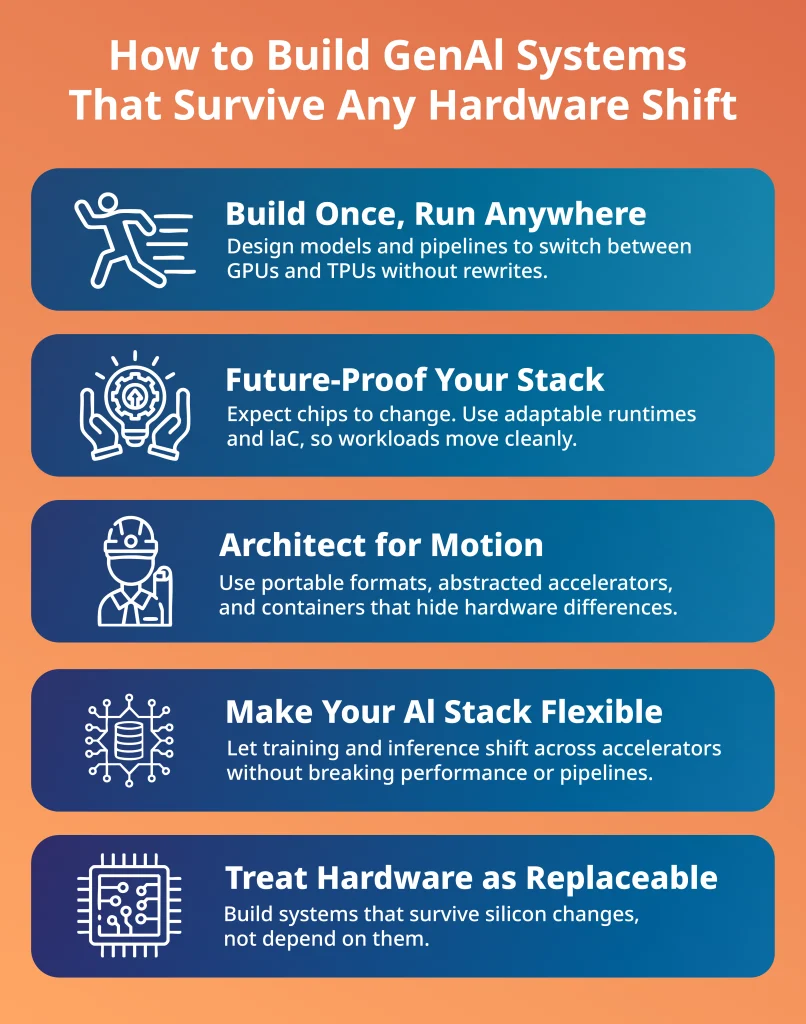
- Build Once, Run Anywhere (Even When the Silicon Changes Overnight)
The chip landscape is unstable, and your architecture needs to survive the next surprise pivot.
Instead of betting everything on CUDA or XLA, GenAI foundations should make models portable by default. That means containers that abstract the hardware, runtimes that can switch backends, and orchestration that treats GPUs and TPUs as interchangeable rather than sacred.
- Future-Proofing GenAI: Your System Should Outlive Today’s Hardware Fads
Everyone is building for H100s or TPUs today, but three years from now, those chips may not even be the centre of gravity. The smarter approach is designing GenAI pipelines around adaptability: models that don’t break when the compiler changes, workloads that can be rescheduled on different accelerators, and infrastructure that reshapes itself through IaC rather than frantic patching. If you can swap silicon without rewriting half your codebase, you’re ready for whatever the market throws next.
- Architect for Motion, Not Stability
GenAI isn’t built on stable ground. Vendors compete, supply chains wobble, pricing shifts, and performance curves keep surprising everyone. Instead of anchoring your company to one vendor’s ecosystem, design for motion: portable model formats, abstracted accelerators, containers that hide runtime differences, and Kubernetes operators smart enough to distribute workloads across mixed hardware. It’s less about predicting the winner and more about staying fluid.
- Your AI Stack Should Bend, Not Break
Real resilience is absorbing change. A GenAI system built to bend can move training from GPUs to TPUs without derailing velocity, can scale inference on whatever is cheapest that week, and can update runtimes without weeks of regression testing. Brittle architectures collapse when the chip market shifts. Flexible ones quietly adapt.
- Stop Chasing the Next Chip: Build a System That Makes the Chip Replaceable
Engineering teams keep trying to future-proof by selecting the right hardware. But the real advantage comes from making hardware replaceable. When your models load cleanly onto different accelerators, when your pipelines don’t assume CUDA forever, and when orchestration can mix hardware in a single workflow, you’re no longer at the mercy of a vendor roadmap. That level of independence is the real strategic payoff.
Practical Checklist for CTOs Preparing to Scale GenAI
Scaling GenAI is reducing uncertainty. The most valuable move is creating clarity around what you can control.
Three actions matter more than anything else:
- Prove your models run somewhere other than Nvidia. A single smoke test on TPUs or another runtime tells you instantly whether your architecture is flexible or fragile. If everything breaks, you know where to invest before scaling.
- Stress-test your cloud and CI/CD with artificial variation. Force your pipeline to build, train, or deploy using different runtimes, compilers, or accelerators, even if you aren’t using them in production yet. If the workflow buckles under controlled change, it will absolutely fail under real-world change.
- Map out where you’re most exposed to vendor dependency. Teams often discover that their biggest risks come from the frameworks, drivers, and deployment assumptions baked deep into their environment. A quick audit of where your stack is tied to specific vendors immediately reveals the engineering priorities for the next quarter.
Just three moves that immediately show whether your GenAI plans are scalable or brittle.
Once you’ve pressure-tested your GenAI plans against shifting compute realities, the real work begins: building systems that stay stable even when the hardware market doesn’t.
Deployflow helps organisations through small engineering squads working in fast, outcome-focused sprints.
Full-stack squads design GenAI foundations that run across different chips, not just Nvidia GPUs, and sprint-based delivery turns strategy into working infrastructure without long delays.
Pipelines evolve to handle mixed accelerators, model runtimes become portable, and AI systems gain the observability and governance needed to scale safely.
The outcome is resilience. GenAI stops depending on whichever chip vendor dominates that month’s headlines and starts depending on engineering that can adapt as the market moves.
Deployflow’s Gen AI engineering squads help teams stay ahead of those shifts without rewriting their entire stack.
When the Hardware Shifts, Smart Strategy Stays Standing
The story unfolding between Nvidia and Google is only the beginning. Chips will change, clouds will evolve, and the tools everyone depends on today may look ancient sooner than expected.
But good engineering doesn’t panic when the landscape shifts. It adapts, learns, and keeps momentum.
GenAI rewards teams who think that way. Build for flexibility, assume the ground will move again, and the next big hardware twist becomes an opportunity instead of a crisis.
Frequently Asked Questions About Nvidia, Google TPUs, and Scaling GenAI
Are Google TPUs actually a threat to Nvidia GPUs in enterprise GenAI?
Yes, TPUs are strong enough to challenge Nvidia in specific workloads, especially large-scale LLM training and high-throughput inference.
Google designed TPUs for massive matrix operations, which makes them extremely efficient for transformer architectures and embedding-heavy models. While Nvidia still leads in ecosystem maturity and flexibility, TPUs offer compelling price-performance advantages for training at scale. As Google considers selling TPUs beyond its own cloud, the competitive pressure on Nvidia becomes much more tangible.
Should CTOs expect GenAI costs to rise as hardware options diversify?
Yes, supporting multiple hardware ecosystems almost always increases costs at first.
Each chip family (Nvidia or Google) requires different runtime behaviour, compilers, kernels, and model optimisation paths. Maintaining dual support means more engineering hours, more pipeline branching, and more testing infrastructure. Long-term, flexibility reduces dependency risk, but short-term, organisations must budget for extra complexity.
Can models really perform differently on Nvidia GPUs and Google TPUs?
Yes, the same model can behave very differently depending on the hardware.
CUDA-optimised workloads often lose efficiency when moved to TPUs unless they’re rewritten or tuned for XLA. Memory layout, batch strategies, kernel behaviour, and quantisation choices can all shift performance characteristics. Teams should expect latency, throughput, and cost per step to change when switching between Nvidia and Google.
Do companies need to rewrite their entire AI stack to support TPUs?
Not necessarily, but some refactoring is unavoidable.
Workloads built around CUDA, custom kernels, or Nvidia-specific optimisation libraries rarely run flawlessly on TPUs without adjustments. The transition usually involves updating training loops, adapting model code to TPU conventions, and validating performance under XLA. Organisations that build portable runtimes and containerised workflows from the start will avoid most of the heavy rewrites.
Explore our BLOG
Recent articles

How can a DevOps team leverage the power of AI?
Your CI/CD pipeline is automated, but it still can’t see trouble coming. Alerts land after...
read full article
Why Regulated Industries in the UK Are Getting AI Wrong
Your pilot works. It has worked for months. It still cannot go live, and every...
read full article

What Is AI Foundry, and Why Should CTOs Care?
Somewhere in your Azure tenant, an AI workload is running that nobody formally approved. It...
read full article