


Third-party risk management is one of the requirements under the Digital Operational Resilience Act (DORA). It enables ICT providers and financial institutions to recognise, monitor, and prevent risks associated with their external vendors, including cybersecurity vendors, data hosting companies, cloud service providers, and others.
Key challenges of third-party risk management like revising hundreds of supplier contracts, enhancing due diligence, and boosting ongoing risk monitoring, can feel overwhelming.
But with the right mix of expertise and cutting-edge technologies like AI, this is your chance to strengthen resilience and build trust in your ICT supply chain. So, how do you leverage the capabilities to seize this opportunity?
Remember, your business is only as strong as the weakest link in its ICT chain.
How to Manage Third-Party Risks under DORA
Managing third-party risks can be challenging, especially with the Digital Operational Resilience Act (DORA) setting high standards for compliance and resilience.
Let’s break down what this means and how organisations can effectively manage these risks.
What does DORA require
DORA highlights the need for robust risk management, continuous monitoring, and regulatory oversight. Here’s a closer look at its core principles:
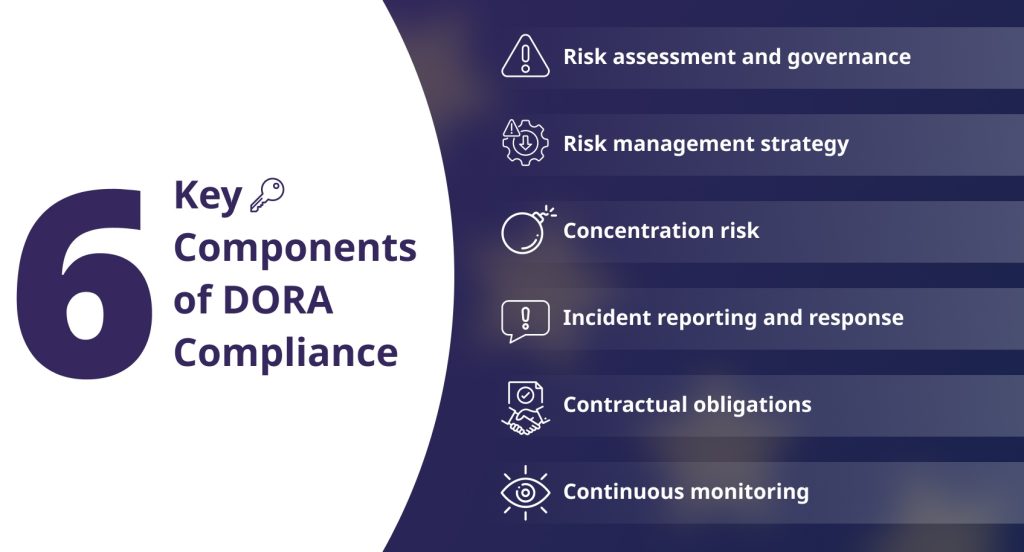
- Building a Solid Risk Management Framework – You need a system to evaluate your vendors’ risks, including operational risks, dependency on just a few providers (what DORA calls “concentration risks”), and systemic risks. DORA’s Proportionality Principle is key here—if a service is highly critical to your operations, your oversight needs to match that importance.
- Due Diligence – Before you sign anything with a vendor, you need to do research on their capabilities. Are they secure? Reliable? Do they follow the rules? Once you have partnered with them, the work doesn’t stop—regular check-ins and monitoring are critical to make sure they are staying on top of their game.
- Locking Down Contracts – Your contracts need to cover all the bases. This includes holding your vendors accountable for managing risks and staying operational during disruptions. You should also be prepared to end relationships with vendors in case they fail to meet regulatory or operational standards.
- Avoiding Over-Reliance on Big Players
DORA emphasises the risks of relying on too many providers. If you’re working with just a handful of big-name providers, you could face significant challenges if one of them fails. The solution? Diversify your vendors and create a strong plan for how to resolve the issues once they occur. - Keeping a Risk Register
You need a detailed list of all your ICT providers, their contracts, the services they offer, and their risk levels. Keep it updated and ready for review, because regulators will want to see it. - Testing Resilience
How would your vendor handle a big cyberattack or an unexpected outage? You don’t have to guess—DORA requires you to test these scenarios through stress tests and simulations. - Watching the Sub-Outsourcing Game
If your vendor is outsourcing parts of their services to someone else, you must make sure those subcontractors follow the same due diligence and monitoring standards. This is essential for covering your bases.
Why does Managing Third-Party Risks feel Complicated
Managing vendors isn’t a one-and-done deal. You’ve got to keep an eye on them continuously, run regular risk assessments, and make sure all your compliance paperwork is in order.
On top of that, you need to prepare for worst-case scenarios—like cyberattacks or service outages—and have solid contingency plans in place.
Tools like AI can optimise and streamline the entire process. Automating parts of the risk assessment process can make things way easier by giving you real-time updates, consistent evaluations, and a whole lot less manual work.
How are Companies Approaching Third-Party Risk Management
Managing third-party risks is a significant challenge for most organisations, with 80% of respondents in a recent poll admitting they struggle in this area.
This is no surprise, given the increasing regulatory expectations and the complexities involved in vendor compliance, real-time visibility, and evaluating vendor resilience.
Here’s what makes it so tricky:
1. It takes forever
Getting vendors to fill out security questionnaires can be quite time-consuming, especially when using lengthy spreadsheets with no version control. Automating this with faster tools isn’t just nice—it’s essential to keep up.
2. Not digging deep enough
A lot of companies do not need to monitor vendors, including low-risk ones. But the reality is that every vendor matters. Automated tools can help you keep an eye on all your vendors without making it a full-time job.
3. You can’t see the full picture
Traditional methods like penetration testing or on-site visits only give you a snapshot of a vendor’s security. Plus, they’re expensive and time-consuming. Adding tools like security ratings gives you up-to-date, objective insights that keep you in the loop 24/7.
4. Inconsistent Monitoring
While critical vendors need extra scrutiny, a standardised assessment for all vendors will help you make sure no risks are overlooked.
5. Missing the Bigger Picture
Not all vendors are created equal. A company handling sensitive customer data is a much bigger risk than one managing your blog posts. Labeling vendors based on risk levels helps you focus your time and resources where it matters most.
6. Keeping Track of Everything is Hard
When you’re dealing with hundreds (or thousands) of vendors, it’s easy to lose track. Who’s completed their questionnaires? Who hasn’t? A centralised system that will help you track questionnaire progress, vendor engagement, and compliance status in a consistent manner.
7. Getting Vendors to Care
Let’s be honest—vendors aren’t always in a hurry to answer your questions. Long email threads and scattered tools don’t help either. Managing everything in one place can streamline communication and get things moving faster.
How to Streamline Third-Party Risk Assessments with AI Automation
Let’s face it, managing third-party risks can feel overwhelming. Sifting through mountains of vendor data, ensuring compliance, and identifying risks manually is time-consuming and prone to human error. But what if there was a way to make the process faster, more consistent, and way less stressful? Enters AI automation.
Imagine having a tool that analyses vendor data, spots potential risks, and provides insights—all in real time. By automating these tasks, AI frees you up to focus on higher-level decision-making, like shaping strategies to strengthen vendor relationships or responding to pressing security concerns.
In fact, during a recent poll at our DORA webinar, 37% of respondents said that automating risk assessments is the top way AI can help achieve compliance with the Digital Operational Resilience Act (DORA).
3 Key benefits of AI Automation of a Third-Party Risk Assessment
According to the recent webinar poll results, 37% of respondents prioritise automating risk assessments, 25% focus on enhancing security monitoring, 12% aim to reduce manual tasks, and another 25% are unsure how AI fits into their strategy.

From Reactive to Proactive Risk Management
One of the most valuable aspects of AI in risk management is its ability to turn a traditionally reactive process into a proactive one. With AI tools in place, you’re not just addressing risks as they arise—you’re anticipating them before they become problems.
And that’s the kind of forward-thinking approach that can make all the difference in protecting your business.
4 Best Practices for Third-Party Vendor Risk Management
Whether it’s navigating ever-evolving regulations or ensuring operational resilience, a strong third-party risk management (TPRM) strategy is essential. Here are some of the best practices to keep your organisation ahead of the curve.
1. Develop Robust Contracts with Clear Compliance Obligations
Contracts aren’t just legal documents—they’re the backbone of a strong vendor relationship. Clearly define compliance requirements, security standards, and accountability measures.
38% of our webinar respondents emphasised the importance of contracts in ensuring vendors meet their obligations. Don’t forget to include clauses that address termination rights and contingency plans for non-compliance.
2. Implement Continuous Risk Monitoring
Risk management isn’t a one-and-done task. Vendor performance and security postures can change over time, so it’s critical to have systems in place for continuous monitoring. These systems can help you detect vulnerabilities, assess resilience, and ensure your vendors remain compliant with regulatory and organisational standards.
3. Leverage AI for Dynamic Risk Assessments
AI is transforming the way businesses approach TPRM. Dynamic risk assessment tools powered by AI can adapt to evolving vendor relationships, market conditions, and emerging threats. These tools not only provide real-time insights but also reduce the burden on your team by automating repetitive tasks. By staying agile, you can address risks as they arise rather than reacting to them after the fact.
4. Build Strong Vendor Partnerships
Strong partnerships go beyond transactions—they’re built on mutual trust and shared goals. Work with your vendors to prioritise compliance, operational resilience, and security. Open communication channels and collaborative problem-solving can help align your
Elevate Your Risk Management Game for Seamless DORA Compliance with Deployflow
Managing third-party risks is at the heart of DORA compliance, but let’s be honest—it’s no easy task. The good news? AI can transform how you approach it. Imagine automating risk assessments, streamlining vendor management, and gaining real-time insights while reducing manual processes’ stress.
With AI, you can tackle compliance challenges head-on, ensuring your organisation stays resilient and ahead of the curve. Ready to see how automation can simplify your third-party risk management and supercharge your DORA compliance efforts? Watch the webinar How will EU DORA affect UK Fintech in 2025 to learn more about how to automate risk assessments and streamline vendor management for better DORA compliance.
Reach out to our team of experts to learn how we can help you navigate your third-party risk assessment.
Explore our BLOG
Recent articles

Is Claude Down? Anthropic Outage: Protect Your Cloud Infrastructure
Claude.ai has spent 2026 fighting its own success. Twenty-one incidents landed between 12 August and...
read full article

AI Experimentation vs AI Engineering: The Difference That Decides Whether Your AI Budget Survives
Experimentation buys you knowledge. Engineering buys you a system that still works next quarter, when...
read full article

Why Most Agentic AI Projects Fail Before They Scale
Has your agent been three months from production for nine months? Agentic projects break at...
read full article