


Following OpenAI’s deep integration with the US military apparatus (now rebranded as the Department of War) and a subsequent 295% surge in uninstalls (source: TechCrunch), UK technical leaders are facing a stark reality: your AI infrastructure is now a proxy for your corporate values and data sovereignty.
TL;DR: The 2026 AI Infrastructure Pivot
- The Tipping Point: OpenAI’s deal with the US Department of War triggered a trust exodus, resulting in a record-high uninstall rate.
- The Claude Surge: Anthropic’s refusal to support autonomous weaponry or mass surveillance has made Claude the number 1 choice for UK enterprise compliance.
- Infrastructure Risk: Relying on a single, military-linked AI provider creates vendor monoculture and significant geopolitical risk.
- The Solution: Transitioning to Claude via a sovereign, multi-model framework ensures data residency and adherence to the UK’s 2026 Cyber Security and Resilience Bill.
This guide provides a technical roadmap for exporting institutional memory from OpenAI and reclaiming data sovereignty within UK-compliant infrastructure.
You will learn how to leverage Claude’s 2026 architectural advantages to lower the total cost of ownership while insulating your intelligence from foreign defence mandates.
The solution can’t be just switching tools, but building a governed cloud infrastructure where AI remains portable, compliant, and under your control.
The Geopolitical Shift: Why UK Tech Leaders Are Reassessing OpenAI Risk
The mass uninstall of ChatGPT in early 2026 was the first major geopolitical churn event in the history of generative AI. For UK-based CTOs and founders, the data from March 2nd serves as a stark warning: on the Saturday following OpenAI’s partnership with the rebranded US Department of War, uninstalls surged by 295% while 1-star reviews grew by 775%.
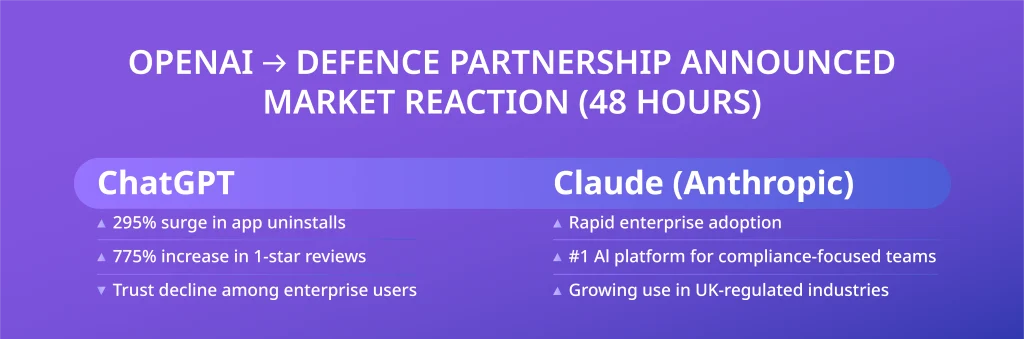
This represents a fundamental break in the default status of ChatGPT within the British enterprise ecosystem.
While OpenAI leaned into defence contracts, Anthropic (the company behind Claude.ai) took a public stand against allowing its AI to be used for mass domestic surveillance or fully autonomous weaponry.
This refusal led to the US government designating Anthropic a supply-chain threat, a move that ironically bolstered Claude’s reputation among UK firms seeking to align with the UK’s own 2026 Cyber Security and Resilience Bill.
For a UK Head of IT, the risk is structural. Staying with a provider whose roadmap is now dictated by foreign military mandates introduces three critical liabilities:
- Priority Realignment: Feature requests for enterprise productivity now sit behind defence-sector requirements in the OpenAI development queue.
- Compliance Friction: The UK AI Safety Institute’s 2026 guidelines emphasise neutrality and safety, areas where Claude’s constitutional AI approach has a native advantage over models integrated into military infrastructure.
- Data Sovereignty: The risk of corporate IP being caught in the crossfire of US federal agency bans or defence-related data harvesting protocols.
The “Great Migration” of 2026 is about selecting a partner that respects the boundaries of sovereign enterprise data. UK leaders are realising that in a fractured geopolitical landscape, AI infrastructure neutrality is the ultimate insurance policy.
Assessing the Infrastructure Risk: The AI Supply-Chain Problem
AI providers today are part of your infrastructure supply chain. When governments classify AI companies as strategic assets or potential risks, enterprise users inherit that volatility.
Recent pressure around major AI vendors illustrates the problem clearly. If a provider becomes entangled in geopolitical disputes, defence programmes, or regulatory intervention, your organisation’s workflows may be affected overnight.
Claude’s architecture has attracted attention partly because of its Constitutional AI approach, where safety and behavioural constraints are embedded into training rather than applied as external filters. For governance-focused organisations, that design can make model behaviour easier to predict and audit.
Infrastructure resilience also means preparing for model outages, as recent incidents affecting Claude’s infrastructure have shown.
For CTOs and IT Heads, the real question is exposure: how dependent is your organisation on decisions made by a single AI vendor?
The Risks of Staying with a Single AI Provider
- Vendor lock-in: AI workflows slowly become tailored to a specific model’s behaviour, making migration difficult.
- Data sovereignty exposure: Enterprise data may pass through infrastructure governed by foreign regulatory frameworks.
- Regulatory friction: Dependence on opaque external models can complicate UK and EU AI compliance requirements.
AI infrastructure should be designed the same way modern cloud architecture is designed: portable, abstracted, and never dependent on a single provider.
Strategic Migration: Transferring Your Digital Memory
Losing accumulated AI knowledge is the biggest reason organisations hesitate to switch providers. Over the past two years, your teams have likely built a large set of prompts, instructions, and workflow patterns inside ChatGPT. That operational knowledge is what many teams call digital memory.
The good news is that this knowledge is portable if you treat it as structured data rather than chat history.
AI tools are no longer experimental infrastructure. According to McKinsey’s global State of AI survey, 65% of organisations now regularly use generative AI in at least one business function.
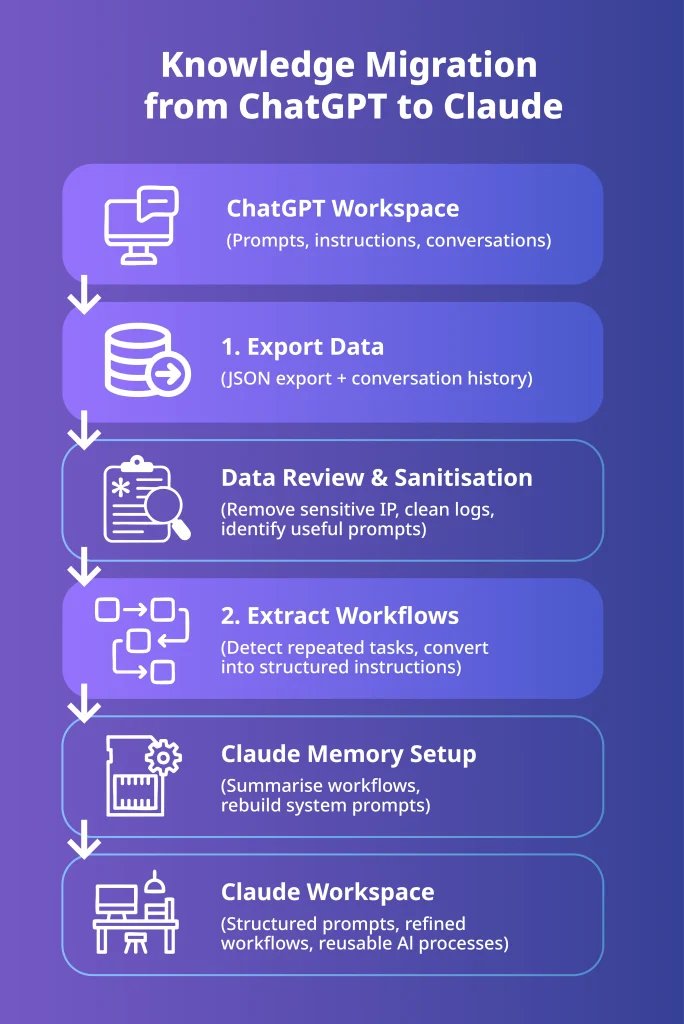
Step 1: Export the Core
Start by exporting the full dataset from ChatGPT using the Export Data feature.
This produces a downloadable archive containing conversation history and JSON records that represent your accumulated prompt interactions.
These exports are valuable because they reveal patterns: documentation prompts, engineering queries, research workflows, and internal templates.
Step 2: Scrub the Source
Before closing the account, review stored memory entries inside Manage Memory and remove any sensitive intellectual property.
This step reduces the risk of proprietary workflows remaining associated with the previous provider’s long-term training ecosystem.
Step 3: Structured Claude Ingestion
Do not paste raw chat logs into Claude.
Instead, use the export strategically. Ask Claude to analyse the dataset and reconstruct your working patterns.
Example instruction: “Analyse this export of my previous AI usage and summarise the 10 core workflows I rely on for engineering, research, and documentation.”
This transforms unstructured chat history into structured operational prompts.
Why Manual Migration Works Better
Treating the transition as a curation process rather than a copy-paste exercise improves the quality of your AI workflows.
Teams often discover redundant prompts, unclear instructions, or duplicated processes during the migration. Cleaning these up produces a more efficient Claude environment than the one they started with.
What you get is an opportunity to rebuild AI workflows with clearer structure, stronger governance, and better long-term maintainability.
Evaluating Claude as an Enterprise AI Platform
Claude 3.7 and 4.0 have gained attention among UK organisations because of their architectural focus on safety, large context handling, and flexible deployment through platforms such as AWS Bedrock.
But adopting any AI model as part of enterprise infrastructure involves trade-offs. The question for CTOs is not simply whether Claude is powerful, but whether it fits the organisation’s governance, cost, and operational requirements.
Claude for Enterprise AI: Advantages vs Trade-offs
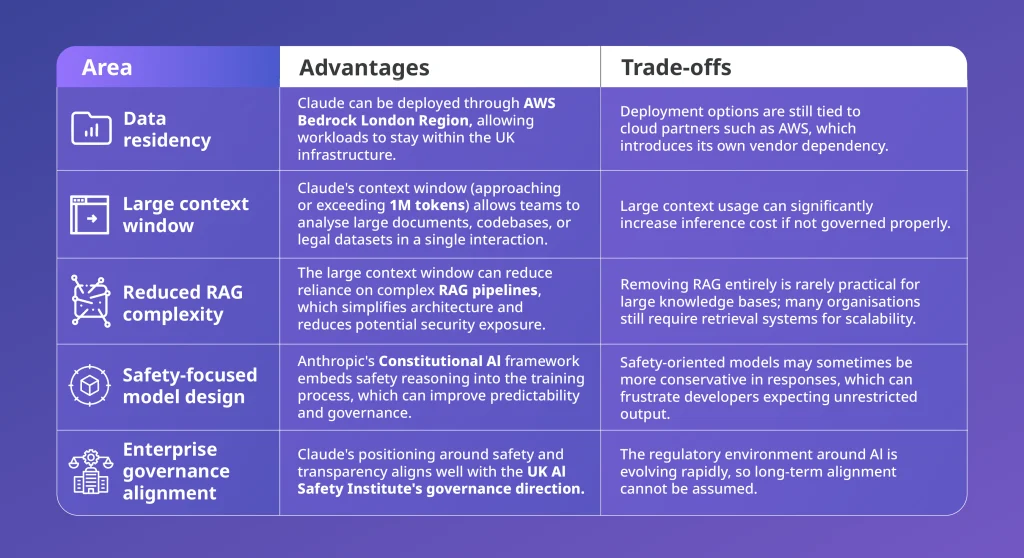
Claude vs ChatGPT for Enterprise Infrastructure Strategy
Claude may offer advantages for organisations prioritising governance, large-context reasoning, and safety-oriented design. But replacing one AI provider with another does not eliminate infrastructure risk.
If your architecture depends entirely on Claude tomorrow, you have simply recreated the same vendor concentration problem that exists today.
The more resilient approach is to treat Claude as one component in a multi-model AI architecture, alongside other LLMs and specialised models.
The goal is not to replace one dependency with another. The goal is to ensure your AI infrastructure survives whichever provider becomes unstable next.
Deployflow helps organisations design secure cloud and DevOps infrastructure where AI systems can be integrated safely and governed properly.
Experienced teams support cloud migration, AI adoption strategies, and DevSecOps practices that allow companies to deploy generative AI tools without losing visibility into security, cost, or compliance.
Building a Resilient AI Stack with Deployflow
Switching models is not the only solution to AI risk. Infrastructure design is more important. If your organisation simply replaces one provider with another, the dependency problem remains unchanged.
Deployflow works with CTOs and IT leaders in the UK and worldwide to integrate AI into secure, governed cloud infrastructure, ensuring that generative AI tools operate within a controlled DevOps environment rather than as isolated tools scattered across teams.
The focus is not only on GenAI adoption but on building infrastructure that can safely support AI workloads at scale.
AI Infrastructure Must Come First
AI systems should run on the same disciplined infrastructure that supports your applications, cloud workloads, and CI/CD pipelines.
Deployflow helps organisations design that foundation through cloud architecture, DevOps automation, and security governance.
This includes:
✔️Cloud-integrated AI deployment: AI models can be deployed through controlled infrastructure environments such as AWS, ensuring proper monitoring, access control, and data governance.
✔️Infrastructure abstraction: Applications should not be tightly coupled to a single AI provider. Deployflow helps teams design infrastructure where AI services can evolve without forcing major changes in the underlying application architecture.
✔️DevOps-driven AI operations: CI/CD pipelines, monitoring systems, and infrastructure-as-code practices are extended to cover AI systems, allowing organisations to maintain visibility over cost, performance, and reliability.
✔️Security and governance controls: AI workloads are deployed within environments that support logging, auditing, and compliance monitoring aligned with UK regulatory expectations.
✔️AI usage audits: Many organisations already have AI tools embedded across developer workflows, internal tools, and productivity platforms. Deployflow helps identify these hidden dependencies and brings them under proper infrastructure governance.
Key Lessons from the ChatGPT-Claude Shift
AI vendor decisions are no longer simple tooling choices. Governance models, regulatory alignment, and geopolitical exposure now directly affect how AI can be deployed inside enterprise infrastructure.
The organisations that benefit most from generative AI will not be the ones choosing the “right” model today, but the ones building infrastructure that remains stable as providers, policies, and technologies evolve.
What This Means for Your AI Strategy
- AI vendors are infrastructure dependencies. Treat them the same way you treat cloud providers or identity platforms.
- Single-model reliance creates risk. Vendor lock-in makes future migration expensive and operationally disruptive.
- AI knowledge is portable. Prompts, workflows, and institutional usage patterns can be exported and rebuilt.
- Claude may improve governance alignment. But switching tools alone does not solve infrastructure risk.
- Resilient AI architecture is model-agnostic. Infrastructure should allow organisations to change providers without disrupting operations.
If your organisation is assessing the risks of AI vendor lock-in or planning a more resilient AI architecture, the next step is to evaluate your AI infrastructure with Deployflow and see how these systems should integrate with your cloud and DevOps environment.
Frequently Asked Questions: Switching from ChatGPT to Claude for Enterprise AI
Should enterprises switch from ChatGPT to Claude?
Not necessarily. The real goal is to reduce dependency on any single AI provider.
Switching from ChatGPT to Claude can improve governance alignment or technical capabilities depending on the use case, but it does not eliminate infrastructure risk on its own. Organisations that simply replace one model with another recreate the same vendor dependency problem. The more resilient approach is to design an AI infrastructure where models can be changed without disrupting workflows. This usually involves deploying AI through controlled cloud environments and abstracting model access through infrastructure layers.
Is Claude better than ChatGPT for enterprise use?
Claude can be advantageous for certain enterprise workloads, particularly those involving large documents or compliance-sensitive environments.
Its large context window allows teams to process extensive documentation, codebases, or legal materials in a single interaction. Anthropic’s Constitutional AI design also appeals to organisations prioritising governance and predictable model behaviour.
However, ChatGPT still offers strong capabilities, extensive integrations, and a large ecosystem of tools. The better choice depends on the organisation’s infrastructure, compliance requirements, and operational workflows.
Can companies migrate their ChatGPT prompts and workflows to Claude?
Yes, most institutional AI workflows can be migrated with the right approach.
ChatGPT allows users to export conversation history and associated JSON records, which contain valuable prompt patterns and operational knowledge. Instead of copying conversations directly, organisations should extract repeatable workflows and convert them into structured prompts for the new system. This process often improves prompt quality and removes redundant instructions. With careful migration, teams can preserve their institutional knowledge while improving how AI supports their operations.
How can organisations avoid AI vendor lock-in?
The most effective solution is designing a model-agnostic AI infrastructure.
Instead of integrating applications directly with a single AI API, organisations can deploy models through controlled cloud environments such as AWS or similar platforms. This approach allows teams to change providers without rewriting large portions of their application stack. Governance controls, logging, and DevOps automation can then monitor AI usage across the environment. Treating AI models as interchangeable infrastructure components reduces long-term operational risk.
Explore our BLOG
Recent articles
ISO 42001 Explained: Requirements, Certification and What Your Engineering Team Must Build
ISO 42001 is the international standard that demonstrates your organisation governs AI properly, and enterprise...
read full article

Is Claude Down? Anthropic Outage: Protect Your Cloud Infrastructure
Claude went down across every surface on 29 September 2026. From 14:00 to 14:59 UTC,...
read full article

Top 10 Healthtech Companies in 2026: What Their Growth Means for AI and DevOps
Every software change that reaches a hospital has to clear regulatory, legacy system, and clinical...
read full article