


SSO only controls entry, not exposure. Treating it as access control leaves your GDPR compliance dependent on luck rather than enforceable rules.
Without a real access control system behind it, your customer login system becomes a soft target: easy to use, hard to defend, and difficult to explain when scrutiny arrives.
TL;DR: Where Cloud Security Actually Starts
Problem: SSO only controls entry, so permissions sprawl inside application code.
Risk: This weakens cloud security and makes GDPR and audit answers hard to prove.
Solution: Add policy-driven access control (CIAM) behind login as a central decision layer.
Outcome: Cloud access becomes enforceable, explainable, and defensible across your platform.
What Auditors Will Ask About Your Login
For UK organisations, the distance between a successful login and an unauthorised data export is measured by how well you can satisfy an ICO auditor. If your permissions are buried in application code instead of a centralised policy engine, you are facing a regulatory liability.
If single login is used as access control, security becomes guesswork. Access grows without rules, and no one can clearly justify who has access to what.
This article does three things:
- Clarifies the difference between a single login and an access control system
- Shows what breaks when they are treated as the same thing
- Explains how to fix it with customer identity management
If your login works but your access rules are hard to explain, the risk is already live. This guide is about fixing it before the question comes from an auditor instead of your own team.

Treating a single login as security is a structural mistake. SSO only proves identity. It does not enforce business rules, limit data exposure, or explain why access was granted.
Without a separate access control layer, every application ends up making its own decisions, often in slightly different ways.
That is how customer login systems become shallow. They stop at authentication and never mature into proper access management. Users can log in, but the system cannot consistently answer who should see what, or why.
Over time, access spreads, exceptions pile up, and control becomes something the platform assumes rather than something it can demonstrate.
The Hidden Risks of Treating Single Login as Security
When access is tied only to a successful login, control becomes shallow.
- Everyone inside looks similar to the system
- Permissions spread instead of being enforced
- Rules sit inside application logic and not in one place
- Changes require code and not policy
- Access decisions cannot be clearly traced
- A single compromised account moves across the platform easily
Login security gives a false sense of safety. The system proves identity, but it doesn’t actively limit behaviour. It can confirm who signed in, but it cannot consistently explain why something was allowed.
From a CTO perspective, that creates a dangerous gap:
The platform can authenticate users, but it cannot confidently justify access.
What a Real Access Control System Does
A real access control system is not a screen or a button. It is a decision layer that sits behind the platform and consistently controls behaviour.
It works through access management:
- Role-based access: permissions follow roles such as member, editor, partner, or admin
- Attribute-based access: decisions use context like location, subscription level, or account status
- Policy-driven decisions: access is granted or denied by defined rules, not scattered conditions
- Centralised enforcement: one place decides, every application follows
- Decoupled from apps: systems ask for a decision instead of inventing their own
Access control is not a UI feature but a decision engine that makes security predictable instead of implied.
CIAM: The Missing Layer Between Growth and Chaos
Customer identity behaves differently from internal staff identity. It changes more often, carries privacy obligations, and must work across public websites and platforms. That difference is the reason customer identity and access management (CIAM) exists.

This is the layer that keeps growth from turning into chaos. It is what allows a platform to manage users consistently instead of app by app.
Single Login Without Access Control: What Breaks in Real Life
When a customer login system relies only on a single login, it works while the platform is simple. As soon as it grows, gaps appear in places that look unrelated to login but depend on it.
- On multi-site platforms, one sign-in leads to several products or services. Without control behind the login, each system decides access on its own. Rules drift, and fixing them means touching multiple systems instead of one.
- In portals and CMS setups, content should follow clear rules: public, member-only, paid, internal. Single login confirms identity, but it cannot enforce those rules by itself. Exposure depends on templates and custom logic rather than policy.
- With partners and customers, separation matters. They often share an entry point but should not share the same access. Without a control layer, boundaries weaken as new features appear.
- For location-based content, the login does not know where a user should be allowed to operate. Regulation and service coverage require rules and not just identity.
- For subscription tiers, entitlement becomes the issue. Login proves who the user is, not what they paid for. Features and data need decisions tied to plans and status.
Across all of these cases, SSO alone cannot enforce:
- Business rules
- Entitlements
- Segmentation
At that point, login security stops helping. The user is authenticated, but access is no longer controlled.
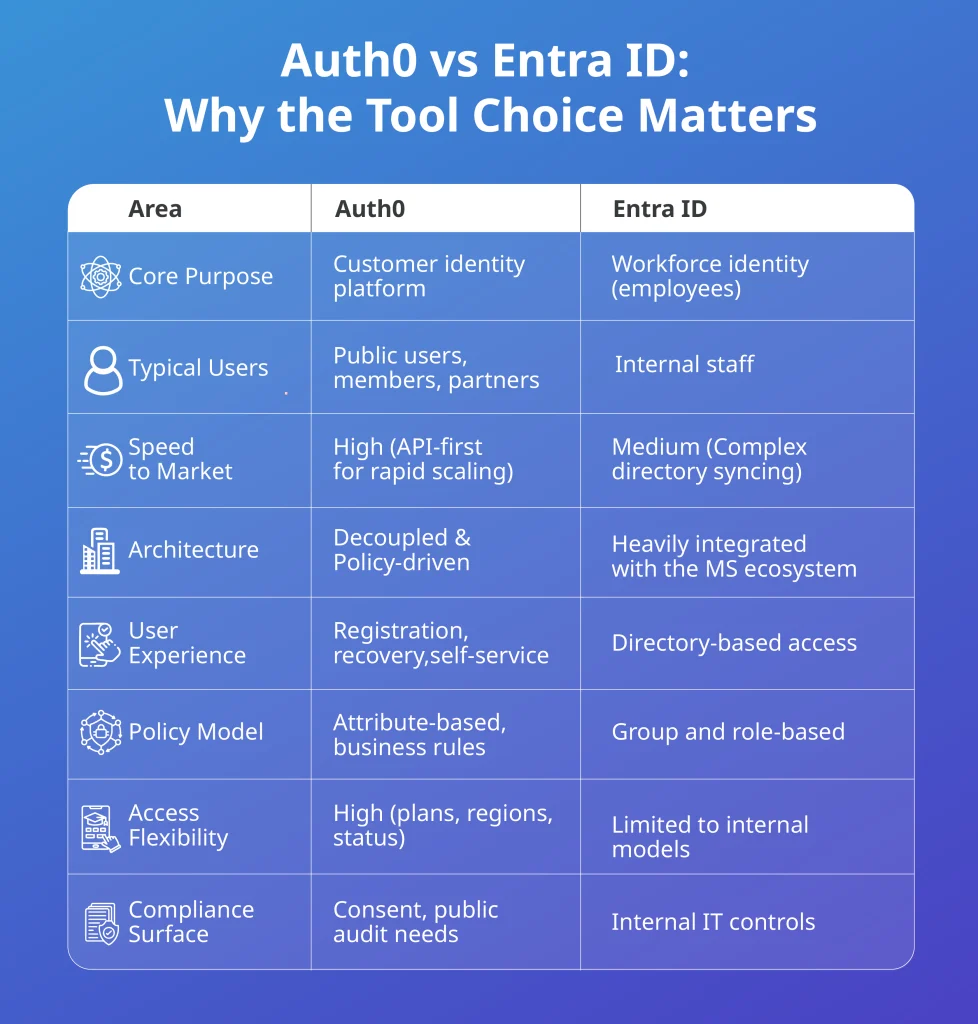
Auth0 vs Entra ID: Why the Tool Choice Matters
Auth0 vs Entra ID is a control decision. Your SSO provider determines how much authority your platform can actually enforce.
Entra ID is designed for employees.
Auth0 is designed for customers.
That difference shapes user experience, policy design, and compliance handling.
What Good Looks Like: Secure Single Login with Proper Access Control
Here is what good looks like when a secure login is backed by a real access control system and supported by customer identity management.
- There is one login for the entire platform. Users authenticate once, and that identity follows them across every site, service, and feature.
- Behind that login sits a central identity store. User data, status, and attributes live in one place instead of being duplicated across systems.
- Access is decided through policy-based rules and not application code. Features and data are granted based on clear conditions such as role, location, or subscription status.
- Those decisions are enforced across the platform. Each application asks the access control system for permission instead of making its own assumptions.
- Application logic stays minimal. Apps focus on their function, not on deciding who should be allowed to use them.
The improvement is built into the system:
Security improves because access is actively controlled
Architecture simplifies because rules live in one place
Compliance risk drops because decisions can be explained
Why UK Organisations Should Treat Login as a Governance Issue
In the UK, login sits inside the regulatory perimeter.
Under GDPR, enforced by the Information Commissioner’s Office (ICO), access to personal data must follow principles of data minimisation and purpose limitation. That means a platform must be able to show who can access data and why. A weak or implicit login model makes it hard to demonstrate.
The DORA regulatory technical standards specifically require logical access control and identity management as part of security and operational resilience obligations. (source: European Commission)
For regulated sectors, the bar is higher. The Financial Conduct Authority (FCA) expects firms to control and evidence access to systems that influence customer outcomes.
In health and public services, expectations from bodies aligned with NHS Digital and government audit frameworks focus on traceability and accountability.
In all cases, auditors look for consistent rules, not ad-hoc logic buried in applications.
In the UK, access control is how organisations demonstrate they control data. With proper customer identity and access management, access decisions can be tied to defined policies, logged, and explained after the fact.
If a system cannot demonstrate how access is controlled, it cannot demonstrate compliance.
CTO Checklist: Do You Have a Login or Access Control System?
Use this to test whether you have real access management or just login security:
- Can access rules be defined in one place?
- Can you clearly explain who can see what, and why?
- Can you audit access decisions, not just login events?
- Can policies be changed without touching application code?
If the answer to any of these is “NO”, you do not have access control.
You have SSO, and a login screen is not a control system.
How to Fix the Gap Without Rebuilding Everything
When someone asks, “Why can this user see this?”, the system should be able to answer.
Deployflow builds access so that the answer exists. Permissions are no longer hidden inside services and templates. They are defined once, as rules, and every part of the platform obeys them. A page, an API, and a feature all get the same decision from the same place.
A UK health platform, Little Journey, faced security and compliance risk as its cloud environments scaled. Deployflow implemented centralised security controls and full data segregation using policy-driven infrastructure, enabling compliant environments to be created in hours instead of days while meeting medical regulatory requirements.
“Their strategic approach has greatly enhanced our platform’s security, consistency, and overall efficiency, allowing us to better serve our users with a robust and user-friendly solution.”
Azim Palmer
CTO at Little Journey
Deployflow’s Cloud Security practice treats access control as part of system security, alongside networks and data. Identity is centralised, rules are enforced centrally, and applications stop carrying their own versions of the truth.
For CTOs, this simplifies day-to-day control:
✔️ Access can be explained without reading code
✔️ Changes happen in policy, not in deployments
✔️ New systems inherit the same controls
✔️ Login no longer masks risk
This is how customer identity management becomes something the platform can defend.
Make Access Defensible
Single login makes entry easier, but access control defines what happens after entry.
Confusing the two turns convenience into risk. Identity alone cannot explain permissions, enforce boundaries, or satisfy governance questions. Control only exists when access decisions are explicit, consistent, and defensible.
If your single login can’t explain who is allowed to see what, it isn’t an access control system but just a doorbell.
If this sounds uncomfortably close to your current setup, it’s worth reviewing how access decisions are actually being made across your platform.
Is your login a doorbell or a defence? CTOs realise the gap only during a security audit.
Deployflow helps CTOs bridge this gap by transitioning from hard-coded permissions to centralised, policy-driven access control.
Secure your architecture before the next audit. Contact Deployflow’s cloud security team to discuss how to decouple your identity logic from your code and build a defensible, scalable access model.
Frequently Asked Questions About Single Login and Access Control Systems
Is single sign-on (SSO) enough to meet GDPR and UK compliance requirements?
No, single sign-on alone is not enough to meet GDPR or UK regulatory expectations.
SSO only proves who the user is, not whether they should see specific data or features. Regulators care about purpose limitation and data minimisation, which require clear access rules, not just authentication. If access decisions live inside application code, they are difficult to audit and explain. Compliance depends on being able to show why access was allowed, not just that a login succeeded.
Can access control be added without rebuilding the entire platform?
Yes, access control can be added without rebuilding the whole platform.
Modern access systems work as a separate policy layer that applications query for decisions. This allows existing services to keep their logic while delegating permissions to one central place. Rules can then be changed without redeploying multiple applications. The result is consistent enforcement without a full architectural reset.
Why do breaches spread faster when only SSO is used?
Because once an account is compromised, the system has no strong internal limits.
SSO confirms identity but does not actively restrict behaviour across features and data. Without policy-based access rules, a stolen login can move laterally through the platform. Each service trusts the login instead of checking a central decision engine. That turns one mistake into a system-wide exposure instead of a contained incident.
Explore our BLOG
Recent articles

ISO 42001 Explained: Requirements, Certification and What Your Engineering Team Must Build
ISO 42001 is the international standard that demonstrates your organisation governs AI properly, and enterprise...
read full article

Is Claude Down? Anthropic Outage: Protect Your Cloud Infrastructure
Claude went down across every surface on 29 September 2026. From 14:00 to 14:59 UTC,...
read full article

Top 10 Healthtech Companies in 2026: What Their Growth Means for AI and DevOps
Every software change that reaches a hospital has to clear regulatory, legacy system, and clinical...
read full article