


According to Salesforce’s 2024 Connectivity Benchmark Report, 85% of IT leaders expect AI to boost developer productivity, but 62% say their systems aren’t integrated enough to support it.
For healthcare and health tech companies, where patient safety, compliance, and uptime are non-negotiable, the pressure to modernise infrastructure is even greater.
The gap between digital ambition and infrastructure reality is growing fast, and for many businesses, it’s not just about what they build but how they deliver it.
Rebuilding infrastructure from scratch sounds bold. Modernising what you already have feels safer. But both approaches can lead to long, expensive projects that stall halfway. The issue often isn’t the strategy but the delivery model.
Traditional IT projects rely on fixed timelines, long planning cycles, and internal resources that are already stretched thin. That creates bottlenecks, rising costs, and slow progress, especially for teams with limited capacity.
There’s another option worth considering: sprint-based infrastructure delivery. Instead of committing to a six or 12-month overhaul, you move in short, focused sprints designed to deliver real results fast, with less overhead.
In this guide, you’ll learn:
- What does it really mean to rebuild vs modernise
- The trade-offs in cost, speed, and risk
- How does sprint-based delivery compare to traditional methods
- When each approach makes sense based on your tech stack, team, and goals
A clearer direction starts with better choices. Let’s break them down.
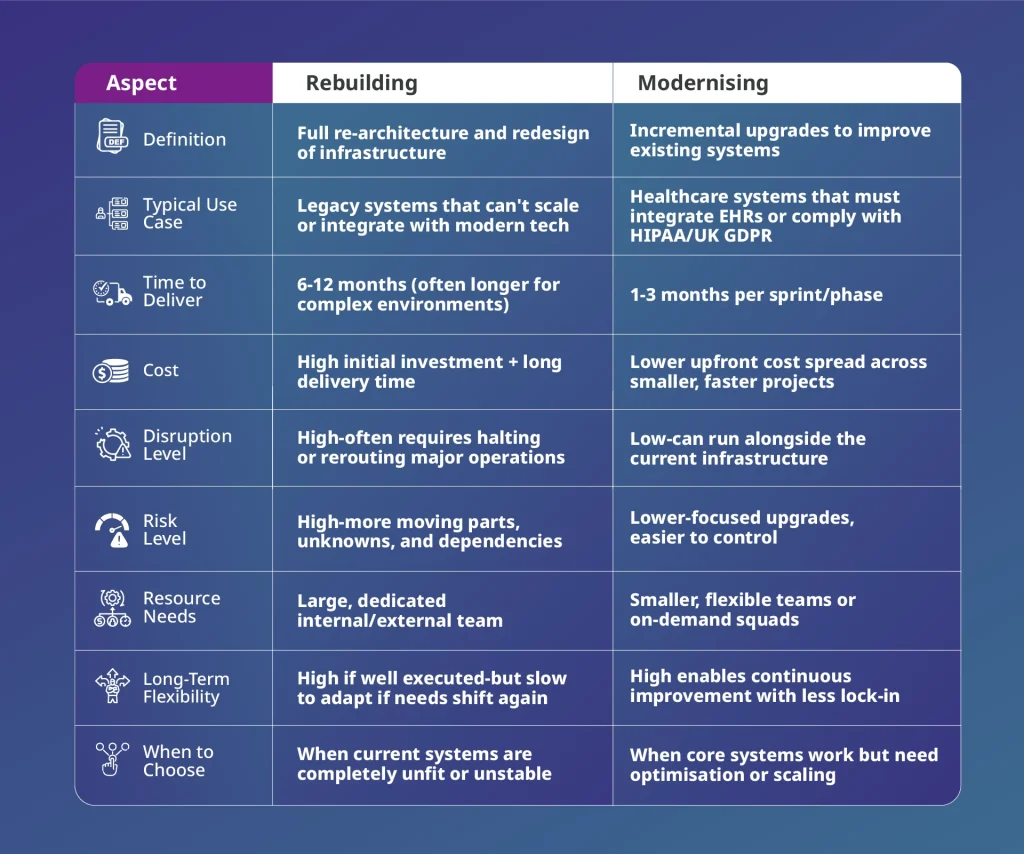
What Does It Mean to Rebuild vs Modernise Your Infrastructure?
Before choosing a delivery method, it’s important to understand the difference between rebuilding and modernising your infrastructure. They may seem similar on the surface, but they solve very different problems and come with very different trade-offs.
Real-World Example: Modernising Infrastructure in Health Tech
For health tech companies, infrastructure decisions carry even more weight, impacting patient care, regulatory compliance, and service scalability.
When Little Journey, a digital health platform supporting pediatric patients and families, faced growing infrastructure demands, they needed a solution that could scale securely and efficiently.
Rather than rebuilding from scratch, they partnered with Deployflow to modernise their infrastructure using a sprint-based approach.
When hardware level upgrades are also part of the equation, teams often turn to electronic design services to handle the physical layer while the sprint model handles the rest.
The goal was clear: create secure, compliant, and scalable environments without disrupting service delivery.
Deployflow’s engineering squad worked closely with Little Journey’s team to define business requirements, automate deployments, and meet vendor security standards. The solution was powered by Terraform and designed to enable the fast, secure creation of personalised cloud environments with robust, centralised controls.
The team:
- Reduced deployment timelines from several days to just two hours
- Automated key infrastructure tasks, cutting manual work by 70%
- Increased infrastructure scalability by 50% to meet rising user demand
- Achieved 100% data segregation and full compliance with medical security standards
- Centralised security controls and replaced inconsistent processes with auditable, policy-driven automation
This wasn’t a ground-up rebuild but a focused effort to scale efficiently while meeting strict compliance requirements. Deployflow’s sprint-based model helped Little Journey modernise with precision, speed, and full alignment with the realities of medical technology.
Learn more about how sprint-based cloud app modernisation can help stabilise and improve your existing systems without starting from scratch.
The Hidden Costs and Delays of Traditional IT Projects
According to Professor Bent Flyvbjerg, the average cost overrun on failed IT projects is a staggering 447%, and many projects exceed this figure.
For small and mid-sized businesses, this is a serious risk to operations, growth, and stability. The root cause is often how these projects are run.
Internal teams usually face three major challenges:
- First, hiring delays and limited bandwidth slow everything down. You might wait weeks or months for the right engineers while existing staff juggle other priorities.
- Second, projects often start with an unclear scope, leading to shifting goals and bloated timelines.
- Third, the waterfall approach forces teams to work in long phases without early feedback, making it hard to adapt and easy to overspend.
These delays and cost traps add up fast, especially when you can’t pivot midstream. That’s why traditional infrastructure projects are so risky and why sprint-based delivery offers a much smarter path forward.
This is also why so many CTOs turn to DevOps as a Service, which gives them flexible, high-performing engineering squads without long-term hiring delays.
Introducing the Sprint-Based Delivery Option: How It Actually Works
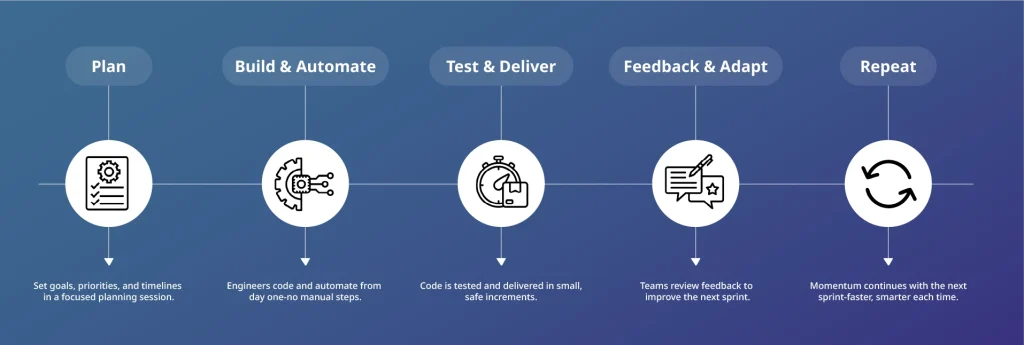
Sprint-based delivery breaks complex IT work into manageable, high-impact cycles called sprints, typically lasting 2 to 4 weeks. Each sprint is a self-contained loop with a clear goal, a fixed budget, and a committed engineering squad.
Instead of drawn-out projects with vague timelines, sprint-based delivery delivers value in sharp, predictable bursts.
Here’s what a single sprint looks like:
Why SMBs Choose Sprint-Based Delivery:

When Should You Rebuild?
Rebuilding an entire system from the ground up is a drastic move, but sometimes, it’s the only viable path forward. Here’s when a full rebuild isn’t just justified; it’s essential.
Red Flags That Signal the Need to Rebuild
- Outdated Architecture: If your infrastructure is monolithic, tightly coupled, or built on obsolete frameworks, modernisation may only patch over deeper structural flaws. Rebuilding allows you to re-architect for scalability, resilience, and modern deployment standards (e.g., microservices, containers, cloud-native designs).
- Security Gaps You Can’t Close: Legacy systems often lack modern encryption standards, identity access controls, or compliance safeguards. If security vulnerabilities are systemic and recurring, no patchwork will be enough. Rebuilding lets you harden security from the ground up. For healthcare organisations, outdated systems might lack proper audit trails or encryption, putting sensitive patient data at risk and increasing exposure to fines.
With rising cyber threats, rebuilding also gives you the chance to re-architect security from day one. See how major breaches, like the recent 16-billion-password leak, are forcing businesses to rethink their infrastructure.
- Unsupported or End-of-Life Technologies: If your platform depends on deprecated languages, discontinued vendor products, or systems with no community or enterprise support, continuing to build on them becomes a liability. A rebuild eliminates reliance on tech that’s no longer future-proof.
Rebuilding requires a significant upfront investment, but it can lead to major long-term savings if your current system causes frequent outages, high maintenance costs, or blocks innovation.
When technical debt, delayed feature delivery, or lost revenue outweighs the cost of a rebuild, postponing the decision only increases risk. It’s the right choice for companies in highly regulated industries, those with deeply outdated systems, or organisations preparing for rapid growth.
In such situations, starting from scratch allows you to build a secure, scalable foundation designed to support future growth.
When Is Modernisation the Best Fit?
Modernising an existing system is often the most effective way to extend its value, especially when the core architecture is still functional but certain components are holding you back. When done right, modernisation doesn’t just improve performance but unlocks agility, scalability, and faster delivery with far less disruption than a full rebuild.
Signs You’re Ready to Modernise
- Solid Core Systems: If your application is stable, well-structured, and aligned with your business goals, there’s no need to reinvent the wheel. Instead, modernisation lets you enhance what works while targeting pain points with precision.
Many electronic health record (EHR) platforms fall into this category, stable enough to retain but in need of better automation or patient engagement features.
- Bottlenecks in Delivery or Performance: If deployments are slow, testing is manual, or environments aren’t scalable, modernisation can introduce smart CI/CD pipelines, automation, and cloud-native infrastructure to fix those exact gaps.
- Gradual Cloud or Container Transition: If you’re migrating to the cloud, containerising workloads, or modularising services, modernisation enables this shift incrementally without disrupting day-to-day operations. This is common in health tech firms adopting FHIR APIs or preparing for NHS Digital’s cloud-first strategies.
Modernisation is more cost-effective than a rebuild when your technical debt is isolated, not structural.
It allows you to evolve your systems piece by piece, replacing outdated layers with modern ones while keeping mission-critical logic intact.
It’s the better choice for organisations that want to:
- Increase delivery speed without sacrificing system stability
- Adopt DevOps practices and automation without a full rebuild
- Gradually modernise legacy components while preserving core functionality
- Migrate to the cloud or containers in controlled, low-risk phases
- Reduce technical debt incrementally while maintaining business continuity
In these cases, modernisation delivers the best of both worlds: a more agile, cloud-ready system built on the reliable foundations you already trust.
Rebuild vs Modernise vs Sprint Approach: Side-by-Side Comparison

Where Sprint-Based Infrastructure Makes the Biggest Impact
According to the UK government’s Cyber Security Breaches Survey 2024, 47% of medium-sized businesses reported significant delays in delivering digital projects due to skills shortages and infrastructure limitations. This gap in internal capacity is particularly acute in health tech, where development teams often juggle innovation with strict compliance demands.
This gap in internal capacity is where sprint-based infrastructure offers a measurable advantage.
Sprint-based delivery is ideal for businesses that need to move fast without the burden of long hiring cycles or complex rebuilds.
Whether you’re launching a Minimum Viable Product (MVP), scaling workloads in the cloud, or adopting DevOps for the first time, this approach delivers focused execution, predictable costs, and immediate outcomes.
It’s especially effective for fast-growing UK SMBs that don’t have the time or resources to build full in-house teams. Each sprint acts as a self-contained unit of progress, backed by a ready-to-deploy squad with proven expertise in automation, security, and modern DevOps tooling.
Each sprint helps deliver real value, whether that’s a faster lab results module, an improved patient intake system, or secure backend upgrades to meet evolving standards.
Making the Right Choice for Your Business
Choosing between rebuilding, modernising, or adopting sprint-based delivery depends on your current tech landscape, business goals, and internal capacity. Here’s a quick recap to guide your decision:
Key Takeaways: Rebuild or Modernise?
- Rebuild when your system is outdated, insecure, or based on unsupported tech—start fresh for long-term scalability.
- Modernise when your core infrastructure is solid but needs targeted upgrades—keep what works and improve the rest.
- Sprint-based delivery when you need fast, flexible progress without the delays of hiring or full-scale transformation—ideal for MVPs, DevOps rollouts, and cloud adoption.
For a deeper look at how to plan and execute your first high-impact sprint, read Deployflow’s DevOps whitepaper for proven strategies and practical steps.
Questions to Ask Internally Before Sprint-Based Infrastructure Modernisation
- Is our current architecture limiting delivery speed or scalability?
- Do we have the internal skills and capacity to manage major infrastructure changes?
- Are we facing regulatory or security pressures that require urgent updates?
- How quickly do we need results, and what can’t we wait for?
- Would short, high-impact sprints help us move forward without disruption?
If you’re relying heavily on a single engineer to run DevOps, you’re not alone, but it’s a hidden risk. This guide explains why delegating infrastructure to one person could stall your growth.
Are you curious whether a focused infrastructure sprint could work for your team? Reach out and find out.
Frequently Asked Questions: Infrastructure Modernisation, Rebuilding, and More
What does infrastructure modernisation mean?
Infrastructure modernisation refers to upgrading and optimising existing IT systems without replacing them entirely. It typically involves improving performance, scalability, and security by integrating modern technologies such as cloud computing, containerisation, DevOps automation, and continuous delivery pipelines. Rather than starting from scratch, you evolve your current environment incrementally, keeping core functionality intact while replacing outdated components that slow you down.
What does rebuilding infrastructure mean?
Rebuilding infrastructure means discarding your existing systems and designing new architecture from the ground up. This is a full re-architecture, often involving new technologies, frameworks, deployment models, and security practices. It’s typically chosen when legacy systems are no longer maintainable, cannot scale, or pose serious security and compliance risks. While it demands more time and resources upfront, rebuilding enables businesses to eliminate technical debt and create a future-ready foundation.
What is an infrastructure update?
An infrastructure update is a smaller-scale change (such as patching software, updating hardware, or upgrading a specific service) meant to improve stability, security, or performance. Unlike full-scale modernisation or rebuilding, updates are reactive and operational in nature. They address short-term needs but rarely resolve underlying architectural or strategic challenges.
What’s the difference between rebuilding and reconstruction?
In IT, “rebuilding” and “reconstruction” are often used interchangeably, but there’s a subtle difference. Rebuilding usually implies a total redesign using new technologies and paradigms (e.g., cloud-native architecture). Reconstruction may involve recreating an older system’s structure in a newer environment without fundamentally changing how it works. Rebuilding is transformative; reconstruction tends to be restorative.
What is infrastructure transformation?
Infrastructure transformation is a broad term that covers both rebuilding and modernisation strategies. It refers to the comprehensive evolution of an organisation’s IT infrastructure to align with modern business needs, technology standards, and operational goals. Transformation includes changes in infrastructure design, deployment, security, automation, and scalability. It’s often part of a larger digital transformation initiative focused on speed, agility, and resilience.
How does infrastructure modernisation apply to health tech?
In health tech, modernising infrastructure helps ensure uptime for mission-critical applications like EHRs and diagnostic tools while improving compliance with standards such as HIPAA, HL7, or NHS Digital requirements. It enables faster deployment of features like patient portals, mobile apps, and real-time reporting dashboards.
Explore our BLOG
Recent articles

ISO 42001 Explained: Requirements, Certification and What Your Engineering Team Must Build
ISO 42001 is the international standard that demonstrates your organisation governs AI properly, and enterprise...
read full article

Is Claude Down? Anthropic Outage: Protect Your Cloud Infrastructure
Claude went down across every surface on 29 September 2026. From 14:00 to 14:59 UTC,...
read full article

Top 10 Healthtech Companies in 2026: What Their Growth Means for AI and DevOps
Every software change that reaches a hospital has to clear regulatory, legacy system, and clinical...
read full article