


Microservices architecture is often sold as the path to faster software delivery, but for many teams it becomes a costly expansion of complexity instead.
More services can mean more dependencies, more coordination, and more operational strain unless the business is structured to handle them.
Find out when microservices improve speed and control, when they create drag, and how CTOs can judge whether the model fits their organisation.
The CTO’s Quick Read on Microservices
- The upside: Microservices architecture can improve release speed, team ownership, and scaling flexibility.
- The trade-off: It also increases operational complexity, debugging difficulty, and platform overhead.
- The common mistake: Many teams adopt microservices too early and end up with more friction instead of less.
- The real test: Success depends on delivery discipline, observability, and platform support, not the architecture diagram alone.
What Microservices Are Supposed to Improve
Microservices architecture breaks an application into smaller services that can be developed, deployed, and scaled more independently.
CTOs keep considering it because the model promises something practical: faster releases, clearer team ownership, more targeted scaling, and less dependence on one large release cycle.
That helps when one shared codebase starts slowing everything down. Instead of pushing every change through the same deployment path, teams can move specific services with less coordination. That can make delivery faster, reduce team bottlenecks, and give the business more flexibility as the product grows.
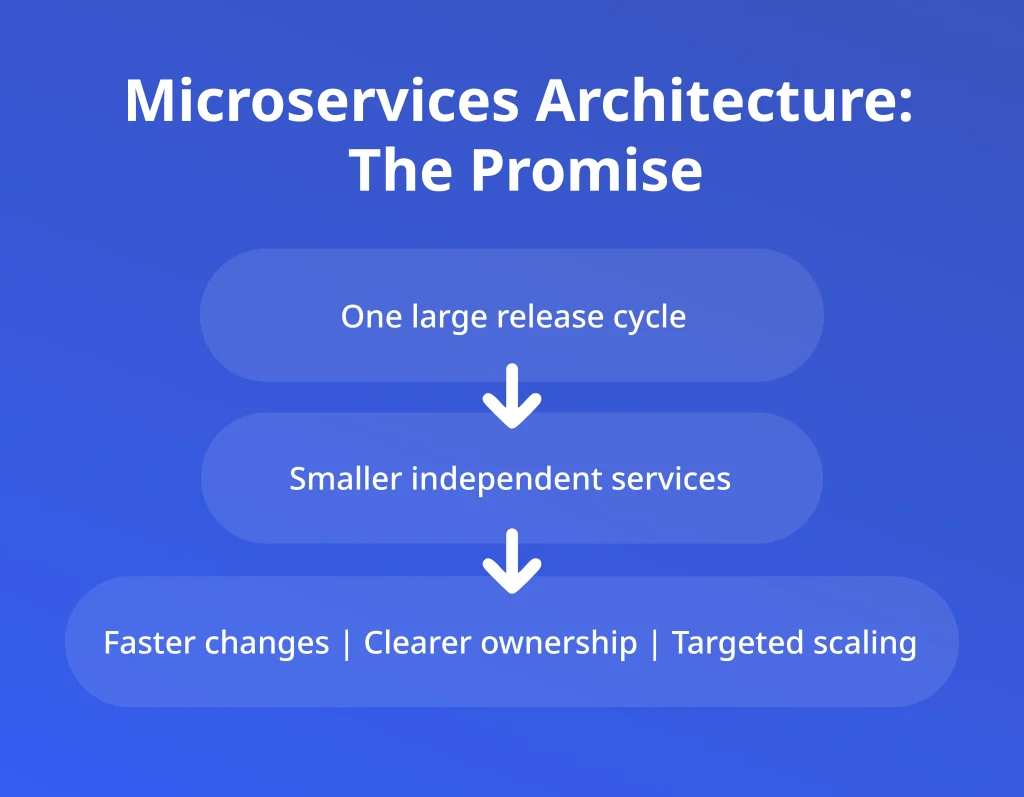
That is why the model stays attractive. It offers a more flexible way to build and run growing platforms. The real question is whether the organisation is ready for the operational demands that come with it.
When Distributed Systems Improve Delivery, Scale, and Ownership
The real value of microservices architecture is that it can make a growing platform easier to change, scale, and manage when different parts of the business are moving at different speeds.
One of the clearest benefits is targeted scalability. A business does not always need to scale the entire application at once. In many cases, only one area is under real pressure, such as payments, search, user authentication, or reporting. Microservices make it easier to scale the part that needs more capacity without increasing infrastructure everywhere else.
There is a strong case for better team autonomy. As platforms grow, large shared codebases often slow teams down because too many changes depend on the same release path. Microservices can give teams greater control over the services they own, reducing coordination friction and making delivery more efficient.
That is not just a structural preference. McKinsey found that organisations that combine agility, talent investment, strong engineering practices, and modern technical capabilities typically see up to 27% gains in efficiency, customer satisfaction, employee engagement, and operational performance.
Distributed systems make it easier to accelerate change where it matters most. Some product areas change constantly, while others stay relatively stable. Microservices allow the business to move faster in the areas that need frequent updates without forcing every part of the platform to move at the same pace.
Decentralised services can improve resilience in certain failure scenarios. When services are properly separated, an issue in one part of the system does not necessarily disrupt everything else. That can help reduce the impact of local failures and make the platform more manageable under pressure.
What Happens to Transactions in a Distributed System
Microservices architecture can create more flexibility, better ownership, and more efficient scaling, but only when the service boundaries are clear and the operating model is strong enough to support them.
Moving to microservices often shifts some cross-service workflows away from simple ACID-style transaction handling and towards patterns such as eventual consistency, Sagas, or event-driven coordination.
The Biggest Risks of Modular Software Architecture in Real Operations
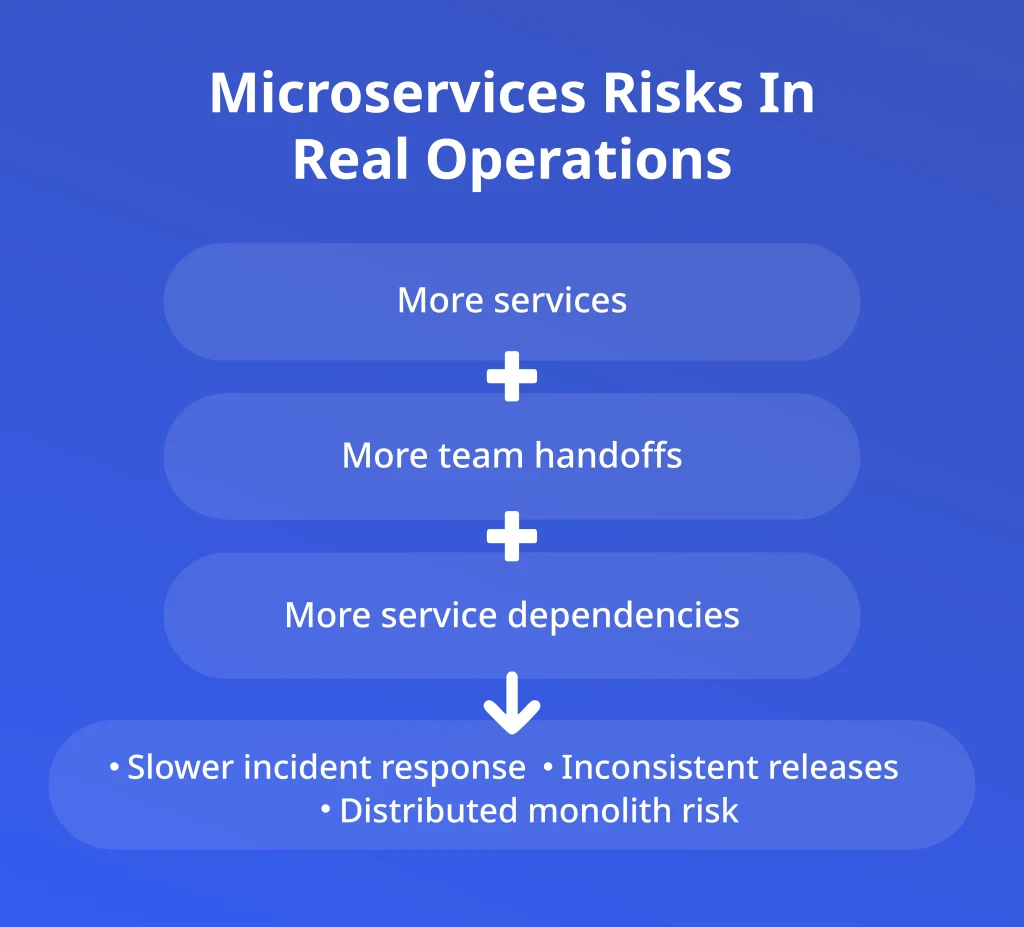
The biggest risk is that complexity spreads faster than control. What looks clean on an architecture diagram can become much harder to manage in production.
- Incident tracing gets harder because one issue can move across several services.
- Dependencies grow until teams lose the independence they expected.
- Deployment standards drift when services are managed differently.
In the worst case, the business ends up with a distributed monolith: more moving parts, but not much more flexibility.
Microservices vs Monolith: Which One Fits Your Business Better?
Microservices make more sense when the business is being slowed down by shared release cycles, uneven scaling needs, or clearer domain boundaries across the platform.
A monolith is often the better choice when the product is still tightly connected, the team is smaller, or the organisation does not yet have the operational discipline to run distributed services well.
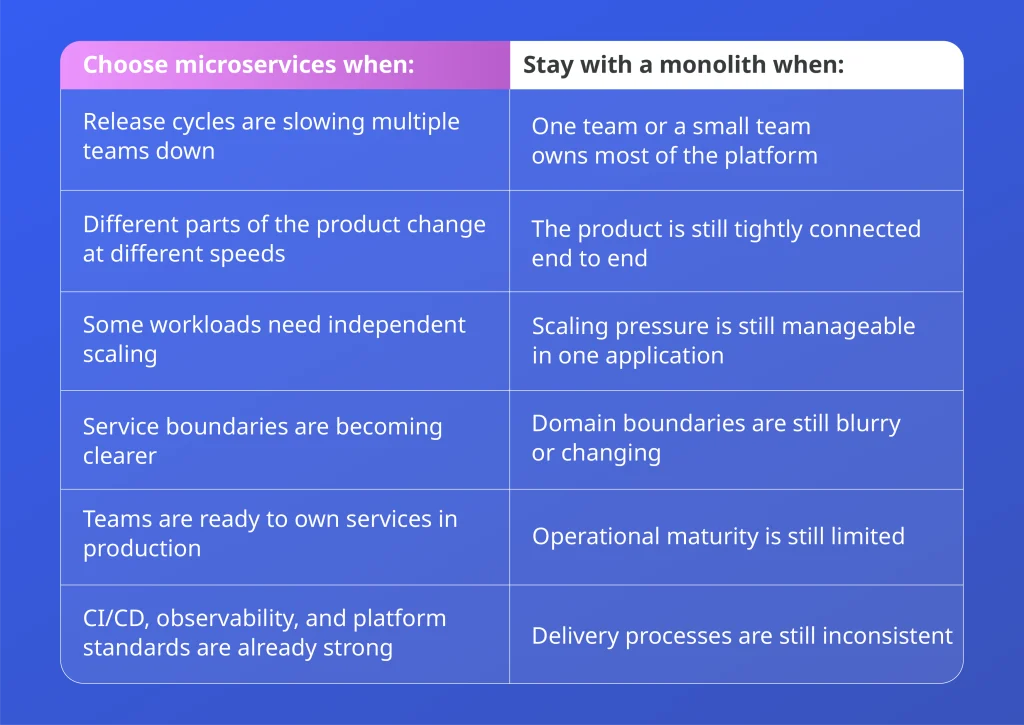
The better choice is the one that fits the product, the team, and the level of operational maturity you actually have today.
Readiness Signals CTOs Should Look For First
You can tell when microservices architecture is becoming a realistic option because the friction starts showing up in the same places.
Teams are blocked by shared release timing.
One part of the platform needs to move faster than the rest.
A few services carry very different performance or reliability demands.
Ownership starts to follow business domains more naturally than one shared application boundary.
The business may be reaching the point where one application is creating more coordination than clarity. The best readiness signal is repeated evidence that the current structure is slowing down change in ways the team can already see.
Why Readiness Matters More Than Architecture Ambition
There is a difference between technical pressure and organisational readiness. Some teams feel the strain of growth, but still do not have the operating consistency to benefit from a more distributed setup.
Others already have the habits, standards, and ownership model that make a gradual move far less disruptive.
That maturity shows up in delivery pace too: in the CNCF Annual Survey, 37% of organisations where much or all development and deployment is cloud native said they release multiple times a day, compared with 16% where only some development and deployment is cloud native, and 9% among organisations that are just starting.
Software architecture eventually mirrors your communication lines (Conway’s Law). Microservices tend to struggle when ownership remains too centralised and service accountability is unclear. Success requires cross-functional squads that own a service from start to finish. If you aren’t prepared to restructure your teams for independent ownership, you will end up with a Distributed Monolith: all the complexity of microservices with all the bottlenecks of a monolith.
Platform Execution Determines Whether Microservices Succeed
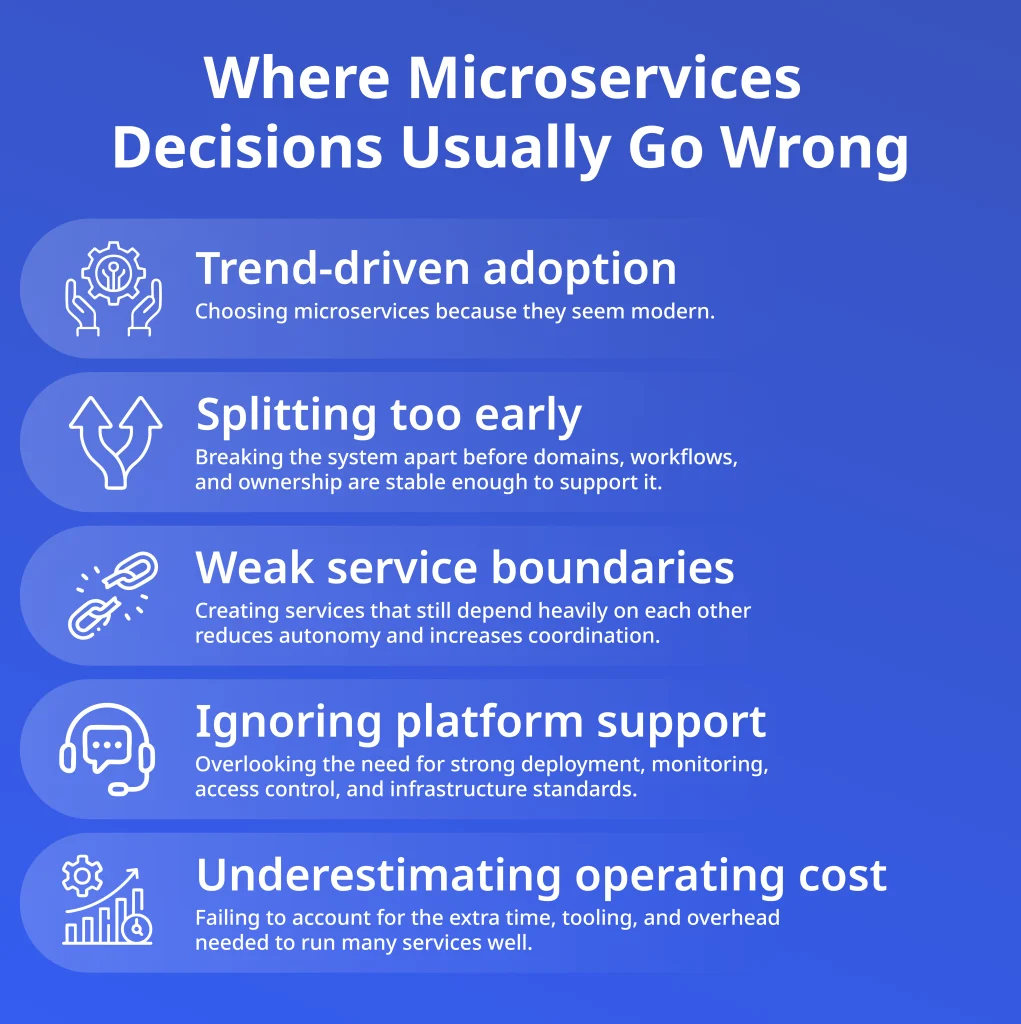
Microservices architecture does not succeed on design alone. It depends on how well the platform is built, deployed, monitored, secured, and handed over to the team that has to run it.
Platform support matters so much:
- Reliable deployment pipelines keep independent services from turning into release chaos.
- Infrastructure consistency reduces drift across environments and services.
- Monitoring and tracing make distributed issues easier to detect and fix.
- Secrets and access control help teams scale safely without creating avoidable risk.
- Cost visibility matters more as service count, environments, and tooling grow.
What Strong Execution Looks Like at Scale
As service count grows, infrastructure complexity outweighs business logic. CTOs must budget for distributed tracing (for example, Jaeger) and observability from day one. In a distributed system, a standard stack trace is useless.
As service count grows, teams usually need stronger observability, traffic management, and security controls. In more complex environments, tools such as service meshes can help manage service-to-service communication, mTLS, and traffic policies, but they are not a universal requirement.
Why Microservices Need Strong Full-Stack Squads
Delivery quality is a huge advantage.
Deployflow supports microservices delivery and platform engineering with full-stack squads that bring platform, cloud, application, and operational capability into one delivery model.
That model is stronger for a few reasons:
- Sprint-based delivery keeps progress controlled and visible.
- Knowledge transfer helps internal teams retain ownership.
- Experienced, award-winning developers bring practical judgement to decisions that can otherwise create long-term complexity.
In practice, the win is better control over change, scale, and ownership.
Get Clear on Whether Microservices Will Help or Hurt
The wrong microservices decision fails because the business commits before it has a clear view of the trade-offs, pressure points, and operating demands involved.
The next step is to claim a free microservices readiness review. That gives your team an outside view of where the current setup is creating friction, whether service separation is likely to help, and what would need tightening first to avoid expensive mistakes.
Frequently Asked Questions About Microservices Architecture
Is microservices architecture always more scalable than a monolith?
No, not always. Microservices can improve scalability when different parts of the system have very different performance demands, but that does not make them automatically more efficient.
A well-optimised monolith can still scale very effectively in the right context. The real question is whether the business needs independent scaling badly enough to justify the added operational overhead.
Do microservices reduce development costs?
No, not by default. In many cases, microservices increase costs because they require more infrastructure, monitoring, deployment management, and inter-team coordination.
Cost benefits tend to appear later, when the architecture genuinely improves delivery speed, ownership, or scaling efficiency. Early on, the operating bill often goes up before the business sees a return.
How long does a move to microservices architecture usually take?
It depends on the platform, the delivery model, and how much of the system is being changed. For most businesses, this is not a quick switch but a staged process that unfolds over multiple delivery cycles.
The safer approach is usually to separate domains one at a time rather than to treat microservices as a one-off migration project. That reduces risk and gives the team space to prove the model before expanding it.
For teams comparing delivery models and pipeline complexity during that transition, this guide to Jenkins vs GitLab CI for microservices offers a useful look at how tooling choices can affect release speed, control, and long-term maintainability.
Can microservices architecture work without Kubernetes?
Yes, absolutely. Kubernetes can help manage complex distributed environments, but it is not a requirement for a microservices architecture.
Some businesses run microservices effectively with simpler orchestration, container setups, or managed cloud services. The important issue is not whether the stack looks advanced, but whether the operating model is reliable and maintainable.
Who should own microservices in the business?
The teams responsible for building and running them should own them.
Microservices work best when ownership is clear at both the development and runtime level, and not split across too many disconnected teams, which is why many businesses move towards full-stack delivery squads.
That doesn’t mean every team works in isolation, but it does mean accountability should be visible and practical. Without that, the architecture often creates handoff friction instead of autonomy.
Can you migrate back to a monolith if microservices fail?
Yes, you can migrate back to a monolith if microservices fail.
Some teams move services back into a modular monolith when the operational overhead of microservices outweighs the delivery gains. If infrastructure complexity, observability demands, and cognitive load create more drag than speed, consolidation can be the more practical choice.
Explore our BLOG
Recent articles

ISO 42001 Explained: Requirements, Certification and What Your Engineering Team Must Build
ISO 42001 is the international standard that demonstrates your organisation governs AI properly, and enterprise...
read full article

Is Claude Down? Anthropic Outage: Protect Your Cloud Infrastructure
Claude went down across every surface on 29 September 2026. From 14:00 to 14:59 UTC,...
read full article

Top 10 Healthtech Companies in 2026: What Their Growth Means for AI and DevOps
Every software change that reaches a hospital has to clear regulatory, legacy system, and clinical...
read full article