


Recent insights suggest that in 2025, DevOps is expected to shift from reactive troubleshooting to proactive operations, with AI playing a bigger role in automation, security, and cost management across CI/CD pipelines (source: 2025 DevOps Predictions by DevOps Digest)
AI in DevOps is rewriting the rules of how software is built, tested, deployed, and secured. Teams that fail to adapt risk falling behind as competitors harness AI to move faster, predict problems, and optimise resources like never before.
This article is about reshaping mindsets, workflows, and team skills to thrive in a world where AI and DevOps are deeply intertwined.
What this guide covers:
- What AI brings to DevOps in 2025 and how it accelerates delivery, boosts quality, and improves resilience
- The key enhancements AI delivers to DevOps processes, from automation to intelligent testing
- Challenges and risks of AI integration you must prepare for
- Essential skills for AI-powered DevOps teams to stay ahead
- How to secure AI-integrated pipelines without adding new vulnerabilities
- A practical roadmap for starting with AI in DevOps without disrupting what works
Keep reading to discover how to future-proof your DevOps strategy and apply AI where it delivers real value.
What AI Brings to DevOps in 2025
AI is now a core driver of faster, smarter, and more resilient software delivery.
In 2025, AI is expected to deliver. According to Mitch Ashley on devops.com, only a third of AI projects had made it into production by last year. This year, the pressure is on to operationalise and scale those efforts.
This means tighter integration between AI and traditional DevOps workflows, tools with embedded AI features (not just bolt-ons), and smarter automation across complex systems, such as Kubernetes. Teams that adapt to this shift will gain a significant edge, not only in efficiency but also in long-term scalability.
As businesses race to release new features, meet customer expectations, and strengthen security, AI offers a way to move beyond manual bottlenecks and reactive operations.
By blending automation, predictive insights, and self-optimisation, AI in DevOps enables teams to work proactively, reduce risk, and scale with confidence.
The Key Ways AI Transforms DevOps

This projection is based on Techstrong Research, as reported by SalesforceDevops, which predicts that 75% of organisations will be using AI-augmented DevOps tools by 2025.
AI’s impact on DevOps is reshaping how software is delivered at scale. Teams that invest in AI capabilities today position themselves to outperform tomorrow, with faster releases, fewer incidents, and smarter resource use.
6 Ways AI Enhances DevOps Processes
At Salesforce, Marc Benioff recently shared that “AI is doing 30% to 50% of the work” across engineering and service operations. (source: Fox Business)
AI is changing how DevOps teams work, helping them move faster, catch problems earlier, and get more done with less effort. Whether it’s writing better code, predicting outages, or keeping cloud costs under control, AI tools are starting to play a big role in everyday workflows.
Below are six practical ways AI is already making DevOps more efficient, reliable, and scalable.
- Automating Repetitive Workflows
AI frees engineers from the grunt work that slows down delivery. By automating tasks like log analysis, incident triage, and deployment approvals, teams spend less time reacting and more time building.
In platforms like Azure DevOps, machine learning now recommends pipeline fixes based on previous failures, helping developers resolve issues before even running the code. Jenkins users can integrate AI plugins to auto-approve changes that meet pre-set quality gates, removing the need for human rubber-stamping.
- Predicting System Failures and Performance Issues
AI shifts monitoring from reactive to proactive. Instead of waiting for alerts to fire, machine learning models learn your system’s baseline and spot anomalies before they turn into incidents.
Datadog’s Watchdog, for instance, uses unsupervised learning to detect early signs of resource contention or degraded latency, often well before a human would catch them. Teams gain critical minutes (or hours) to act, reducing downtime and firefighting.
- Boosting Developer Productivity with AI Code Suggestions
AI coding tools help developers write cleaner code faster, spot bugs earlier, and maintain consistency across teams.
GitHub Copilot and Amazon CodeWhisperer are increasingly integrated into development environments, serving up relevant code snippets as you type. A junior developer writing a REST API in Python can get real-time guidance aligned with security and performance best practices without digging through Stack Overflow. This boosts confidence and accelerates onboarding across teams.
- Improving QA with Intelligent Testing
Quality assurance often struggles to keep up with modern release cycles. AI helps by prioritising what to test, generating test cases automatically, and reducing false positives.
Tools like Testim adapt to changes in your app and focus test coverage on areas with the highest risk. If a new feature touches the checkout flow, AI can flag it for deeper testing without manual tagging, keeping QA aligned with business impact.
- Optimising Resource Usage and Cost
AI helps DevOps teams balance performance and cost by constantly tuning infrastructure based on usage patterns.
Instead of relying on static thresholds, services like AWS Auto Scaling and Google Cloud’s Recommender engine monitor usage and automatically adjust compute resources in real time. One startup cut its monthly cloud bill by 35% after adopting automated scaling powered by predictive AI, without a single performance complaint from users.
Modern DevOps demands cloud environments that can adapt in real time. With AI optimising workloads and costs, reliable cloud management is non-negotiable. Explore Deployflow’s cloud management services to keep your infrastructure agile, efficient, and ready to scale.
- Enabling Smarter, Scalable Deployments
AI strengthens deployment strategies like blue-green and canary releases by analysing real-time impact metrics and triggering automated rollbacks if anomalies arise.
Spinnaker, widely used at companies like Netflix, integrates with ML-powered monitoring tools to assess user experience during gradual rollouts. If error rates spike or latency climbs, the system can halt the rollout and revert traffic before users notice.
Artificial Intelligence is giving DevOps teams better tools to solve complex problems. As these technologies mature, the teams that learn to work with AI will be the ones shipping faster, breaking less, and staying ahead.
Whether you’re just starting to explore AI or already using it in parts of your pipeline, these enhancements are a solid step toward a smarter DevOps strategy.
What Are the Challenges of AI in DevOps?
At a fast-growing SaaS company in the UK, the DevOps team introduced an AI tool to identify system issues early and minimise late-night alerts. The goal was to automate incident detection so engineers could sleep easier.
But instead of fewer pages, they got flooded with false alarms, and no clear way to understand why the AI flagged them. Instead of saving time, they were pulled into deciphering the tool’s behaviour.
As one team member put it:
“We hoped AI would take work off our plate. But it felt like we just added another layer we didn’t fully understand.”
Challenges of AI in DevOps
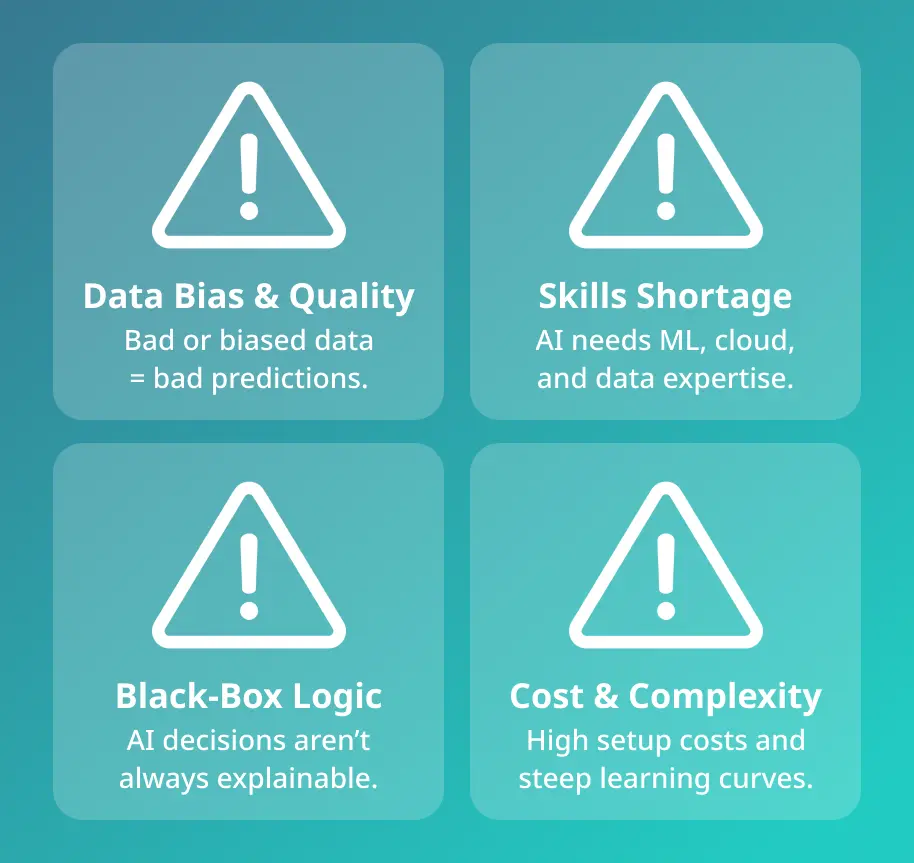
AI can bring real value to DevOps, but only when it’s built on strong foundations. Without the right data, skills, and strategy, even the best tools can cause more friction than progress.
Privacy & Regulatory Risk
AI-driven systems often ingest production logs, telemetry, and even customer data. Without careful oversight, this can unintentionally expose protected or personal data, triggering compliance breaches under GDPR, HIPAA, or other regulatory regimes.
Black-Box Accountability
Many AI models operate opaquely. When an automated decision, like incident escalation or security alerting, is made, DevOps teams often can’t trace which inputs influenced it. This impedes post‑incident auditing and introduces liability risks.
Mitigation & Audit Strategies
- Implement data minimisation and anonymisation on logs fed into AI systems.
- Use explainable AI frameworks (e.g., LIME, SHAP) to surface decision logic.
- Regularly validate model performance and bias with clear accuracy/audit metrics.
- Ensure compliance teams review AI logs and train developers on AI audit requirements.
These practices reduce risk and make AI adoption measurable, transparent, and compliant.
Many UK SMBs are turning to DevOps Managed service providers like Deployflow. With deep expertise in cloud infrastructure, automation, and secure deployment pipelines, experienced sprint-based teams help organisations adopt AI with confidence and without the growing pains.
Must-Have Skills for AI-Ready DevOps Teams
Building an AI-first DevOps team means mastering both tech capabilities and the softer, collaborative devops strategies that lets those tools shine.
According to Spacelift, 37% of IT leaders say a lack of DevOps and DevSecOps skills is their top technical hiring challenge. That gap won’t close by itself. It demands deliberate training and smart hiring.
Technical Skills of AI-Ready DevOps Teams
- Scripting & Automation (Python, Bash)
Automating routine DevOps tasks starts here, whether you’re parsing logs, transforming data, or stitching services together.
As one DevOps engineer on Reddit put it,
“A programming language is a must have – don’t need to SWE level proficiency with it but at least at a scripting level. I personally won’t hire someone without it. So pick a language (preferably Python or go), take a course … learn it then apply to DevOps roles.”
- CI/CD Pipeline Design & Optimisation
Robust, efficient CI/CD is the backbone of modern delivery.
DORA research shows that teams using CI/CD and version control deploy software 2.5 times faster than those using traditional methods. These high-performing teams are also 1.4 times more likely to hit performance targets and report higher client satisfaction.
- ML Model Deployment (MLOps)
Catering to AI means adding MLOps skills (data versioning, model testing, retraining, and serving) to your toolkit.
For example, Visa retrained its fraud-detection models over 200 times in 2023 alone to keep up with evolving threats and ensure consistent performance.
- Cloud Platforms (AWS, Azure, GCP)
Hands-on experience with major cloud providers is essential for deploying scalable, AI-powered infrastructure.
As of Q4 2024, Amazon Web Services (AWS) led the global cloud infrastructure market with a 30% share, followed by Microsoft Azure at 21% and Google Cloud at 12% (source: Statista). Knowing how to build and automate on these platforms is a must for any AI-ready DevOps team.
Soft Skills of AI-Ready DevOps Teams

The future of DevOps is all about connection, where code, cloud, security, and AI work together. Without the right mix of skills, teams can struggle with slow rollouts and messy workflows.
But when people combine hands-on automation know-how, a solid grasp of machine learning, and a strong team mindset, AI becomes something you can scale with confidence and clarity.
How DevOps Teams Can Secure AI-Integrated Pipelines
Integrating AI into your DevOps pipeline can speed things up, but security must keep pace.
Automation and intelligence are powerful allies, but without strong engineering fundamentals, they’re not enough.
The smartest pipelines are built on secure foundations. That starts with security baked into every layer of delivery:
- Security automation tools like Snyk and Checkov continuously scan your codebase and infrastructure-as-code for vulnerabilities before they become risks.
- Anomaly detection powered by AI catches strange behaviour, whether it’s a permissions change in the middle of the night or traffic spikes in sensitive endpoints.
- DevSecOps platforms like Microsoft Defender for Cloud embed compliance and security checks without adding friction to delivery.
AI can help secure pipelines, but it can’t secure what’s poorly designed. Strategy matters more than ever.
How to Get Started with AI-Powered DevOps
“Problems often happen when organisations try to do too much at once. DevOps isn’t a guaranteed success; it depends on making the right choices. Deployflow’s experienced team delivers sprint-based services that target the right problems, creating measurable impact at every step.”
– Prakash Pilley, CEO, Deployflow
Think evolution, not revolution.
Bringing AI into DevOps is about enhancing what’s already working.
Here’s a practical path to get started without overwhelming your teams or disrupting delivery:

Is your delivery strategy ready for the AI era? Talk to Deployflow to design your first AI-powered sprint, and make sure you’re building smarter, not just faster.
Frequently Asked Questions: AI in DevOps Explained
How is AI used in DevOps today?
AI is used to automate repetitive tasks, enhance monitoring, and support smarter decision-making in DevOps. It powers anomaly detection, predictive maintenance, test automation, and performance optimisation. For instance, AI can detect unusual patterns before they cause outages or suggest deployment improvements based on past data. It helps teams move faster without compromising reliability.
What are the most common AI tools used in DevOps?
Some of the most widely used AI-powered tools in DevOps include GitHub Copilot for intelligent code suggestions, Datadog and Dynatrace for AI-driven observability, Harness for deployment verification, and tools like Snyk and Checkov for security scanning. These tools don’t replace your existing stack—they enhance it by making workflows smarter and more efficient.
Can AI replace DevOps engineers?
No, AI can’t replace DevOps engineers. It can handle repetitive or data-heavy tasks, but it lacks the critical thinking, strategic insight, and system-level understanding that human engineers bring. AI is a powerful assistant, not a replacement. It frees up engineers to focus on architecture, innovation, and solving complex problems.
How can businesses prepare for AI integration in DevOps?
Start by assessing your current DevOps maturity. Identify what’s working and what’s manual or inefficient. Next, look for repetitive tasks that AI could automate. Upskill your teams with AI and ML fundamentals, and introduce tools gradually, beginning with proven platforms like GitHub Copilot or Datadog. Finally, track metrics like deployment frequency, incident rates, and cost reduction to measure the real impact of AI. For expert support, consider working with a sprint-based delivery partner like Deployflow.
Explore our BLOG
Recent articles

ISO 42001 Explained: Requirements, Certification and What Your Engineering Team Must Build
ISO 42001 is the international standard that demonstrates your organisation governs AI properly, and enterprise...
read full article

Is Claude Down? Anthropic Outage: Protect Your Cloud Infrastructure
Claude went down across every surface on 29 September 2026. From 14:00 to 14:59 UTC,...
read full article

Top 10 Healthtech Companies in 2026: What Their Growth Means for AI and DevOps
Every software change that reaches a hospital has to clear regulatory, legacy system, and clinical...
read full article