



OpenAI’s move to an ad-supported model devalues every API-dependent product in 2026. For regulated industries, it’s the moment to reclaim control of AI.
On Friday, 16 January 2026, OpenAI confirmed that advertisements will begin appearing within ChatGPT to subsidise its $1.4 trillion infrastructure roadmap.
UK businesses need to prepare for ChatGPT ads now
For CTOs and CEOs in Fintech, Healthtech, Proptech, and other regulated sectors, ChatGPT ads are a shift in AI’s risk profile. In these sectors, the most dangerous question a user can ask is:
“How did this company know that about me if I only used the AI in private?”
TL;DR: The New Reality for AI Products
- Ads are coming. “Free” AI means no governance.
- Black-box AI adds a trust tax. Data control ≠ guaranteed.
- Ad-funded models create Shadow AI. Sensitive data leaks by design.
- Private models fix this. Run open-source AI on your own infrastructure for cost and data certainty.
The shift towards advertising is driven by cost. The hardware, energy, and silicon demands of 2026 AI models mean public AI has moved from subsidised growth to revenue extraction.
Cheap, private-access APIs are over. Building independent, professional-grade infrastructure is a must.
Read the full article to learn how to remove hidden trust risks, regain full data sovereignty, and deploy private infrastructure that keeps customer data protected in the age of ChatGPT advertising.
The Semantic Trap: Contextual Surveillance vs. User Trust
The arrival of ChatGPT Ads introduces a shift from keyword-based ads to intent-based monitoring.
According to OpenAI’s official roadmap from January 2026, ads will be triggered by semantic relevance to the current conversation. This means the system isn’t just looking for words; it is analysing the problem you are trying to solve.
For regulated industries, this creates a contextual leak where the AI understands the user’s vulnerability even if it doesn’t sell the data.
“With advertisements coming to public AI services like ChatGPT, it will truly undermine the idea of it being private. The fact that the system has so many details about us and will use them to serve advertisements will, for sure, make companies double-check the T&C and probably move away from public instances to completely private ones. This will truly undermine the trust people build in AI systems.”
Thomas Radosh, CTO at Deployflow
A recent Gartner survey says that 53% of consumers are cautious about AI features and want the ability to opt out when they distrust how their data is used. For regulated firms, ad-supported AI creates friction that directly reduces product adoption.
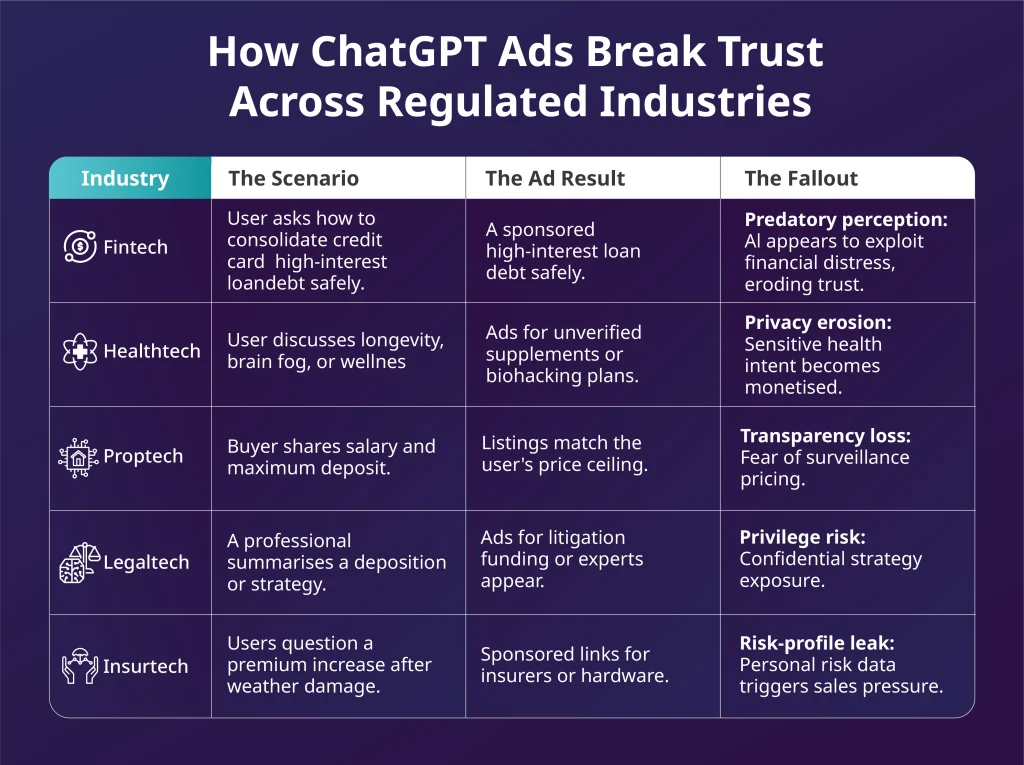
This change is a fundamental shift in the AI product development lifecycle. When your core functionality is rented from an ad-funded platform, you are inheriting a data-harvesting business model. In 2026, building AI-powered products requires a privacy-by-architecture approach that public APIs simply cannot provide.
🚩The liability risk: ChatGPT ads in 2026 create a governance risk, besides a trust issue. Ad-driven AI introduces bias that cannot be fully audited. If AI influences risky financial or medical decisions, the board is accountable.
🛠️The solution: Sovereign AI is the only way to keep decisions auditable and meet regulatory duties. By self-hosting, you provide the verifiable logic and immutable audit trails required to meet fiduciary obligations under the EU AI Act and FCA standards. You move from hoping the AI is unbiased to proving it.
In practice, this means building AI-powered products where intelligence is a part of the application, not an external dependency. AI product development, AI application development, and ML orchestration must be designed into the architecture from day one to ensure performance, compliance, and long-term control.
The 2026 AI Reality Check for CTOs
THE PROBLEM:
Free AI is no longer neutral. Ad-funded models turn user intent into a monetisation signal.
THE RISK:
Public AI APIs inherit data-harvesting logic that conflicts with GDPR and FCA privacy-by-design requirements.
THE SOLUTION:
Sovereign AI. Self-host open-source models inside your own VPC to regain control, auditability, and predictable costs.
If it’s Free, Then You’re the Product
As the 2026 infrastructure reckoning proves, the cost of running these models is too high for privacy-by-default to exist in free tiers.
For a CTO, the only way to guarantee that a user never asks “How did they know that?” is to remove the ad-tracking engine entirely by moving to a Sovereign AI Stack.
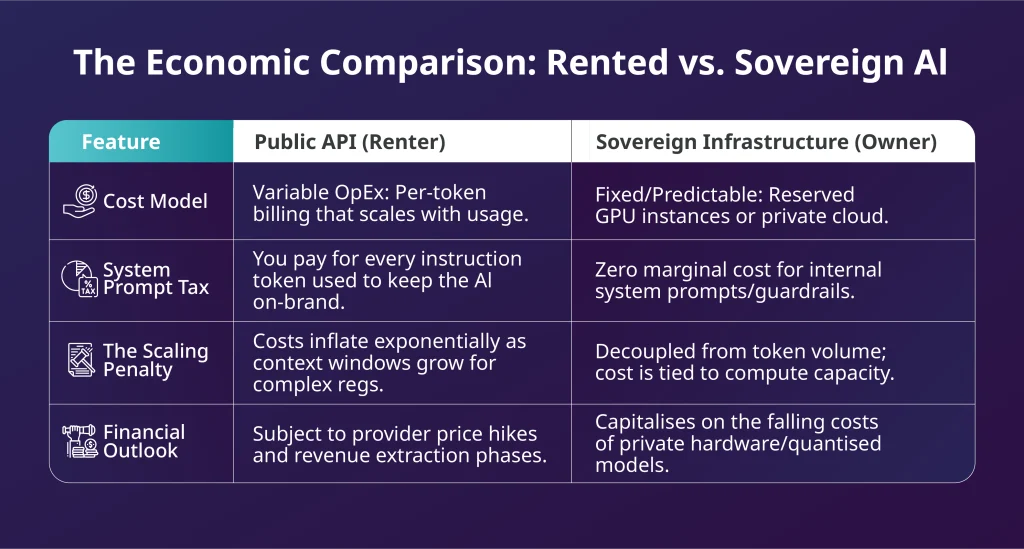
The Scaling Penalty in 2026 is the primary driver for infrastructure migration. As context windows grow to accommodate complex UK regulations and multi-page compliance documents, per-token billing inflates exponentially.
AI application development on public tiers forces a trade-off between product intelligence and profit margins. Transitioning to a private, containerised stack allows a company to move from a variable OpEx model to fixed-cost infrastructure, decoupling long-term growth from the provider’s quarterly revenue targets.
This is already visible in the article covering how generative AI is changing cloud ROI.
Reclaiming Personalisation Without Breaking Trust
For IT leaders and CTOs, the 2026 AI reality is an engineering paradox: users demand hyper-personalisation, but regulators and boards now demand absolute data isolation.
The introduction of ChatGPT ads proves that public APIs are no longer clean pipes; they are data-harvesting engines.
Market leadership depends on AI product development that treats intelligence as a native component of the application. A high-performance AI solution provides sovereign personalisation, intelligence that knows the user without the model provider knowing the user. This architecture defines how AI-powered products are designed, shipped, and trusted in regulated markets.
Sovereign Context: Personalisation Without Data Exposure
Instead of transmitting raw PII or proprietary intent data to an external endpoint, modern stacks utilise Local Vector Databases (such as Qdrant or Milvus) residing within your VPC.
Sovereignty fixes the data gravity problem. Instead of sending sensitive data to an external model, the model runs where the data lives. This ML development approach cuts the attack surface by up to 90% because PII never leaves the secure VPC.
The Execution: Your application performs a local similarity search to retrieve user-specific context. This context is injected into a private model (e.g., Llama 3.3 or Mistral) hosted in your secure perimeter.
The Technical Moat: The AI “knows” the user’s history, but the external model provider receives zero identifiable data. Your intellectual property and customer profiles remain behind your firewall, effectively immunising your firm against “semantic intent” ad-harvesting.
The Solution: A RAG (Retrieval-Augmented Generation) setup inside your own VPC keeps sensitive data under control. A private gateway removes metadata before any request reaches the model. Even in a hybrid setup, intent data stays inside your environment, preventing external ad or tracking systems from seeing user behaviour or vulnerabilities.
Infrastructure Performance: Beating Public API Latency with Private Clusters
Relying on public APIs in 2026 can be a gamble. Unpredictable delays and performance throttling during peak demand can cripple your platform exactly when it needs to be most responsive.
To solve this, high-performance organisations are now using speculative execution and inference orchestration to ensure speed and stability.
Edge-Tier Processing: Small-parameter models (e.g., 8B) handle initial UI token streams and basic validation at the edge.
Private Core Inference: Complex reasoning is routed to your dedicated GPU clusters (Azure ND-series or AWS P5 instances).
The Metric: This hybrid approach consistently delivers sub-100ms latency, outperforming the congested public APIs while ensuring that 100% of the reasoning logic remains ad-free and private.
The Solution: Speculative decoding improves performance beyond public APIs. A smaller draft model predicts tokens, which are then verified by a primary model running in a private cloud.
The Result: ChatGPT-like responsiveness without advertising-driven data risk. Full privacy is maintained, with up to a 20% improvement in tokens per second compared to standard public endpoints.
ML orchestration drives these performance gains. By controlling how data moves between edge models and private core inference, systems stay stable under peak load. Speculative decoding uses a smaller draft model to predict tokens, which are then verified by a primary model in a private cloud. The result is up to 20% better performance than public APIs, with full data isolation.
Compliance-by-Design: Verifiable Governance
In regulated industries, black box outputs (AI results where you can’t see how or why the decision was made) are a liability. If a public AI serves a sponsored suggestion that leads to a financial or medical error, the legal burden falls on you.
This clashes with ISO 27001 expectations around information security control and auditability, because ad-influenced AI behaviour cannot be fully documented or independently verified.
Immutable audit trails: Self-hosting allows full observability. You can log the exact model weights and prompts used for every decision, creating a clean audit trail that meets EU AI Act and FCA requirements.
Eliminating sponsored bias: private models ensure professional advice is driven by your logic instead of a third party’s ad auction. This is the only defensible way to prove algorithmic integrity to auditors in 2026.
The Foundation of Sovereignty: Lessons from Little Journey
While the 2026 AI shift is the current priority, the prerequisite for Sovereign AI is a programmatic, secure cloud environment.
In work with Little Journey, an eSupport platform for paediatric patients, the focus was on building discrete infrastructures with 100% data segregation to meet stringent medical vendor security requirements.
For a CTO, this is the essential first step: before deploying AI-powered products, the underlying environment must be refactored to ensure that data is isolated, auditable, and ready for private ML orchestration.
Little Journey proves that complex, regulated environments can be automated and secured at scale, providing the exact blueprint needed for hosting private AI models today.
What changed as a result:
- 80% reduction in deployment time, cutting environment setup from days to ~2 hours
- 50% increase in infrastructure scalability to support rapid growth
- 100% data segregation and security compliance, meeting strict medical and vendor requirements
- 70% reduction in manual labour through infrastructure automation
- Consistent, repeatable environments replacing ad-hoc setups with centrally governed rules
- Clear audit readiness enabled by a fully programmatic, documented infrastructure
“Working with Deployflow has been transformative for Little Journey. Deployflow’s team addressed our critical needs for scalability, efficiency, and security by simplifying our cloud infrastructure management.
Their strategic approach has greatly enhanced our platform’s security, consistency, and overall efficiency, allowing us to better serve our users with a robust and user-friendly solution.”
Azim Palmer
CTO at Little Journey
How AI Decisions Affect Enterprise Value
As a leader in a regulated space, your valuation is tied directly to user trust. If your core experience is built on a public API that prioritises ad revenue over your clients’ privacy, you are building on a foundation of subsidised sand.
Cloud App Modernisation serves as your defensive moat. Deployflow re-architects your legacy and cloud-native stacks to move you from a renter of intelligence to a sovereign owner.
By refactoring your applications into a modular, containerised architecture, you will:
Increase Enterprise Value (EV): Institutional investors in 2026 devalue firms that rely on wrapper architectures. A business built on a public API lacks a technical moat because the core intelligence can be replicated by any competitor using the same endpoint.
AI product development focused on sovereign infrastructure turns technology into a proprietary asset, significantly increasing the enterprise multiplier during a valuation or exit.
Protect your IP: Ensure your proprietary industry knowledge is hosted within your own perimeter and never used to train a competitor’s ad-supported model.
Guarantee Trust: Build a platform where you can honestly tell your customers: “Your personal life is never our product.”
The EV Multiplier: Why Defensibility Defines Valuation
The Enterprise Value Shift: In 2026, companies that depend on public AI APIs are losing value because they lack defensibility. Investors favour firms that own and control their AI runtime infrastructure. Modernising with Deployflow turns AI from a privacy risk into a proprietary asset that strengthens long-term enterprise value.
How Deployflow Builds Defensible AI Products
The Deployflow advantage lies in building AI-powered products where intelligence, compliance, and performance are engineered together.
Through AI product development, application modernisation, and ML orchestration, legacy and cloud-native platforms are refactored into owned, defensible systems rather than API-dependent features.
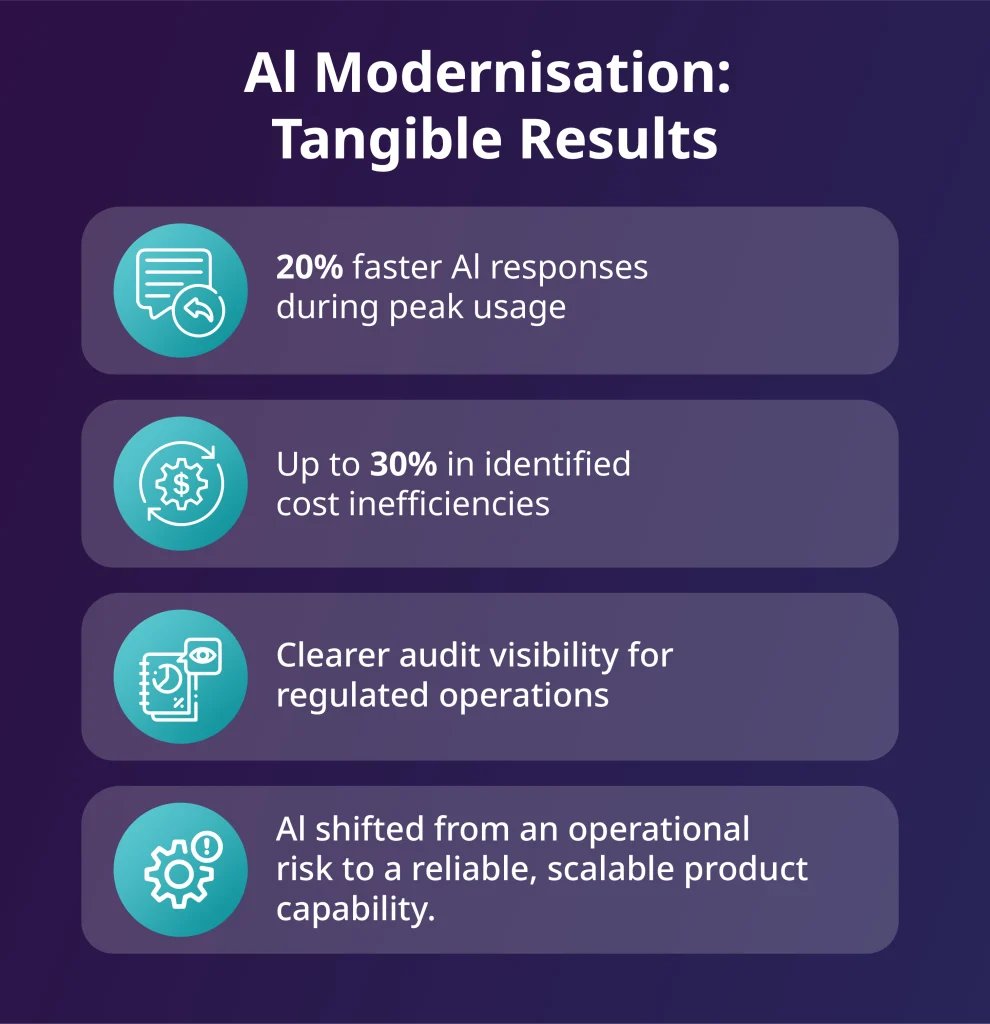
With Deployflow, modernisation goes beyond moving code to building resilient systems. Through discovery workshops and serverless design, full-stack squads help CTOs uncover up to 30% in cost savings typically hidden in inefficient, third-party-dependent architectures.
By leveraging Kubernetes orchestration for scalable deployment, Deployflow ensures your private AI models are as resilient and flexible as any public offering, without the trust tax associated with ChatGPT ads.
Case Study: Modernising AI in a Regulated Fintech Platform
A UK Fintech platform relied on AI for customer insights but struggled with rising costs, latency under peak load, and limited visibility into AI decision paths.
Deployflow modernised the application through AI product refactoring, AI Compliance for FCA-regulated firms, ML workflow optimisation, and improved orchestration within the existing cloud environment. Performance bottlenecks were removed without disrupting the product.
Your AI Roadmap Needs a Reset: Take Control
The announcement of ChatGPT ads marks a permanent shift. For regulated sectors like Fintech, Healthtech, Insurtech, Legaltech, and Proptech, the convenience of public AI now comes with a major liability: the erosion of the client-provider boundary.
Staying on the path of least resistance (relying on ad-supported external APIs) is now a risk.
Deployflow helps CTOs and CEOs design and build AI-powered products where intelligence is owned, auditable, and aligned with regulatory reality and not just rented from ad-funded platforms.
Our app modernisation framework ensures your infrastructure is ready for a future where privacy and performance are managed in-house.
The era of privacy-by-default is over.
Don’t let customer relationships become ad inventory. Get an AI Sovereignty Audit and identify hidden data leaks in your current API stack.
Frequently Asked Questions Regarding AI Sovereignty
How does private AI infrastructure impact GDPR and FCA compliance?
Private AI infrastructure makes compliance easier by design. Public AI tiers operate as black boxes, where it’s unclear how prompts are processed or reused. With private infrastructure, PII stays inside the company’s VPC, meeting GDPR privacy-by-design requirements. For FCA-regulated firms, it also enables clear audit trails that show AI decisions are not influenced by ads or hidden bias. This level of transparency is not achievable on public, multi-tenant AI platforms.
Are ChatGPT ads visible inside private or enterprise accounts?
Ads may not appear visually in all enterprise interfaces, but ad-driven optimisation can still influence model behaviour upstream.
This matters because relevance ranking, response shaping, and intent classification can be affected even when ads are not directly shown. For regulated products, the risk is not UI ads but hidden incentives in the inference layer. That distinction is often missed in vendor messaging.
Can regulated companies safely use public AI APIs if no PII is sent?
Avoiding direct PII is no longer enough. Modern models infer intent, sensitivity, and risk from context, even when identifiers are removed. In regulated industries, inferred data can still trigger compliance, audit, and trust issues. This is why privacy-by-architecture matters more than privacy-by-policy.
Does moving away from public AI APIs hurt product speed or user experience?
No. When designed correctly, private or optimised AI architectures often outperform public APIs. Techniques like ML orchestration, local context retrieval, and speculative decoding reduce latency and remove throttling risk. The result is faster, more predictable performance under load. Speed and control are no longer a trade-off.
Explore our BLOG
Recent articles

ISO 42001 Explained: Requirements, Certification and What Your Engineering Team Must Build
ISO 42001 is the international standard that demonstrates your organisation governs AI properly, and enterprise...
read full article

Is Claude Down? Anthropic Outage: Protect Your Cloud Infrastructure
Claude went down across every surface on 29 September 2026. From 14:00 to 14:59 UTC,...
read full article

Top 10 Healthtech Companies in 2026: What Their Growth Means for AI and DevOps
Every software change that reaches a hospital has to clear regulatory, legacy system, and clinical...
read full article