



Slow deployments are annoying, plus they destroy engineering velocity, blow up sprint plans, and turn every release into a negotiation instead of a workflow.
You might think the problem lives inside your CI/CD pipeline, but the real problem is often far more basic: your network simply isn’t fast or stable enough to support the way you ship software.
A clogged, contended internet connection adds minutes to every build, every push, every test run, every container upload, and minutes multiply into hours before anyone even sees the root cause.
This guide shows you why that happens and how a business leased line can remove the bottleneck your team has been fighting without realising it.
Here’s what you’ll learn:
- How slow or unstable connectivity cripples deployments even when your CI/CD pipeline is solid.
- What a business leased line actually is and why it matters for engineering teams.
- The hidden network issues behind random build failures, timeouts, and inconsistent delivery speeds.
- How dedicated bandwidth boosts DevOps performance, especially in cloud-native workflows.
- When a leased line is worth the investment, and when bandwidth alone won’t fix the problem.
- How Deployflow reduces network-driven friction across hybrid, multi-cloud, and high-volume environments.
If your deployments feel slower than they should be, if your build agents choke during peak hours, or if your team keeps asking, “Why is this taking so long today?”, this article is going to save you months of frustration and thousands of lost engineering hours.
Strong, practical, and brutally honest, this guide will show you exactly how to diagnose the problem and what to fix so your delivery pipeline finally moves at the speed your team deserves.
Why Deployment Speed Depends on Network Reliability (Not Just Pipelines)
You can tune pipelines, optimise runners, and clean up YAML all you want, but if the network beneath it stutters, every stage of delivery slows down.
CI/CD isn’t a self-contained system; it’s a constant exchange of code, artefacts, and metadata across multiple services.
The moment that flow becomes unstable, deployment speed drops, even if nothing inside the pipeline has changed.
A lot of the heavy lifting in delivery relies on smooth, uninterrupted connectivity.
Git pulls and pushes rely on upload stability, especially when repos grow large.
Artefact publishing and container uploads demand consistent bandwidth to avoid retries and partial transfers.
Parallel tests pull assets and talk to remote services, and even small delays compound across dozens or hundreds of executions.
Then there’s the part teams rarely diagnose: the micro-instability that never shows up as “the internet is down.”
Jitter introduces random pauses in build steps that should finish in seconds.
Packet loss forces silent retries and turns fast operations into slow, inconsistent ones.
Latency spikes drag down performance, especially when cloud agents pull from on-prem systems or vice versa.
None of these issues triggers an apparent outage.
They simply chip away at deployment speed until everything feels slower without a clear cause.
This is why pipeline issues often look random when the root cause is actually network volatility.
Fix the network layer, and everything upstream suddenly becomes predictable again.
What Is a Business Leased Line? Clear Definition for Engineering Leaders
A business leased line is a dedicated, uncontended, symmetrical internet connection reserved solely for your organisation.
- No neighbours sharing your bandwidth.
- No peak-hour slowdowns.
- No unpredictable dips in performance.
A business leased line is just a consistent, high-quality connection designed for operational workloads.
Broadband works differently. It’s a shared service, which means your available speed fluctuates based on how many other users are active on the same line. It also lacks strict service guarantees. A leased line, on the other hand, comes with reliability SLAs, uptime commitments, and guaranteed upload and download speeds that stay stable regardless of traffic around you.
And when standard connectivity fails, the financial impact is severe. Over 90 % of large and mid-size enterprises now report downtime costing $300,000 or more per hour, with 4 in 10 saying it exceeds $1 million per hour. (source: N-able)
For DevOps, the symmetry of a leased line is critical.
Pushing code, publishing container images, syncing large repos, streaming logs, and running GitOps flows rely heavily on upload performance, not just download. When that upload speed is predictable, build agents run smoothly, reconciliations don’t stall, and deployment pipelines stop fighting the network.
A leased line simply gives your engineering team what broadband can’t: consistent performance when your delivery pipeline depends on it.
Signs Your Organisation Needs a Business Leased Line for DevOps
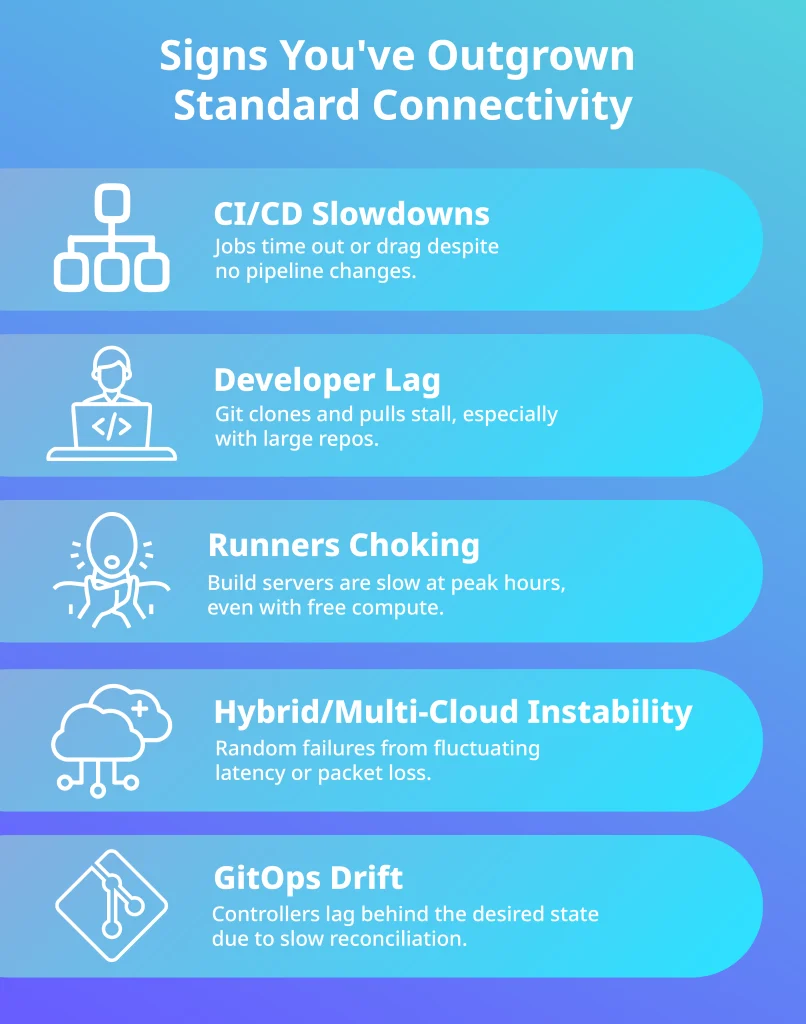
There comes a point where tuning pipelines and adding more runners no longer helps. If your delivery speed rises and falls for no obvious reason, a business leased line for DevOps may be the missing piece your organisation hasn’t evaluated yet.
Here are the clearest signals your team is outgrowing standard connectivity:
- CI/CD jobs that normally run smoothly begin to slow down or time out without any pipeline changes, a common indicator that bandwidth is being shared or throttled elsewhere.
- Remote developers experience lag during Git clones and pulls, especially with large repos or monorepos, a problem that disappears when upload speeds are symmetrical and consistent.
- Build servers or cloud runners choke during peak hours, even when compute capacity is available, because the network layer can’t keep up with the amount of artefact movement.
- Hybrid-cloud or multi-cloud setups show intermittent failures and random instability, a classic sign of fluctuating latency or packet loss between environments.
- GitOps workflows drift because slow reconciliation forces controllers to lag behind the desired state, making clusters feel unreliable even though the manifests are correct.
If any combination of these symptoms sounds familiar, you’re dealing with a connection that can’t support the way your software teams operate. A leased line for CI/CD and engineering workloads is often the fastest way to restore predictability.
How Slow Networks Ruin Deployment Velocity at Every Stage of the Pipeline
A slow or unstable connection weakens everything. CI/CD is a chain of dependent actions, and the network sits underneath each one. When that layer falters, every stage pays the price.
Source control becomes sluggish when Git operations struggle with upload and download stability. Large repos take longer to clone, branch merges slow down, and developers waste time waiting for actions that should be instant.
Build processes stall because container layers, dependencies, and package downloads rely on fast, predictable throughput. Even a slight drop in bandwidth stretches build times across all runners.
Artefact storage interactions degrade when pushing or pulling from locations like S3, Nexus, or Artifactory. Partial uploads trigger retries, and large images become bottlenecks rather than a smooth handoff.
Parallel test execution loses its advantage when tests access external services. Latency spikes and packet loss make even well-designed test suites feel inconsistent.
Delivery slows to a crawl when Helm charts, Terraform plans, Kubernetes manifests, and GitOps flows rely on network responsiveness to propagate changes. Slow transfers create gaps between “desired state” and “actual state.”
This is why network reliability sits on the same level as compute and storage in cloud-native environments. When the connection falters, the entire delivery pipeline inherits the slowdown, no matter how well-architected the tooling above it might be.
How a Business Leased Line Improves DevOps Performance and Reliability
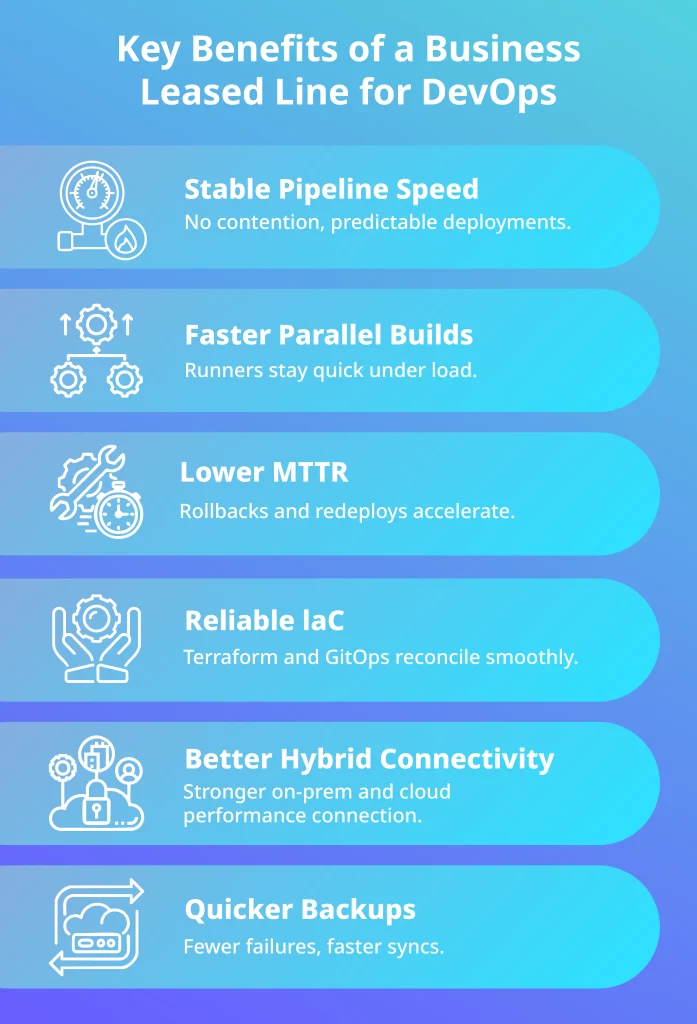
A business leased line gives engineering teams something standard broadband never can: a stable, uncontended connection that behaves the same at 9 a.m. as it does at 9 p.m. That single change has a noticeable impact on every part of your delivery pipeline.
With dedicated bandwidth, contention disappears, and pipeline timings finally become predictable instead of fluctuating for reasons no one can trace.
Parallel build runners can operate at full capacity because uploads, downloads, and layer transfers stop fighting for shared bandwidth, allowing teams to scale horizontally without degradation.
Rollback operations, container republishing, and emergency redeployments run faster, which means MTTR drops, which is a direct win for reliability and engineering morale.
Infrastructure-as-Code pipelines become more stable when Terraform, Helm, and GitOps controllers don’t compete with other traffic, preventing drift and reducing reconciliation delays.
Traffic between on-prem and cloud systems improves dramatically, making a leased line for cloud workloads especially valuable in hybrid setups where latency swings disrupt delivery.
And because throughput becomes consistent in both directions, backup sync speeds and disaster recovery jobs finish faster and fail less often, removing a major risk factor for high-volume teams.
For organisations that depend on smooth, uninterrupted deployment workflows, a leased line for engineering teams often becomes the foundation that makes everything else more reliable.
This stability also plays a key role in faster MVP delivery for SaaS teams that rely on quick iteration cycles and need their pipelines to support rapid build–measure–learn loops.
Business Leased Line vs Standard Broadband for DevOps Workloads
When you look at them side-by-side, the gap becomes obvious. One is built for engineering workloads; the other isn’t.
| Factor | Business Leased Line | Standard Broadband |
| Speed | Guaranteed, consistent | Varies throughout the day |
| Upload/Download | Fully symmetrical | Download-heavy, weak upload |
| Contention | Uncontended (yours only) | Shared with many users |
| Latency | Low and predictable | Fluctuates constantly |
| SLA/Uptime | Strong guarantees | “Best effort” availability |
| CI/CD Impact | Stable pipeline timings | Random slowdowns/timeouts |
| Hybrid Cloud Traffic | Smooth, reliable | Prone to jitter and packet loss |
| DR & Backups | Faster sync, fewer failures | Slower and inconsistent |
Cheap broadband seems fine until you factor in longer builds, delayed deploys, failed image uploads, and wasted engineering hours, at which point it becomes the most expensive option.
A hybrid setup can work for non-critical traffic, but any workload that touches CI/CD, GitOps, IaC, or high-volume cloud operations performs best on dedicated connectivity.
When a Business Leased Line Alone Is Not Enough
A faster connection can remove a lot of friction from your delivery pipeline, but bandwidth alone doesn’t guarantee high performance. Even with a dedicated line in place, DevOps network optimisation is still the real driver of fast, reliable deployments.
It’s easy to assume that strong connectivity automatically fixes slow builds or inconsistent deployments. It doesn’t. A poorly designed CI/CD pipeline stays slow even on excellent internet, especially when builds drag in huge dependency sets, run everything serially, or constantly republish large images.
This is the point where real optimisation starts to matter.
Builds accelerate when teams introduce caching layers, parallelisation, smarter orchestration, and tighter dependency management, all of which reduce the amount of data that needs to move across the pipeline.
Infrastructure benefits from the same approach. Consistent IaC, policy-as-code, and automated governance prevent drift, reduce retries, and eliminate manual approvals that slow deployment cycles even on a rock-solid network.
And this is where expert guidance changes everything. Deployflow’s Cloud Consulting team specialises in designing cloud-aware, performance-oriented architecture, the kind of optimisation no internet connection can solve on its own.
A business leased line is a powerful upgrade, but pairing it with smarter pipeline and infrastructure design (backed by cloud connectivity and WAN optimisation) is what truly accelerates delivery.
Where Deployflow Fits: Making Leased Lines Work for Cloud-Native Delivery
A business leased line gives your organisation stable bandwidth, but you still need the right engineering approach to turn that reliability into faster, smoother deployments. Deployflow’s strengths naturally complement the network layer, not by replacing it, but by making it truly work for cloud-native delivery.
Deployflow’s full-stack engineering squads focus on shaping CI/CD pipelines that make efficient use of bandwidth, reducing unnecessary artefact movement and speeding up the steps that depend on steady connectivity.
Their teams design cloud-aware network paths that work seamlessly across hybrid and multi-cloud environments, helping organisations avoid the latency spikes and routing issues that slow down cross-environment workflows.
Infrastructure pipelines (whether built on Terraform, Helm, or GitOps controllers) are tuned for high-throughput, ensuring changes propagate quickly and predictably, even in large or complex estates.
Deployflow also builds observability into the pipeline, giving engineering leaders visibility into how the network impacts builds, tests, reconciliations, and deploys. This makes diagnosing the root cause of slowdowns faster and far less painful.
And across the entire estate, Deployflow improves end-to-end pathing between developers, build agents, artefact stores, and cloud environments, ensuring that your leased line is used intelligently.
With strong connectivity in place and full-stack squads embedded in your existing team, deployment speed stops fluctuating and finally becomes predictable.
Teams that operate in small, high-output squads often see even bigger gains from reliable connectivity, as shown in Deployflow’s insights on how small, high-output squads outperform much larger teams in delivery speed.
Real-World Deployment Failures Caused by Poor Connectivity and How a Leased Line Fixes Them
Connectivity issues rarely show up as dramatic outages. They surface as small, frustrating, inconsistent failures that make your pipeline feel unreliable. Here are some of the most common ones engineering teams face, and why a business leased line resolves them.
⛔ Slow container pushes to ECR, GCR, or ACR. Large image layers struggle to upload when bandwidth fluctuates, causing retries and delays.
✅ A leased line stabilises upload throughput so containers publish consistently.
⛔ Terraform plans are timing out. IaC workflows depend on repeated API calls to your cloud provider. Latency spikes stretch those calls until Terraform gives up.
✅ A leased line delivers the predictable latency Terraform expects.
⛔ GitHub and GitLab runners are behaving inconsistently. Self-hosted or cloud runners lag when network congestion slows the transfer of repos, artefacts, or dependencies.
✅ Dedicated bandwidth keeps runner performance steady throughout the day.
⛔ Kubernetes cluster reconciliation is running slowly. Controllers fall behind when they can’t pull manifests or state updates quickly enough, especially across hybrid environments.
✅ Stable, low-latency connectivity keeps controllers in sync with the desired state.
⛔ S3 and GCS read/write operations are dragging. Even small delays in object storage calls ripple through tests, builds, and deployments.
✅ A leased line removes jitter and packet loss, so storage operations complete on time.
⛔ Multi-region traffic bottlenecks. Cross-region replication, image pulls, or data syncs stall when the network layer can’t sustain throughput.
✅ A leased line provides consistent performance for high-volume, distributed workloads.
And because the SLA for a leased line can guarantee 99.999% uptime (limiting downtime to around 5 minutes per year), you’re no longer gambling on “hope the network behaves today.” (source: Connect2)
When these problems disappear, your delivery pipeline stops feeling random and starts behaving like a predictable, well-engineered system.
How to Justify a Business Leased Line to Leadership (ROI, Cost Avoidance, Time Savings)
A business leased line is a productivity investment. Slow deployments quietly drain engineering time, delay releases, and create delivery risk, which leadership eventually feels in missed deadlines and rising costs.
Lost time is the biggest expense.
Every extra minute spent on pushes, plans, or test execution compounds across runners and sprints. When throughput improves, teams ship faster and spend less time waiting on infrastructure.
A leased line also reduces MTTR (Mean Time to Recovery), making rollbacks and redeployments quicker. Faster recovery has an immediate financial impact in any environment where downtime or degraded service affects revenue or customer experience.
With outage costs creeping beyond $16,000 per minute (source: Calyptix), even minor delivery delays become significant financial exposures.
Saving a couple of minutes per build across multiple runners can return entire days of productivity per sprint, giving teams room to deliver more without increasing headcount.
Finance teams also care about predictability. Standard broadband introduces variability into the delivery process, while a leased line’s strict SLAs stabilise uptime and throughput. When the network stops being a risk factor, planning becomes far more reliable.
In short, a leased line cuts waste, speeds delivery, and reduces operational risk, the combination that leadership looks for when approving investment.
Choosing the Right Business Leased Line for DevOps
Picking the best business leased line in the UK depends on how much traffic your engineering teams generate and how predictable your CI/CD workloads need to be.
- A 20-person startup typically runs smoothly on 100–200 Mbps of symmetrical bandwidth.
- A 200+ developer organisation often needs 500 Mbps to 1 Gbps to support large repos, parallel builds, and frequent image publishing.
Certain features matter more than raw speed.
Symmetric upload, low jitter, latency guarantees, and a strong uptime SLA determine how stable your deployments feel under load. Anything less predictable will eventually slow down CI/CD, no matter how fast it looks on paper.
For hybrid or multi-cloud setups, location matters.
A leased line that connects efficiently to AWS Direct Connect, Azure ExpressRoute, or GCP Interconnect keeps cross-environment traffic fast and avoids the latency spikes that break Terraform plans, runners, and GitOps flows.
When evaluating leased line providers in the UK, focus on what benefits your pipeline and not just your office network. Dedicated internet for engineering teams is valuable only when it delivers consistent performance for the way your developers push code, move artefacts, and run cloud workloads.
Faster Deployments Start With a Faster, More Predictable Network Layer
Deployment pipelines can only move as fast as the network that feeds them. Even the most carefully designed CI/CD setup slows down the moment connectivity becomes unstable, a pipeline friction that many organisations never fully diagnose.
A business leased line stabilises upload speed, eliminates contention, and cuts out the jitter and latency spikes that quietly drag down deployment performance day after day.
Pair that stable network foundation with an optimised CI/CD pipeline, consistent IaC workflows, and cloud-aware architecture, and delivery speed becomes predictable instead of fluctuating without warning.
If you want clarity on where your real bottlenecks are (and how to remove them), you can reach out through Deployflow’s contact page. It’s the fastest way to get expert insight into making your deployments as reliable and efficient as your engineering team needs them to be.
Frequently Asked Questions About Business Leased Lines for DevOps
Do business leased lines really make CI/CD pipelines faster?
Yes, a leased line improves CI/CD speed by providing stable upload and download performance.
Pipelines depend heavily on consistent throughput for Git operations, artefact publishing, container uploads, and IaC workflows. When bandwidth stops fluctuating, build times become predictable, and runners stop timing out.
If you want your pipelines continuously monitored and optimised beyond connectivity alone, Deployflow’s DevOps managed services provide ongoing support to keep CI/CD performance stable as your workloads grow.
How much does a business leased line cost in the UK?
Most UK leased lines range from £200 to £800 per month, depending on speed and location.
Costs vary by distance from the provider’s fibre network, required bandwidth, SLA level, and whether your organisation needs 100 Mbps, 500 Mbps, or 1 Gbps. For engineering teams, the ROI usually outweighs the cost due to time saved per build.
Is a leased line worth it for smaller engineering teams?
Yes, even small teams benefit when pipelines rely on large repos or container-heavy workflows.
A 10–20 person team pushing frequent updates will still see significant gains in upload stability, quicker builds, and fewer deployment retries. Smaller teams also feel delays more acutely because every slowdown affects a larger share of the workforce.
Can a leased line improve hybrid or multi-cloud deployments?
Yes, a leased line reduces latency and jitter between on-prem systems and cloud environments.
Hybrid architectures depend on reliable round-trip performance for Terraform plans, GitOps reconciliation, container pulls, and cross-region data syncs. Stable connectivity dramatically reduces intermittent failures caused by broadband fluctuations.
What speed leased line does a software engineering team actually need?
Most teams need at least 100–200 Mbps, while larger organisations may require 500 Mbps to 1 Gbps.
The ideal speed depends on repo size, the number of runners, build frequency, container image size, and whether teams work across multiple cloud providers. Upload performance matters more than headline download speed; symmetrical bandwidth is essential.
Explore our BLOG
Recent articles

ISO 42001 Explained: Requirements, Certification and What Your Engineering Team Must Build
ISO 42001 is the international standard that demonstrates your organisation governs AI properly, and enterprise...
read full article

Is Claude Down? Anthropic Outage: Protect Your Cloud Infrastructure
Claude went down across every surface on 29 September 2026. From 14:00 to 14:59 UTC,...
read full article

Top 10 Healthtech Companies in 2026: What Their Growth Means for AI and DevOps
Every software change that reaches a hospital has to clear regulatory, legacy system, and clinical...
read full article