


Australia has become the first major Western nation to introduce a complete under-16 social media ban, a move that reshapes the global conversation around online safety and regulatory responsibility.
TL;DR
Australia introduced a legally enforced ban on social media accounts for users under 16.
The law shifts youth safety from content moderation to strict access and identity control.
Platforms must prove age verification, enforcement actions, and audit readiness.
For UK CTOs, this signals rising expectations around identity, logging, and compliance architecture.
The UK may not copy the ban directly, but stricter age-assurance rules are increasingly likely.
Now is the time to assess how easily your systems could enforce age-based access and demonstrate compliance.
Instead of relying on platforms to self-police, the new law shifts the burden toward government-mandated age verification and access control, setting a precedent other regulators can no longer ignore.
For UK CTOs, CPOs, CISOs, and compliance leaders, this moment marks the start of a global shift in regulatory expectations. Regulatory ripple effects travel quickly, especially across countries that already share frameworks, partners, and safety objectives.
With pressure mounting on governments to take stronger action against youth-related online harms, Australia’s approach could influence future revisions of the UK’s Online Safety Act and shape Ofcom’s enforcement priorities over the next 12–24 months.
In this article, you’ll learn:
- What Australia’s under-16 ban actually requires from platforms
- How the model differs from the UK’s Online Safety Act and current EU standards
- Why regulators are shifting from “safety by design” to strict access control
- What engineering, product, and compliance teams must prepare for
- Realistic scenarios for if and how the UK might follow Australia
- Practical steps CTOs can take now to build a future-proof compliance strategy
This may be the beginning of a new compliance era where platform architecture, onboarding workflows, and user identity systems are dictated by law rather than internal policy.
To understand the scale of this shift, it’s important to look at what the law actually requires from platforms.
What Australia’s Under-16 Social Media Ban Requires
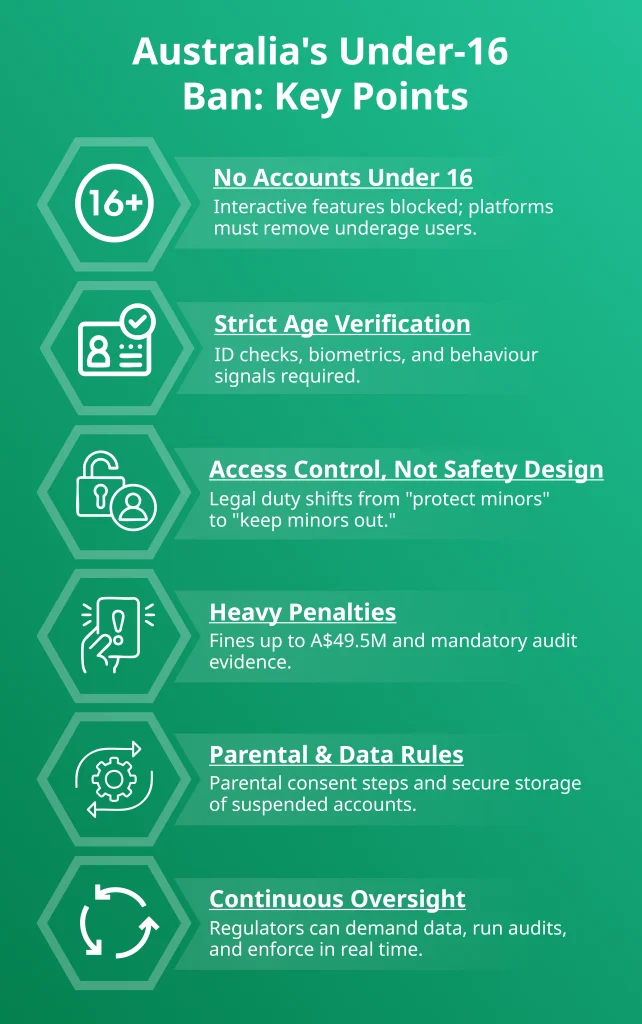
Australia’s new legislation goes far beyond the typical safety-feature model used in the EU or the UK. It establishes a mandatory, access-based prohibition that stops anyone under 16 from creating or using accounts on ten major social platforms: Facebook, Instagram, Snapchat, Threads, TikTok, Twitch, X, YouTube, Kick, and Reddit. (source: eSafety)
These rules officially took effect on 10 December 2025, making access by under-16s illegal from that date onward.
Children can still see content passively, but all interactive functionality (posting, commenting, messaging) is locked behind age-verified accounts.
Mandatory Age Verification & Identity Checks
Platforms must take “reasonable steps” to confirm a user is over 16. In practice, this means deploying age-assurance technologies far more intrusive than the EU’s or UK’s current standards, including:
- Verification via official identity documents
- Biometric age estimation (live video selfies, facial scans)
- Behavioural analysis (social graph, browsing patterns, account history)
The law doesn’t prescribe a single method, but regulators expect multi-layered verification and will treat weak assurance as non-compliance. Early reporting shows that minors can still circumvent some checks, which is a risk that will push Australia toward even stricter enforcement in the coming year.
Access-Based Restrictions, Not Just Content Rules
Unlike the Digital Services Act (EU) or the UK’s Online Safety Act, Australia isn’t asking platforms to protect minors through content changes. It is removing minors entirely from the platform ecosystem. Under-16s cannot legally hold accounts, and platforms must proactively suspend or deactivate them.
This is a fundamental shift: The compliance obligation is no longer “keep them safe,” but “keep them out.”
Penalties, Oversight, and Audit Requirements
Enforcement is aggressive. Platforms that allow underage access face penalties up to A$49.5 million (£25 million). To demonstrate compliance, companies must maintain:
- Documented age-verification workflows
- Records of enforcement actions
- Internal audits of suspended or removed accounts
- Incident reporting when verification fails
The government’s eSafety Commissioner has broad investigative powers and may require evidence of the technical and operational steps taken.
Parental Consent and Data Handling
Users can reactivate accounts once they turn 16, and several platforms are storing deactivated minors’ data until that date. The law also expects robust parental involvement, creating new operational requirements around:
- Parental consent validation
- Secure storage of suspended accounts
- Transparent communication when a minor is removed
This introduces a new compliance architecture that blends online safety, identity governance, and data lifecycle management.
Regulatory Model: Compliance as an Ongoing Operational Burden
Australia’s ban is not a static rule; it’s a supervised compliance regime. The eSafety Commissioner can:
- Update the list of banned platforms
- Request verification data
- Order audits or technical explanations
- Penalise failures in real time
This mirrors financial-sector regulation more than typical tech policy, and it signals where global legislators may go next.
YouTube Highlights Operational Side Effects for Parents
YouTube has already warned that the ban will have unexpected side effects for families. The platform noted that parents will lose the ability to supervise or configure their teen’s account, including content settings, channel blocking, and personalised restrictions.
Children will still be able to watch videos without logging in, but YouTube’s parental controls only function on signed-in accounts, creating a new operational and safety challenge for parents and regulators alike. (source: BBC)
“Most importantly, this law will not fulfil its promise to make kids safer online, and will, in fact, make Australian kids less safe on YouTube. We’ve heard from parents and educators who share these concerns.”
Rachel Lord, Public Policy Senior Manager, Google and YouTube Australia, in Google’s blog post on December 9, 2025
This highlights that compliance changes often create secondary safety challenges, even when platforms attempt to adapt responsibly.
How Australia Breaks New Ground Compared to the UK
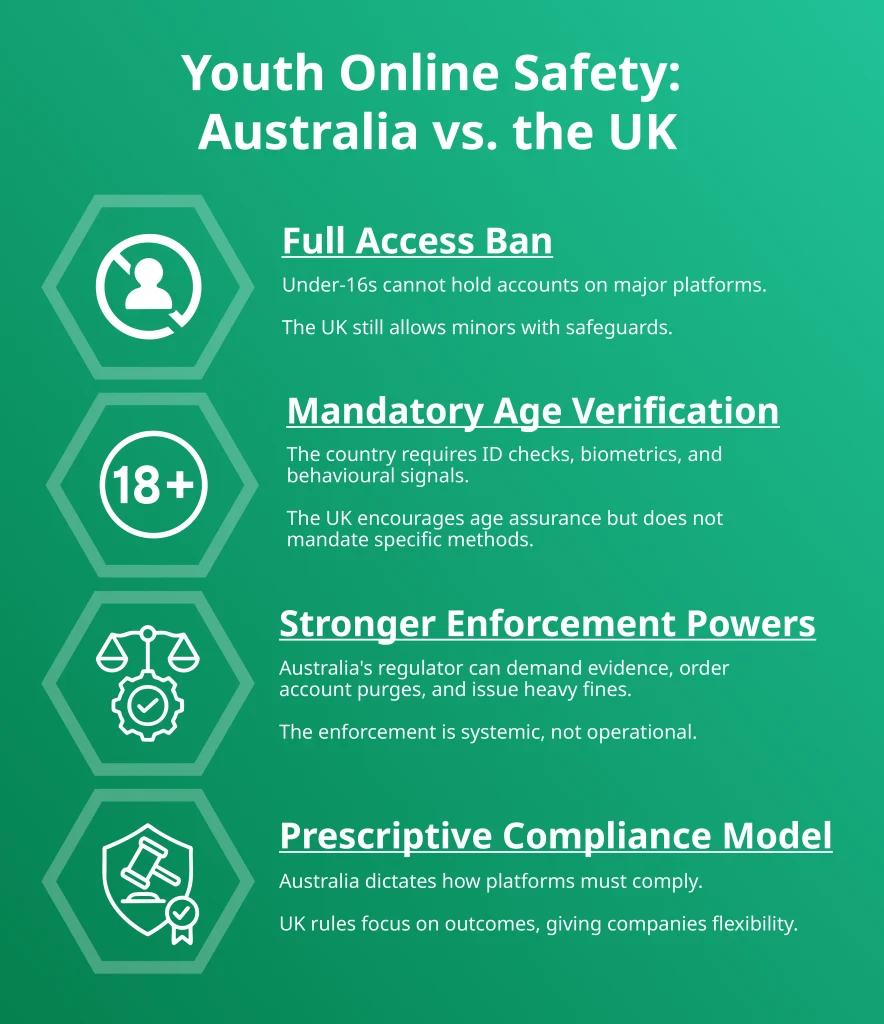
Australia’s model is the first in the West to move from protecting minors while they are on platforms to preventing minors from being on those platforms at all.
This represents a significant escalation beyond anything currently required under the UK’s Online Safety Act (OSA), which focuses on risk mitigation rather than access prohibition.
The UK also operates under the ICO’s Children’s Code, which enforces age-appropriate design standards but still stops short of requiring hard identity verification.
Australia’s approach introduces several regulatory elements that go far beyond current UK expectations:
A Default Legal Ban on Under-16 Accounts:
This is not a safety feature but a legally enforced prohibition. Anyone under 16 is barred from creating or using accounts on major platforms.
UK comparison:
The OSA does not ban minors from social media. Instead, UK platforms must assess the harm risks to children, apply safety-by-design measures, and restrict certain features for teens. But minors are still permitted to have accounts if appropriate protections are in place.
Mandatory Age Verification Backed by Law
Australia legally requires platforms to deploy age-assurance mechanisms that satisfy regulators. This includes:
- Identity document checks
- Biometric age estimation
- Behavioural analysis of usage patterns
Platforms are held accountable for the effectiveness of these systems.
UK comparison:
The OSA encourages age assurance but does not mandate any specific verification technology. Ofcom requires platforms to demonstrate that they can identify children with reasonable accuracy, but there is no legal obligation to verify identity. Platforms retain the flexibility to choose lighter-touch solutions, and implementation varies widely across the industry. Australia removes this flexibility entirely.
Stronger Government Enforcement Powers
Australia’s enforcement model is far more hands-on than anything the UK currently operates. The eSafety Commissioner can step directly into a platform’s operations, asking for proof of how age verification works in practice, requesting data on removed under-16 accounts, and ordering large-scale account clean-ups when needed.
Penalties are substantial, but the bigger shift is the level of oversight: compliance isn’t reviewed months later through reports and audits but monitored in real time, with regulators able to intervene the moment something appears out of line.
UK comparison:
Ofcom has strong fining powers, but enforcement is systemic, not operational. It can penalise platforms for failing to meet safety duties, but does not oversee account-level enforcement, require evidence of individual age-verification decisions, or mandate account removals for specific age groups. The UK model remains more hands-off in day-to-day operations.
A Prescriptive Compliance Framework (vs. the UK’s Principle-Based Approach)
Australia goes a step further by specifying exactly how platforms must comply. Instead of giving companies room to interpret the rules, the law requires them to deploy effective age-verification systems, maintain detailed audit trails, provide regulators with clear evidence of enforcement, and follow procedures defined by regulators.
UK comparison:
The OSA sets out outcome-focused duties (e.g., protect children from harmful content) but allows platforms significant freedom in how they achieve those outcomes. Ofcom issues codes of practice, but companies may use alternative approaches if they can justify them.
The Compliance Model That Could Reshape UK Platform Obligations
Australia’s approach is far more prescriptive than anything we’ve seen in Europe or the UK. Instead of simply outlining the outcome it expects, the law spells out how platforms must meet those expectations, from the technical controls they put in place to the evidence they provide.
Where frameworks like the GDPR and the Online Safety Act leave room for interpretation and alternative approaches, Australia closes that gap almost entirely. There’s very little flexibility in how compliance is achieved.
Why Australia’s Under-16 Ban Matters for UK CTOs: The Regulatory Signal Behind the Policy
Australia’s under-16 social media ban is a breakpoint. For the first time, a major Western nation has moved from protecting minors on platforms to removing them from those platforms entirely. That shift sends a global signal, and the UK cannot afford to treat it as a distant experiment.
The Online Safety Act already puts child protection at the heart of the UK’s digital governance agenda, but it still operates on the principle of assessing risks, mitigating harms, and documenting your decisions.
The “how” is flexible. Australia replaces recommendations with requirements and introduces mandatory age checks, locked-down onboarding flows, and strict evidence trails that prove compliance, not just promise it.
This change reflects something bigger: youth safety is no longer seen as a content or moderation issue; it’s being treated as a public-health challenge.
Regulators are shifting from a trust-but-verify approach to a verify-and-enforce approach. Platforms must show that under-16s cannot slip through identity checks, that onboarding journeys block workarounds, and that minors are removed quickly when detected. Compliance becomes continuous, supervised, and measurable.
And the UK is watching.
If Australia’s model delivers political wins or measurable harm reduction, Westminster and Ofcom will feel pressure to tighten their own approach. That may not mean a full under-16 ban, but it could mean tougher requirements for high-risk environments like short-form video apps, anonymous networks, and algorithmic social platforms. Once access control becomes part of the public conversation, it’s hard to walk it back.
For CTOs, CPOs, and CISOs, the implication is that the regulatory bar is rising faster than the industry’s default architectures were designed to handle. The organisations preparing now (upgrading identity systems, mapping onboarding variants, and building traceable compliance workflows) will be the ones that adapt smoothly when the UK inevitably tightens its stance.
The direction of travel isn’t subtle. Australia just turned the dial. The UK will decide how far to follow, but not whether to engage with the shift.
Compliance Implications: What UK Engineering & Product Teams Must Prepare For
Australia’s ban introduces a new operational reality. If similar expectations eventually make their way to the UK, engineering and product teams will face a level of scrutiny and technical obligation that goes far beyond current Online Safety Act requirements.
Preparing early will matter, not because change is guaranteed, but because the cost of reacting late will be far higher.
One of the clearest signals is the shift toward stronger age verification. Australia has normalised the idea that platforms should prove a user’s age, not merely ask for it.
If the UK moves in the same direction, teams will need to evaluate third-party verification providers, explore privacy-preserving age-assurance models, and establish policies around biometric data.
Borderless identity management will also become a challenge, especially for global platforms serving both regulated and lightly regulated markets.
Compliance won’t stop at verification. Australia’s framework forces companies to produce concrete evidence that they are enforcing the ban, which translates into detailed audit trails, documented enforcement decisions, and system logs that withstand regulator scrutiny.
The UK is already edging in this direction through OSA enforcement discussions, and Ofcom has made it clear that stronger audit expectations are on the horizon.
Data governance for minors will also evolve. Children’s data is already classified as high-risk under both GDPR and the Online Safety Act, but a more rule-bound model (similar to Australia’s) could introduce new rules around retention, minimisation, and deletion. Managing suspended accounts, parental permissions, and age-based data states will require systems designed for precision.
All of this has a direct impact on engineering velocity. Introducing gated user journeys, parental approval workflows, or region-specific onboarding logic will add friction to both product development and testing.
Each regulatory touchpoint becomes another dependency to maintain, another scenario to model, and another place where compliance and product goals intersect.
This is the operational reality Australia is building, and it’s a preview of what could reach the UK if public pressure or political momentum shifts. Early preparation protects product roadmaps from the shock of regulatory change.
Will the UK Follow Australia? Realistic Short-Term & Mid-Term Scenarios
Australia’s ban has changed the global tone around youth safety, and the UK will have to decide how far it wants to follow that lead. Here are the most realistic pathways, each with different implications for engineering, compliance, and product teams.
Scenario 1: Partial Adoption (Most Likely)
The UK tightens controls without introducing a full ban. High-risk platforms (such as anonymous chat apps, addictive short-form video services, and algorithm-heavy networks) become the primary targets.
Mandatory age verification could be required for these environments, allowing policymakers to strengthen protections without banning all under-16s from social media. This approach delivers political signalling without overhauling the entire regulatory landscape.
Scenario 2: Full Under-16 Ban (Medium Probability)
A universal ban becomes plausible if a major youth-safety incident sparks national debate or if regulatory pressure intensifies during an election cycle. Under this outcome, the UK may mirror elements of Australia’s model: identity checks backed by law, prescriptive onboarding requirements, and real-time oversight from Ofcom. It’s a bolder move, but one that gains traction quickly if public sentiment shifts.
Scenario 3: Strengthened UK Model, No Ban (Longer Horizon)
The UK maintains its safety-by-design approach but reinforces the system behind it. Expect stronger audits, higher penalties, and stricter expectations for how platforms identify and protect minors, all without removing young users entirely. This is the least disruptive path and fits the UK’s current regulatory philosophy, but it may not satisfy future political pressure if online harms continue to rise.
Strategic Guidance for UK CTOs: What to Do Now
Australia’s ban has created a new regulatory baseline, and while the UK hasn’t crossed that line yet, the direction of travel is unmistakable. CTOs don’t need to rebuild their systems overnight, but they do need to prepare.
A smart starting point is a current-state regulatory gap analysis. Comparing today’s controls to the kinds of verification, logging, and data-governance expectations emerging in Australia helps expose which parts of your architecture are adaptable and which ones aren’t.
From there, product and engineering teams can design more flexible onboarding pathways that can handle region-specific requirements, stronger age assurance, or parental consent workflows without disrupting core functionality later.
Governance also needs a refresh. Evidence trails, internal audits, and risk registers must evolve to anticipate more prescriptive oversight rather than to rely on principle-based interpretation. That shift demands cleaner documentation, more transparent accountability, and stronger internal processes for demonstrating why decisions were made, not just how.
And this isn’t theoretical. Organisations already operating in regulated or sensitive environments are feeling similar pressure and thriving when the right foundation is in place.
Little Journey, for example, dramatically improved system security and reduced manual labour by 70% after moving to a fully automated, compliant cloud architecture powered by Terraform and robust DevSecOps pipelines.
Another client in the crypto sector cut deployment time by 35% and tripled transaction capacity after re-engineering their infrastructure to meet strict stability and scalability demands, the same kind of operational discipline regulators increasingly expect.
These outcomes show what becomes possible when compliance, automation, and engineering velocity are aligned rather than competing priorities.
That’s why this is the right moment for UK organisations to evaluate RegTech tooling and build automated compliance into the delivery pipeline. The goal is not to predict every regulatory change, but to become the kind of organisation that can adapt quickly when change arrives.
How UK CTOs Can Prepare for Australia-Style Regulation
Preparing for stricter youth-safety and platform-governance rules requires more than policy updates. It demands architectural clarity, operational evidence, and systems designed to adapt as regulation tightens.
Support typically focuses on four practical areas:
- Regulatory gap analysis and architecture review: Identity flows, onboarding logic, data handling, and auditability are reviewed against emerging Australia-style expectations to surface exposure and prioritise remediation.
- Identity and age-verification architecture design: Age-assurance models are designed to match product risk, privacy requirements, and regional obligations, including guidance on verification approaches and vendor selection.
- Automated compliance pipelines: Policy-as-code, compliance checks, and audit-ready logging are embedded into delivery pipelines so enforcement can be demonstrated clearly and consistently.
- Ongoing managed DevSecOps with regulatory monitoring: Security, compliance, and delivery remain aligned through continuous monitoring as rules evolve, reducing the risk of reactive, high-cost change later.
CTO Readiness Checklist (Quick Reality Check)
Australia’s under-16 ban shows where regulation is heading: enforcement must be provable. Before similar expectations reach the UK, CTOs should be able to answer the following questions.
Do you have:
- A unified identity model that stores verified age and how it was verified
- Region-specific onboarding flows controlled by feature flags
- Centralised audit logs for age verification and enforcement actions
- Clear data-retention rules separating minors from adult users
If any of these are unclear, your platform is compliant with today’s rules, but not designed for where regulation is going.
How Deployflow Helps UK CTOs Prepare for Australia‑Style Regulation
For companies preparing for tighter youth-safety and platform-governance rules, Deployflow’s DevOps managed services can provide that foundation by integrating compliance checks, documentation, and verification workflows directly into everyday engineering practices, keeping teams fast, secure, and audit-ready.
Shifting regulations are coming. The teams that prepare early will be the ones who stay ahead.
Next Step for UK CTOs
If you’re a UK CTO or technical leader and want to understand how exposed your current architecture is to an Australia-style regulatory model, a focused assessment can quickly surface the real risks.
In 2–3 weeks, it becomes possible to identify gaps in age verification, onboarding flows, audit readiness, and data handling before regulation forces reactive change.
Book a 30-minute consultation to discuss whether this assessment makes sense for your platform.
Frequently Asked Questions: Social Media Regulation & Under-16 Safety
Will VPNs allow under-16 users in the UK or Australia to bypass age restrictions?
A VPN alone will not reliably bypass age restrictions because age verification measures do not rely on location data.
Modern age-assurance systems are increasingly tied to identity signals (such as biometrics, behavioural analysis, or document checks) rather than IP addresses. While some users may attempt to avoid the rules through VPNs, platforms are under pressure to detect and prevent such workarounds as part of their compliance obligations.
Australia has already stated that VPN circumvention will not be considered a valid loophole, and regulators expect platforms to block suspicious activity patterns. If the UK eventually strengthens age-verification rules, VPNs are unlikely to undermine compliance with those rules meaningfully.
How will stricter age verification affect user onboarding and conversion rates?
Stronger age verification will slow down onboarding and may initially affect conversion rates for younger demographics.
Platforms will need to adjust sign-up flows to accommodate additional verification steps, which can introduce friction and increase abandonment.
However, regulators are growing more comfortable with this trade-off, especially for high-risk platforms. Companies that invest in seamless, privacy-preserving age-assurance technologies will experience less disruption, but the need for clearer user journeys and stronger parental involvement will still reshape onboarding design. Over time, verification may become an industry norm, reducing its impact on user expectations.
Will platforms need to redesign their data-retention policies for minors under new regulations?
Yes, stricter youth-safety rules will require more prescriptive retention, deletion, and minimisation policies for minors’ data.
Australia already expects platforms to store, suspend, or delete underage accounts in very specific ways, creating a precedent that could reach the UK. Under the Online Safety Act, children’s data is already treated as high-risk, and Ofcom is expected to demand stronger evidence that platforms handle it responsibly. This may include shorter retention windows, clearer parental permissions, and universal deletion rules when a child turns 16.
Explore our BLOG
Recent articles

ISO 42001 Explained: Requirements, Certification and What Your Engineering Team Must Build
ISO 42001 is the international standard that demonstrates your organisation governs AI properly, and enterprise...
read full article

Is Claude Down? Anthropic Outage: Protect Your Cloud Infrastructure
Claude went down across every surface on 29 September 2026. From 14:00 to 14:59 UTC,...
read full article

Top 10 Healthtech Companies in 2026: What Their Growth Means for AI and DevOps
Every software change that reaches a hospital has to clear regulatory, legacy system, and clinical...
read full article