


DevOps automation services are now essential as businesses struggle with increasingly complex and fragmented delivery pipelines.
Nearly half (47%) of businesses experienced data loss in 2024, highlighting the urgent need for robust DevOps automation and disaster recovery practices (Gearset’s State of Salesforce DevOps 2025).
Businesses that simplify their automation tools are five times more likely to deploy changes in under an hour, showing how effective DevOps automation speeds up delivery.
This guide explains how DevOps automation directly helps businesses overcome risks like data loss, deployment delays, and operational complexity by:
- Why automation is essential for reducing complexity and improving delivery speed.
- The specific tools that drive reliable CI/CD automated services and scalable infrastructure.
- Step-by-step methods to implement automation without disrupting current workflows.
- How expert consultancy accelerates success while avoiding costly missteps.
For SMBs navigating rapid growth, automation is the difference between scalable success and operational bottlenecks. This guide shows exactly how to get automation right from the start.
What Is DevOps Automation and Why It Matters
DevOps automation integrates and streamlines tasks across the entire software development lifecycle (SDLC). It removes manual handoffs between development, testing, deployment, and operations teams by automating routine and repetitive processes. This means faster, more reliable software delivery.
The purpose of DevOps automation is to:

In cloud-native environments, where rapid growth and frequent changes are standard, automation keeps systems stable and ensures compliance with industry regulations.
The core automation stack often includes tools like Jenkins or Bitbucket Pipelines to manage continuous integration and deployment workflows.
Infrastructure is provisioned consistently using Infrastructure as Code platforms such as Terraform.
For teams adopting containerisation, Docker and Kubernetes provide the scalability and orchestration needed to support cloud-native growth.
Rapid growth makes automation crucial for staying in control, reducing overhead, and delivering updates quickly and reliably.
Key Benefits of DevOps Automation for Businesses
The strategic advantages of automation extend across technical, operational, and financial domains:
Faster Delivery
CI/CD pipelines provide fast releases, while UK firms lose £107K yearly as deployment delays average nearly 4 months, according to Gearset.
Fewer Errors
Standardising workflows through automation reduces manual mistakes and strengthens security across environments.
Higher Productivity
Developers focus on feature creation while automation manages testing, deployments, and infrastructure updates.
Lower Costs
Automation reduces downtime, prevents configuration drift, and ensures optimal cloud resource use. UK companies waste up to 32% of cloud spend on unused or misallocated resources, says CloudZero.
Better Quality
Automated testing catches defects early, helping prevent costly production issues. Top DevOps teams have 7x lower failure rates than low performers (DORA, 2023).
With well-implemented automation, SMBs deliver faster, more reliable software without the heavy costs, complexity, or firefighting that often slow down growing teams.
How to Implement DevOps Automation Successfully
A methodical, step-by-step approach ensures successful automation integration:
- Optimise Infrastructure First: Start by replacing manual infrastructure setup with Infrastructure as Code (IaC). Use tools like Terraform to create consistent, version-controlled environments that can be deployed and replicated automatically.
- Build the DevOps Pipelines: Set up CI/CD pipelines with tools such as Jenkins, Bitbucket Pipelines, or GitHub Actions. These pipelines handle code integration, automated testing, and smooth deployments across staging and production environments.
- Automate Testing and Compliance Early: Shift testing and compliance checks to the start of the pipeline. Automate security scans, code quality checks, and policy enforcement during development to catch issues before they reach production.
- Use Containers and Orchestration When Needed: If applications require scalability, adopt Docker for packaging and Kubernetes for orchestration. Containers simplify deployments and make scaling services across cloud environments far more efficient.
- Monitor and Fine-Tune Continuously: After deployment, track system health, reliability, and security in real time. Use monitoring data to optimise performance, prevent issues, and plan for future growth.
Of course, none of this works if your infrastructure is still stuck on old systems that can’t keep up. That’s why many teams start by moving their existing workloads to the cloud. A proper cloud migration lays the foundation, so automation, scaling, and modern delivery pipelines aren’t constantly fighting against legacy roadblocks.
The right implementation partner helps turn technical setup into practical results that actually support the business from the start.
Why the Right Consultancy Partner Matters
Successful DevOps automation is about making tools work together within the reality of your business. Pipelines, infrastructure, compliance, security, and long-term maintainability must all connect seamlessly. That’s where the right consultancy turns complexity into momentum.
The right partner delivers more than just implementation:
- Tailored Solutions: Every business has its own tech stack, workflows, and risk profile. Off-the-shelf playbooks often break under real-world complexity. A strong consultancy aligns automation directly to your business priorities.
- Toolchain Mastery: Deep expertise across CI/CD, Infrastructure as Code (IaC), cloud platforms, and security frameworks ensures technology decisions are future-proof and fully integrated.
- Transparent Collaboration: Clear, ongoing communication with internal teams builds confidence, enables knowledge transfer, and avoids creating new dependencies.
- Proven Execution: Real experience matters. Consultancies with a delivery track record in regulated and complex environments bring battle-tested approaches to avoid costly missteps.
Real-World Results: How Strike Recovered from DevOps Breakdown
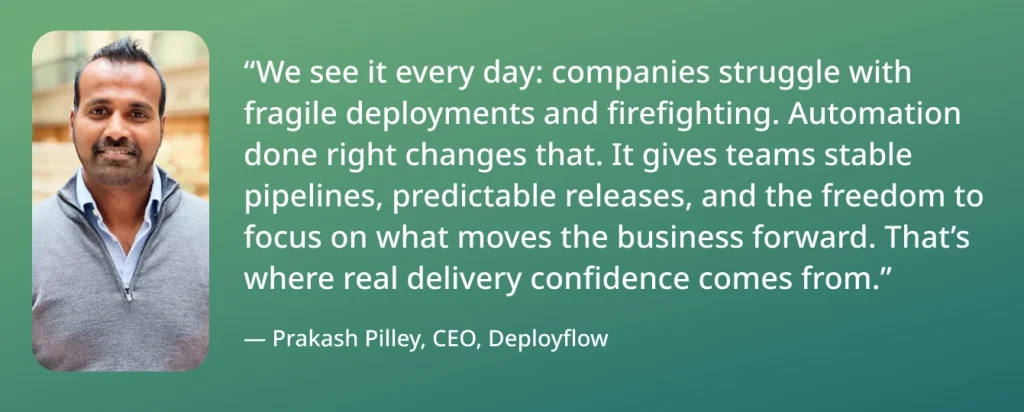
A great example of this is Deployflow’s work with Strike, the UK property platform now operating under Purplebricks.
With their internal DevOps team gone, Strike was left fighting instability, database outages piled up, deployments became fragile, and unresolved issues kept growing. Short-term fixes couldn’t keep up, leaving the business exposed and in urgent need of a scalable, reliable solution.
Deployflow became the missing piece Strike needed. In a matter of days, the team dived in directly into daily operations, clearing access issues, resolving outages, and rebuilding fragile pipelines to restore release stability.
With AWS, Terraform, Lambda, and other cloud-native tools, Deployflow rebuilt a stable, resilient foundation that let Strike focus fully on growth instead of putting out fires.
Best part? These results were measurable:

Strike’s turnaround is one example of how Deployflow’s DevOps as a Service gives companies the stability, speed, and expert support they need to keep moving, even in complex, high-pressure environments.
For CTOs dealing with talent gaps, mounting complexity, or fragile legacy systems, the right consultancy offers stability where things break, momentum where things stall, and confidence where risks once lived.
What are the main goals of DevOps automation?
At its core, DevOps automation isn’t about adding more tools – it’s about removing friction from software delivery so teams can build, release, and scale with confidence. In real-world environments, that translates into several concrete goals:
1. Make Software Delivery Predictable and Repeatable
Automated pipelines turn deployments from risky events into routine operations. For example, instead of a developer manually copying files to production at 2 AM (hoping nothing breaks), automation handles every step, from code integration to testing to deployment, with consistent results every time.
2. Reduce Human Error by Eliminating Manual Touchpoints
Every manual step is a chance for something to go wrong, missed configuration files, forgotten environment variables, or last-minute hotfixes that introduce new bugs. Automation removes these risks by enforcing standard processes end-to-end.
3. Deliver Faster Without Sacrificing Stability
The goal is safe speed. Automation enables more frequent releases while still running automated tests, validations, and rollbacks to catch issues before they reach users. Mature teams can confidently release multiple times per day, not once per quarter.
4. Bake In Security and Compliance From the Start
In regulated industries like Fintech or MedTech, automation gives that security scans, code quality checks, and compliance audits happen automatically at every stage. This prevents last-minute security checks before go-live and keeps audit trails fully intact.
5. Scale Infrastructure Seamlessly as Demand Grows
In cloud-native environments, automation makes it possible to spin up new resources instantly based on workload needs. For example, if a SaaS platform experiences a sudden traffic spike, automated infrastructure scaling can add capacity in real-time without manual intervention, keeping systems responsive and users happy.
When done right, DevOps automation turns fragile delivery processes into resilient, scalable systems that free both engineers and the business to focus on real growth instead of firefighting.
Continuous delivery is built on the idea that software should always be ready for production, no matter when the business decides to release. For a deeper dive into these principles, see Martin Fowler’s Continuous Delivery.
How Does DevOps Automation Reduce Time to Market?
Automation takes repetitive tasks off engineers’ plates, such as merging code, running tests, setting up environments, and handling deployments. Instead of developers waiting hours (or days) for manual QA or staging setup, new features, bug fixes, and security patches can move from commit to production in a matter of minutes.
Standardising these workflows not only accelerates delivery but also allows teams to react quickly when business priorities shift, whether it’s pushing a hotfix to address a critical vulnerability or releasing a new feature to stay ahead of competitors.
Which tools are best for implementing DevOps automation?
A variety of industry-standard tools power effective DevOps automation:
- Jenkins, GitHub Actions, Bitbucket Pipelines: Automate code testing, merging, and deployment, so engineers aren’t stuck manually moving code between environments or waiting for approvals.
- Terraform, Ansible: Replace fragile setup documents with Infrastructure as Code, allowing entire environments to be spun up or recreated in minutes, fully version-controlled and consistent.
- Docker, Kubernetes: Package applications into containers that behave the same everywhere (whether on a developer’s laptop, in staging, or in production), while Kubernetes handles orchestration and scaling automatically.
- SonarQube, Snyk: Continuously scan code for security vulnerabilities, bugs, and code quality issues before they ever reach production, reducing risk without slowing delivery.
- Custom combinations: The right stack always depends on the business: its architecture, regulatory requirements, in-house skills, and how aggressively it plans to scale.
The best mix isn’t one-size-fits-all. It depends on the business’s existing architecture, the technologies already in play, the team’s capabilities, and how quickly the company needs to scale.
How do DevOps consultants help with automation strategies?
DevOps consultants help companies avoid the trial-and-error that often slows down internal teams. In practice, their role covers several critical areas:
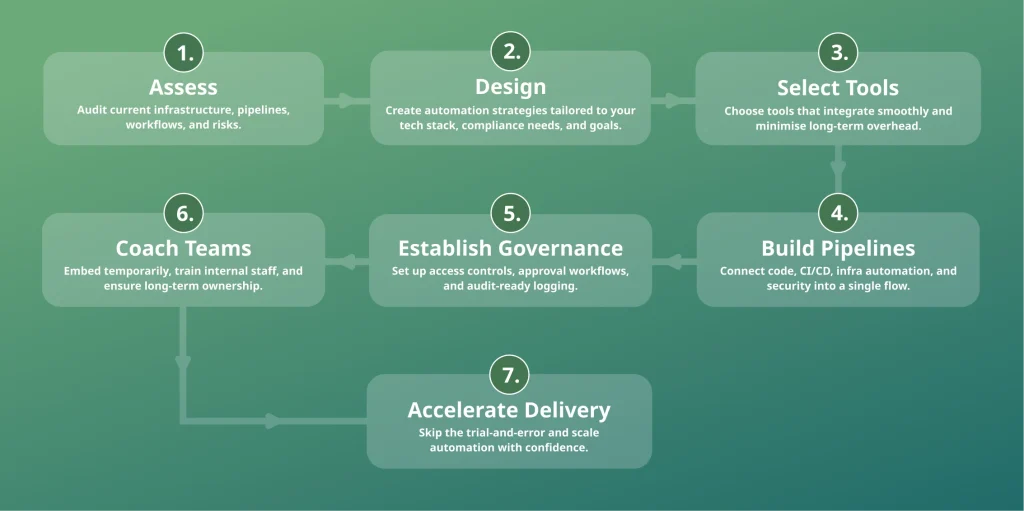
- Assess what’s already there. They start by auditing the current infrastructure, code pipelines, deployment processes, and team workflows. This helps identify what’s working, where bottlenecks exist, and which manual processes create unnecessary risk or delays.
- Design automation that fits reality. Instead of offering generic playbooks, consultants design pipelines, infrastructure, and tooling that match the company’s actual tech stack, team skills, compliance requirements, and growth plans. For example, a fintech startup subject to FCA regulations will need a different approach than a SaaS platform pushing daily updates.
- Select the right tools, not just popular ones. With hands-on experience across multiple environments, consultants know where certain tools shine and where they break. They help select technologies that integrate smoothly with existing systems while minimising long-term maintenance headaches.
- Build pipelines that actually flow. Many internal teams struggle with connecting code repositories, CI/CD platforms, infrastructure automation, monitoring, and security scans into one seamless flow. Consultants design and implement these end-to-end pipelines so that code moves safely from development to production without constant manual interventions.
- Establish governance and guardrails. As automation scales, consultants help set up role-based access, audit logging, approval workflows, and automated compliance checks — especially critical for regulated industries where audit trails and security controls are non-negotiable.
- Coach internal teams for long-term ownership. Rather than creating dependency, strong consultants embed themselves temporarily, train internal staff, document processes, and transfer knowledge, so the business owns the automation long after the engagement ends.
- Accelerate maturity. Most importantly, consultants help companies skip years of costly mistakes by applying patterns and solutions proven across multiple businesses and industries. What might take an internal team 12–18 months to figure out can often be done in a fraction of the time with the right guidance.
Even after automation is fully up and running, the job’s not done. Systems still need ongoing care; outages happen, environments drift, and small issues can snowball fast.
Deployflow’s IT managed support really makes a difference, keeping everything running smoothly while your team stays focused on actual product work instead of babysitting infrastructure.
24/7 Eyes, Smart Prevention, and Bulletproof Systems
What’s your plan when things break in the middle of the night?
Your app is growing fast. Users are signing up, traffic spikes on launch days, and expectations are high.
But one night, a server goes down. Then another. Support tickets pile up. Suddenly, your team is firefighting instead of building.
This is precisely where Deployflow delivers its strongest value.
Deployflow’s experts don’t wait for alerts; they watch your systems 24/7, respond to issues in minutes, and prevent problems before they begin.
The team integrates with yours, keeps your cloud infrastructure stable under pressure, and makes sure you’re always compliant, no scrambling before audits, no last-minute patches.
With Deployflow, the 3 AM outage never becomes a crisis. It’s spotted, fixed, and documented before your customers even notice.
That’s what real DevOps support looks like.
Final Thoughts: Build with Automation at the Core
When pipelines are fully automated, releases don’t stall because a key engineer is on holiday, staging environments don’t need to be rebuilt manually, and critical security patches ship the same day instead of next quarter.
With the right strategy, companies reduce complexity, speed up delivery, and build resilience directly into their operations, turning fragile processes into stable engines for growth.
That’s the kind of stability and momentum Deployflow helps companies build, keeping delivery on track, even when the pressure’s high and the environment is complex.
For any SMB serious about long-term growth, embedding automation early is how you stay competitive, protect your delivery, and give your team room to innovate where it matters most.
If your team’s ready to simplify delivery and cut through the complexity, let’s have a conversation.
Frequently Asked Questions About DevOps Automation
What is DevOps automation?
DevOps automation means handing repetitive, error-prone tasks over to reliable systems. Instead of manually running tests, deploying code, or configuring servers, teams use automation tools to handle these steps consistently. This speeds up delivery, reduces mistakes, and allows developers to focus on building features instead of managing infrastructure.
Is DevOps automation only for large enterprises?
Not at all. In fact, automation can be even more valuable for small and mid-sized businesses. Smaller teams often have limited resources, so automating deployments, testing, and infrastructure helps them move faster without burning out staff or creating risky manual processes. It’s how many SMBs punch above their weight as they scale.
Can DevOps automation improve security?
Absolutely. By embedding security checks directly into the development pipeline, teams can catch vulnerabilities early, before code ever reaches production. Things like static code analysis, dependency scanning, and automated compliance checks run automatically with every code change, making security part of the normal workflow rather than a last-minute scramble.
What tools are commonly used in DevOps automation?
It depends on the stack, but many teams use Jenkins, GitHub Actions, or Bitbucket Pipelines to automate builds and deployments. Tools like Terraform handle infrastructure setup through code, while Docker and Kubernetes manage containers and scaling. For security and code quality, platforms like SonarQube and Snyk are often used to spot issues automatically during development.
Explore our BLOG
Recent articles

Is Claude Down? Anthropic Outage: Protect Your Cloud Infrastructure
Claude.ai has spent 2026 fighting its own success. Twenty-one incidents landed between 12 August and...
read full article

AI Experimentation vs AI Engineering: The Difference That Decides Whether Your AI Budget Survives
Experimentation buys you knowledge. Engineering buys you a system that still works next quarter, when...
read full article

Why Most Agentic AI Projects Fail Before They Scale
Has your agent been three months from production for nine months? Agentic projects break at...
read full article