



Your platform can run on thousands of nodes and still go offline when a single cloud region fails. That is the real story behind the worst crypto outages of the past year. The blockchain rarely broke. The cloud beneath it did.
In October 2025, one AWS region disrupted Coinbase, Robinhood, and several Ethereum layer-2 networks at the same time. (NBC News) The exchanges that stayed up were not luckier. They were built differently.
By the end, you will know where your own platform is centralised, what an outage would cost, and how to keep it trading when a provider cannot.
Crypto Outage Risk at a Glance
- The recent crypto outages were cloud failures, not blockchain failures.
- A single AWS region downed Coinbase for over three hours in October 2025.
- Exchanges on multi-region or multi-cloud setups, such as Kraken and OKX, stayed online.
- The top three clouds hold ~63% of the market, so one fault hits many firms at once.
- Resilience is an architecture decision: multi-region, IaC, tested failover, observability.
- One Deployflow rebuild took an exchange to 35% faster deploys and 200% more capacity.
- UK and EU regulators now classify cloud concentration as systemic risk (CTP, DORA).
The Real Reason Crypto Platforms Keep Going Offline
The fault is almost always below the chain. On 20 October 2025, a DNS resolution failure in DynamoDB, a database service that much of AWS relies on, cascaded through the us-east-1 region. Coinbase users saw degraded performance for three hours and seventeen minutes, a figure the exchange confirmed in its own post-incident review.
Base, Coinbase’s own layer-2 network, reported reduced capacity, and the node provider Infura was caught in the same event.
For a full breakdown of how one DNS fault spread across the region, see Deployflow’s analysis of the October 2025 AWS outage.
The pattern returned in 2026. On 8 May, Coinbase went offline for more than two hours after a thermal event in a single availability zone caused a power loss that damaged hardware. The timing stung, as the outage landed on the day of the company’s quarterly earnings.
The weakness appeared elsewhere in 2025 as well. A power failure at an AWS data centre on 15 April froze withdrawals and trading on Binance, KuCoin, and MEXC for around an hour, disrupting a market that turns over roughly $45 billion a day.
One detail explains why a single fault reaches so far. Amazon, Microsoft, and Google together account for 63% of enterprise spending on cloud infrastructure (Synergy Research Group). Much of the industry sits on the same few platforms, often in the same default region. When that region stumbles, the damage is shared.
The diagram below shows how one local fault becomes a full outage and where a resilient design breaks the chain.
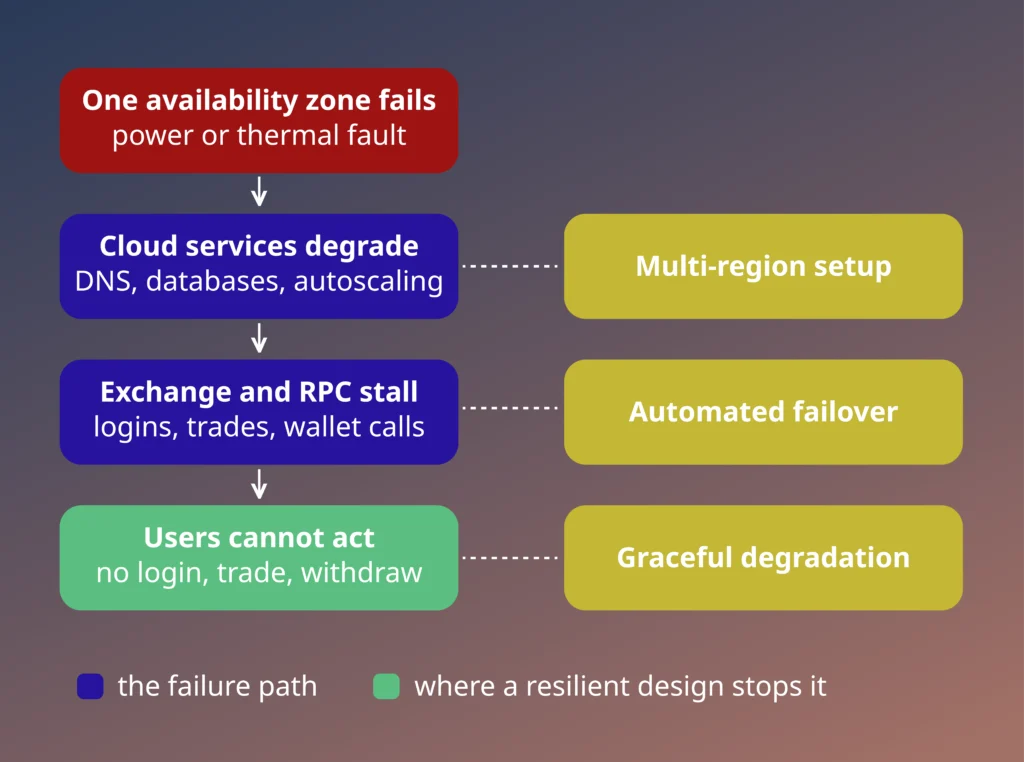
Where Crypto Platforms Are Centralised: Four Common Chokepoints
Consensus is only one layer. Everything a user touches sits above it, and most of that upper stack runs through a few chokepoints. The four that matter most:
- Front-end and APIs. Web and mobile clients, load balancers, and logins usually live with one provider, often in one region. Lose the region, lose the app.
- Node and RPC layer. Wallets and dApps rarely run their own nodes. They call a small set of providers, so one stalled provider can freeze reads and writes across many apps.
- Layer-2 sequencers. Many rollups rely on a centralised sequencer to order transactions, which a cloud incident can throttle directly.
- Exchange and custody. A centralised exchange is centralised by design. Its matching engine and custody are engineering assets, and their reliability is an engineering property.
A platform can be decentralised in its marketing and centralised in its operations. Run a quick test on your own stack.
- Do your front end and APIs live in a single region?
- Do your wallets and dApps depend on one RPC provider?
- Does a centralised sequencer order your rollup’s transactions?
- Is your matching engine tied to one cloud?
Every “yes” is a single point of failure waiting for its regional outage.
The True Cost of Downtime for a Crypto Trading Platform
Downtime has a price, and independent data puts a figure on it. In the Uptime Institute’s Annual Outage Analysis 2026, 57% of operators said their most recent major outage cost more than $100,000, and for the second year running, one in five put the cost above $1 million. These are cross-industry figures, and a live trading venue sits at the sharper end of them.
For a crypto platform, the bill arrives in three ways.
- Lost trading revenue is the obvious one, as halted markets mean missed fees and failed liquidations.
- Reputation is the second, because a platform that promises always-on service invites scrutiny the moment it fails.
- Trust is the third and the quietest, since traders locked out during a volatile hour tend to remember it, and a rival that stayed online is one download away.
The cost of resilience is visible and fixed. The cost of an outage is unpredictable and, on the wrong day, severe.
Multi-Cloud vs Single-Region: Why Some Exchanges Stayed Online
During the October 2025 disruption, Binance, Kraken, and OKX stayed online because they run their infrastructure across different cloud providers, several regions, or, in some cases, their own hardware.
Resist the easy conclusion that some exchanges are simply immune. In April 2025, Binance, KuCoin, and MEXC were the platforms that were knocked offline. Surviving one incident guaranteed nothing in the next.
Resilience is the product of deliberate architecture, funded and maintained over time. It decays when teams stop investing in redundancy, and the bill lands during the next regional failure.
How to Build a Resilient Crypto Platform That Survives Cloud Outages
Staying online through a provider outage is a solved problem, so the real question is how far up the ladder you choose to climb. Each rung removes a class of failure, and each one costs more than the last.
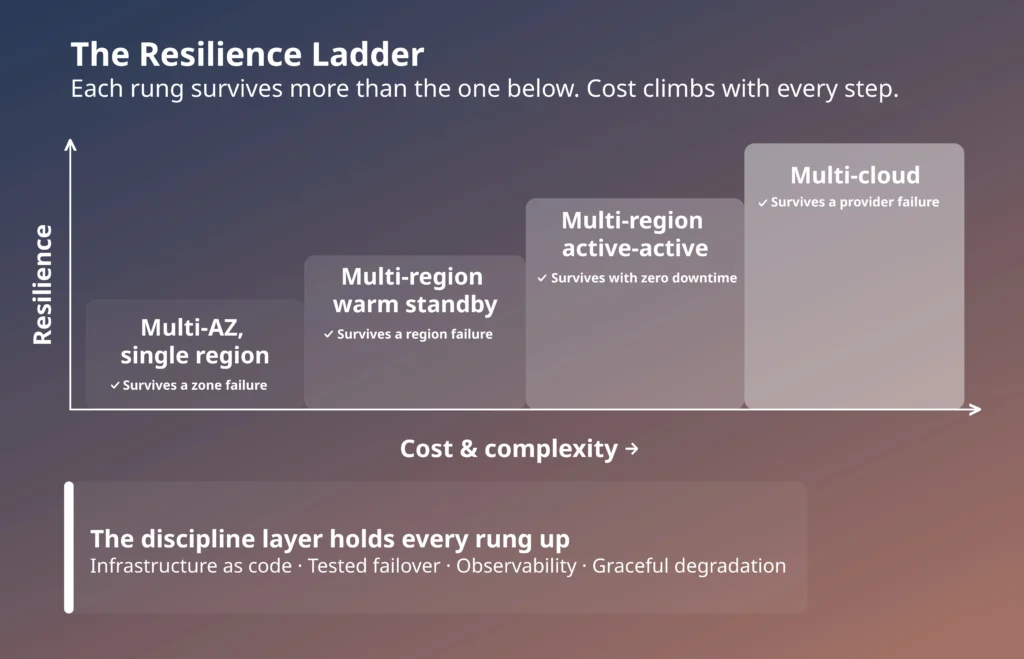
Climbing the ladder rests on a handful of established practices. Multi-region and multi-cloud design comes first, because running active-active across regions or holding a warm standby with a second provider removes the single point of failure that us-east-1 has become.
A planned cloud migration is how most teams get there without downtime. Infrastructure as code makes recovery fast and repeatable, since tools such as Terraform define your whole environment in version-controlled configuration, so you can rebuild in a clean region within minutes and prove exactly what is running.
The rest is discipline. Failover needs rehearsal, so disaster recovery and chaos testing let you trigger the switch on your own schedule instead of during a real incident. Observability keeps you in command because metrics and alerting that survive a provider outage tell you what is happening, and reliable cloud management keeps that visibility in place day to day.
Graceful degradation limits the harm when full recovery takes time, as read-only modes and queued withdrawals hold user trust far better than a blank error page.
When Uptime Is a Legal Requirement: DORA and CTP Rules for Crypto
For firms serving UK or EU clients, this has moved from good practice to regulation.
The clearest signal is recent. In July 2026, HM Treasury designated Amazon Web Services, Google Cloud, Microsoft and Oracle as Critical Third Parties to the UK financial sector. The move puts them under joint oversight from the Bank of England, the PRA, and the FCA. The reason is plain: a fault at a provider this widely used can disrupt many firms at the same time.
As these providers become embedded in financial institutions, they can introduce new forms of systemic risk.
The same logic runs through the EU’s Digital Operational Resilience Act. Under DORA, operational resilience, cybersecurity, and vendor management are regulatory obligations, with reporting duties when your cloud infrastructure suffers an outage or a security incident.
Resilience engineering therefore does double duty, since the multi-region architecture and tested recovery that keep you trading also keep you compliant.
What Crypto CTOs Should Do About Cloud Concentration Risk
Decentralisation deserves an honest definition. A distributed consensus layer counts for little if the operational layer above it rests on one provider in one region. Where that holds true, decentralisation is a label rather than a property.
The picture below is the one to keep in mind.
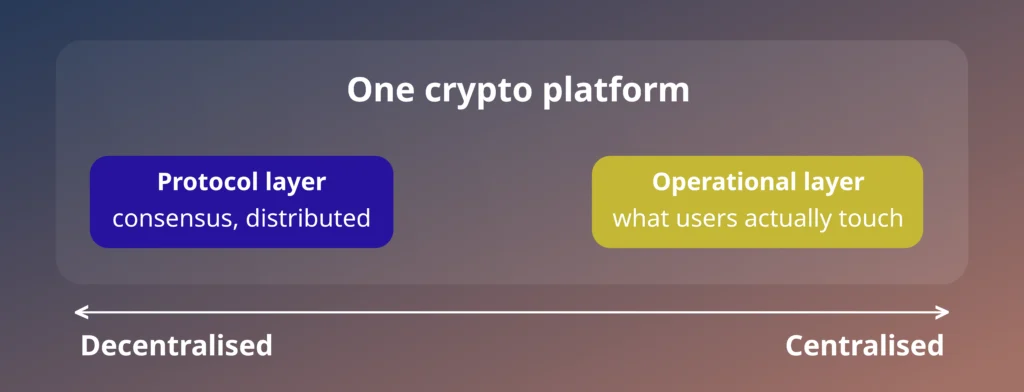
Multi-region deployment, infrastructure as code, tested failover, and real observability have a long track record in high-stakes systems. The barrier is prioritisation, and the cost of ignoring it is measured in outage minutes on your busiest day.
Treat resilience as a discipline you fund and rehearse, and the next regional failure becomes a competitor’s headline instead of yours.
How a Crypto Exchange Cut Deployment Times by 35% and Tripled Capacity
Resilience is easier to argue with a live example. Deployflow worked with a leading cryptocurrency exchange whose platform had outgrown its foundations.
The starting point was ageing infrastructure, manual processes, and little room to scale. Deployments were slow, capacity ran tight under load, and stability suffered. For a venue that never closes, each was a standing risk.
The fix began with an audit. A full review mapped the bottlenecks first. Then the team rebuilt the foundations. Terraform brought the environment under infrastructure as code, GitHub gave a single source of truth, and the core deployment steps moved onto a stronger CI/CD pipeline.
The payoff showed up in the numbers:
- Deployment time fell by 35%, so changes ship faster and safer.
- Manual tasks dropped 40%, cutting the human error behind many outages.
- Transaction capacity rose 200%, adding headroom for volatility spikes.
- Productivity climbed 25%, freeing the team from firefighting.
Reproducible infrastructure, automated delivery, and spare capacity are what any platform leans on when a provider stumbles. The route there started with one step: a clear look at where the stack was weakest.
Find Your Single Points of Failure Before They Find You
If your platform still runs in a single region or leans on one provider, it is better to find out on your own terms. Book an independent technical audit to map where your stack concentrates and leave with a prioritised plan for closing the gaps.
Then talk to Deployflow’s cloud and DevOps team about a resilience review and turn dependable uptime into an advantage your users can feel.
Frequently Asked Questions About Crypto Infrastructure and Decentralisation
Is any cryptocurrency truly decentralised?
No cryptocurrency is completely decentralised. Decentralisation sits on a spectrum, not a simple yes or no.
Bitcoin and Ethereum rank among the most decentralised at the consensus layer, with thousands of independent nodes spread across the world and no single owner. Even so, points of concentration remain. Mining pools and large staking providers hold significant influence, and most users reach these networks through centralised exchanges, wallets and node providers.
A useful test for any project is to ask who runs the validators, who controls upgrades, and what happens if one company disappears.
Does an AWS outage affect Bitcoin and Ethereum themselves?
No, an AWS outage does not stop Bitcoin or Ethereum, and your holdings on the chain stay safe.
Both networks keep producing blocks because their nodes run across many providers, countries and internet connections at once. A fault in one cloud region cannot halt a ledger spread that widely.
What breaks instead is access. Exchanges, wallets, and node providers that sit on the affected cloud go offline, so you may lose the ability to log in, trade, or move funds for a while. The record stays intact, yet the doors to it can close temporarily.
What is the difference between multi-cloud and multi-region?
Multi-region means running across several regions of one cloud provider, such as two AWS regions in different countries.
Multi-cloud means running workloads across different providers, such as AWS and Microsoft Azure.
Multi-region protects you when a single region fails, which is the pattern behind most recent crypto outages. It does not help when a provider has a wider or account-level problem. Multi-cloud guards against a whole provider going down, though it adds cost and complexity, since each provider has its own tools and data transfer charges. Many exchanges combine both for the strongest cover.
Can decentralised cloud platforms replace AWS?
Not yet, at least not for a high-traffic crypto platform.
Decentralised cloud networks spread storage and computing across many independent operators, which lowers reliance on any single company. That model is promising for resilience and censorship resistance.
For now, though, it struggles to match the speed, consistency, tooling, and support that large providers offer, and most production exchanges still run on AWS, Google Cloud, or Azure. A more realistic near-term step is to reduce concentration on one provider through multi-cloud design. Decentralised cloud may play a bigger role over time as the technology matures and proves itself under real load.
Why do so many services depend on AWS us-east-1?
Northern Virginia, known as us-east-1, is the oldest and largest AWS region, so a huge amount of infrastructure has settled there over the years.
Many tools and code libraries treat it as the default region, which means teams often deploy there without a second thought. It also tends to be among the cheapest, and new AWS features usually arrive there first. Some of AWS’s own global control functions are anchored in the region as well. All of that concentration explains why a single fault in us-east-1 can ripple out across thousands of unrelated services worldwide.
Explore our BLOG
Recent articles
ISO 42001 Explained: Requirements, Certification and What Your Engineering Team Must Build
ISO 42001 is the international standard that demonstrates your organisation governs AI properly, and enterprise...
read full article

Is Claude Down? Anthropic Outage: Protect Your Cloud Infrastructure
Claude went down across every surface on 29 September 2026. From 14:00 to 14:59 UTC,...
read full article

Top 10 Healthtech Companies in 2026: What Their Growth Means for AI and DevOps
Every software change that reaches a hospital has to clear regulatory, legacy system, and clinical...
read full article