



You can ship AI features fast and keep your security, compliance, and customer trust intact. AI governance is how you do both at once.
The trick is to treat it as an engineering discipline you own, not a policy your legal team files away. When you do that right, governance stops slowing you down and starts helping you win deals.
Executive Summary
- Governance is now a CTO job, because the controls live in your pipeline, not a filing cabinet.
- You govern two things: the AI in your product and the AI your engineers use to build it. Mixing them up hides real risk.
- Three frameworks matter to UK software vendors: the EU AI Act, ISO/IEC 42001, and the NIST AI Risk Management Framework.
- Multi-tenancy, third-party models, and shadow AI are where SaaS governance quietly fails.
- Tier your risk, and low-stakes changes still ship fast while high-stakes ones get real scrutiny.
- Strong governance shortens enterprise sales cycles. It removes a common procurement blocker.
Why AI Governance Is Now an Engineering Job
Governance became your job the moment AI went into a live product. The controls that decide whether it stays safe are technical, so they sit with you.
Data isolation, model access, output filtering, audit logging: all of it lives in code, not in policy. That puts it in your remit, not compliance’s.
Three pressures drove the handover.
Buyers now interrogate your engineering. Enterprise procurement runs detailed AI security reviews before signing anything. The questionnaires ask technical questions, and a vague answer loses the deal.
Regulators turned guidance into law. Binding obligations now fall on the teams that build and deploy AI systems, not the ones writing policy about them.
The cost of getting it wrong keeps climbing. Documented AI incidents reached 362 in 2025, up from 233 the year before, according to the Stanford HAI AI Index. Each leaked dataset or unsafe output is a potential headline and a churned account.
Governance has stopped being a document you produce on request. It is now an operating capability. Whoever owns the pipeline owns that capability, and that is you.
The Two Surfaces of AI Governance You Must Separate
Teams tend to govern one surface and forget the other. There are two, and each needs its own controls. Get the distinction right, and you close the gaps that catch everyone else out.
The Two Surfaces of AI Governance
One job, two surfaces. Each carries its own risk and needs its own controls.
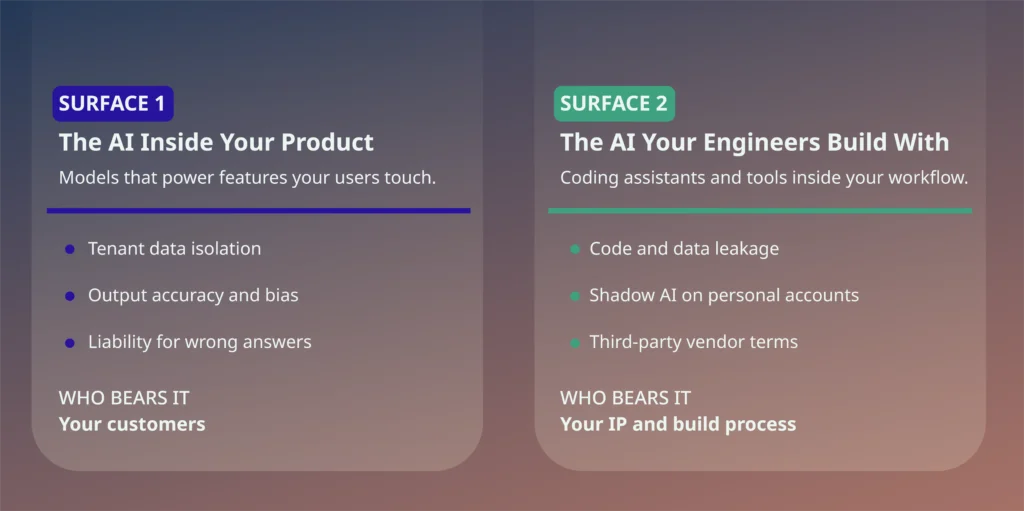
Surface One: The AI Inside Your Product
Customer-facing AI makes you accountable for how the model behaves. That covers the data it reads, the outputs it returns, the decisions it shapes, and the fallout when it gets one wrong.
Before any AI feature ships, answer three questions:
- Where does customer data go when a prompt hits the model?
- Can one tenant’s data surface in another tenant’s output?
- What happens when the model returns something biased, harmful, or false?
Answer them early. Fixing the same problems after an incident costs far more, in money and in trust.
Surface Two: The AI Your Engineers Build With
The second surface gets almost no attention, yet it carries just as much risk. Your engineers use coding assistants and chat tools every day. Each one is a channel through which proprietary code or customer data can slip out of your control.
Shadow AI sharpens the danger. Staff adopt tools faster than any policy can track, often on personal accounts with no oversight. Governing this surface starts with visibility: know which tools are in use and what data they can reach. You cannot manage an exposure you cannot see.
Keep the two surfaces separate in every decision. A control that protects your product does nothing for your build pipeline, and the reverse holds too.
The Three Rulebooks You Cannot Ignore
Three frameworks carry real weight for UK software vendors. Know what each one asks, and you sidestep both over-engineering and nasty surprises.
The EU AI Act Reaches You, Brexit or Not
The EU AI Act binds your business the moment you serve EU users, wherever your company is based. Brexit changes nothing here. The Act sorts AI systems by risk, and the heaviest duties land on high-risk uses such as employment screening or credit scoring.
The timeline just moved, so this is worth getting right. The EU’s Digital Omnibus on AI, Regulation (EU) 2026/1744, was published in the Official Journal on 24 July 2026 and entered into force on 27 July 2026.
It pushes the main high-risk deadline back: standalone high-risk obligations under Annex III now apply from 2 December 2027 rather than August 2026, and high-risk AI embedded in regulated products (Annex I) from 2 August 2028. (source: Regulation (EU) 2026/1744, EUR-Lex)
Do not read the delay as a pause. Article 50’s core transparency duty still takes effect on 2 August 2026: if your product uses a chatbot, you have to tell users they are dealing with AI.
The one carve-out is the duty to machine-mark AI-generated content under Article 50(2), which the Omnibus moved to 2 December 2026. Neither delay buys you much runway.
The steady move is unchanged: classify your AI features by risk now. You have more runway to comply, but you still need to know which tier each feature sits in before the clock runs out.
The UK picture keeps shifting under regulator-led enforcement, so it pays to track how the UK AI governance landscape is changing and which deadlines apply to you before a deal stalls at procurement.
ISO/IEC 42001, the One Buyers Ask For
ISO/IEC 42001 sets the requirements for an AI management system, and you can certify against it. It is the first certifiable AI management system standard, and it maps closely onto the AI Act’s governance expectations, so a single certification does double duty in procurement and compliance.
That matters commercially. Certification hands enterprise buyers independent proof that you manage AI responsibly.
The credential turns a subjective trust conversation into a documented one. For SaaS firms selling into regulated or security-conscious markets, it increasingly appears on procurement checklists before a contract moves.
The NIST Framework for Structure Without a Mandate
The NIST AI Risk Management Framework is voluntary, and it gives you a practical structure for managing AI risk. Its strength is flexibility. You can adopt it with no compliance mandate hanging over you.
The framework gives your team a shared language for risk that maps cleanly onto engineering work. Its four functions (govern, map, measure, manage) translate directly into pipeline stages you already run. Building a governance capability from scratch? Start here.
Where AI Governance Quietly Breaks in SaaS
Generic governance advice assumes a simpler setup than you run. Four features of the SaaS model create failure points that standard guidance misses.
Multi-Tenancy
When customers share infrastructure, data isolation becomes a governance-critical control. The leak comes from shared context: a retrieval layer or vector store that pulls one tenant’s data into another tenant’s prompt. Verify isolation on every integration, and treat “it should be isolated” as unproven until you have tested it.
A support-summarisation feature that retrieves “relevant past tickets” is the classic trap: nothing in the code says “cross-tenant,” yet the vector search happily returns another customer’s data if the namespace filter is missing.
The Model Supply Chain
You call third-party APIs, fine-tune open weights, and chain services together. Each dependency carries risk you did not create and cannot fully see, starting with what each provider does with the data you send it. Keep an inventory of every model and vendor in your stack, along with their data-retention and training terms. You cannot govern a dependency you have not written down.
Shadow AI
The autonomy that makes engineers productive also lets them adopt tools without review. Coding assistants, browser extensions, and IDE plugins arrive on personal accounts, outside any policy. Visibility is the fix, and it comes before control. Find out what is already in use before you write the rules for it.
Continuous Deployment
Ship dozens of times a day, and a manual review gate cannot keep pace. An AI change is harder still, because it does not always look like a change. A new prompt or a swapped model can shift behaviour with no meaningful code diff to review. Your controls have to test behaviour itself, since the diff alone will hide the shift. That is where the operating model comes in.
An Operating Model That Keeps You Fast
Governance earns its bad name when it treats every change as equally risky. The fix is a model that matches scrutiny to real risk. Speed survives where speed is safe.
Matching scrutiny to risk this way is the core of governed AI engineering, where low-stakes work ships fast and high-stakes changes earn the review they deserve.
Tier Your Risk So Small Changes Still Fly
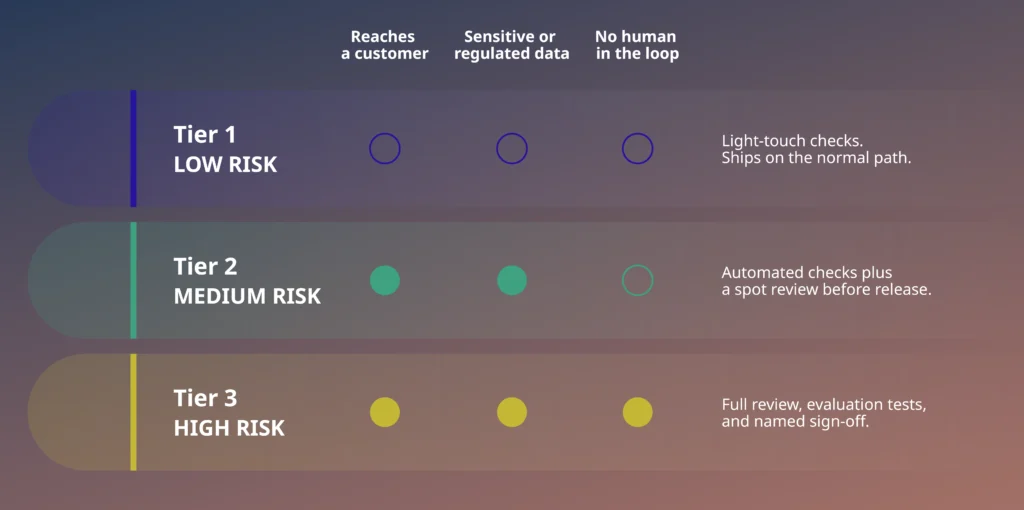
Sort your AI changes into tiers before you build any process around them. A copy tweak to a low-stakes feature should not face the same review as a model touching customer financial data. Define the tiers, set clear criteria for each, and let low-risk work move with minimal friction.
The trick is making the tier obvious at the point of change. Tie it to what the feature touches: the sensitivity of the data, whether output reaches a customer, and whether a human stays in the loop.
Get that mapping right and an engineer knows the tier before they open a pull request, rather than waiting on a committee to tell them.
Those three signals are all you need to place a feature. The test below shows how they stack up.
Bake Controls Into Your Pipeline
Governance in a document gets ignored. Governance in the pipeline gets enforced. Build your checks into CI/CD so they run whether anyone remembers them or not. Add automated tests for model behaviour, scans for data leakage, and logging that produces an audit trail on its own.
Getting there takes deliberate work, since automated tests for behaviour, leakage scans, and self-generating audit trails are what a mature engineering and automation practice builds into your delivery flow.
Behaviour is the hard part, and it is the part that matters. A prompt or model swap can pass every code test and still change what users see, so add evaluation tests that assert on outputs, not just code. Once controls run automatically, compliance becomes the easy path.
Split Ownership So Nothing Falls Through
Governance fails when everyone assumes someone else owns it. Draw the lines plainly. Engineering owns the technical controls. Security owns threat modelling and monitoring.
That threat modelling and monitoring is exactly the kind of continuous security coverage that belongs in the pipeline, so your defences run alongside every change rather than in a periodic check. Legal owns regulatory interpretation and liability.
The gap that catches most teams sits between those three. Model behaviour is the obvious orphan: too technical for legal, too product-shaped for security, too risk-laden for engineering to carry alone.
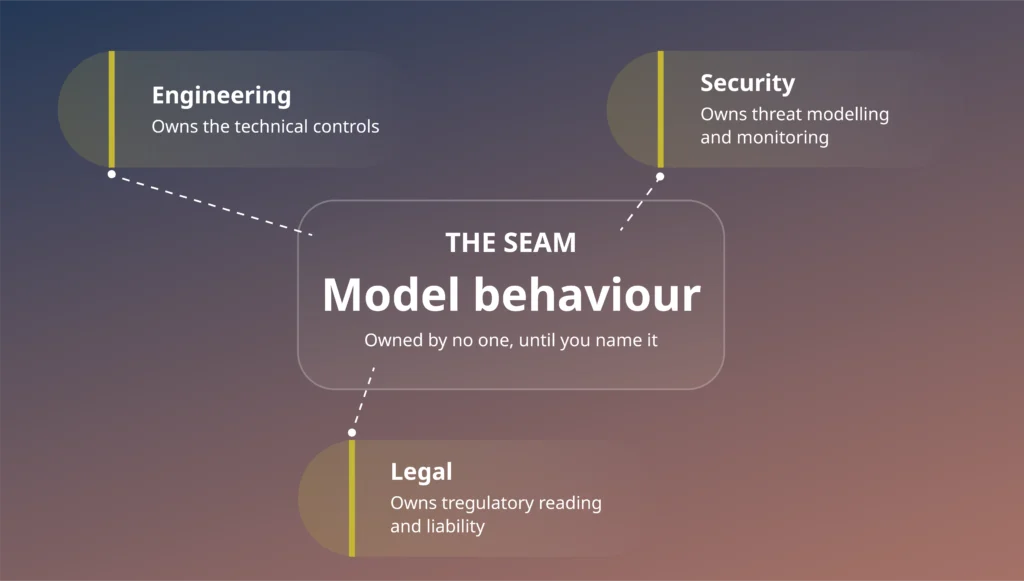
Three teams own their boxes. Model behaviour is the seam that falls through unless you assign it.
Name an owner for the seams, and the exposure that usually hides in the handoff starts to close.
How Governance Wins You Bigger Deals
Strong AI governance sells software. That is the part your board needs to hear.
Enterprise buyers run AI-specific security reviews before they sign. A vendor who answers with documented controls, clear data handling, and recognised certifications clears procurement faster.
Your governance evidence becomes a sales asset. A trust page, a completed questionnaire, or an ISO certificate removes friction from the deal.
Verified tenant isolation and an automatic audit trail are that evidence in practice: the exact artefacts a security review asks for, answered before a buyer has to raise them.
Governance stops being a cost centre when you frame it this way. It becomes a lever that wins larger customers sooner.
How to Start Your AI Governance Without Boiling the Ocean
You don’t need a perfect programme on day one. You need momentum in the right order.
- Map your AI usage across both surfaces. Cover the product and the build process, and write it down as a single inventory. Most teams are surprised by how long the list runs.
- Tier what you find by risk. Use the same criteria your operating model runs on: data sensitivity, output exposure, and whether a human stays in the loop.
- Close the highest-exposure gaps first. Fix the few items that could leak data or trip a regulator, and leave the low-stakes work for a later pass.
A staged approach cuts real risk fast and gives you a clear path to maturity, without stalling the roadmap.
The hardest step is the first one, the honest look. Familiarity hides exposure, so the AI already running quietly across your stack is easy to miss from the inside. An outside assessment tends to surface what internal habit walks straight past.
AI Governance at Production Scale: A Proof Point
A national energy sector AI platform needed to run AI across petabytes of sensitive data without relaxing a single control. Deployflow built a governance-first architecture where controls are inherited, not bolted on.
- 1PB+ of sensitive data processed in real time
- 100% air-locked to the customer network
- 0 manual steps, with every environment auto-inheriting its security, networking, and governance policies
- GitOps audit trail that satisfies regulatory requirements by default, not on demand
New AI workloads now land on the platform without re-engineering the core.
One discipline, proven at national scale: isolate by default, automate the controls, and let the audit trail fall out of how you ship rather than scrambling for it before an assessment.
See Where Your AI Governance Stands
By now, you can probably name one or two places your own governance is thinner than you would like. That instinct is worth acting on while it is fresh.
A free consultation with Deployflow turns it into a short, specific list. Bring the features, tools, or decisions you are not sure about, and you leave with a clear picture of your exposure and a sensible order to address it. Nothing to prepare beforehand, and no obligation afterwards.
Deployflow works with SaaS engineering leaders as a transformation delivery partner, so the conversation stays practical: what you have, where the gaps sit, and what to close first.
Frequently Asked Questions: AI Governance for SaaS Leaders
What is AI governance, in plain terms?
AI governance is the set of controls, processes, and ownership that keep the AI you build and use safe, compliant, and accountable. It answers three practical questions: what your AI is allowed to do, who is accountable when it gets something wrong, and how you prove both to a customer or regulator.
For a software business, most of it lives in engineering, since the controls that matter are technical. Good governance makes a safe release the default path, so an unsafe one has to actively break a rule to ship.
What is the difference between AI governance and data governance?
Data governance controls how data is collected, stored, and accessed. AI governance controls how models use that data and how they behave. AI governance adds concerns data governance never had: model outputs, bias, hallucination, and behaviour that shifts without a line of code changing.
The catch is that strong data governance can create a false sense of coverage. You can have flawless database access controls and still ship a model that leaks one tenant’s data through a shared prompt. Data governance secures the inputs; AI governance has to secure the behaviour.
Do we still need AI governance if we only use third-party models like OpenAI or Anthropic?
Yes. Calling someone else’s model does not transfer the risk, because you stay accountable for what your product does with it. You still decide what data you send, how outputs reach users, and what happens when an answer is wrong.
Buying in also creates its own dependency. Each provider sets its own data-retention terms and update schedule, and a silent model update can shift your product’s behaviour overnight. The governance shifts rather than disappears: less on model internals, more on vendor terms and output handling.
How much does AI governance cost to set up?
Less than most teams expect, because the early work is mapping and prioritising rather than buying tools. Your first costs are time: an inventory of where AI runs, a risk tiering, and a handful of pipeline checks.
Tooling and certification come later, and only where a real gap justifies them. The cheapest risk reduction comes from better decisions, not new purchases. Work out which features are high-risk and what each one is allowed to do.
How long does it take to implement AI governance?
You can stand up a working baseline in weeks by starting with an inventory and risk tiers rather than a full framework. Putting controls on your highest-risk features is a few weeks of focused effort, not a year-long transformation.
Full maturity takes months: automated pipeline checks, certification if your market expects it, and clear ownership across engineering, security, and legal. The point of starting early is that risk reduction is front-loaded, so the first few weeks return far more safety than the later months.
Explore our BLOG
Recent articles
ISO 42001 Explained: Requirements, Certification and What Your Engineering Team Must Build
ISO 42001 is the international standard that demonstrates your organisation governs AI properly, and enterprise...
read full article

Is Claude Down? Anthropic Outage: Protect Your Cloud Infrastructure
Claude went down across every surface on 29 September 2026. From 14:00 to 14:59 UTC,...
read full article

Top 10 Healthtech Companies in 2026: What Their Growth Means for AI and DevOps
Every software change that reaches a hospital has to clear regulatory, legacy system, and clinical...
read full article