



Scaling an AI product exposes every shortcut taken during the build. Infrastructure designed for pilot load buckles under production demand. Deployment pipelines that worked at low frequency become bottlenecks overnight. That is the delivery problem.
The companies closing the gap fastest are bringing in engineering partners who embed directly into the delivery process, own the infrastructure work, and start adding value within days.
Before You Read On: TLDR
- Delivery infrastructure is what breaks AI products at scale.
- An AI engineering partner owns outcomes. A consultant documents them.
- DevOps and cloud optimisation are where commercial damage accumulates
- Embedded delivery teams outperform advisory retainers when roadmap pressure peaks.
- The strongest engagements start with a bounded audit.
The organisations closing the gap fastest are not waiting for the infrastructure to break. They are bringing in specialist AI engineering services that integrate directly into the delivery process, own the infrastructure work, and start adding value within days.
Why Traditional IT Consulting Doesn’t Work for Scaling AI Products
The AI consulting model was built for organisations that lacked strategic direction and needed external expertise to find it. For that challenge, the model was the right tool.
AI companies at scale have a different problem. The direction is set. The roadmap exists. What breaks down is execution velocity, and a consulting engagement is structurally built to advise on it.
A standard engagement follows a familiar arc: discovery, analysis, recommendations, and handoff. By the time the final report lands, the technical environment it describes has already shifted. AI development does not keep pace with implementation.
What lands on the CTO’s desk is a thorough document describing a technical environment from three months ago. The backlog is unchanged. The runway is shorter.
Consultant vs AI Engineering Partner: What the Difference Looks Like
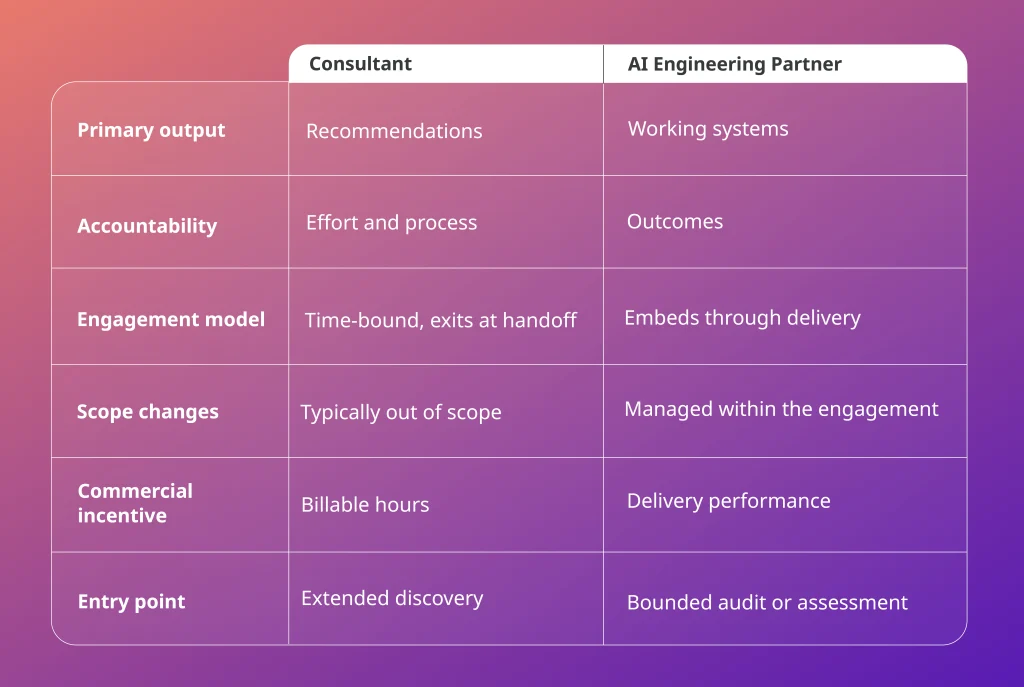
This is not a critique of consultants. The structural problem is that advisory engagements are not designed to carry delivery risk. At AI scale, that is the one thing that cannot be delegated to the client.
From Pilot to Production: Where AI Infrastructure Breaks Down and What It Costs
AI products fail at scale for predictable reasons.
- Cloud infrastructure sized for a controlled pilot cannot absorb production load.
- Deployment pipelines built for infrequent releases become blockers as model iteration accelerates.
- Infrastructure costs outpace revenue forecasts as inference volumes climb, and by the time finance escalates it, the margin damage is already done.
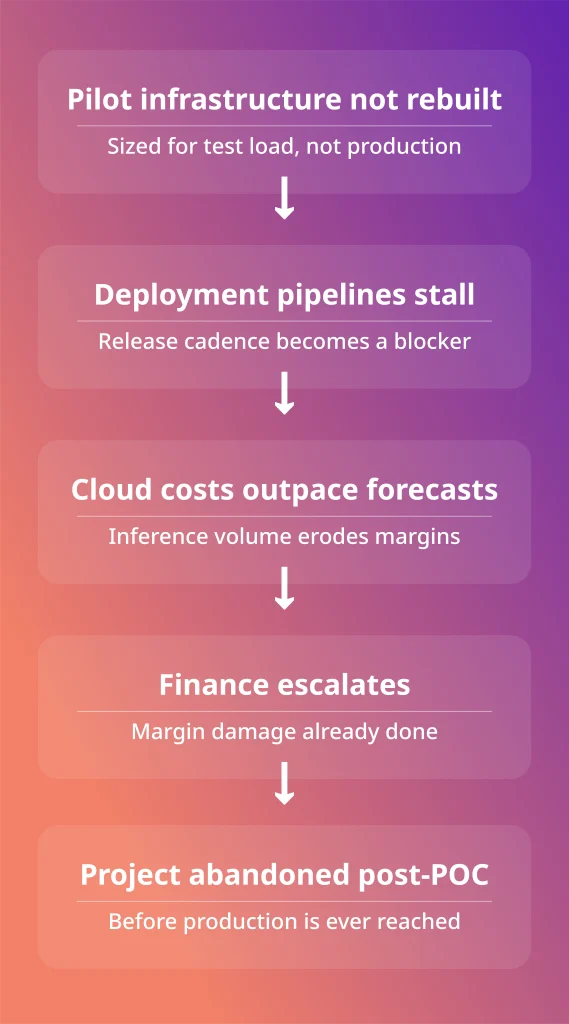
The pattern is consistent across AI companies at the same growth stage. One failure point triggers the next.
Gartner estimates that at least 30% of generative AI projects will be abandoned after proof of concept, with infrastructure costs and delivery gaps cited as primary reasons. The move from pilot to production is where most of that damage happens.
Engineering and infrastructure problems require engineering solutions. The organisations scaling AI products fastest treat delivery infrastructure as a first-order priority from the moment growth becomes visible.
DevOps for AI Companies: The Gap That Erodes Your Margins
DevOps is the capability most AI companies underinvest in until something fails visibly.
Skipping a dedicated internal function is easy to justify in the early stages. The product is still proving itself, and full-time DevOps is not yet justified. The gap becomes visible later, when deployment frequency has increased, cloud costs have spiked without a clear cause, or infrastructure cannot absorb traffic growth at the rate the product team expects. By that point, fixing it costs three times what building it right would have.
For AI companies, DevOps maturity is a marginal question. As inference volumes grow, architecture decisions made at the pilot stage determine whether the unit economics hold at production scale. Cloud optimisation, delivery acceleration, and infrastructure scalability are where the commercial outcome is either protected or eroded.
Specialist DevOps support tied to specific outcomes, rather than a permanent internal hire, is how many scaling AI companies manage this efficiently. The expertise is available when it is needed, focused on a defined problem, and exits cleanly when the work is complete. Engagements in this space tend to move quickly: assessed need, defined scope, measurable result.
According to a Gartner survey of over 300 CIOs, more than 90% said that cost constraints limit their ability to get value from AI. Gartner estimates that without a clear understanding of how AI costs scale, CIOs could miscalculate their infrastructure spend by 500% to 1000%.
Five Questions That Separate a Real Engineering Partner From a Vendor
Both will use the word “partner.” The distinction shows up in how the engagement is structured, not how it is sold.
- Does the team own delivery, or do they advise and observe? A genuine engineering partner takes accountability for outcomes.
- Can they show measurable transformation outcomes? Delivering on time is a low bar. Ask for evidence of improvement in infrastructure cost, deployment velocity, or system resilience. Completion is not the same as impact.
- Do they embed with the internal team or operate in parallel? Parallel workstreams create handoff problems. Embedded squads stay aligned to the same delivery priorities as the internal team and adapt when those priorities shift.
- Are they invested in your cost efficiency? A partner with genuine skin in the outcome will flag cheaper architectural options and optimise for long-term performance. One without it optimises for contract value.
- What happens when scope changes mid-engagement? Scope always changes. A capable engineering partner has a clear, practised answer to this question. Ask it early and listen carefully to what follows.
The five questions above are a starting point. For a more detailed framework covering MLOps maturity, IP ownership, data practices, and what a clean handover actually looks like, this guide to evaluating AI engineering companies covers what most procurement processes never think to ask.
Why the Strongest Engagements Start Small and Deliver Value Fast
Extended discovery phases exist because they are billable. Three months of workshops and stakeholder interviews generate revenue for the consulting firm before a single delivery commitment is made.
The most effective entry points into an engineering partnership are bounded and immediate.
- An infrastructure audit
- A cloud cost review
- A DevOps maturity assessment
- An architecture evaluation
Each one delivers actionable insight before any long-term commitment is required.
It also changes the nature of the conversation. Engineers discussing a specific problem in the client’s actual environment produce better decisions than a sales team presenting hypothetical scenarios in a pitch deck.
The CTO gets a clearer picture of what the engagement will involve before signing anything.
Longer engagements built on that foundation are better scoped, faster to deliver, and less likely to drift. The work starts from an informed context rather than an assumption.
Signs Your AI Product Needs an External Engineering Partner Now
The instinct is to wait. To bring in external support only after the internal team is already stretched, costs are already elevated, or a release has already slipped.
The organisations scaling AI products most effectively move earlier. They engage engineering support when the pressure is visible but not yet critical. The difference between those two moments is cost.
When to Act: What Each Signal Costs You If You Wait
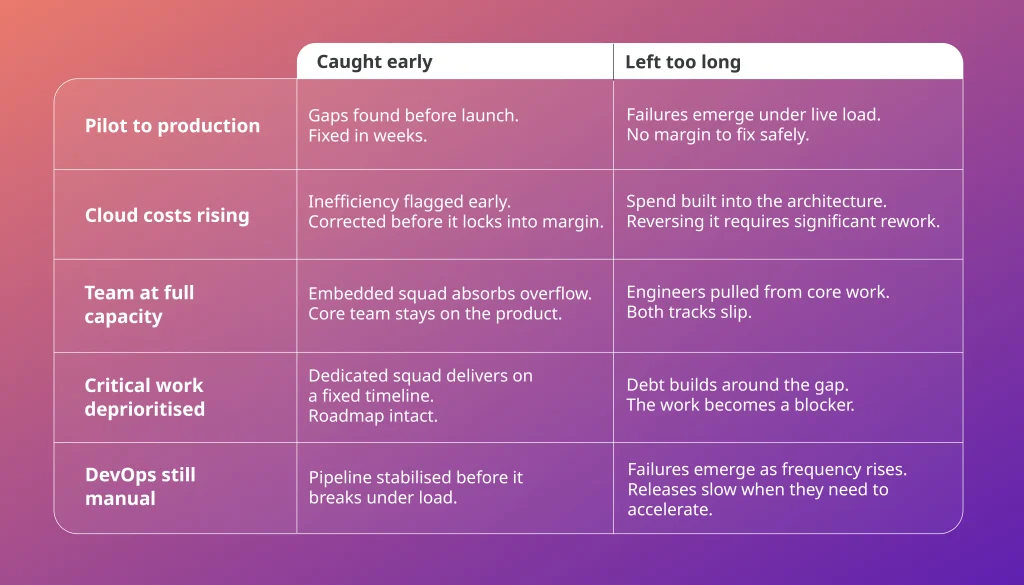
According to Forrester, roughly one in three AI rollouts fail because organisations deploy under cost pressure before the infrastructure is ready to support it. The signals in the table above are early warnings that readiness is not where it needs to be.
At any of these points, an embedded engineering partner produces better outcomes than another advisory retainer. The later the engagement starts, the smaller that margin becomes.
What a High-Performing AI Engineering Engagement Delivers
Long-term product build engagements structured around full delivery ownership consistently outperform resource supply models. Placing individual engineers within a client team is not the same as owning the outcome. When the team is accountable for what the programme achieves rather than the hours it logs, the incentive structure changes and so does the quality of the work.
Full-stack engineering teams supporting transformation initiatives produce measurable, reproducible results across verticals: regulated industries, healthcare, fintech, edtech, and AI-native companies. The model travels because its underlying principle does not change across sectors. Delivery ownership works wherever delivery pressure exists.
The pressure is intensifying as AI agents begin replacing the tools built around them. Here is what that shift means for your stack right now.
The entry point is always a concrete technical conversation, and the output is always well-defined.
The Engagement That Changed an AI Platform Started With a Technical Conversation
A nationwide energy company driven by AI had a petabyte-scale infrastructure problem with no clear owner. H100 GPU clusters under pressure. Strict air-locked security requirements across multiple business units. The infrastructure had grown faster than the governance around it.
Deployflow came in through a technical conversation. Within weeks, the team was embedded within the platform engineering function and working on a specific, defined problem.
The result is that every environment now automatically inherits security, networking, and governance policies. New AI workloads land on the platform without touching the core infrastructure. Zero manual steps across the board.
Deployflow brings the same dedicated team approach to AI companies, fintech platforms, healthcare organisations, and PE-backed businesses at the point when delivery pressure becomes visible, before it becomes a crisis.
The starting point is a free infrastructure audit, cloud cost review, or DevOps assessment. Each one provides a clear picture of where your delivery capacity is at risk and what it would take to address those risks.
If your AI product is scaling and the infrastructure beneath it is not keeping pace, Deployflow’s AI engineering services are the starting point. Book your free assessment, and leave with a clear picture of where your delivery capacity is at risk.
Frequently Asked Questions About AI Engineering Partnerships
What does a DevOps maturity assessment include?
A DevOps maturity assessment examines your current deployment pipelines, infrastructure architecture, release frequency, monitoring setup, and cloud cost structure to identify where delivery velocity is being lost and where risk is accumulating undetected.
The output is a prioritised picture of specific gaps: pipelines that cannot support the release cadence your product now demands, cloud configurations that made sense at pilot scale but are bleeding margin at production volume, and monitoring blind spots that mean incidents surface through user complaints rather than internal alerts. A well-run assessment takes days and produces decisions the engineering team can act on immediately.
What is the difference between an AI engineering partner and staff augmentation?
Staff augmentation places individual engineers inside your team. An AI engineering partner places an accountable team that owns delivery outcomes instead of just headcount.
With staff augmentation, the client retains full responsibility for direction, coordination, and results. The engineers fill a skills gap; the outcome is still the client’s problem. An engineering partner inverts that accountability structure: the partner team is responsible for the engagement’s output. This distinction matters most when roadmap pressure peaks and there is no room for coordination overhead or knowledge gaps at the point of execution.
How long does it take an AI engineering partner to start delivering value?
A capable AI engineering partner should produce measurable output within the first two to four weeks.
The fastest entry points are bounded assessments: infrastructure audits, cloud cost reviews, and DevOps maturity evaluations. These are designed to deliver actionable insight before any long-term commitment is required. Engagements built on a defined technical problem in the client’s actual environment move faster than those that begin with open-ended discovery. If an onboarding phase is stretching past six weeks before anything concrete is produced, that is a structural signal worth questioning early.
Should AI companies build an in-house engineering team or bring in external partners?
For most scaling AI companies, the answer is both, sequenced deliberately rather than treated as an either-or decision.
Internal teams carry institutional knowledge, product context, and long-term continuity. External engineering partners bring specialist depth, immediate availability, and delivery accountability that a growing internal function cannot always absorb during high-pressure periods. The practical model is to use embedded partner teams to close specific capability gaps and stabilise delivery infrastructure while the internal function matures around them. The risk of waiting until the internal team is fully built is that the infrastructure problems compound faster than hiring timelines allow.
What is MLOps and why does it matter for AI product scaling?
MLOps is the practice of applying DevOps principles to machine learning workflows, covering model training, versioning, deployment, monitoring, and retraining at production scale.
Without MLOps maturity, AI products hit predictable ceilings: models deployed manually, no reliable way to track performance degradation, and no automated pipeline for rolling out updates when the underlying data changes. At the pilot scale, this is manageable. At the production scale, it becomes a compounding liability. Infrastructure decisions made before MLOps processes are in place tend to create technical debt that grows faster than the product team can address, and the cost of retrofitting those processes rises with each release cycle that skips them.
Explore our BLOG
Recent articles

Is Claude Down? Anthropic Outage: Protect Your Cloud Infrastructure
Claude.ai has spent 2026 fighting its own success. Twenty-one incidents landed between 12 August and...
read full article

AI Experimentation vs AI Engineering: The Difference That Decides Whether Your AI Budget Survives
Experimentation buys you knowledge. Engineering buys you a system that still works next quarter, when...
read full article

Why Most Agentic AI Projects Fail Before They Scale
Has your agent been three months from production for nine months? Agentic projects break at...
read full article