



ESG (Environmental, Social, and Governance) reporting in 2026 has become a serious operational challenge. Data is spread across finance, procurement, HR, supplier systems, and spreadsheets, while reporting teams are expected to produce clear, consistent, and audit-ready disclosures under growing scrutiny.
Generative AI services help by reducing manual effort, improving reporting consistency, and supporting stronger evidence trails across compliance workflows.
The value is in making sustainability data easier to manage, disclosures easier to prepare, and reporting processes more reliable at scale.
Executive Summary: What Senior Teams Must Know
- ESG reporting is harder when data sits in disconnected systems.
- Generative AI helps teams consolidate information and reduce manual reporting work.
- The biggest gain is better consistency, traceability, and audit readiness.
- Strong results depend on governed data, clear workflows, and human review.
Read on to see where generative AI can make ESG reporting faster, cleaner, and more defensible, and where strong governance still makes all the difference.
Why ESG Reporting in 2026 Still Feels Fragmented Across Systems
ESG reporting still feels difficult because the data is rarely centralised. Supplier data may sit in procurement tools, workforce metrics in HR systems, cost data in finance platforms, and energy figures in separate tracking tools, while many teams still rely on spreadsheets to fill the gaps.
Even where sustainability reporting systems exist, they often do not connect cleanly to the source data behind the final report.
That fragmentation slows down compliance workflows and makes reporting harder to trust. Teams spend too much time chasing inputs, checking versions, and reconciling different formats across departments.
In most cases, the real problem is not the reporting framework itself. It is fragmented ESG data, split ownership, and disconnected systems that turn a reporting task into a cross-functional bottleneck.
How Gen AI Improves ESG Reporting by Reducing Manual Reporting Work
Generative AI improves ESG reporting most when it removes repetitive manual work, so internal teams can focus on review, judgment, and assurance.
Much of the manual ESG reporting work is not high-value thinking. It is admin. Teams spend too much time summarising source documents, chasing missing inputs, reformatting submissions, and rewriting draft disclosures. That slows down ESG reporting workflows and leaves less time for the work that actually needs human oversight.
Generative AI development services help by taking pressure off those repetitive tasks. It can summarise supplier documents, highlight missing fields, standardise draft outputs, and reduce the manual clean-up that often delays reporting cycles.
The benefit is a cleaner process, better consistency, and more time for informed review.
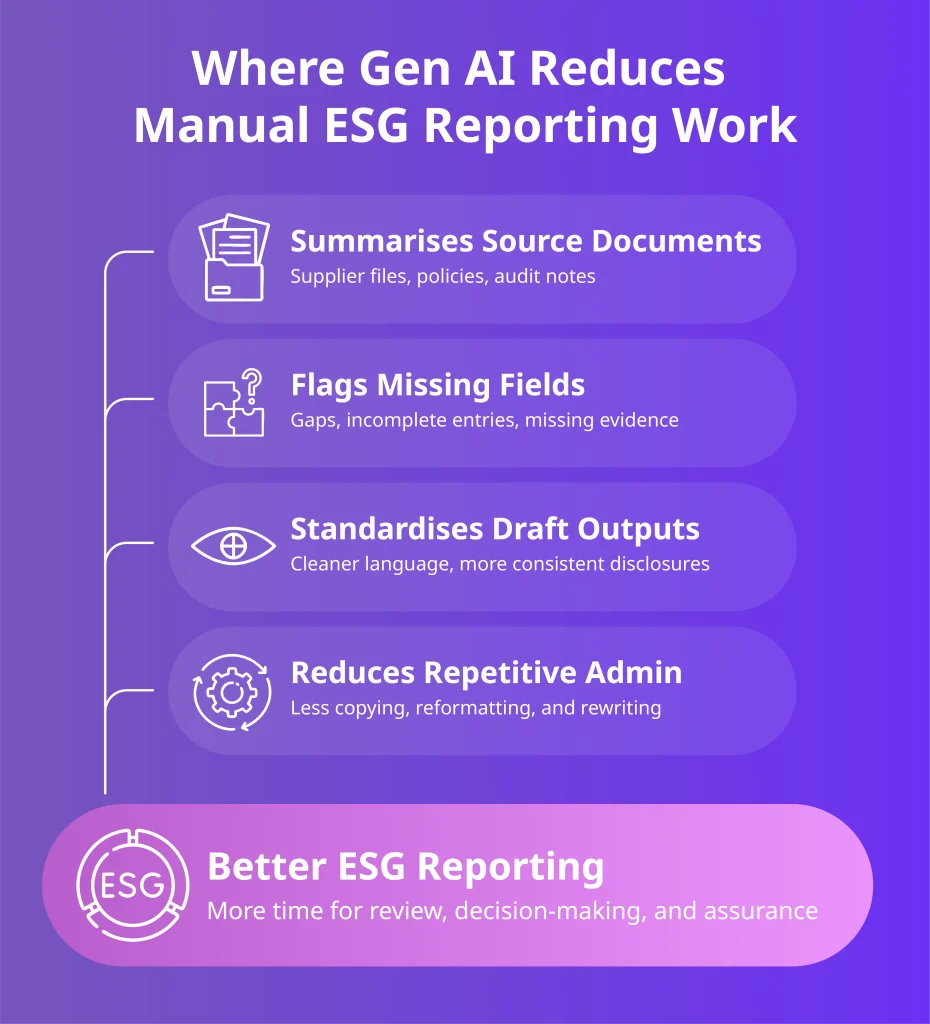
Generative AI adds the most value when it removes low-value reporting effort without weakening human control.
ESG Data Consolidation and Sustainability Data Quality
ESG reporting becomes more reliable when AI helps unify data across systems and catch quality issues before they reach the final report.
ESG data consolidation is difficult because the source data rarely arrives in a clean, consistent format. One team may track emissions in one unit, another may use a different format, and supplier submissions may arrive incomplete or duplicated across multiple files. Add spreadsheets, version confusion, and disconnected systems, and even simple reporting tasks become harder than they should be.
Generative AI can support stronger ESG data management. It can help pull together information from procurement, HR, finance, energy tools, and supplier portals into a more usable reporting layer.
Just as importantly, it can support AI ESG data validation by flagging issues early, before they create bigger problems downstream.
In practice, that means it can help identify:
- Unit mismatches: The same metric appears in different units or formats.
- Duplicate records: The same supplier or data point is submitted more than once.
- Incomplete supplier submissions: Key fields, evidence, or declarations are missing.
- Version confusion: Different teams are working from different files or outdated inputs.
That is the real value for sustainability data quality. AI does not make weak data trustworthy on its own, but it can make problems easier to spot and easier to resolve.
For teams responsible for reporting reliability, that means less manual checking, fewer surprises during review, and a more stable foundation for the final disclosure.

Better ESG reporting starts with better data handling.
AI-Powered ESG Disclosures, Narrative Drafting, and Multi-Framework Reporting
Today, the challenge is writing ESG disclosures clearly, consistently, and in a way that stands up across different reporting requirements. AI-powered ESG disclosures can definitely help. Generative AI works well as a drafting assistant, helping teams turn approved internal data and evidence into stronger first drafts.
In ESG narrative drafting, instead of rewriting the same points repeatedly, teams can use AI to shape more consistent language across sections while still maintaining control over the final message. It can also help when businesses need to think across different sustainability disclosure frameworks, including CSRD reporting and ISSB reporting.
This is not just an internal reporting issue. The OECD notes that better alignment between sustainability reporting frameworks can make disclosures easier to compare and less costly to manage across different markets.
While AI can support drafting, it should not replace judgment. Internal teams still need to validate the facts, review the wording, and sign off on the final disclosure. Verification tools, such as a highly accurate AI checker and fact-checking tools, can help teams review AI-generated drafts for consistency and flag potential issues before final approval.
Example: Where Gen AI Adds Practical Value
A procurement team may hold supplier certifications in one system, HR may own workforce metrics in another, and finance may manage cost or operational data elsewhere. In that setup, ESG reporting often becomes a manual exercise in collecting files, checking formats, and rewriting the same points across multiple drafts.
A governed AI workflow can help retrieve approved inputs, flag missing evidence, standardise first-draft language, and route the output to internal reviewers before anything reaches the final report. The outcome will be faster drafting and a more controlled and repeatable reporting process.
Why Audit-Ready ESG Reporting Matters More Than Faster Report Writing
Faster drafting helps, but audit-ready ESG reporting matters more. That shift is now built into the reporting landscape: the IFRS Foundation says sustainability disclosures should be decision-useful and globally comparable, while IOSCO (the International Organisation of Securities Commissions) has noted growing investor demand for high-quality assurance to improve the reliability of sustainability reporting.
Senior teams need every number and claim to be backed by clear reporting evidence.
That means a strong ESG audit trail with source links, timestamps, version control, and approved records behind the final report. Traceable sustainability data makes reporting easier to review, easier to defend, and easier to repeat. In practice, that is what builds confidence.
The Risks of Using Gen AI in ESG Compliance and How to Control Them
Generative AI ESG compliance can improve speed and consistency, but it also introduces real control risks.
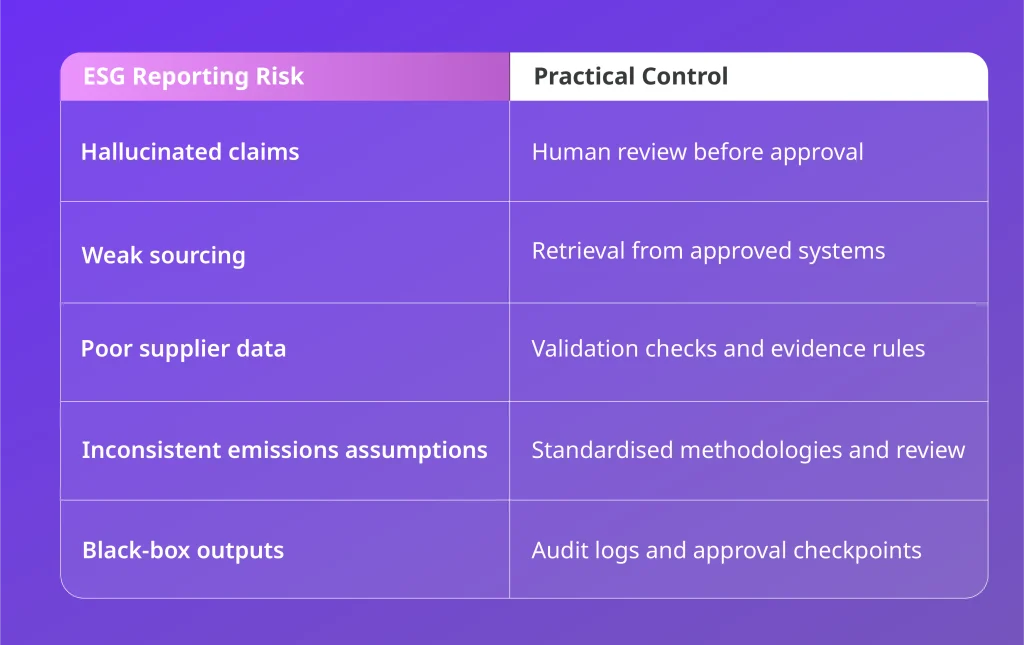
In ESG reporting, the biggest issues are not abstract but rather practical. Hallucinations in AI reporting, weak sourcing, poor supplier data, inconsistent emissions assumptions, and black-box outputs can all weaken trust in the final disclosure.
That is why AI governance matters. Generative AI should not work from unverified prompts or disconnected files. It should work from approved systems, with clear access controls, human review, audit logs, and approval checkpoints built into the process.
The goal is not to remove risk completely. It is to make ESG reporting risks visible, controlled, and easier to manage.
What an AI-Enabled ESG Reporting Stack Should Look Like in Practice
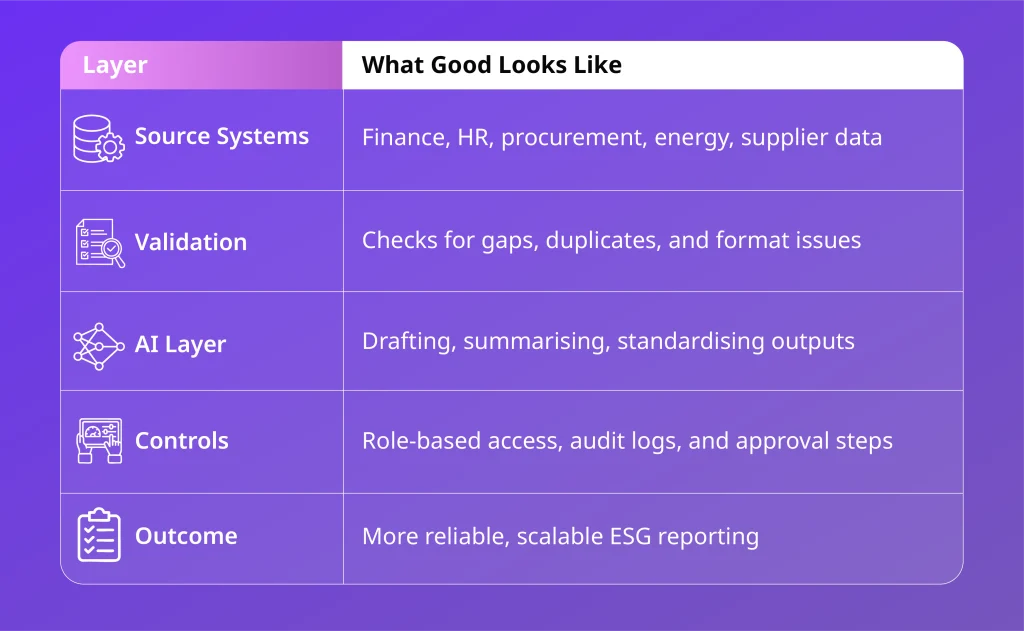
A strong AI-enabled ESG reporting stack starts with connected systems, clear validation rules, and controlled workflows.
A good ESG reporting platform should pull trusted data from finance, HR, procurement, supplier systems, and operational tools, then check it before it reaches reporting.
From there, AI can support drafting, summarising, and workflow automation, but only within a solid sustainability reporting architecture. That means approved document retrieval, role-based access, and review layers built into the process.
Secure AI workflows improve ESG reporting when they sit on top of good engineering and governance.
Strategic Framework: Building Robust AI-Driven ESG Reporting
A Practical First Step for Generative AI ESG Reporting in 2026
A practical first step is to choose one reporting workflow that already creates repeated friction, such as supplier evidence collection, emissions documentation, or first-draft disclosure support.
That gives the business a controlled way to test how generative AI fits into ESG reporting without turning the whole process upside down.
Instead of trying to automate everything, the smarter move is to improve one workflow, measure the impact, and build from there with better controls and clearer ownership.
With the right approach to sustainability reporting automation, teams can reduce manual effort while keeping review, control, and accountability in place.
Begin With One Workflow You Can Measure and Control
Deployflow helps organisations design secure generative AI workflows for ESG reporting by connecting approved data sources, introducing validation and retrieval controls, and building human review into the reporting process.
That can include structured document retrieval, controlled drafting support, workflow automation, and audit-friendly checkpoints that make reporting easier to manage without weakening governance.
Start small, prove the value, and build from there.
That is how AI becomes useful in ESG reporting: as a practical way to create a stronger and more reliable process.
If your team is looking for a practical way to make ESG reporting more reliable, traceable, and easier to manage, contact Deployflow to explore how a secure Gen AI workflow could fit your reporting process.
Frequently Asked Questions About Generative AI and ESG Reporting
Can generative AI replace ESG reporting teams?
No, generative AI should support ESG reporting teams, not replace them.
Its strongest role is reducing repetitive work such as summarising documents, flagging missing inputs, and helping with first-draft disclosures. Internal teams still need to validate the data, review the wording, and approve the final report. In practice, the value comes from better efficiency and control, but not by removing human judgment.
How long does it take to see value from AI in ESG reporting?
It often starts with one focused use case rather than a full transformation.
A business might begin with supplier documentation, emissions evidence, or disclosure drafting support, and see process improvements there first. That makes it easier to test the workflow, prove value, and expand with less risk. The fastest wins usually come from reducing manual review and clean-up work.
Does generative AI work if ESG data is still spread across different systems?
Yes, but the results will be limited if the underlying data remains messy or disconnected.
AI can help bring together information from different systems and highlight gaps, duplicates, or inconsistent formats, but it cannot fix weak data governance on its own. Better outcomes depend on stronger source connections, validation rules, and clear ownership. That is why data quality still matters as much as the model.
What should companies prepare before using AI for ESG reporting?
They should start with the basics: trusted source systems, clear data ownership, validation rules, and a review process.
It also helps to define which reporting areas create the most manual effort today and where AI can add value without increasing control risk. Businesses that prepare the workflow first usually get better results than those that start with the tool.
Is AI useful only for large enterprises with complex ESG programmes?
No, smaller and mid-sized organisations can benefit as well.
In many cases, they feel the reporting burden even more because fewer people are managing the work across multiple systems and deadlines. A focused AI workflow can help them reduce manual effort, improve consistency, and create a reporting process that is easier to scale as requirements grow.
Can generative AI support ESG reporting across multiple frameworks?
Yes, it can help teams draft and adapt disclosures across multiple frameworks, but only when it works from approved internal data and reviewed evidence.
This is useful for businesses dealing with overlapping reporting expectations across markets or stakeholder groups. The value is usually in reducing repetitive drafting work and improving consistency, not in replacing expert interpretation. Framework-specific review still matters before publication.
What is the biggest mistake companies make when using AI for ESG reporting?
The biggest mistake is starting with the tool before fixing the workflow.
If data is fragmented, ownership is unclear, and review controls are weak, AI will only speed up a broken process. Better results come when businesses first define trusted sources, approval steps, and validation rules, then add AI where it reduces friction without reducing control.
Explore our BLOG
Recent articles

Is Claude Down? Anthropic Outage: Protect Your Cloud Infrastructure
Claude.ai has spent 2026 fighting its own success. Twenty-one incidents landed between 12 August and...
read full article

AI Experimentation vs AI Engineering: The Difference That Decides Whether Your AI Budget Survives
Experimentation buys you knowledge. Engineering buys you a system that still works next quarter, when...
read full article

Why Most Agentic AI Projects Fail Before They Scale
Has your agent been three months from production for nine months? Agentic projects break at...
read full article