


Reduce your deployment failure rate by 40% without adding to your engineering headcount.
While UK competitors struggle with release-day anxiety and spiralling salary costs, elite tech leaders are embedding Generative AI into their CI/CD to automate human bottlenecks and reclaim 15+ hours of senior engineering time per week.
TL;DR for CTOs and Founders
- Cut deployment failures before they reach production
- Enforce governance automatically inside CI/CD
- Reduce security and compliance friction
- Improve DORA metrics without hiring
- Turn delivery stability into a competitive advantage
Maximising DORA Metrics: The Impact of Automated Anomaly Detection
Recent research into AI-enhanced pipelines shows that when organisations move from manual oversight to automated anomaly detection, they see a 60% reduction in post-deployment security bugs and 63% faster mean-time-to-repair (MTTR) (Source: GeeksforGeeks 2025).
By implementing these same controls, Deployflow helps UK leaders achieve similar stability gains while maintaining elite DORA performance.
If release cycles still depend on manual reviews, if compliance slows delivery, or if senior engineers spend more time fixing than building, this shift is a must.
The rest of this guide outlines how embedding GenAI into DevOps delivers measurable resilience, predictable releases, and scalable growth.
Scaling Deployment Frequency Without Increasing Operational Risk
You might be under pressure to release faster without increasing operational risk. Historically, those goals conflicted. More deployments meant more exposure, more misconfigurations, and more late-stage security reviews.
Generative AI reduces human bottlenecks by enforcing security and governance during implementation.
AI provides continuous validation directly into CI/CD. Code is assessed for security, policy compliance, and configuration integrity during implementation.
What does embedded validation mean for speed, risk, and cost?
- Deployment frequency increases without driving up incident rates.
- Security risks are intercepted before production.
- Compliance controls are enforced automatically.
- Senior engineers spend less time reviewing routine changes and more time delivering strategic improvements.
Speed no longer depends on accepting instability.
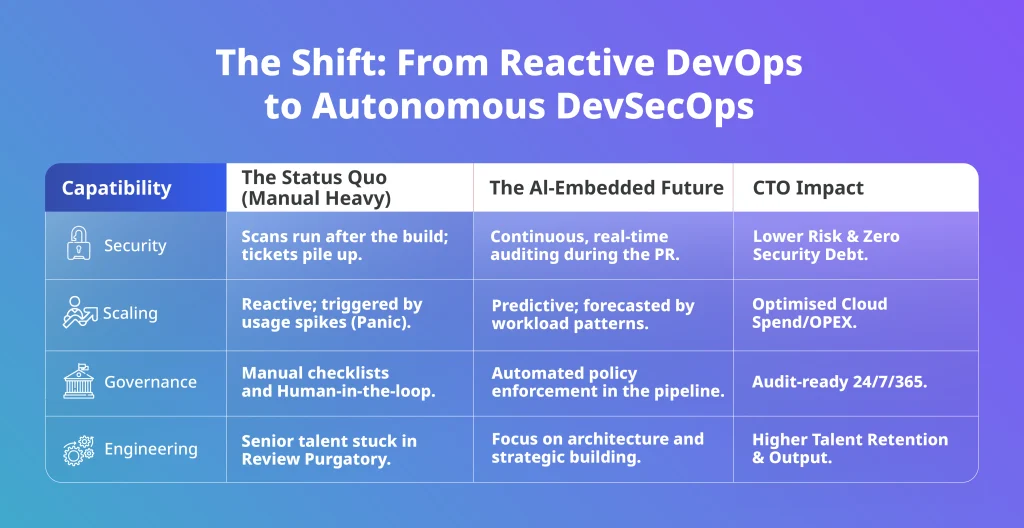
AI in DevOps is not limited to pipeline automation.
It reshapes security, collaboration, governance, quality, and operational feedback loops across the entire delivery lifecycle.
From Business Intent to Production-Ready Requirements
Most delivery delays start in interpretation.
Business teams describe outcomes. Engineers interpret them. Gaps appear. Weeks later, the rework begins.
Generative AI is analysing stakeholder input, from meeting notes to product briefs. AI can generate:
- Structured user stories aligned to delivery workflows
- Clear, testable acceptance criteria
- Baseline architectural scaffolding to accelerate implementation
This does not replace product thinking. It removes translation friction.
✔️ Requirements become testable earlier.
✔️ Acceptance criteria are defined before development begins.
✔️ Architectural assumptions are surfaced before they harden into risk.
For CTOs, that means fewer mid-sprint corrections, and for founders, it means less budget wasted on building the wrong thing. To put it simply: clearer inputs lead to cleaner releases.
Transitioning to Autonomous, Self-Healing Systems
Teams provision extra capacity to avoid performance risk. Environments stay running longer than necessary. Non-production workloads consume budget. Scaling decisions are reactive.
And over time, that compounds.
Generative AI shifts resource management from reactive threshold-based scaling to pattern-based forecasting.
Instead of waiting for usage to spike, models analyse historical demand, release velocity, workload behaviour, and seasonal trends. Capacity is adjusted before inefficiencies grow.
These are measurable, practical outcomes:
- Idle workloads are automatically identified and stopped
- Non-production environments are right-sized dynamically
- Resource allocation matches real usage instead of worst-case assumptions
- Scaling events are predicted rather than triggered in panic.
How can that help your organisation? Cost control becomes structural, forecasting becomes more accurate, and waste stops expanding as delivery velocity increases. Efficiency scales with growth instead of fighting it.
Fortifying the Perimeter: Advanced Threat Intelligence
Most security tools still operate on cycles.
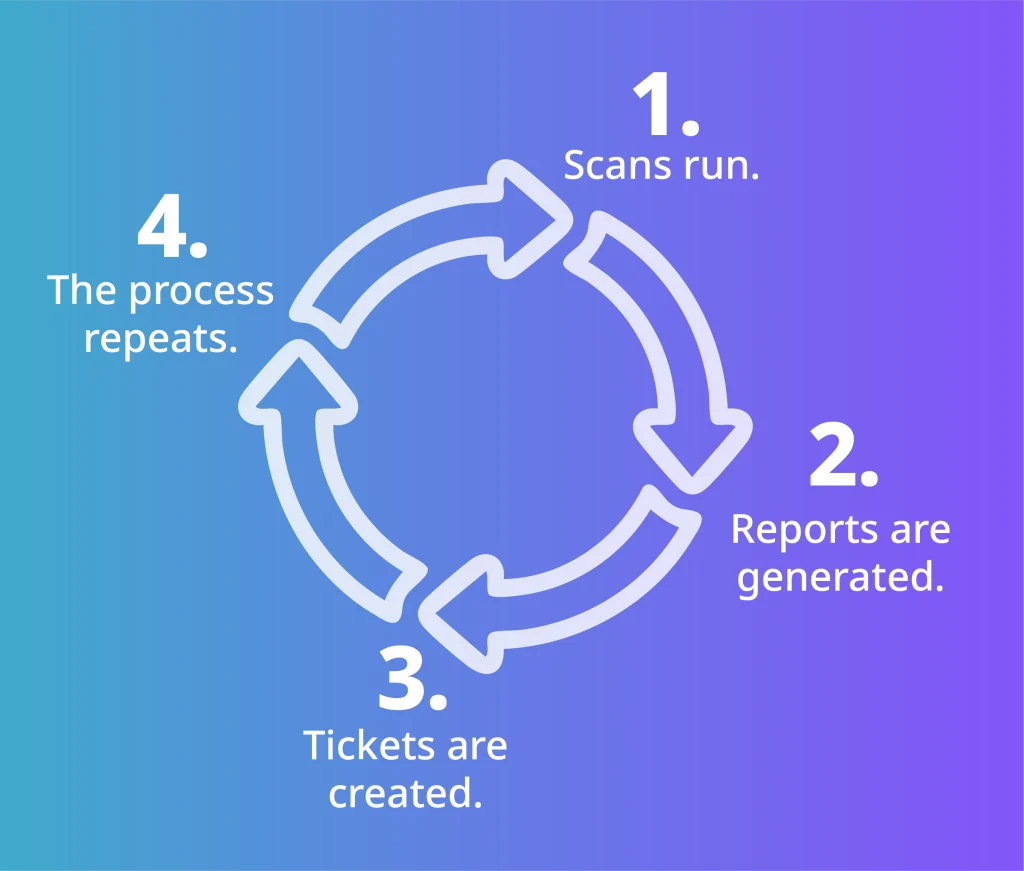
The problem is that threats don’t move in cycles. They move continuously.
Signature-based detection is effective against known attack patterns. It is far less effective against subtle behavioural changes: lateral movement inside the network, unusual privilege escalation, or API misuse that looks almost normal.
Generative AI strengthens DevSecOps by analysing behaviour rather than static signatures.
Instead of only flagging known vulnerabilities, models continuously evaluate:
- How identities behave compared to their historical baseline
- Network traffic shifts that don’t match normal patterns
- Unusual permission changes or privilege elevation
- Irregular API calls across services
This means security controls are not just verifying rules. They are learning what normal looks like inside your environment.
When abnormal behaviour emerges, containment does not wait for a human to connect the dots. Workloads can be isolated. Access paths can be restricted. Alerts can be enriched with context instead of noise.
The measurable impact for UK CTOs and tech leaders:
✔️ Vulnerabilities are identified while changes are being introduced
✔️ Lateral movement is detected earlier, before it spreads
✔️ False positives decline as the model refines its baseline
✔️ Security checks inside the pipeline become faster because validation is continuous
✔️ Security enforcement shifts from periodic inspection to embedded governance.
✔️ Risk does not quietly build between audits; it is evaluated every time the system changes.
Strategic Implementation: Embedding AI into the CI/CD Pipeline
When AI is embedded directly into pull request analysis, infrastructure plans, testing prioritisation, and deployment telemetry, the pipeline becomes risk-aware. And that shift has measurable consequences.
Research from the DORA programme consistently shows that elite performers deploy more frequently while maintaining significantly lower change failure rates.
High-performing teams are also more likely to integrate automated security and compliance checks early in the lifecycle.
Embedding AI within CI/CD strengthens these characteristics: continuous validation, faster feedback loops, and earlier detection of risky changes.
The business gains show up in three places.
1. Reduced Change Failure Rate
Organisations with strong automated validation practices experience materially lower change failure rates and faster recovery times.
When AI flags high-risk diffs, enforces policy at merge time, and monitors canary telemetry against behavioural baselines, fewer risky releases reach full production. Fewer failed releases mean fewer customer-impacting incidents and fewer emergency escalations that derail roadmap delivery.
2. Shorter Mean Time to Recovery
Every minute of degraded service has a cost. Gartner has estimated that the average cost of IT downtime can reach thousands of dollars per minute, depending on the industry.
When AI monitors live rollout telemetry and halts progression early (or performs component-level rollback rather than full-stack reverts), MTTR shrinks. Containment becomes surgical instead of disruptive. That’s preserved revenue and protected brand trust.
3. Lower Cost of Governance
Manual review cycles are expensive. Senior engineers spending hours reviewing routine changes is an operational cost. When AI pre-classifies risk, highlights blast radius, and embeds compliance checks into CI/CD, review becomes targeted. High-risk changes receive scrutiny. Low-risk ones move quickly.
That balance increases deployment frequency without increasing headcount.
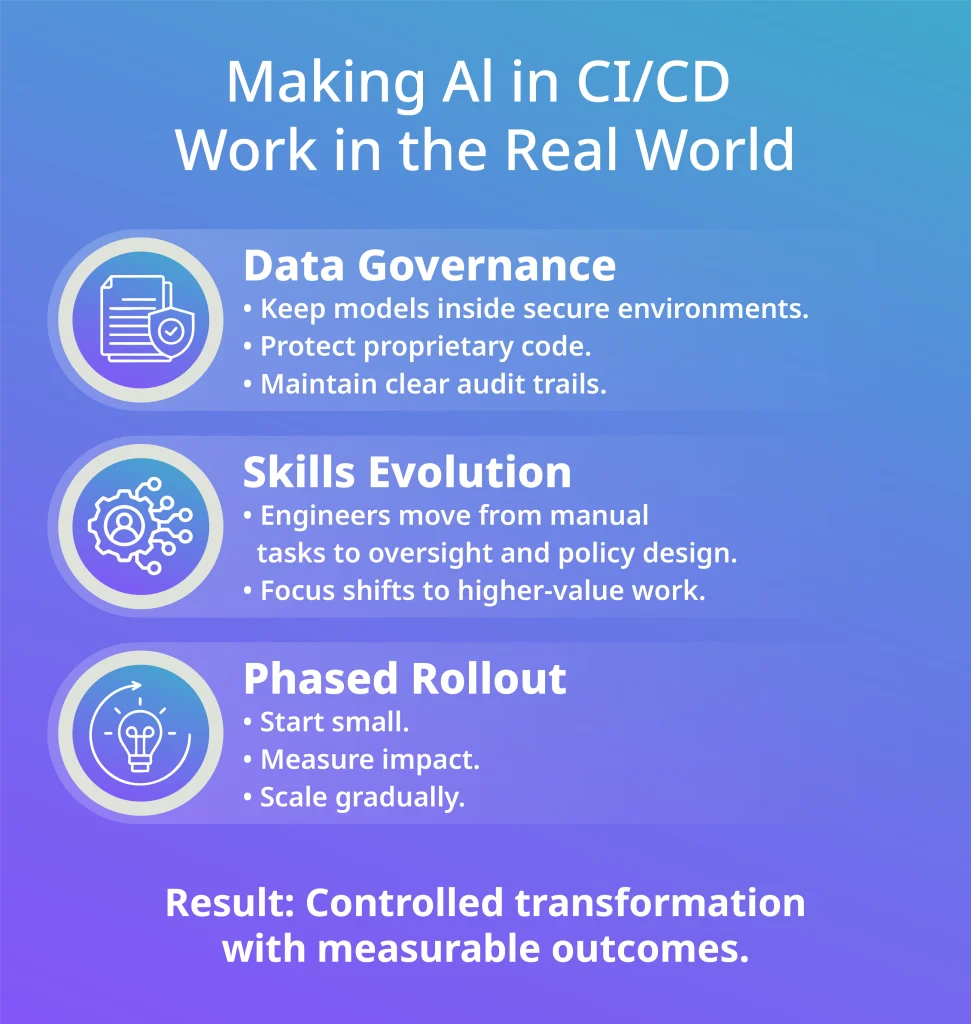
The UK Compliance Edge: For CTOs navigating FCA, PRA, or GDPR, GenAI doesn’t just speed up code; it generates the audit trail as the code is written. This transforms “Compliance” from a blocker into a background process.
This aligns with Gartner’s 2025 positioning of AI TRiSM (Trust, Risk and Security Management), which describes layered technical capabilities that enforce enterprise policy across all AI-enabled systems.
Building AI into CI/CD effectively operationalises AI TRiSM within the delivery lifecycle, making governance continuous, risk scoring automated, and compliance enforcement part of every change.
Automated Quality Assurance
Testing is when delivery momentum typically slows.
Most pipelines still treat validation as a volume problem: run more tests, increase coverage, extend regression cycles. That can be expensive over time. As suites grow, execution time expands, yet edge cases still slip into production.
AI-enhanced quality assurance changes how testing decisions are made.
Instead of executing every test path with equal weight, the system analyses historical defect clusters, code ownership patterns, and change impact signals.
If a specific module has a history of regression when modified, it receives deeper simulation. If a change touches a stable, isolated component, it doesn’t trigger unnecessary overhead.
The practical outcome is smarter sequencing.
- High-risk components are stressed harder.
- Low-risk changes move without friction.
- Regression exposure narrows over time because patterns are learned.
Release confidence increases without extending pipeline duration.
For the business, this translates into shorter cycle times, fewer escaped defects, and lower post-release remediation costs. Testing becomes a precision control layer.
Smart Deployment and Targeted Rollbacks
Before rollout progresses, AI evaluates the environment against the incoming build, surfacing configuration drift, dependency conflicts, or behavioural anomalies early. During release, live telemetry is compared against expected patterns.
If something deviates, the response is precise: pause the rollout, redirect traffic, or roll back a single service instead of the entire stack.
How does that influence your business? Issues are contained before they spread, recovery happens faster, and customers are far less likely to feel the impact. Stability improves, and delivery doesn’t have to slow down to achieve it.
Autonomous DevOps: How AI Is Transforming IT Operations and Governance
As AI becomes built into CI/CD, infrastructure, and security layers, IT operations move from reactive intervention to supervised autonomy. Systems assess risk in real time, enforce policy during change, and respond to anomalies before they escalate.
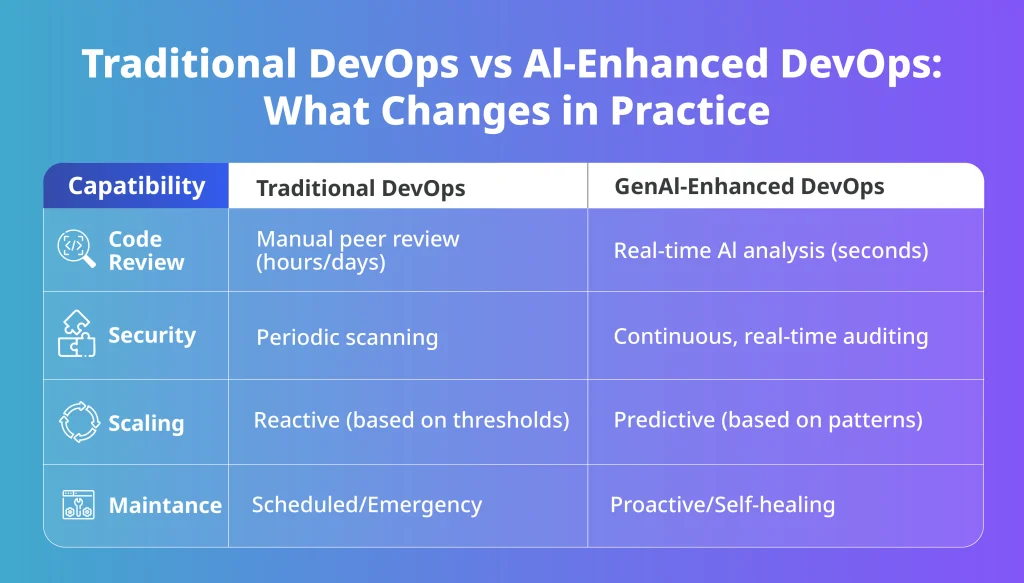
AI-driven DevOps as a service management can replace periodic control with continuous intelligence, allowing organisations to scale delivery without scaling instability.
Partnering for Transformation: The Deployflow Approach
Don’t let delivery depend on senior engineers, security checks run as separate processes, and incident response rely on manual interpretation. As demand increases, effort scales faster than output.
Deployflow restructures delivery so that operational judgement is a part of the pipeline.
In one recent UK SaaS engagement, the shift was simple but decisive:
- AI enforcement replaced manual waiting.
- Pull requests were validated against platform standards automatically.
- Infrastructure changes were assessed before deployment.
- Incident remediation followed predefined policy logic instead of ad hoc diagnosis.
Engineers defined the rules, and the system executed them consistently.
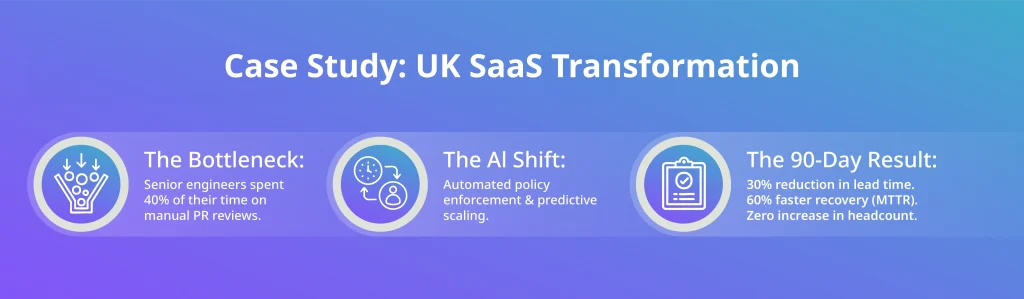
That is what happens when governance becomes continuous. This is not about adding AI to DevOps. It is about removing human bottlenecks from critical control points.
Ready to Modernise Your DevOps Model?
If delivery speed increases while operational exposure grows, the architecture needs to be redesigned.
Deployflow builds AI-enabled DevOps systems that embed risk validation, automated enforcement, and recovery intelligence directly into CI/CD.
Start a strategic conversation with Deployflow to redesign delivery to scale, build resilience, and drive controlled growth.
Frequently Asked Questions About AI in DevOps and CI/CD
How much does it cost to implement Generative AI in a CI/CD pipeline?
Costs vary by scope, but ROI is typically realised within a few sprints.
When delivered through focused sprint cycles and full-stack squads, implementation stays controlled and avoids large, open-ended transformation spend. AI reduces senior engineer review time, lowers incident remediation effort, and prevents expensive production failures. That combination lowers the cost per release without increasing headcount, where the real savings appear.
Will AI in DevOps replace DevOps engineers?
No, it shifts what they focus on. AI removes repetitive validation and reactive firefighting, but engineers still define rules, policies, and architectural standards.
Instead of manually reviewing every pull request or diagnosing every alert, teams supervise automated enforcement and refine governance models. This increases output per engineer without increasing headcount. The result is capability elevation, not workforce reduction.
Is AI-driven CI/CD secure for regulated UK industries?
Yes, when implemented inside controlled environments with clear governance boundaries.
AI systems should operate within secure VPCs or internal networks, with strict access controls and full audit logging. When embedded properly, AI strengthens compliance by enforcing policy during implementation rather than after deployment. For organisations operating under FCA, PRA, or GDPR oversight, this creates continuous evidence of controlled change. Security improves because validation happens at every merge, not just during scheduled audits.
How long does it take to see measurable results from AI in DevOps?
Early signals typically appear within the first 60 to 90 days.
Risk-aware pull request validation and automated policy enforcement reduce review delays almost immediately. Incident detection and rollback intelligence begin improving MTTR as soon as telemetry baselines stabilise. More structural improvements (such as sustained reduction in change failure rate and cloud cost optimisation) emerge over a few release cycles. Most organisations see measurable improvements in DORA metrics within a quarter when rollout is structured properly.
Explore our BLOG
Recent articles

Is Claude Down? Anthropic Outage: Protect Your Cloud Infrastructure
Claude.ai has spent 2026 fighting its own success. Twenty-one incidents landed between 12 August and...
read full article

AI Experimentation vs AI Engineering: The Difference That Decides Whether Your AI Budget Survives
Experimentation buys you knowledge. Engineering buys you a system that still works next quarter, when...
read full article

Why Most Agentic AI Projects Fail Before They Scale
Has your agent been three months from production for nine months? Agentic projects break at...
read full article