


Cloud migration feels predictable until the moment you push real data through the pipe. Then latency jumps, throughput sinks, and a perfectly planned cutover suddenly turns into a race against time.
The problem isn’t your workloads. Your WAN just can’t keep up with what you’re asking it to move.
WAN is the network layer that connects your on-prem systems, cloud platforms, and remote locations into one unified, scalable path for moving data.
This guide shows you how to turn that weak point into the backbone of a fast, stable, low-stress migration.
What you’ll understand after reading:
- How WAN shapes the real performance of your migration: speed, stability, and cross-region behaviour.
- Why your network design creates friction that tools can’t solve.
- Which WAN technologies actually make migrations predictable.
- How to build a WAN strategy that removes uncertainty during cutover.
- How Deployflow engineers create migrations that stay stable under heavy data movement.
And you’ll want to keep reading because fixing the WAN layer gives you the biggest payoff in cloud migration: fewer surprises, smoother cutovers, and a level of predictability that no amount of tuning on top can ever replace.
Why Cloud Migrations Fail at the Network Layer
Imagine your migration is running smoothly, workloads deployed, pipelines green, environments aligned, until a single heavy database transfer begins.
Suddenly, the cutover slows, dashboards lag, and services start behaving in ways no runbook prepared you for. Nothing inside the application changed. The network did.
Legacy routing wasn’t built for cloud-scale data bursts or cross-region replication. Public internet links behave unpredictably the moment you push terabytes instead of normal user traffic.
And without visibility into latency, congestion, or packet loss, every slowdown feels mysterious because the real failure is happening between systems.
This isn’t a fringe problem. Today, 94% of organisations with more than 1,000 employees host a significant portion of their workloads in the cloud. (source: CloudZero) When almost every enterprise is pushing critical systems into distributed environments, the WAN becomes the crucial piece that determines how predictable, safe, and stable any migration feels.
These are structural limits.
And until the network layer is shaped for cloud-scale behaviour, every migration will feel like a fight against forces you can’t see.
How a High-Performance WAN Transforms Migration Quality
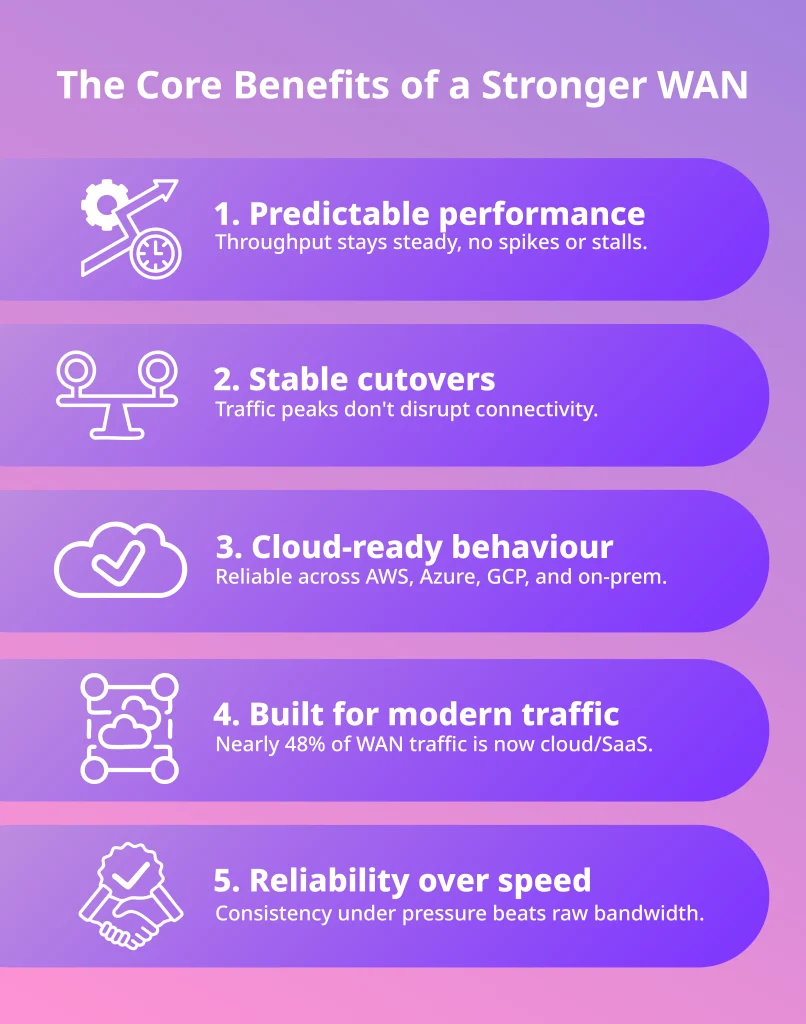
A strong WAN doesn’t make migrations faster in the marketing sense, but it can make them behave the way you need them to.
The real benefit is predictability. When the network layer is engineered properly, large database copies don’t spike or stall, VM transfers follow a consistent pattern, and you stop guessing how long critical steps will take.
Cutover windows become calmer because connectivity stays stable even when traffic peaks. Instead of reacting to jitter or packet loss, you work through a controlled, repeatable process.
And whether you’re moving workloads across AWS, Azure, GCP, or on-prem systems, a high-performance WAN gives you the same behaviour every time: steady throughput, stable paths, and fewer surprises.
Modern traffic patterns make the gap even clearer. A Network Computing survey shows that roughly 48% of WAN traffic already goes to external cloud, SaaS, and IaaS platforms. Nearly half of your network’s daily workload is cloud-bound, yet many organisations still run migrations on WAN architectures designed for a world where everything lived inside one datacenter.
This is what actually improves migration quality; it’s not raw speed but a network that acts the same under pressure as it does during planning.
WAN as a Built-In Security and Compliance Layer
When sensitive workloads start moving toward the cloud, the network becomes a core part of your security posture.
A well-designed WAN gives you something the public internet never can: a private, controlled pathway where every packet moves under your rules.
- Encrypted private links remove the constant back-and-forth with compliance teams because data never travels through unpredictable routes.
- Segmented network paths let you isolate workloads the moment they leave on-prem systems, reinforcing zero-trust principles without rearchitecting your entire stack.
- When you’re migrating data tied to financial regulations, insurance policies, or clinical records, a high-assurance WAN dramatically reduces the legal overhead that slows projects down.
Frameworks like PCI DSS, FCA, GDPR, and HIPAA stop feeling like blockers. With the right WAN foundation, they simply become requirements you can satisfy by design.
Modern WAN Technologies Cloud Teams Should Be Using
The moment your migration starts moving real workloads, the type of WAN you rely on becomes the difference between a controlled transition and a chaotic one. But you don’t need a dozen network products, just a few that meaningfully change how data moves under pressure.
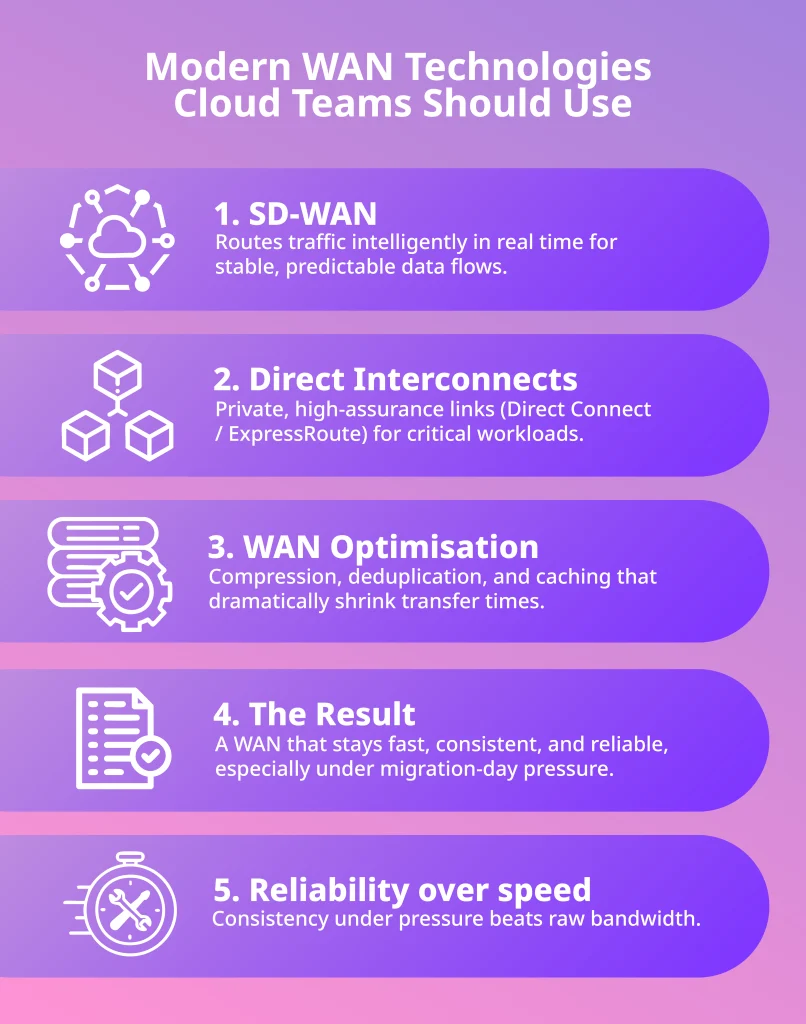
SD-WAN matters because it thinks before it routes. Instead of pushing traffic through a single, predetermined path, it chooses the best route in real time based on congestion, loss, and latency. During a migration, that means high-volume transfers follow clean, predictable paths instead of fighting against random network conditions. The network adapts around the workload, not the other way around.
Direct Interconnects are what you use when “good enough” performance is no longer acceptable. AWS Direct Connect, Azure ExpressRoute, and GCP Interconnect give you a private, stable bridge straight into the cloud provider’s backbone. For critical workloads (banking systems, medical data, insurance platforms), this isn’t a luxury. It’s how you ensure that data moves through a predictable, legally safe path instead of bouncing across half the internet.
WAN optimisation is the quiet workhorse nobody appreciates until they see the difference. Compression, deduplication, and caching: these techniques dramatically reduce the amount of data you actually need to move. For multi-terabyte databases or VM images, optimisation turns a migration step that could take hours into something that behaves consistently every time you run it.
You don’t need exotic networking tricks to improve migration quality, just the right tools used for the right reasons. Each of these technologies solves a real slowdown point, and together they turn your WAN from a wildcard into a reliable backbone for everything you move to the cloud.
The Hidden Costs of Underusing WAN
Migrating to the cloud without the right WAN foundation is like trying to move an entire house using a single narrow road. The trip still happens, but every minute takes longer, every delay becomes expensive, and every bump increases the risk of damage.
The network doesn’t stop the migration, but it slows the whole process, makes it costlier, and makes it far more fragile than it should be.
Longer migration windows mean paying for extra cloud resources, additional storage time, and extended engineering support you never planned for.
A stretched cutover increases the chance of downtime and customer impact, and every unexpected slowdown raises the odds of a costly rollback. And when network controls aren’t strong enough, compliance teams step in, timelines slip, and sensitive workloads can’t move until security concerns are resolved.
Underusing the WAN is a financial and operational drag that compounds with every step of the migration.
Building a WAN Strategy That Makes Migration Predictable
A predictable migration comes from understanding how your data behaves before you move it.
Every workload has its own rhythm: steady flows, sudden bursts, or massive one-off transfers. When you map those patterns early, the WAN stops being a wildcard and starts becoming an engineered part of the plan.
A strong strategy also means testing the network under real pressure. When you simulate peak loads, replication bursts, and cross-region transfers ahead of time, you uncover how the WAN behaves when it’s pushed. That insight turns unknowns into constraints you can design around.
And the final piece is treating network logic as code. When routing rules, access controls, and connectivity paths live inside your IaC and CI/CD pipelines, the network becomes versioned, reviewable, and repeatable. No surprises during cutover, no last-minute configuration drift, no scrambling to rebuild paths manually.
When your WAN strategy reflects how your data actually moves, how your network actually behaves, and how your pipelines actually deploy, the entire migration becomes calmer, cleaner, and far easier to predict.
How Deployflow Engineers Deliver WAN-Optimised Cloud Migrations
A WAN-aware migration is something engineered into the process from the very beginning.
That’s why Deployflow uses P-Suite, a model built around small, full-stack engineering squads that handle everything required to move workloads safely: cloud architecture, DevOps, networking, security, automation, and the migration work itself.
P-Suite brings squads embedded in your existing team and a sprint-based delivery method for complete control.
A focused squad with the exact skills needed to design, build, and run a cloud migration as a single, integrated system rather than a chain of disconnected teams.
Because the squads are full-stack, they bring capabilities that traditional setups struggle with:
- Network-aware pipelines: the migration path, cutover steps, and data sync flows are designed with real routing behaviour in mind.
- IaC-driven network builds: interconnects, routing rules, VPC/VNet structures, and security policies are fully codified, versioned, and deployed automatically.
- Security woven into delivery: encryption, segmentation, logging, and policy checks are automated through DevSecOps workflows instead of being handled as late approvals.
- End-to-end ownership: the same squad plans, builds, tests, and executes the migration, which means no handoff delays, no conflicting standards, and no surprise dependencies.
- Rapid iteration under pressure: full-stack squads can adapt quickly when data volumes shift, routing changes, or unexpected behaviours surface during cutover.
Case Study: Turning an Unstable Cloud into a Reliable, Predictable Platform
A real example of how much the network layer can make or break a cloud environment comes from Deployflow’s work with Strike (now Purplebricks).
When Strike suddenly lost its internal DevOps team, its platform started slipping into a cycle of outages, strange performance behaviour, and routing paths that collapsed under even moderate pressure. Nothing was wrong with the product itself; the real issue was a network foundation that couldn’t keep the system steady when it mattered.
Deployflow used an embedded DevOps squad and began rebuilding the environment from the ground up. Automated pipelines replaced brittle manual processes, network paths were hardened, and cloud-native routing patterns brought consistency back to the platform.
By tightening the fundamentals (interconnects, VPC setup, DNS behaviour, and deployment flow), the team transformed a reactive, outage-prone environment into one Strike could trust.
The results tell the story on their own:
- 70% improvement in overall stability
- 60% reduction in downtime
- 55% jump in release reliability
- 25% lower operating costs
This mirrors exactly what a WAN-aware migration achieves: when the network foundation is engineered properly, everything above it becomes calmer, cleaner, and far more predictable.
The combination of full-stack ownership, network-aware engineering, and automated security is what makes Deploflow’s cloud migration predictable.
An embedded squad works as one unit, shaping the network, pipelines, and cloud environments together so the WAN is a controlled, engineered asset that supports every migration step.
WAN Is the Accelerator Behind Successful Cloud Migrations
Cloud migrations have a habit of making teams look in the wrong direction. When things slow down, everyone inspects the workloads, rechecks the pipelines, or blames the cloud provider.
Meanwhile, the real issue is sitting underneath it all: the network layer that decides how smoothly everything moves, how stable cutovers feel, and whether your weekend stays your weekend.
A well-designed WAN simply removes chaos. No strange behaviour when traffic spikes, no eleventh-hour surprises, no cutover anxiety. Just a migration that behaves like the plan you wrote, not the one you feared.
And honestly, anything that makes cloud work less dramatic deserves a little more respect.If you want a migration that feels controlled instead of unpredictable, and a network layer that supports your team instead of testing its patience, get in touch with Deployflow and let a full-stack delivery squad build the WAN foundation your cloud migration actually needs.

WAN in Cloud Migration: Frequently Asked Questions
What WAN bandwidth do I need for a cloud migration?
You need enough bandwidth to move your largest data transfer within the cutover window you’ve committed to.
Migration planning shouldn’t be based on average daily throughput but on the size of full database copies, VM images, and replication bursts. Once you calculate what must be moved and in what timeframe, add overhead for encryption, retries, protocol inefficiency, and packet loss. Most teams underestimate because they size the WAN for operations, not for the extreme peaks that only happen during migration.
Does latency matter more than bandwidth during a migration?
Latency often impacts migration performance more than bandwidth, especially for long-distance or cross-region transfers.
Block-level replication, VM image transfers, and database syncs rely on round-trip acknowledgements. When latency climbs, throughput collapses even if there is plenty of available bandwidth. This is why migrations that span regions or continents perform unpredictably unless the WAN uses low-latency interconnects or SD-WAN path selection to stabilise the route.
Should I use VPN or a private interconnect like Direct Connect or ExpressRoute?
Private interconnects are the better choice for critical or regulated workloads.
VPN tunnels depend on the public internet, which introduces variable latency and packet loss that can derail a migration under load. Direct Connect, ExpressRoute, and Interconnect give you deterministic routing, stable latency, and a private, compliant path into the cloud provider’s backbone. For financial data, healthcare records, or insurance systems, this level of predictability isn’t optional.
How do I test my WAN before running the real migration?
You should test the WAN with workload-accurate simulations that mimic the heaviest data transfers you expect.
Checking connectivity isn’t enough. You need to push synthetic database dumps, large VM images, and replication traffic at full volume. Only then do you see real behaviour: latency under pressure, jitter patterns, congestion points, and how the network reacts when bursts occur. This type of testing turns unknowns into measurable constraints you can design around.
To avoid blind spots in testing, many organisations use structured cloud consulting services that help validate network behaviour under real migration loads and uncover issues before cutover.
What’s the most common WAN mistake teams make during cloud migrations?
The biggest mistake is designing the WAN for everyday traffic instead of migration-day loads.
Normal operations don’t resemble a migration at all. Migrations generate sustained replication, multi-terabyte transfers, and cross-region peaks that legacy WAN architectures were never meant to handle. When teams don’t model this early, cutovers stretch, costs rise, and unexpected slowdowns appear at the worst possible moment. Treating WAN design as part of the migration plan is what prevents that.
Explore our BLOG
Recent articles

Is Claude Down? Anthropic Outage: Protect Your Cloud Infrastructure
Claude.ai has spent 2026 fighting its own success. Twenty-one incidents landed between 12 August and...
read full article

AI Experimentation vs AI Engineering: The Difference That Decides Whether Your AI Budget Survives
Experimentation buys you knowledge. Engineering buys you a system that still works next quarter, when...
read full article

Why Most Agentic AI Projects Fail Before They Scale
Has your agent been three months from production for nine months? Agentic projects break at...
read full article