



A proof of concept tells you whether an idea can be built before you commit the budget to build it. Delivered early, that one answer separates a funded win from an expensive write-off.
Gartner expects more than 40% of agentic AI projects to be cancelled by the end of 2027, many of them hype-led proofs of concept that never reached production.
The guide below shows you how to scope, run, and productionise a POC so yours is not one of them.
Executive Summary for IT Leaders
- A POC answers one question: can this be built? Keep it apart from “should we build it?” and “will the market want it?”.
- Scope it to your single riskiest assumption, with pass or fail criteria and a hard deadline set on day one.
- Treat the code as disposable. A POC skips security, scale, and monitoring by design.
- Two failure modes kill most POCs: they stall in limbo, or their throwaway code leaks into production. A decision gate stops both.
- A well-evidenced “no” is a win. It spends a little to avoid losing a lot.
What a Proof of Concept Proves and What It Does Not
A proof of concept proves that a specific technical approach can work, on your data, inside your constraints.
It is silent on everything else. Whether people will use it, and whether the economics hold, are separate questions for a later stage.
That distinction is where budgets are won or lost. Confirm feasibility first, then design, then build at scale. Reverse the order, and you fund a solution whose foundations were never tested.
Say you want to auto-triage support tickets with an LLM. A POC proves the model can classify your real tickets accurately enough, on your data, within your latency budget. It says nothing about whether your agents will trust its routing, or whether it saves more than it costs to run.
The expensive mistake is reading a passed feasibility test as proof of demand. Those are different claims, and conflating them turns a good POC into a bad bet.
POC vs Prototype vs Pilot vs MVP, in Plain Terms
Four terms get muddled in board meetings, and the mix-up is expensive. Each proves a different thing, for a different audience, and meets a different fate.
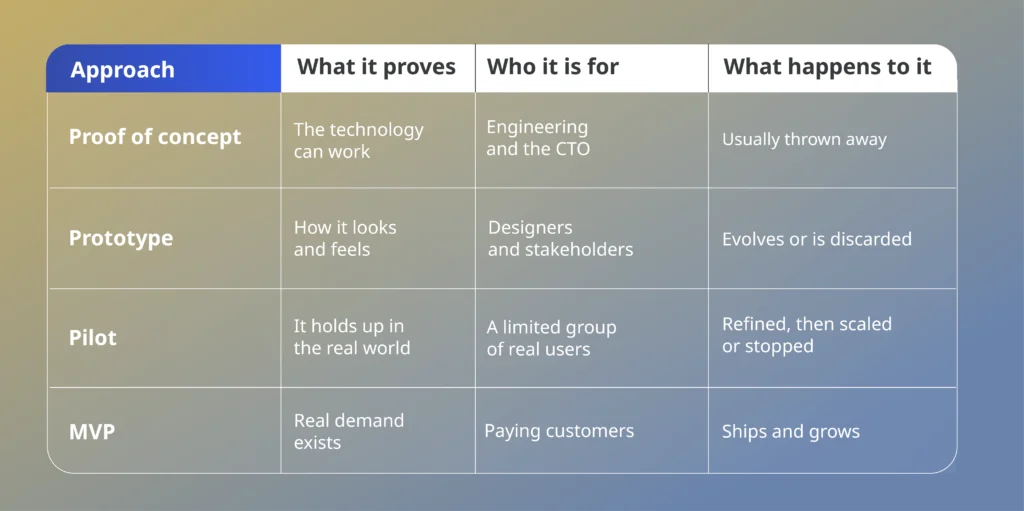
The difference is how much of the product each one is willing to fake.
- A POC builds only the risky part for real and fakes the rest.
- A prototype fakes the engineering entirely to test how the product looks and feels.
- A pilot is the real thing, run with a limited group in a controlled setting.
- An MVP (Minimum Viable Product) is the real thing sold to customers who pay real money, stripped back to the smallest complete product you can ship.
The Single Question Every Proof of Concept Should Answer
Every good POC answers a single question: Can this be built with the technology, data, and constraints you already have?
Two others always crowd in. “Should we build this?” is a business case. “Will people use it?” is a market question. Aim the POC at feasibility alone, and it stays fast, cheap, and conclusive.
How a Proof of Concept Guards Your Largest Delivery Cost
A proof of concept protects the largest line in your delivery budget by catching an unbuildable idea before it becomes an unbuildable project. It gives the board feasibility evidence, tests a vendor or platform before a licence is signed, and stops good money chasing a flawed premise.
The argument comes down to asymmetry, and the numbers are stark. A landmark McKinsey and University of Oxford study of more than 5,400 IT projects found that large IT projects run 45% over budget on average while delivering 56% less value than predicted, and that roughly 17% overrun so badly they threaten the survival of the company.
A POC costs a fraction of a full build. Set against a project that could sink the company, it is the cheapest insurance you will buy all year.
Three Signs a Proof of Concept Is Worth Building
Run a POC only when a build is the one thing that can settle a real technical unknown. Three quick questions tell you whether you are there:
- Can only a working slice of code prove it, one way or the other?
- Is the risk technical rather than commercial?
- Is the answer genuinely unknown to your team?
Three yeses mean build it. The candidates are easy to spot: a new architecture your team has not used before, an integration with an unfamiliar third-party system, a performance target you are unsure the stack can hit, or an AI capability whose accuracy on your data is unknown.
When to Skip the POC and Run a Spike Instead
A single no changes the answer. If the risk is commercial, a POC proves the wrong thing, and the question belongs to market research or an MVP. If a senior engineer can settle the doubt in a day of reading or a short feasibility spike, spend the day and skip the ceremony. Reserve the POC for uncertainty that nothing cheaper can resolve.
Keeping a Proof of Concept Small, Fast, and Conclusive
You keep a POC small by building only what tests your riskiest assumption, and nothing more.
Three decisions keep it tight, and all three come before anyone writes code: what you are testing, how you will know, and when you will stop.
Begin With the Assumption That Carries the Most Risk
Name the one assumption that sinks the whole project if it turns out to be false. That is the only thing your POC needs to test. Build just enough to put it under real pressure, and leave everything else out. Polished screens, edge cases, error handling, and scale all wait until feasibility is confirmed.
Here is a quick test for whether you have the right assumption. If failing would not change your decision to proceed, it is not the one worth a POC. Go after the assumption that carries the whole business case on its back.
Agree Pass or Fail Criteria Before You Write Code
Decide what a pass looks like before a single line of code exists. The criteria must be measurable and binary, so no one can argue the result afterwards. “The model performs well” is an opinion waiting to happen. “The model classifies 90% of last quarter’s tickets correctly, in under 400 milliseconds” is a criterion, because it can only be true or false.
Write down what counts as failure too. A clear threshold turns a disappointing result into a clean “no” and a saved budget, rather than an open invitation to keep tinkering until the numbers flatter you.
Set a Deadline, a Budget, and a Kill Switch
Fix three things on day one: the deadline, the budget, and the person who owns the go or no-go call. A POC without a deadline quietly expands to fill whatever time it is given.
The kill switch matters most. A POC you cannot stop has stopped being a risk instrument. It has become an unmanaged project wearing a smaller label. Naming who can end it, and on what evidence, is what keeps a small experiment from becoming a slow and expensive one.
Size it in weeks. As a rule of thumb, two to six weeks with one to three senior engineers is enough to pressure-test a single assumption. If the plan needs a full quarter and a full dedicated team, scope has already crept past feasibility into a build, and the deadline is doing its job by flagging it.
The 6-Step Proof of Concept Process Your Team Can Reuse
A repeatable six-step process keeps every POC honest, from first question to final verdict. The first three steps happen before anyone writes code. The last three turn the build into a decision.
- Frame the riskiest assumption as a single testable question.
- Agree on the pass or fail criteria everyone signs up to.
- Assemble a small, senior team, usually a lead engineer and one or two specialists close to the problem.
- Build the thinnest slice that exercises the assumption and nothing else.
- Test against your criteria with real or representative data.
- Decide: scale it, refine and retest, or stop.
Step six is the one teams skip. A pass sends you to scale. A near miss sends you back to step four to refine and retest, once. A clear fail ends it there. Choosing those routes in advance is what stops a finished POC from drifting into limbo.
A POC rewards deep problem knowledge over headcount. Large teams tend to build more than the question requires, so hold the line on size even when momentum tempts you to add people. Aim for the fastest credible answer and let the thorough build wait for production.
The Two Ways a Proof of Concept Fails
Two predictable failures account for most disappointing POCs, and you can plan around both. Neither is dramatic. Both trace to the same root cause: a proof of concept that ends without a real decision being made.
POC Purgatory, and How to Escape It
POC purgatory is the limbo where a proof of concept works, then sits untouched for months. It is neither killed nor productionised. Momentum drains, the team moves on, and the sunk cost quietly climbs.
You can catch it early. The demo lands, everyone nods, and then no one owns the next step. The verdict slips to “let us revisit next quarter.” The engineers drift onto other work while the code goes stale. Each is a sign that the decision never actually happened.
The escape is a decision gate. Every POC ends with a documented verdict, a named owner, and a date to act. A result that produces no decision is itself the failure, whatever the code managed to do.
The Danger of Shipping Throwaway POC Code
Trouble starts the moment throwaway POC code gets pushed into production to save time. A POC is built for speed. It skips security hardening, error handling, testing, and monitoring because proving feasibility doesn’t require them.
The warning signs are familiar. Someone calls the POC “basically done.” A deadline tightens, and a rebuild starts to look like a waste. The prototype picks up real users before anyone has hardened it. The shortcuts that made it fast then become the technical debt that makes it fragile.
Treat POC code as disposable from the outset, and say so plainly, so no one mistakes a feasibility test for a foundation. Rebuild for production on purpose, with the security, testing, and monitoring the POC was right to skip.
The POC-to-Production Gap That Sinks Good Ideas
The gap between a working POC and a live production system is far wider than most roadmaps assume. A POC proves the idea can work once. A production system has to make it work every day, for real users, without anyone watching over it. Underrate that distance and a validated idea stalls at the worst possible moment, with expectations already set.
The catch is that success hides the gap. A POC that passes feels finished, when all it has really done is prove the idea is possible. The hardest engineering, the part that makes it safe, reliable, and able to scale, has not begun.
What a POC Leaves Out on Purpose
By design, a POC leaves out almost everything production depends on. The list is long: authentication and access control, monitoring and alerting, automated testing, load handling, failover, and compliance controls. None of it is an oversight. Leaving it out is what keeps the POC fast and cheap.
Every item on that list separates a demo that works from a system you can trust with real users and real data. Naming the omissions on day one sets an honest view of the work still to come.
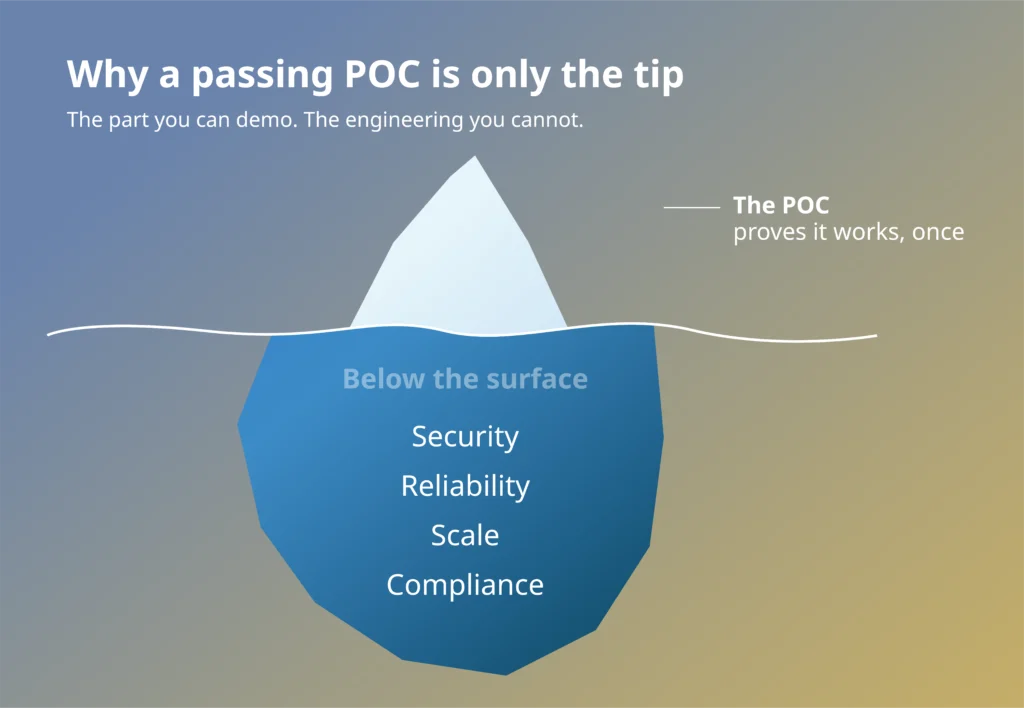
Everything below the waterline is real engineering that a passing POC has not started.
Turning a Validated Concept Into Production-Ready Software
You close the gap by re-engineering the validated idea for reliability, security, and scale from a clean base. The POC proved the concept; production earns the trust. Done well, the shift shows up in the numbers.
Deployflow’s published outcomes include a 90% reduction in downtime through automation and a 35% drop in network security incidents. Cloud security is part of that work, and the payoff is a system that holds under real load: Zilch grew from MVP to a double-unicorn fintech on infrastructure built for exactly that.
How AI Changes the Way You Run a Proof of Concept
AI changes the rules of a POC, because an AI system rarely behaves the same way twice. A traditional POC can pass a fixed test. An AI POC has to prove consistent quality across many inputs, and that calls for a different method.
The stakes are higher than they look. MIT Project NANDA’s 2025 report, The GenAI Divide: State of AI in Business, found that 95% of enterprise GenAI pilots delivered no measurable business impact, with most stalling on how well the tool fitted real workflows rather than on model quality.
Proving a model can impress once is easy, and nowhere near enough. That higher bar is what production-grade AI engineering is built to clear, and agentic AI systems that act on their own raise it further still.
Prove AI Features With Evaluation Sets, Not Demos
Prove an AI feature with an evaluation set, never with a one-off live demo. A demo shows one impressive result. It tells you nothing about the hundred results you did not see.
An evaluation set is a curated batch of representative inputs paired with known good answers. Build it to mirror reality: the common cases, the awkward edge cases, and the adversarial inputs that tend to break things. Then score the model across the whole set for accuracy, consistency, and failure rate. Feasibility becomes a number you can defend, such as correct answers on 92% of several hundred real cases, rather than a single clean run in front of an audience.
Start an AI POC by Checking Your Data and Risk Surface
Before you test feasibility, confirm the data exists, is accessible, and is good enough to trust. An AI POC is only as sound as the data behind it. Check that first, because a data problem can masquerade as a model problem for weeks if you let it.
The same exercise exposes your AI risk surface: where sensitive data flows, where output needs guardrails, and where agentic AI governance has to sit before anything reaches production. Surfacing those risks at the POC stage is far cheaper than finding them after launch.
How to Know If Your Proof of Concept Succeeded
You judge a POC against the criteria you set at the start, and nothing else. Did the build clear the threshold, yes or no? A clear pass supports the case to scale. A clear fail is just as valuable, because it redirects the budget before a bigger commitment is made.
One distinction saves a lot of grief here. A technical pass is not the same as a green light. The POC has proven the idea can work; whether it should be built still rests on cost, demand, and timing. Keep those verdicts separate, so a strong result informs the business decision without quietly making it for you.
The reframe worth taking to the board follows from that. A proof of concept that returns a well-evidenced “no” has done its job. It spent a small sum to avoid a big mistake. On that measure, the only failed POC is the one that never produced a clear answer.
Which Ideas Earn a Proof of Concept, and Which Do Not
The hardest call comes before any code: choosing which idea actually deserves a POC. You now have the tests to make it, the three-question gate, the riskiest-assumption rule, and the criteria that turn a hunch into a pass or fail. What is harder to supply from the inside is an honest read of where your real technical risk sits.
Deployflow works with technology leaders to pinpoint the one assumption worth testing first, define what a credible pass looks like, and map the route from a validated concept to production-grade delivery. Entry is through an audit or assessment, so the work starts by finding where your real technical risk sits before any code is written.
As a transformation delivery partner across DevOps, cloud, and AI engineering, the aim is a green-light decision the board can trust, built on evidence rather than optimism.
Talk to the Deployflow team to plan the path from feasibility to production before committing budget.
Frequently Asked Questions About Proof of Concept
What is the difference between a proof of concept and a feasibility study?
A feasibility study assesses whether an idea is viable on paper; a proof of concept builds a small piece to prove it works in practice.
The study weighs cost, risk, timelines, and technical options through research and analysis, before anyone writes code. A POC comes afterwards, or instead, when the only way to settle a technical doubt is to build a working slice and test it. Reach for a study to answer a broad “should we, and roughly can we?”, and a POC to answer a single “can this specific approach actually work?”.
What is the difference between a proof of concept and a proof of value (POV)?
A proof of concept shows an approach can technically work; a proof of value goes further and shows it delivers a measurable business benefit.
A POC answers “can it be built?” over days or weeks in a controlled setting. A POV, common in vendor evaluations, runs longer and on your real data, to prove the solution shifts a metric you care about, such as cost, speed, or accuracy. When a supplier proposes one, treat it as a longer, value-focused pilot, and hold it to the same hard, agreed success criteria as a POC.
Are proofs of concept free, and who pays for them?
Rarely free. Someone always pays, in engineering time if it is internal, or in fees if a partner runs it.
Some vendors will run a short POC at no charge to win a deal, though a serious, custom POC on your own data and systems is normally paid work. Either way, budget for it as a real cost and keep it small, because the whole point is to spend a little to de-risk a lot. Agree up front who owns the cost, the code, and the final decision.
Should you run a proof of concept with your own team or an external partner?
Use your own team when you hold the skills and have the spare capacity; bring in a partner when the risk sits in technology your team has not worked with before.
An internal team knows your systems and keeps the knowledge in-house, which suits assumptions close to your existing stack. A specialist earns its place when the unknown is exactly what they handle daily, such as a new cloud platform, data pipeline, or AI capability, because they reach a reliable answer faster. Whichever route you take, agree in advance how the findings and any code will be handed back to you, so the POC leaves you better informed rather than dependent.
How do you protect your data and intellectual property during a proof of concept?
Put the terms in writing before the work starts: who can access which data, who owns the code and findings, and how anything sensitive is handled and deleted afterwards.
An NDA and a short data-processing agreement cover most of it, especially when an external partner touches your systems. Use the smallest realistic dataset, prefer anonymised or synthetic data where you can, and confirm that IP in whatever gets built belongs to you, not the party running the POC. Settling this on day one avoids an awkward negotiation once the POC has proven its worth.
Explore our BLOG
Recent articles

ISO 42001 Explained: Requirements, Certification and What Your Engineering Team Must Build
ISO 42001 is the international standard that demonstrates your organisation governs AI properly, and enterprise...
read full article

Is Claude Down? Anthropic Outage: Protect Your Cloud Infrastructure
Claude went down across every surface on 29 September 2026. From 14:00 to 14:59 UTC,...
read full article

Top 10 Healthtech Companies in 2026: What Their Growth Means for AI and DevOps
Every software change that reaches a hospital has to clear regulatory, legacy system, and clinical...
read full article