



Your AI moves at the speed your engineering infrastructure allows, and no faster. The model is the easy part to swap. The harder part is everything around it: the pipelines, cloud architecture and release process that carry it into production.
RAND puts the AI project failure rate above 80%, and lists inadequate infrastructure for deploying finished models among the root causes.
Capable models are now a commodity. Your edge comes from deploying, testing and scaling faster than your rivals. Most teams cannot, and the reason hides in their infrastructure. Strong models sit idle in staging, held back by manual provisioning and slow, brittle releases.
Fix that layer and delivery speed follows.
The sections below map where AI roadmaps lose weeks, what an AI-ready stack looks like in practice, how to control the cloud bill before it controls you, and how a dedicated team ships that work in sprints without a permanent DevOps hire.
The Short Version for Time-Poor CTOs
- Your engineering infrastructure sets the ceiling on how fast AI ships. The model matters far less.
- Five blockers cause most of the delay: manual provisioning, cloud cost sprawl, weak DevOps maturity, architecture that cannot scale, and environment drift.
- Automation and infrastructure as code cut the time from idea to deployed model.
- A dedicated team ships the fixes in sprints and owns the outcome, with no permanent hire.
- A short infrastructure or DevOps assessment pinpoints your gaps and returns a ranked roadmap.
Infrastructure Beats Model Choice for AI Speed
Frontier capability has converged. Any team can call a top-tier model through an API within the hour, so the model itself no longer separates the fast movers from the slow. The edge has shifted downstream, to a harder question: how quickly, and how safely, can you get that model in front of users, learn from it and improve it?
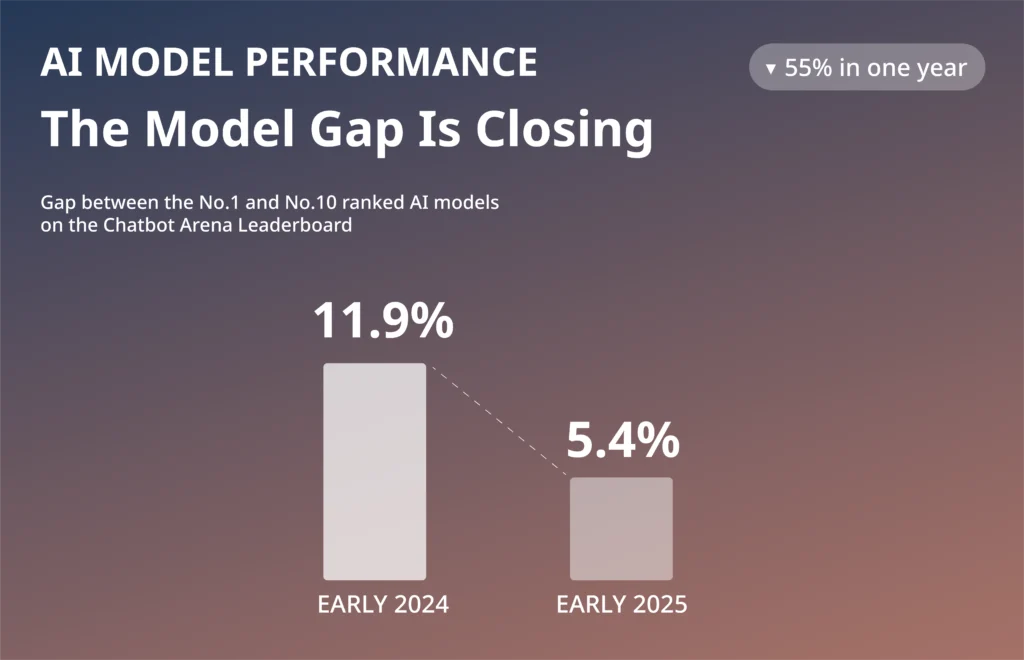
Source: Stanford HAI, AI Index Report
The convergence is not slowing. As of March 2026, Anthropic, xAI, Google, OpenAI, Alibaba and DeepSeek all sat in the top tier of the Arena Elo ratings, with the leading fifteen models separated by as little as three points on individual benchmarks, according to Stanford’s AI Index.
Competitive pressure has moved to cost, reliability and domain-specific performance. Picking a different model now buys you less. Shipping faster than your rivals buys you more.
Experimentation speed comes down to plumbing.
- How fast can you provision an environment?
- How consistent is it across dev, test and production?
- How long does a release take, and how often does it break?
Answer those, and you have measured your real AI velocity. Talent and model choice matter. Neither can outrun a pipeline that takes a fortnight to ship a change.
AI-ready engineering infrastructure is the automated, scalable foundation that lets teams deploy, monitor and improve AI workloads at speed, without manual bottlenecks. The more autonomous the workload, the more that foundation matters. A single model integration tests it; full AI agent development depends on it entirely.
AI-Ready Infrastructure: The Layers That Decide Delivery Speed
Readiness comes down to a few layers, each one removing a specific source of delay. Name them, and the gaps in your stack surface.
In a live AI system, the model is a sliver of the code. A widely cited NeurIPS paper made this point: only a small fraction of a real-world ML system is the model itself, and the surrounding infrastructure is vast and complex. That infrastructure decides how fast you ship.
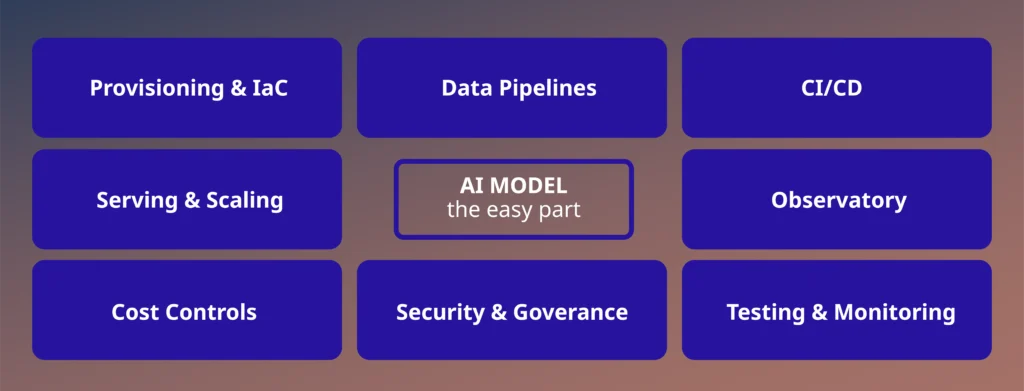
The blocks above are where AI-readiness actually lives, and a few of them shape delivery speed more than the rest. Here is what each one buys you, and where its absence shows up as delay.
Automated provisioning comes first. Environments spin up on demand through code, so engineers stop losing days to tickets and manual setup. Infrastructure as code keeps that provisioning repeatable and version-controlled, so every environment comes out identical. Drift stops causing deployments that pass in test and fail in production.
Delivery pipelines come next. Continuous integration and delivery, built for data and machine learning workloads, move changes through automated testing into production on a predictable cadence, which turns risky, occasional releases into routine ones.
Observability runs across the whole stack, giving you live visibility of performance, cost and model behaviour, so a problem takes minutes to locate rather than days.
Underneath it all, a scalable cloud architecture handles compute and GPU orchestration as demand grows, so the platform stretches with the workload instead of hitting a wall in production.
Audit each layer on its own, because a weak one caps the speed of everything that depends on it. Cost gets its own section below, and security and testing run through all of these layers at once.
Where AI Projects Lose Weeks: Five Infrastructure Blockers
AI delay clusters in a few familiar places. Pin down which ones you have, and each becomes fixable.
- Manual provisioning. Hand-built environments burn days on setup and firefighting.
- Cloud cost sprawl. Spend outruns the forecast as workloads scale, and finance starts blocking growth.
- Weak DevOps maturity. Painful releases ship rarely, so AI iteration stalls.
- Architecture that cannot scale. A platform that passed the pilot buckles under production load.
- Environment drift. Code that works locally fails live once dev, test and production diverge.
So why do AI projects slow down? The delivery system around the model cannot match the pace the team needs.
How to Speed Up AI Delivery: Fix DevOps First
DevOps is the most practical place to start, because its practices attack delay directly. Automation, continuous delivery and infrastructure as code shrink the distance between an idea and a deployed, monitored model.
Automate those steps, and each release gets cheaper and safer than the last, so AI engineering automation turns shipping from an event into a habit. A model you can redeploy daily improves faster than one you touch once a quarter. The gains do not stop at speed.
Higher stability means fewer incidents stealing engineering time.
Lower infrastructure cost frees budget for the work that matters.
Better scalability means the platform grows with the product rather than capping it.
Many organisations have no appetite for a large permanent DevOps team, and treat a standing internal function as over-engineering for their stage. Managed DevOps services, focused on optimisation and scaling, fit the real need far better. You get the maturity without the fixed overhead.
How a Dedicated Team Ships AI Faster Than Hiring Can
A dedicated engineering team ships AI faster because it owns the outcome from end to end. It is an embedded specialist squad, focused on your result.
Rather than handing you engineers to manage, the team takes accountability for the outcome. It plugs into your roadmap. It absorbs the work your internal team lacks the capacity, capability or prioritisation bandwidth to take on. You can see how the dedicated team model works in more detail.
Sprint-based delivery gives that ownership a rhythm. Improvements ship in short, iterative cycles. Every sprint shows visible progress against your readiness gaps. You see working software in weeks. The roadmap stays honest, and priorities can flex as you learn.
A dedicated team earns its place when speed is the whole point. A tricky integration or a stubborn scaling problem often stalls internally, held up by a roadmap already full. An embedded expert team running in sprints closes that gap while your core team keeps its focus.
Deployflow ran this model for Zilch, the BNPL fintech, when survival depended on delivering complex API integrations inside a single month. An embedded team took ownership and automated the AWS infrastructure. The results:
- One month to deliver the complex API integrations the business was betting on.
- 2x faster environment setup through automation.
- $2bn+ valuation reached as Zilch scaled from MVP to double unicorn.
“Their seamless team-building and thorough knowledge transfer have been instrumental in bringing our product to life.”
Sean Hederman, CIO at Zilch
AI Cloud Costs at Scale: Where the Money Goes
AI infrastructure turns into a board-level cost the moment your product scales. The catch is where the money goes: waste drives the bill, faster than users ever do.
Idle GPUs left running, capacity provisioned for peak and never released, non-production environments running around the clock. A pilot hides all three. Production shows them as a line item leadership can see.
Bringing it back under control is engineering work. Right-sizing, autoscaling and committed or spot pricing cut what you pay for compute. Cost observability ties spend to teams and features, so waste has an owner.
Do this well and cost and scalability become the same win: a platform that scales efficiently serves more users per pound of spend, which protects margin as you grow.
Start Here: Find Your Infrastructure Gaps Before You Build
The lowest-friction first step is a focused assessment. A short, targeted review surfaces your specific gaps before you commit to a bigger programme, so you see where delivery actually breaks before you spend on fixing the wrong thing.
Each assessment targets a source of delay from earlier:
- Infrastructure audit. Reviews provisioning, environments and scalability.
- Cloud cost review. Finds waste and right-sizing opportunities.
- Architecture assessment. Tests whether your platform holds under production load.
- DevOps assessment. Measures release maturity and automation.
- Code review. Examines quality and delivery risk in the codebase itself.
Deployflow works with engineering leaders through these exact entry points, and the right partner matters as much as the right assessment. Each one produces a prioritised readiness roadmap, so you leave with a ranked set of actions rather than a vague sense that something needs fixing.
For a wider view of the market before you choose, the guide to the top custom software development companies is a closer match for this decision.
AI Infrastructure Results: Measured Gains From Real Projects
Better infrastructure produces numbers. Every figure below comes from a real Deployflow engagement where delivery improvements were measured.
80% faster deployments. Little Journey cut a release process that once took most of a working day down to around two hours, with manual effort down 70%.
“Their strategic approach has greatly enhanced our platform’s security, consistency, and overall efficiency, allowing us to better serve our users with a robust and user-friendly solution.”
Azim Palmer, CTO at Little Journey
55% more reliable releases. Strike, now Purplebricks, lost its internal DevOps team; Deployflow stabilised the platform, cutting downtime by 60%, lifting cloud stability by 70% and reducing cost by 25%.
“One of the most impressive aspects of Deployflow is their commitment to delivering customised solutions. They took the time to understand our specific requirements and crafted a strategy that perfectly aligned with our goals.”
Dan Rafferty, CTO at Strike
0 manual provisioning steps. A national energy AI programme runs H100 GPU clusters against petabyte-scale data inside an air-locked network, every environment auto-inheriting its security and governance policies.
Each figure traces back to one root cause: better infrastructure and delivery practice, applied by a team that owned the result.
Make Infrastructure the Foundation of Your AI Edge
By this point, the pattern is clear. In AI, delivery speed is a function of infrastructure, and the teams pulling ahead treat pipelines, automation and cloud architecture as the platform everything else runs on.
You do not need to guess where you stand. A Deployflow infrastructure or DevOps assessment gives you a clear read on your delivery gaps and a prioritised roadmap for moving AI faster, grounded in your own systems rather than generic best practice.
It is the shortest route from AI ambition to AI in production. Book your free consultation.
Frequently Asked Questions About AI and Engineering Infrastructure
How long does it take to make our infrastructure AI-ready?
Weeks to see the first gains, months to reach full maturity.
A focused review maps the gaps in one to two weeks, and the first foundational fixes, such as automated provisioning and a working pipeline, usually land within the first few sprints. The full timeline depends on your starting point: teams with some cloud maturity often reach a solid baseline in a quarter, while heavy legacy modernisation takes longer. Readiness is incremental, so each sprint should remove a specific bottleneck, and you gain speed continuously.
Should we run AI workloads on-premise, in the cloud, or hybrid?
For most teams, the cloud is the right default, because it gives you elastic GPU capacity without heavy up-front spend.
On-premise or hybrid earns its place once you run large, steady workloads where owning hardware beats renting it, or where data residency rules demand it. The deciding factors are utilisation and control: cloud wins when demand is variable, or you are still finding product-market fit, while owning hardware can lower cost per hour at consistently high GPU use. Many organisations settle on hybrid, keeping sensitive data in a controlled environment and bursting to the cloud for everything else.
How do we keep AI infrastructure secure and compliant at scale?
Bake the controls into the platform rather than adding them afterwards.
When you treat security as code, with networking and governance policies defined alongside the infrastructure, every new environment inherits them automatically, so compliance holds as you scale. Manual security reviews cannot keep pace with fast provisioning, which is how gaps appear in the first place. Infrastructure as code makes policy consistent and auditable, with every change version-controlled and traceable, which is exactly what regulators expect.
Which metrics show whether our AI delivery is actually improving?
Track the four DORA metrics: deployment frequency, lead time for changes, change failure rate, and time to restore service.
Together they show how fast and how safely you ship, which is the clearest signal of delivery health. Speed and stability need watching in pairs, so improving all four at once is the mark of a mature system. For AI specifically, add a cost dimension, such as spend per workload tracked over time, so efficiency stays visible as usage grows.
Do we need our data ready before we invest in AI infrastructure?
Largely yes, and best handled in parallel rather than as a prerequisite.
Reliable, accessible data is the foundation most AI projects actually stumble on, so it deserves attention alongside your infrastructure work. Data readiness comes down to three things: quality that you can trust, pipelines that move it where it is needed, and clear ownership over governance. Infrastructure and data reinforce each other, since automated pipelines and observability keep data flows reliable and visible, which avoids the common trap of a capable platform sitting idle while it waits on data nobody prepared.
Explore our BLOG
Recent articles

ISO 42001 Explained: Requirements, Certification and What Your Engineering Team Must Build
ISO 42001 is the international standard that demonstrates your organisation governs AI properly, and enterprise...
read full article

Is Claude Down? Anthropic Outage: Protect Your Cloud Infrastructure
Claude went down across every surface on 29 September 2026. From 14:00 to 14:59 UTC,...
read full article

Top 10 Healthtech Companies in 2026: What Their Growth Means for AI and DevOps
Every software change that reaches a hospital has to clear regulatory, legacy system, and clinical...
read full article