

When an AI agent gives wrong answers, the cause is usually the data it reads. A stronger model can’t compensate for stale records, duplicate customers or files the agent should never have opened. Gartner predicts that through 2026, organisations will abandon 60% of AI projects unsupported by AI-ready data.
This guide covers the five data faults behind most wrong answers, the UAE rules that decide where your agent can run and a six-step audit that ends in a clear go or no-go for one use case.
It closes with how a UAE public sector organisation fixed its data before putting AI on top of it.
TL;DR: What CTOs Need to Know About AI-Ready Data
- Five data faults cause most wrong answers: stale records, conflicting sources, open permissions, uncited answers and the wrong hosting location.
- Your UAE regime decides where the agent runs. Tag every source with its regime before the build starts.
- Audit one use case in six steps. Each step ends in Go or Stop, so you know what to fix before any build starts.
- Test Arabic data from day one. Check name spellings, scanned documents and cross-language retrieval in your own records.
- Fix the data before you swap the model. Only a wrong answer built on a correct record points to the prompt or the model.
Why AI Agents Give Wrong Answers: Five Data Faults That Look Like Model Faults
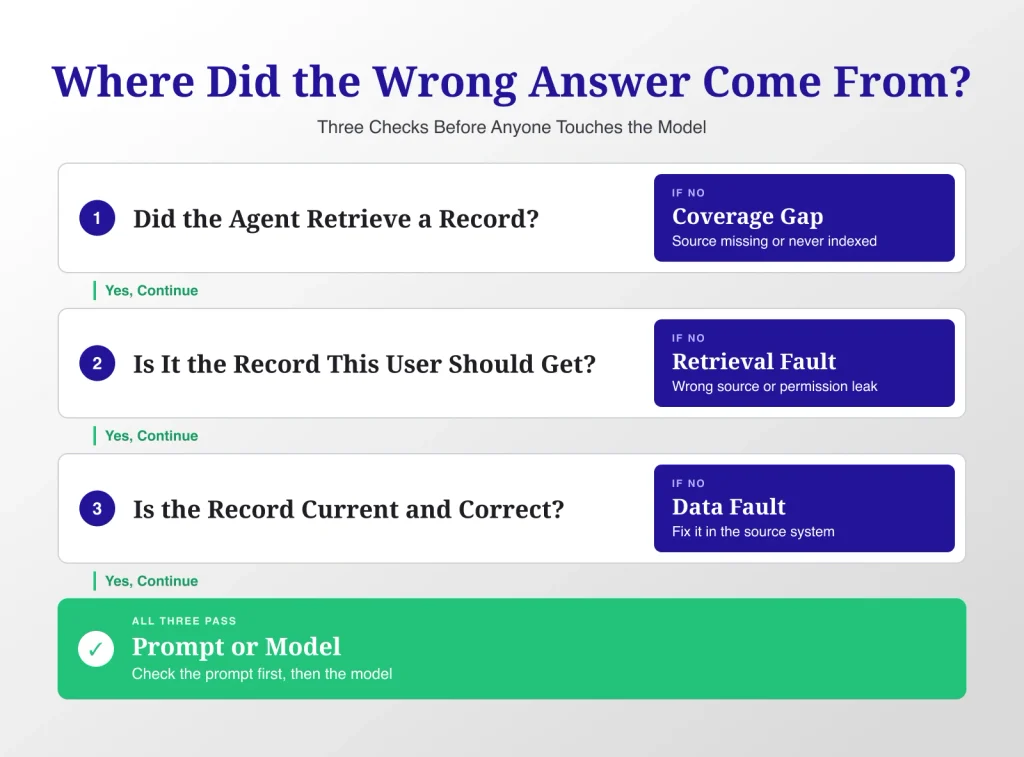
Before you blame the model, trace one wrong answer back to the record the agent retrieved. If it retrieved nothing, the source is missing from the index. If the record is outdated, duplicated or belongs to someone else, the data is at fault. If the record is right and the answer is still wrong, check the prompt, then the model.
A dashboard tolerates messy data because a person reads it and notices when a figure looks wrong. An agent acts on every record it reads, at speed, with no second look. Each fault below first reaches you as a user complaint.
Stale records: “It quoted last year’s policy.” The agent answers from whatever was last loaded.
Fix: set a refresh schedule per source, matched to how often the underlying decision changes.
Conflicting sources: “It gave me two different answers.” Two systems hold the same fact and disagree.
Fix: name one system of record for each data type and point the agent at that source alone.
Open permissions: “It showed me a colleague’s salary.” Indexing pipelines often copy documents without their access rules, so the agent can read more than the person asking.
Fix: carry each document’s access rules into the index, and check the requesting user’s permissions at the moment of retrieval.
Uncited answers: “Nobody can tell where that came from.” Without a source, nobody can verify or correct an answer.
Fix: attach the source record and its version to every answer.
Wrong location: “Compliance halted the project.” The data is stored or processed outside the jurisdiction its regulator allows.
Fix: confirm hosting against your regime before the build, using the next section.
Fixing these faults is data and platform engineering work. Give it an owner of its own, separate from whoever runs model experiments.
UAE Data Rules for AI Agents: Which Regime Decides Where Yours Can Run
Your agent inherits the data rules of every source it reads. Four regimes cover most UAE estates:
| Regime | Who It Covers | What It Means for Your Agent |
| Federal PDPL (Decree-Law 45 of 2021) | Onshore organisations outside free zones that have their own data law | Personal data needs consent or another permitted basis, plus a defined purpose. Government data, and health or banking data governed by their own laws, fall outside it |
| DIFC Data Protection Law and Regulation 10 | Firms in the DIFC | Notice at first use, a register of AI use cases and documented triggers for human review. High-risk processing carries extra conditions |
| ADGM Data Protection Regulations 2021 | Firms registered in ADGM | GDPR-style rules, including impact assessments for high-risk processing and controls on transfers abroad |
| CBUAE AI and ML Guidance Note (February 2026) | Onshore licensed financial institutions | Accountability stays with you, including for AI bought from vendors |
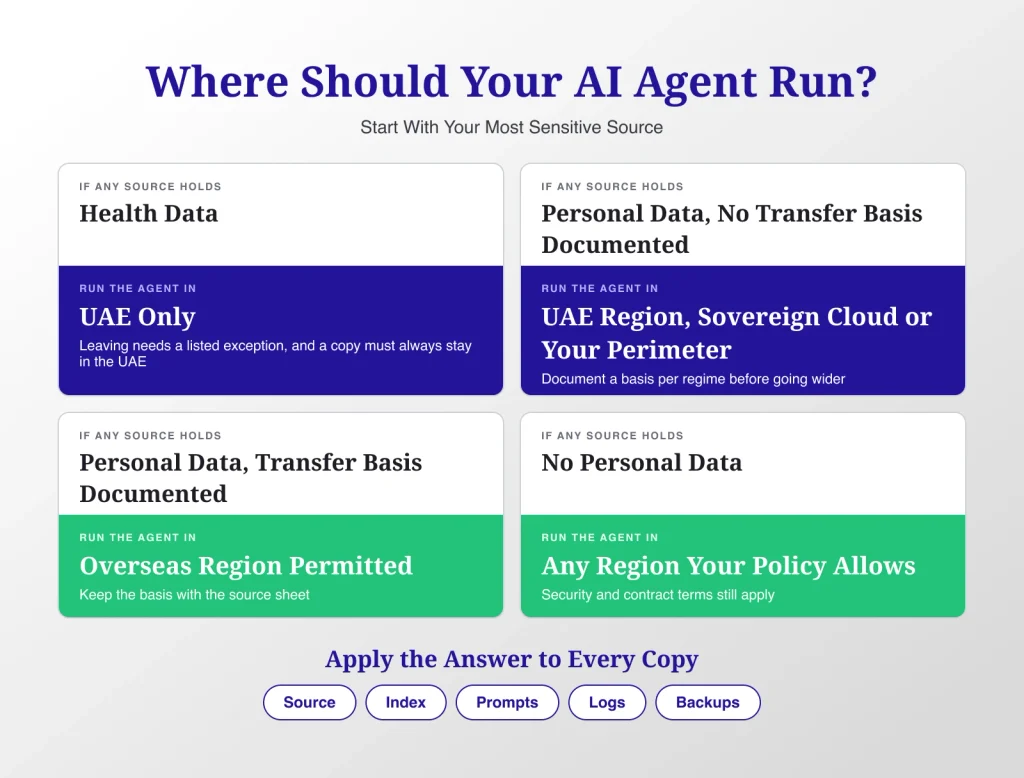
Two rules outside the table catch teams late. Health data has its own location rule: Federal Law No. 2 of 2019 keeps it in the UAE unless a listed exception applies; even then, a copy must stay in the country. Groups with an onshore entity and a DIFC entity can also find one agent answering to two sets of rules.
Start with a four-column sheet: source, owner, regime and location. A typical row reads: customer CRM, head of sales, federal PDPL, UAE cloud region.
The regime tag decides where the agent can run and what it must log, and it feeds steps 2 and 6 of the audit below. A shared sheet is enough for one use case. Once several agents draw on the same sources, a data catalogue earns its cost.
The Six-Step AI Data Readiness Audit
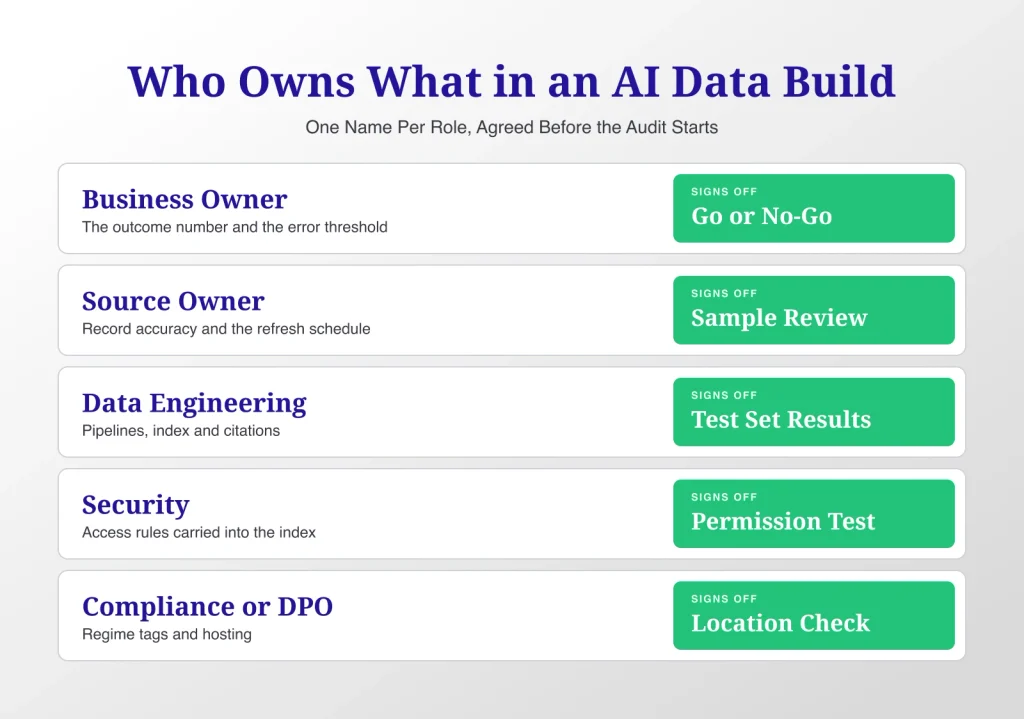
Run it on one use case, with the business owner involved from the first step. Each step asks one question and ends in Go or Stop.
- What number will this agent move? Pick one measurable outcome (e.g., minutes per case) and one business owner who’ll own it.
✔️Go: one outcome, one number, one owner.
🛑Stop: narrow the use case until a single number fits.
- What will the agent read, and who owns each piece? List every system the agent will touch. It’s usually more than the team first thinks once shared drives and old exports surface.
✔️Go: every source has a named owner and a regime tag.
🛑Stop: a source nobody owns stays out of scope until someone claims it.
- How wrong is the data today? Pull a few hundred records from each source and review them with the business owner, who’ll spot bad records in seconds. Count the duplicates, gaps and out-of-date entries.
✔️Go: the error rate is below the threshold the business owner agreed to.
🛑Stop: clean the sources before any build work starts.
- Could the agent show someone more than they’re allowed to see? Decide what each role should see, then log in as the most junior user you have and ask for something restricted.
✔️Go: the agent shows nothing that the user couldn’t open in the source system.
🛑Stop: fix access rules before any build work starts.
- Can it prove where every answer came from? Ask the people who’ll use the agent to write real questions they already know the answers to, then run them.
✔️Go: every answer cites a specific record and is correct.
🛑Stop: if the data is clean, the cause is usually retrieval, such as how documents are split and tagged. Fix that before trying another model.
- Is every copy of the data somewhere it’s allowed to be? Check each source’s regime tag against where the agent, its index, logs and backups will run.
✔️Go: every location is permitted.
🛑Stop: move whatever is out of place before go-live.
Go on all six, and the use case is ready for a pilot on real data.
Arabic and Mixed-Language Data: Three Tests Before You Trust the Agent
UAE estates usually mix Arabic and English, often in the same record. Three problems surface early, and you need to test each on your own data.
| Test | What Goes Wrong | How to Run It |
| Name matching | One name has several Latin spellings (Mohammed, Muhammad, Mohamed), and Arabic letter variants split one customer into three | Write normalisation and matching rules, then run them on duplicates you already know about |
| Scanned documents | Arabic text extraction degrades with print quality, stamps and handwriting | Run extraction on your worst scans and have an Arabic reader check the output |
| Cross-language retrieval | An English question misses the Arabic document that answers it, and Arabic performance shifts between models and releases | Ask the same questions in both languages, compare the records returned, and repeat after every model change |
Add these questions to the step 5 test set, so Arabic coverage is measured alongside everything else.
AI-Ready Data Case Study: One Intelligence Layer for a UAE Public Sector Organisation
A large UAE public sector organisation tracks social and economic wellbeing across its regions. Its data came from surveys, spreadsheets, and regional platforms, so it couldn’t compare the same measure across sources.
Deployflow AI engineers fixed the data before building anything on top of it:
- Conflicting sources: they moved scattered sources into one data layer, replacing several disconnected systems.
- Stale records: pipelines ingest new survey and regional data as it arrives, keeping the view current.
- Incomparable records: AI pipelines sort each record into comparable indicators, work that teams previously did by hand.
Only then did an executive layer go on top. It shows correlations between policy milestones and indicator changes, and leaves causal conclusions to analysts.
Hold your agent to the same limit: one that claims more than its data proves loses the trust of the people who rely on it.
AI-Ready Data Foundations in the UAE: How Deployflow AI Builds Them
Deployflow AI builds the data layer and the agents on top of it as one job, so the team that cleans your sources also answers for what the agent says about them.
Work starts with a paid discovery session that scopes the first use case and sets the price. Delivery then runs in two-week sprints, each measured against a number agreed before it starts.
Two of the faults from the start of this guide are handled from day one. Every answer arrives with the record it came from, and hosting follows your regime: in-country, in a sovereign cloud or inside your perimeter. The cost of every run is logged, and customer data is never used to train models.
Bring one use case to a discovery session with Deployflow AI. You’ll leave knowing whether your data can carry it, what to fix first and what the build will cost.
AI-Ready Data: Frequently Asked Questions
What is AI-ready data?
AI-ready data is data an agent can read, trust and safely cite for a specific task. It is current, comes from a single system of record per data type, includes access rules that travel with it, and is stored where its regulator allows. Readiness depends on the use case, so the same estate can be ready for one agent but not another.
Can a UAE company use an AI model hosted outside the UAE?
It depends on the data and the regime. The federal PDPL allows personal data to leave the UAE under set conditions, and the DIFC and ADGM each have their own transfer rules. Health data is stricter and stays in the UAE unless a listed exception applies. Check the regime tag of every source the agent reads, and remember that the index, prompts, logs and backups hold copies of that data too. Where the rules are tight, in-country hosting, a sovereign cloud or a model run inside your perimeter settles the question.
How much data do you need to build an AI agent?
Less than most teams expect. Agents built on existing large language models don’t need training data in the traditional sense. They need access to the right sources for the task, such as policies, case records or product documentation, and a few well-maintained sources can be enough. Coverage and accuracy matter more than volume: the sources must answer the questions users will actually ask. You also need real example questions with agreed correct answers, so you can test the agent before go-live.
Can AI agents use unstructured data like PDFs and emails?
Yes. Agents can read PDFs, emails, scanned forms and chat logs, where much of an organisation’s knowledge is stored. Unstructured data needs more preparation than database tables, though. Documents must be extracted cleanly, split into sensible sections and tagged with metadata such as owner, date and sensitivity. Without that tagging, an agent can’t tell a current policy from a draft, or know who may see a document. Emails often contain personal data, so apply the same permission and retention rules as the mailbox itself.
What is a vector database and do you need one?
A vector database stores text as embeddings, numerical representations of meaning that let an AI system find passages with similar meaning even when the wording differs. Many agents use one, but you may not need a separate product, because several mainstream databases and search engines now support vector search. Governance is the bigger decision. Embeddings made from sensitive records carry that sensitivity, so they need the same access rules, residency controls and deletion processes as the original data.
Explore our BLOG
Recent articles
AI Guardrails: Why Prompts Won’t Pass an Audit and Where Your Controls Belong
AI guardrails that survive an audit are enforced outside the model, through identity, policy checks,...
Read full article
AI-Ready Data: Why Your AI Agent Gives Wrong Answers and How to Fix It
When an AI agent gives wrong answers, the cause is usually the data it reads....
Read full article

AI Roadmap: How to Get Board Approval for Your AI Strategy in Six Weeks
A board-ready AI roadmap takes six weeks if you rank, cost and sequence use cases...
Read full article